Showing posts with label Great Chicago Fire. Show all posts

Monday, October 4, 2021

The Great Chicago Fire - Its 150 Year Anniversary

 By Pamela S. Meyers

From Chicago History Museum
Printed in Chicago Tribune 9/27/21

As I write this during the last week of September, we’re coming up on the 150th anniversary of the Great Chicago Fire that ignited on October 8, 1871, and continued until October 9.

Growing up in Lake Geneva, Wisconsin, not far from Chicago, I was always aware of that catastrophic event. Especially so, since it had a strong influence on the history of my hometown when it caused many well-to-do Chicagoans to move their families to Geneva Lake. Their intention was to make it a temporary displacement, but many chose to make the area their home away from home and built beautiful lakeshore mansions there. 

Ironically, the weather around Chicago right now is very similar to what it was leading up to the fire. Back in 1871, the summer had been particularly dry and summer-like temperatures still prevailed in early October. 

The city of Chicago, including buildings in the business district as well as homes in the neighborhoods, was constructed mostly of wood. Even the sidewalks were wooden. The hot southwest winds blowing through the city streets, combined with the dry weather conditions, and lack of recent rain made a perfect recipe for fire. 

Although rumor has said a cow belonging to a woman named Mrs.
Public Domain
O’Leary, caught the woman’s barn on fire when it kicked over a lantern, it’s never been confirmed. Regardless of what sparked a fire that hot, dry night, the blaze did begin in the O’Leary neighborhood and spread quickly. 

The red-hot sky across the Chicago River from the affluent neighborhoods to the north alerted the wealthy inhabitants to the fire. Assured the river would stop the blaze from spreading their direction, people continued on with their usual Sunday night activities ... until a ball of fire erupted over the city and exploded, sending small orbs of flame to the ground. 
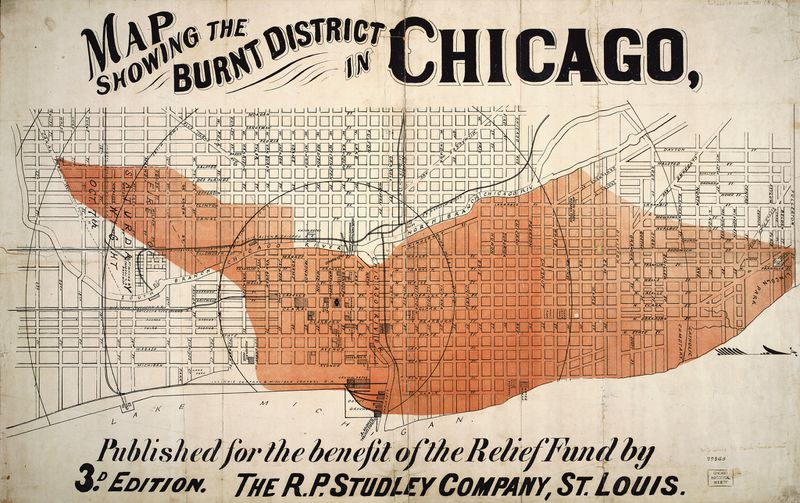
Resource: Chicago Tribune, 9/27/21


Soon, the courthouse bell clanged out a call to all firemen to report for duty. The river was no match for the ugly flames as they ate up the oil slick in the water, climbed the riverbank, and ignited the homes along the riverbank. People raced to fill their carriages with as much as they could of their possessions, and the streets filled with horses, carriages, and people on foot, all heading north. Many made it as far as Lincoln Park near Lake Michigan and scurried into the lake to soak their clothing to protect themselves from falling sparks. 

People from all walks of life filled the park, from squalling babies being comforted by their nursing mothers and elderly grandmothers to worried men attempting protect their families and calm their horses.

The following day, the flames finally died down, but those who had escaped the fire had no home to return to. Much of Chicago’s business district and its neighborhoods were destroyed. The Chicago Tribune reported in the September 28, 2021, edition that 17,450 buildings were destroyed and of that number, six remain standing today, including the infamous water tower on Michigan Avenue.

Water Tower & Pumping Station on 
Michigan Avenue After the Fire
Source: Chicago Tribune 9/28/21


Water Tower and Pumping Station Today
Source: Chicago Tribune 9/28/21

Chicago wasn't the only city to experience a large fire that night. Farther to the north, Peshtigo, Wisconsin was destroyed and across Lake Michigan, the town of Holland, Michigan burned to the ground.


Have you ever experienced a fire that damaged your home or place of work? 

Resources: 
  • The Great Chicago Fire; Robert Cromie; Rutledge Hill Press; 1958
  • Nationalgeographic.org/article/chicago-fire-1871-and-great-rebuilding The Great Chicago Fire; Wikipedia
  • Chicago Tribune, 9/28/2021, The Great Chicago Fire Destroyed. 17,450 Buildings. Here Are Six That Survived.


Pam Meyers says of herself: I'm just a Wisconsin girl living in Illinois. She lives in the Chicago suburbs and makes her way north to her hometown of Lake Geneva, Wisconsin every chance she gets. Her historical novels set in Lake Geneva are available on Amazon and other online book stores, as well as in stores around Lake Geneva.


"This is the kind of book you hate to put down, with unexpected twists and turns that leave you on the edge of your seat!" An Amazon Reader


Wednesday, April 25, 2018

Virginia City’s Great Fire of 1875


If you were like me, you may have heard—or even sung—the following little children’s song in your youth.

Late one night, when we were all in bed,
Old Mother Leary left a lantern in the shed,
And when the cow kicked it over, she winked her eye and said,
"There'll be a HOT time on the old town tonight."
FIRE, FIRE, FIRE!


The song was a parody of the tune of “A Hot Time in the Old Town Tonight” and was meant to be about the Great Chicago Fire of 1871 (although it was later found that poor Mrs. Leary and her cow had nothing to do with starting the Chicago fire). Songs like these get lodged in the fabric of our childhood and help us to recall major historical events like this fire, which burned for several days, killed up to 300 people, and left another 100,000 homeless.

But there are other fires we don’t recall or may never have heard of. I featured one such event in Heartfelt Echoes, my novella from the First Love Forever Romance Collection. It was the Great Fire of 1875, which burned a large portion of Virginia City, Nevada.

Virginia City was a boomtown which sprang up in 1859 with the discovery of the Comstock Lode—the first major silver deposit to be discovered in the United States. Of course, as you probably know, once gold, silver, or other such mineral/ore deposits are found, people flock to that area and towns crop up quickly. In the case of Virginia City, the new settlement formed almost overnight. People flooded in to work for one of several major mining operations.

Virginia City in 1868-1869.
The city reached its peak in the mid-1870s, it’s maximum population topping out at about 25,000 residents. Of course, this was just when the Great Fire of 1875 broke out.

On October 26, 1875, the perfect storm occurred. A boarding house on “A” Street, halfway between Taylor and Union Streets, was home to a rowdy bunch of men and women. Said boarding house residents were known to be carousing until about 2:00 AM the morning of October 26. The home, belonging to a woman known as “Crazy Kate,” was known for its rough characters and many wished for it to be closed. That hadn’t happened, much to the dismay of the surrounding community.

Only a few hours after the carousing had finally stopped—right at dawn—a small fire broke out in a downstairs hallway. Under normal circumstances, the fire should have been easily handled by the Virginia City Fire Department. However, on this day, a strong westerly wind was blowing, and it fanned the small fire to life. The flames lapped at the building, quickly overtaking the structure until the wind blew the flames to some of the neighboring homes. Also at risk was a livery stable that the boarding house sat behind. Soon, several buildings were burning. With the fierce wind, the flames traveled quickly, and within a very brief time, the fire was out of control, spreading to the north, west, and south simultaneously. The Virginia Cidy Fire Department came, but their fire engines were small and there wasn’t enough water for the growing conflagration. The firemen could do little, if anything, other than to direct residents to evacuate.


When the residents realized there was little chance of saving the buildings, they turned their attention to saving their belongings instead. Many grabbed whatever they could and ran. However, the flames continued to spread. Mayhem ensued.

Eye-witness accounts say that from the mountains surrounding Virginia City, the town seemed to be a sea of flames. The roar of the fire surrounded residents on all sides. The sounds of roofs and walls collapsing as buildings fell victim to the inferno also punctuated the city. In some places, buildings exploded with such violence that the concussion rattled pottery and windows at a town five miles away. Smoke billowed through the streets and hundreds of feet into the air, making finding one’s way nearly impossible.

The residents ran where the firemen directed—to a “safe” area, but as soon as they arrived in the safe zone, they were told to move again. The ever-advancing flames continued to devour the city. Residents were forced to run to new “safe zones” as many as six or eight times, and each time they left more and more of their rescued belongings behind. In some cases, it was furniture. In several other instances, it was larger items like pianos. The flames roared through the city and destroyed all manner of things—clothes, business wares, family heirlooms. Nothing was safe.

Historic firefighters.
The fire raged for hours, burning through Virginia City’s business district, as well as many homes. When the flames finally died out, the burned area fell between Taylor Street to the south, Carson street to the north, Stewart Street to the west, and the Chinese quarter to the east, encompassing 75% of the city. The hoisting works of all three major mining companies—the Ophir, the Consolidated Virginia, and the California—were destroyed, as well as about 400 feet of shafts on one of the mines. No building was safe. Even brick buildings burned as quickly as wooden structures. In fact, the fire had burned so hot that the wheels of train cars were melted on their tracks!

The losses from the fire were estimated to be around $7,000,000, and some 3,000 Virginia residents were left homeless. While it was a horrific time for ther residents of Virginia City, it was also a time that showed the helpfulness and resilience of humanity. Neighboring towns and cities such as Carson, Gold Hill, and Reno stepped in immediately to help. Carson provided food enough for 2500 people. Other towns donated clothing and other goods for those who’d lost everything. Neighboring towns—and even neighboring states—took in refugees who were left without homes or shelter as they headed into the winter months. And people came from all around to clear away the debris and begin rebuilding.


Virginia City did rebound and rebuild. Unfortunately, the Comstock Lode played out within a few years after the fire, and the city’s population fell drastically, as is often the case with mining towns.

Jennifer Uhlarik discovered the western genre as a pre-teen when she swiped the only “horse” book she found on her older brother’s bookshelf. A new love was born. Across the next ten years, she devoured Louis L’Amour westerns and fell in love with the genre. In college at the University of Tampa, she began penning her own story of the Old West. Armed with a B.A. in writing, she has finaled and won in numerous writing competitions, and been on the ECPA best-seller list numerous times. In addition to writing, she has held jobs as a private business owner, a schoolteacher, a marketing director, and her favorite—a full-time homemaker. Jennifer is active in American Christian Fiction Writers and lifetime member of the Florida Writers Association. She lives near Tampa, Florida, with her husband, college-aged son, and four fur children.


First Love Forever Romance Collection

A first love is never easily forgotten...
and coming face to face with that person again can be awkward when the heartstrings are still holding on to the “what ifs.”

In settings from 1865 to 1910, nine couples are thrown back on the same path by life’s changes and challenges. A neighbor returns from law school. An heiress seeks a quick marriage. A soldier’s homecoming is painful. A family needs help. A prodigal son returns. A rogue aeronaut drops from the sky. A runaway bridegroom comes home. A letter for aid is sent. A doctor needs a nurse. Can love rekindle despite the separation of time and space?

Heartfelt Echoes by Jennifer Uhlarik
1875—Virginia City, Nevada: A short, urgent letter mentioning his childhood love, Millie Gordon, forces deaf Travis McCaffrey to turn to his estranged birth father for help rescuing the woman he can’t forget.


Saturday, March 3, 2018

Diaries of Old--Snapshots of Lives Past

By Pamela S. Meyers


I can't believe we're already in March. This is quite a busy month as I am seeing my newest historical romance novel, Safe Refuge, releasing on the 27th.

I recalled this morning how much researching the diaries written by a lady who lived in my home town of Lake Geneva, Wisconsin, where the novel takes place, at the very time my story takes place, helped me in developing my story. I published an article here at this site back on January 4, 2014, as I was writing the novel, and I thought it might be of interest now, over four years later.

-----------------------------------------------------------------------------------------
January 4, 2014

Last month I shared here about researching family history, and many readers responded, saying they were encouraged to begin their own family history research. I hope some of you have gotten started or plan to in the new year!

Another way of learning about your ancestor’s lives--or maybe your ancestral hometown's history--is to locate personal diaries and journals written in the past.

One artifact that came to me through my dad and his family was a small notebook. It wasn’t intended to be a diary. In fact, the name "Wigwam Tobacco" is imprinted on its cover. Even back then they were making promotional items to advertise a product! 
Edith's Diary

It may not have been a real diary, but my paternal grandmother, Edith, decided to make it one. And for a bit more than an entire year, she recorded her life in that little notebook. There wasn’t a lot of room for her to write, but through those pages I was able to read about a year in her life as a young woman on the verge of falling in love. This was very special to me because I never had a chance to know her since she died before I was born.

She began the diary in August of 1899 and the last entry was made in September 1900. Through the pages I read about a young man named Jack turning her head, her celebration of the turning of the century on 1/1/1900, and her mother dying that May. What really caught my attention though, was the sweet flirtatious attraction between Edith and Jack, who would become my grandfather. It seems that although Jack was interested in Edith, a pretty girl or two would still capture his attention. Or, at least it seemed that way to Edith :-). They often attended dances, coming alone, but then at the end of the evening Jack would walk her home. 

One summer night she walked into the dance and the Tumbolt sisters were there. Jack having a good time. The following day she says she went uptown in the evening. Saw Tombolt girls AND saw Jack. She put the emphasis on the word "and." I could almost feel her stomach growing hot as she watched my grandfather probably cajoling with the Tombolts. At least it made good fodder for a story.

And a story I wrote for a fiction writing class I was taking.  A lot of the story came from my imagination, and the Tombolts were there to be sure.

Eliza's Lake Geneva Diaries
Fast forward to this past fall. While researching for my current work in progress, a 19th Century story set in Lake Geneva, WI,  my hometown (which is not the same town my grandmother lived in), I attended an event at the town's museum. The speaker mentioned a set of diaries written by a lady, Eliza Baker, who lived in Lake Geneva during the 19th century. Her seventeen diaries, dating from the Civil War up to the early 1880s, are housed in the archive library located at the University of Wisconsin-Whitewater. When I heard this, I couldn’t wait to get to that library and look at the ones written in 1871 and 1872, the time when my story takes place.What better way to read about life in my story setting than that?

How I picture the scene
I did not know about the lady or any of her descendants, but I knew the house (long since torn down) that she lived in. The flavor of the town seemed to leap off the pages. For example, in winter she took a horse-drawn sleigh to church, and one time she and her husband took a horse-drawn sleigh across the frozen lake where he "found an Irishman"  there and hired him to chop firewood. Later in my reading, her husband suddenly took ill and died a few hours later. I gasped and said, “Oh no.” By that time I felt I really knew Eliza and blinked at tears as she described her grief.

I wished I'd had the time that day to read through all 17 diaries. But I'll have to save that for another time. My research makes me wonder what else is housed in those archives. You can be sure I’ll be heading back up there as soon as I can to find out.

Your family may not have passed down a diary, but something else. Perhaps you have some letters or postcards. Or possibly some newspaper clippings or a cookbook with notes written in the margins.

What artifacts from the past do you have that tell you about your family several generations ago?


Pamela has written most of her life, beginning with her first diary at age eight. Her novels include Thyme For Love, Surprised by Love in Lake Geneva, Wisconsin (a reissue of Love Finds You in Lake Geneva, Wisconsin), a 1933 historical romance, and Second Chance Love, a contemporary romance set at a rodeo in rural Illinois. Her novella, If These Walls Could Talk, was published in May 2017, in a collection called Coming Home: A Tiny House Collection. Safe Refuge, a historical romance set in Chicago and Lake Geneva, Wisconsin releases in March 2018 and Whatever is True, a sequel to Second Chance Love will publish at a date to be announced.


Available in  Kindle at Amazon now for preorder.