Showing posts with label Mayan Culture. Show all posts

Sunday, April 9, 2017

Soccer or Football?

By Tiffany Amber Stockton


Last month, I shared about a recent cruise I took, and the "famous" celebrities who sailed with me *grins* I also delved into the history of the cruise ship. If you missed that post, you can read it here: http://www.hhhistory.com/2017/03/cruise-travel-for-leisure_9.html.

This week, our children began their spring soccer season, and boy am I exhausted with the practices on 2 different days, 2 different times, and at 2 different locations. Then, we have games every Saturday at a third location. Phew! Praise God this is only 5 weeks.

But soccer got me thinking. How long has this sport been around? Let's look a little closer, shall we?

~~~~~~~~~~~~~~~~~~~~~~~~~~~
Mayan sports arena
Records trace the history of soccer back more than 2,000 years ago to ancient China. Greece, Rome, and parts of Central America also claim to have started the sport (I remember visiting Mayan ruins and seeing what was left of a sporting arena with stone loops used as the goal for the ball sent there by kicking, butting with the head, or using any body part except the hands); but it was England that transitioned soccer, or what the British and many other people around the world call “football,” into the game we know today. The English are credited with recording the first uniform rules for the sport, including forbidding tripping opponents and touching the ball with hands.

Red Card in soccer
As the sport developed, more rules were implemented and more historical landmarks were set. For example, the penalty kick was introduced in 1891. Red and yellow cards were introduced during the 1970 World Cup finals.

For over a century, despite protests from the Italians, England has been credited as having given birth to modern football. A claim which had looked quite solid until as recently as 2011, when a shocking find by historians traced football’s roots to a quite extraordinary place.
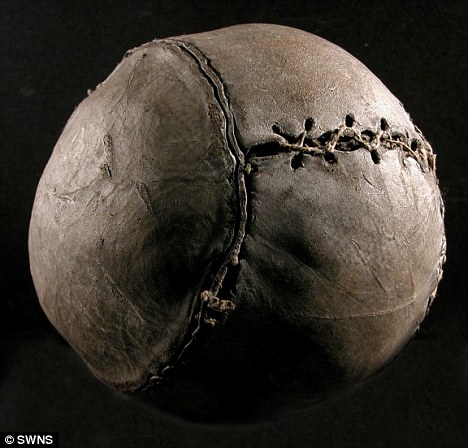
World's oldest "football"
An uncovered book, titled Vocabula, turned soccer’s history on its head. Written by a citizen of Aberdeen in Scotland, it detailed a game in which two teams played with a ball on a field roughly the size of the present regulation pitches. Not only that, but terms such as keeper (goalkeeper), kick off, and switch halves were also mentioned. How does this refute England’s claim? Well, this account was written in the fourteenth century, more than 400 years before the English association was formed.

Also, a football found behind a wall in Stirling Castle has been dated and named as the oldest in the world. It dates back to the fifteenth century.

Scotland was also the country who invented possession play, using short passes to work up the field into dangerous positions instead of the long ball hit in practice before then.

Football has a long and glorious history. Its methods have been refined and improved through the centuries to give us the king of all sports. Scotland, rightfully, can claim the title as its home. That is, currently. Who knows, maybe someone with a nose for history and a bit of determination will uncover evidence to refute Calendonias’ claim in the future. As much as I love history, that won't be me. *winks*

Until then, Scotland can proudly reclaim the mantle as the home of world football.

NOW IT'S YOUR TURN:

* Which name do you feel is the "better" name for this sport? Why?

* Did you play sports as a child? Do you have children in sports? Which ones?

* What is 1 fascinating fact about today's post which caught your eye today?

Leave answers to these questions or any comments on the post below. Come back on the 9th of April (my son's birthday) for my next appearance.


BIO

Tiffany Amber Stockton has been crafting and embellishing stories since childhood, when she was accused of having a very active imagination and cited with talking entirely too much. Today, she has honed those childhood skills to become an author and speaker who has partnered with Nerium International in the anti-aging, health & wellness, and personal development industry, helping others become their best from the inside out.

She lives with her husband and fellow author, Stuart Vaughn Stockton, in Colorado. They have one girl and one boy, and a Retriever mix named Roxie. She has sold twenty (21) books so far and is represented by Tamela Hancock Murray of the Steve Laube Agency. You can also find her on Facebook, Twitter, Pinterest, and LinkedIn.

Thursday, February 25, 2016

The Mayan Culture and the Ruins of San Gervasio


The Mayan Calendar. In the center is the goddess Ixchel.
© Jennifer Uhlarik
Many of us became interested in the ancient Mayan culture a few years ago, due to the speculation that the world would end on December 21, 2012. These speculations were based on the fact that the Mayan Calendar, which was known to be quite accurate in past predictions, ended on that date. Obviously, we are still here, and the interest in the Mayans seems to have died down again.

My husband Dave and I outside
the San Gervasio ruins, posing with
a woman in Mayan costume


However, my husband and I both love history, and on a recent Caribbean cruise we jumped at the chance to see some of the Mayan Ruins of Mexico. We selected a shore excursion to San Gervasio, located in Cozumel, and found the information our guide shared with us to be truly interesting. I thought you might like to hear some of what we learned about the Mayan culture and the San Gervasio ruins.


Prior to the influence of the Spanish, San Gervasio was called Tantun Cuzamil, which translates to Flat Rock in the Place of the Swallows. While many of the other Mayan ruins like Chichen Itza or Tulum were dedicated to human sacrifices meant to please the thirteen Mayan gods, San Gervasio was different. This location was where Mayan women would come to worship Ixchel, the goddess of fertility and healing. Mayan women would take pilgrimages to this locale at least once in their lifetime, bearing gifts for the goddess in the hopes she would bless them with a fruitful marriage. Also, as expectant mothers neared the end of their pregnancies, those who could would come to San Gervasio in order to bring their children in to the world while surrounded by other women. Our tour guide told us that this location was selected because they found natural wells or cenotes that would fill with fresh water. The expectant mothers would climb down into these wells and rest in the life-giving waters.
One of the large cenotes found at San Gervasio. 
© Jennifer Uhlarik

Among the structures at San Gervasio, there is an arch, which signified the entrance to the shrine. A stone pathway leads from the coastal areas of Cozumel miles away to this archway, and on into the center of the ruins. The underside of the arch was interesting, in that it was formed like an inverted staircase, a building style that was common to the eastern coast of Cozumel. The Mayans would leave gifts and offerings to Ixchel at the entrance before entering the sanctuary of San Gervasio.

The Arch, with stone pathway--the ancient entrance to San Gervasio.
© Jennifer Uhlarik
Another structure is known as “Manitas,” or Little Hands. It got its name because of several red handprints on one of the walls. The structure’s purpose is not clear—some say it may have been a residence while others say it was for ceremonial purposes.
Manitas--one of the structures at San Gervasio. It got it's name from the several red handprints on the face of the building.
One is visible where the red arrow is pointing.
© Jennifer Uhlarik


Around an area known as the Central Plaza, there were several buildings. I wasn’t able to photograph them all, but here you can see the backside of a structure known as “The Columns.” It contains seven columns of stone, with a bench and altar area in the center, as well as a place for burials along the sides of the building.

The back side of the building known as The Pillars.
© Jennifer Uhlarik
Under one large thatched roof, two structures stood. On the right side is “The Murals,” a building that contained hand-painted geometric designs in blue, red, ochre, and black. To the left was “The Alamo,” which contained an altar where offerings of worship could be left. Our tour guide explained that the Murals was likely the shrine to the goddess Ixchel, and the Alamo was likely the shrine for the god Itzamna.

There were several other ruins around this Central Plaza, but our tour didn’t have time to hear about them all. After learning about The Murals and The Alamo, we were given free time to walk around on our own or explore the gift shops at the front of the park. As we walked around a bit more, I became fascinated with the wildlife. I saw a hummingbird, which I wasn’t quick enough to capture on film, as well as two large iguanas sunning themselves on the ruins of two of the Central Plaza buildings.
Iguanas were everywhere. This one was sunning himself
atop one of the ancient buildings.
© Jennifer Uhlarik

This was a second iguana on another building
just across the walkway from the first.
© Jennifer Uhlarik


Overall, this was the highlight of our trip. Our tour guide was a wealth of information who made the history of the location come alive. If you get the chance to visit San Gervasio, I highly recommend it.

Now it’s your turn: Have you visited any Mayan Ruins? If so, which one(s)? If not, what other cultures are you interested, and have you had the opportunity to visit any locales important to that culture?

Jennifer Uhlarik discovered the western genre as a pre-teen, when she swiped the only “horse” book she found on her older brother’s bookshelf. A new love was born. Across the next ten years, she devoured Louis L’Amour westerns and fell in love with the genre. In college at the University of Tampa, she began penning her own story of the Old West. Armed with a B.A. in writing, she has won five writing competitions and finaled in two other competitions. In addition to writing, she has held jobs as a private business owner, a schoolteacher, a marketing director, and her favorite—a full-time homemaker. Jennifer is active in American Christian Fiction Writers and lifetime member of the Florida Writers Association. She lives near Tampa, Florida, with her husband, teenaged son, and four fur children.


NOW AVAILABLE:


Nine romantic adventures take readers along for a ride on the Oregon Trail where daily challenges force travelers to evaluate the things that are most precious to them—including love. Enjoy the trip through a fascinating part of history through the eyes of remarkably strong characters who stop at famous landmarks along the way. Watch as their faith is strengthened and as love is born despite unique circumstances. Discover where the journey ends for each of nine couples.