Showing posts with label historical research. Show all posts

Sunday, August 20, 2023

No Life for a Lady, an Original Wild West Book

Escape into creative worlds of fiction.

I cut my teeth on tales of the Wild West, spending many a happy Sunday afternoon hunkered down with a bowl of popcorn as cowboys rode their horses across my television screen. My father often joined me, something I remember with particular fondness now he is gone. 

The lure of the American West still has a hold on me. But how much of the western mystique can I believe? Was it as violent as its reputation? In short, what was the West really like? In search of answers, I read orginal diaries and other documents, scoured countless photographs from back in the day, haunted museums, visited ghost towns, and even retraced the Oregon Trail. 

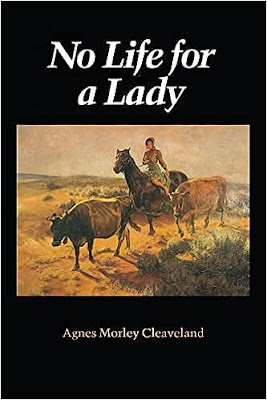
One of my original research resources hails from 1874. No Life for a Lady (Women of the West) by Agnes Morley Cleaveland, provides a first-hand account of growing up in the Wild West. It offers fascinating glimpses into a bygone era.

My favorite passage is Agnes's description of amusing herself by circling a horse pasture atop a log fence. Her brothers and sister followed. Running alongside were quite the playmates--a young deer named Spotty, the fawn's adoptive mother (a goat), a cat, a rooster, a bear cub named Josh, a burro, and a milk-pen calf. Every so often, one of Agnes's brothers would step onto the burro’s back, and this summoned the rooster who generally accompanied him. In the author’s words: “The burro tolerated them, but never Josh.” Can you imagine?

Ever wonder how the mail went through in remote parts of the West? As Agnes explained, the most common method was to “put a kid on a horse.” It wasn’t uncommon for children to ride alone for 20 miles at a time to deliver mail or messages. This doesn't square with the feudal-mentality oftend associated with the Wild West. What happened to fearing outlaws and Indians?

In reality, Agnes felt more threatened by the packs of coyotes that might trail her while riding. Remaining in the saddle saved her from attack, but sometimes the beasts drew close enough to nip at her horse's heels. 

Agnes and her family, were once forced to leave their home during tension with local tribes, but most of the time Native Americans didn’t play a large part in her life. She encountered more outlaws, and recalled vividly how one of them rode into her mother’s ranch, dropping with exhaustion. In her teens, Agnes described being met by two outlaws while riding alone at night. The first gave her his spent horse to care for. The second greeted her mildly and let her pass. When she heard that he died later that night, Agnes felt certain it was due in part because of his unwillingness to frighten her by exchanging her fresher horse for his weary mount.

Agnes Morley (Class of 1900)
member of Stanford University women's basketball team.


Women were usually treated gently in the West, even by outlaws. As Agnes put it: “We didn’t have the horror crimes of today.” That’s a telling statement. 

No Life for a Lady (Women of the West) by Agnes Morley Cleaveland is an original resource from my research for Montana Gold, a western historical romance series about a family of Irish immigrants surviving in the Wild West. Learn more about the books at the end of this post.

Have you learned any surprising facts about the Wild West, either from this article or elsewhere? Comment to let me know.

What's New with Janalyn Voigt

I learned on August 1st, to my infinite delight, that it was National Planner Day. How this lovely fact escaped me until now, I'm not certain. Making lists, scheduling my time, and organizing my sock drawer are all things I enjoy. Reflect that researching historical fiction calls for organization, and you'll understand its appeal for a self-confessed nerd like me. 

If you share my passion, or just want more order in your life, read on. 

I divide tasks into three categories. Personal activities include church and spiritual growth, connecting with friends and family, walking my cat (yes, I really do this), self-care, reading, and the like. Household chores consist of cooking, dishes, laundry, scrubbing the bathroom--you get the idea. The last category is for writing and the duties surrounding it (like promotions, emails, replying to reader comments).  

Three periods take up my waking hours: morning, afternoon, and evening. It becomes, then, a simple matter of dividing tasks into the best time of day for them. In my case, mornings are for household chores, afternoon is when I write, and I take care of personal items in the evening. This system helps me a great deal. Maybe it would work for you, also. Even if you have a different occupation or you don't work from home. a variation of this system should still work. Wouldn't it be wonderful to make more time for reading?

Find out more about Janalyn Voigt and her books. 


The Montana Gold series explores love, courage, and faith at a time of upheaval for America. Fall in love with these redemptive love stories.  Learn more.

Sunday, November 27, 2022

Stranger Things

Dana McNeely


My children once filmed a humorous video about scary titles in my library, such as Crime Scene, All About Poisons, and Famous Villains. (I once thought I’d like to write mysteries.) Now that I’ve found the perfect genre - historical fiction set in Bible times - those books have been shuffled to back shelves. Yet as I paged through my research in preparation for this post, I found it a collection of even stranger things!


Horseback Archery in Shiraz - Image courtesy WikiMedia

Horseback Archery - from The Archer's Guide by an Old Toxophilite, 1833

"The exercise of the bow, as a pastime, is performed by [the Persians] on horseback as well as on foot. The horseman gallops away with the bow and arrow in his hand, and, when he has reached a certain point, he inclines either to the right or left, and discharges his arrow, which, to win the prize, must hit a cup fixed at the top of a pole 120 feet high."
  • I used this research for battle scenes in Whirlwind, along with other interesting historical tidbits about ancient warfare. Whirlwind is now available for preorder, releasing December 6th.


Statuary Angel blowing what appears to be an anafil - courtesy Deposit Photos

Music and War – from HistoryNet.com


"The function of music in war has always been twofold: as a means of communication and as a psychological weapon. 

Among the oldest references to the latter role appears in Chapter 6 of the Old Testament’s book of Joshua, with an exceptionally detailed description of the deployment of ram’s horns against Jericho, the oldest fortified human settlement known to archaeology.

Among the Saracen instruments adapted [during the Crusades] were the anafil, a straight, valveless trumpet; the tabor, a small drum, sometimes snared; and the naker, a small, round kettledrum, usually deployed in pairs.

In The Art of War Niccoló Machiavelli wrote that the commanding officer should issue orders by means of the [anafil] because its piercing tone and great volume enabled it to be heard above the pandemonium of combat."
  • I was familiar with the Israelite's use of the shofar, but found these additional instruments of interest. Another source noted potential use of the naker and anafil (pictured above) by the Arameans. I used anafils to terrify horses in a Whirlwind battle scene.


Image courtesy Chabad.Org


Festival of Dancing Maidens

based on the teachings of the Lubavicher Rebbe – courtesy MeaningfulLife.Org

"There were no greater festivals for Israel than the 15th of Av and Yom Kippur. On these days the daughters of Jerusalem would go out... and dance in the vineyards. And what would they say? 'Young man, raise your eyes and see which you select for yourself....'

And so it is written, 'Go out, daughters of Zion, and see King Solomon, in the crown with which his mother crowned him on his wedding day and on the day of his heart's rejoicing' (Song of Songs 3:11). 'His wedding day' — this is the Giving of the Torah; 'the day of his heart's rejoicing' — this is the building of the Holy Temple, which shall be rebuilt speedily in our days."

Talmud, Taanit 26b

  • I had so much fun using this bit of research and various other sources about men’s dances in a celebratory scene which took place in Naboth’s vineyard, in Whirlwind. This is a scene that would have been impossible without the random impact research often brings to a historical novel.


The Syrian Brown Bear – Wikipedia

The Syrian brown bear's fur is usually very light brown and straw-coloured. The hair on the withers is longer with a grey-brown base and is often a different shade from the rest of the body, seen in some individuals as a dark stripe running across the back. The lighter colors usually appear at higher altitudes. Their legs are commonly darker than the rest of their body. It is the only known bear in the world to have white claws. It is a rather small brown bear. Adult males have skulls measuring approximately 30–40 cm (12–16 inches). The Syrian brown bear weighs up to 550 lb (250 kilograms), and measures from 101–140 cm (40–55 inches) from nose to tail.
  • I am using this bear, currently endangered, in my next book, currently in progress. I'm also finding "What to do when you encounter a bear" of intense interest. Ha!


WHIRLWIND ~ Whispers on the Wind, Book 2  
Preorder ChristianBook  Preorder Barnes&Noble  Preorder Amazon

A king's downfall and a love that transcends war

SPURNED BY POTENTIAL SUITORS, Miriam travels to Jezreel to care for her cousin’s son. There, the precocious seven-year-old works his way into her heart. When Arameans swarm the land like locusts, Miriam focuses on the safety of her young ward but promises adventures beyond the city walls when the war ends.

Gershon, a quiet and kind vintner, is happily building a life for his wife, son, and aging parents. But when his wife dies during childbirth and war looms on the horizon, he must make a decision—will he take a new wife before his heart can mend?

Meanwhile, Dov, a young officer crosses paths with the “bird girl” he remembers from the past, now grown to womanhood. That she is a beautiful woman matters not, as he is a career soldier. Unexpectedly charged with leading Ahab’s army against the Arameans, Dov anticipates death and defeat in Samaria, but when a prophet pledges victory, Dov vows to fight to the end.

When an unlikely victory brings freedom, a bright future seems imminent. Then one afternoon Miriam witnesses a tragedy and must flee with the boy to keep them both safe. With henchmen on their trail, will they find refuge—and her heart the home she’s longed for?
~
DANA MCNEELY writes biblical novels from an Arizona oasis, where she lives with her hubby the constant gardener, two good dogs, an antisocial cat, and myriad migrating butterflies. When not researching, writing, or struggling with the mysteries of social media, Dana can be found wandering in her personal Eden dreaming up new stories.

You may follow Dana at https://DanaMcNeely.com and receive a free eBook. The Eyes of the Lord is a prequel to Rain.


Wednesday, July 27, 2022

Researching in the Ruins + Giveaway

Dana McNeely


While the internet is a wonderful research tool, books are often more dependable. This was driven home to me recently because my computer has been in the repair shop for more than a week, and I'm typing this on a loaner laptop. I was grateful to an "old ruin" of a book, paper and ink rather than the "cloud," for providing me research material for this blog post.

One of my favorite old reference books is PALESTINE AND THE BIBLE by Samuel Schor, born in Jerusalem around 1860. My falling-apart copy is faded and worn, the nineteenth edition published in 1931, so the book itself is a piece of history. Having the appearance of a homemade book, it is a true soft cover, made of tan paper only slightly thicker than its pages, folded back to reinforce the edges. Perhaps it resembles the first pamphlets from which it originated.


In its introduction, Schor wrote "God's Word is an Eastern Book. It was written in the East, by Easterns, and for Easterns." He went on to say his little book was intended to help Western readers understand Eastern expressions as they studied the Bible. He often included Bible verses to illustrate his descriptions of life and customs in Jerusalem. In 1891, he started what he called the "Palestine Exhibitions." His book developed over the time he lectured and wrote pamphlets for the Exhibitions.

I consider PALESTINE AND THE BIBLE an early precursor to "Everyday Life in Bible Times" books. The book is out of print and I believe copies are rare, so in this post I'd like to share with you a few tidbits of Schor's unique insights.

EASTERN PLOUGHS AND YOKES

  • Primitive ploughs were made of wood, had a handle, and were light enough to be carried by a man. And Jesus said unto him, No man, having put his hand to the plough, and looking back, is fit for the kingdom of God. (Luke 9:62)
  • The plough is fastened to the neck of oxen with a yoke and the oxen pass under it.  But the nations that bring their neck under the yoke of the king of Babylon, and serve him, those will I let remain still in their own land, saith the Lord. (Jeremiah 27:11a)
  • The weight of the yoke makes the poor animals stoop, hence the force of the allusion that when God brought Israel out of Egypt and broke their yoke of bondage, He said "I made you go upright." I AM the Lord your God, which brought you forth out of the land of Egypt, that ye should not be their bondmen; and I have broken the bands of your yoke, and made you go upright. (Leviticus 26:13)
  • Partly for protection and partly because of the size of their fields, farmers would often plow together, each with his own team of oxen, creating long, straight plow lines across the field. Thus Elisha was engaged when he was called by Elijah. So he departed thence, and found Elisha the son of Shaphat, who was plowing with twelve yoke of oxen before him, and he with the twelfth: and Elijah passed by him, and cast his mantle upon him. (1 Kings 19:19)
Schor's descriptions of Old Jerusalem painted a backdrop for much of my book RAIN, particularly a scene where Aban, a young former acolyte of Ba'al, observes the prophet Elijah call his successor, Elisha. Part of that scene from RAIN follows:

Antique plow with iron tip as used by prosperous farmers during Israel's Iron Age

Sunday, May 19, 2019

Godey's Lady's Book: an Important Historical Record


Fashion plate from Godey’s Lady’s Book (1840)

Welcome to my new obsession! This is Janalyn Voigt, author of the Montana Gold western historical romance series. While researching The Forever Sky, the fourth Montana Gold novel, I stumbled across a valuable original resource. How I missed this record while researching before this, I’ll never know. It was extremely popular in its day.

Godey's Lady's Book: an Important Historical Record

Godey’s Lady’s Book (also known as Godey's Magazine and Lady's Book), was established in 1836 when Louis Godey merged the Boston Ladies’ Magazine with the Philadelphia periodical, Lady’s Book. Godey employed Sarah Josepha Buell Hale as editor of the newly-minted magazine. Under her guidance, the number of subscriber ranks swelled to 150,000 by 1860, just prior to the Civil War.
Fashion Plate from Godey's Lady's Book (1861)
Godey felt that the magazine should strike a neutral pose during the War Between the States (as the conflict was known back then). However, Hale was a devoted nationalist and used the magazine to subtly sue for unity. She used editorials, letters to the editor, fiction, and poetry to support her views. Her efforts did alienate some readers, and the periodical lost about a third of its subscribers. The publication recovered and continued as an influential voice in America until 1878. By then both Godey and Hale had passed away, and Godey’s Lady’s Book was absorbed into Puritan magazine.
Nightcap, Godey’s Lady’s Book (1840) 

Content

Godey’s Lady’s Book is an important historical and cultural record it is possible to view today. That makes it exciting for a historical fiction author like myself. I also enjoy reading archived issues on a personal level. I enjoy learning about history and love cooking historical recipes, for the way they connect me to the past.

Godey’s Lady’s Book provided entertainment, information, and education to American women. One of its biggest draws was the use of hand-colored fashion plates that brought American women news of the latest apparel. Detailed descriptions and patterns accompanied the plates. The magazine also contained historical biographies and articles on a wide range of subjects of interest to women of the day. Topics included dance, riding, hygiene, hair tutorials, remedies, household tips, recipes, house plans and many others. Every issue contained two pages of sheet music arranged for the pianoforte. At a time when people socialized by gathering to enjoy musical evenings, this was important. Besides fashion plates, the periodical boasted other beautiful illustrations.

Illustration; Godey's Lady's Book (1861)
The periodical became an important literary magazine with celebrated contributors like Harriet Beecher Stowe, Edgar Allan Poe, Herman Melville, Nathanial Hawthorne. I noticed during my perusal that poetry, often shunned today, took a primary place in the pages of Godey’s Lady’s Book. It warmed my heart as a novelist to see fiction given pride of place, second only to the demands of fashion.

How the times have changed! Gone are the days when ladies spent time together in the parlor sipping tea while reading poems and stories to one another. But we, dear reader, can recapture the gentle art of living through the pages of Godey’s Lady’s Book.

About Janalyn Voigt

Janalyn Voigt fell in love with literature at an early age when her father read chapters from classics as bedtime stories. When Janalyn grew older, she put herself to sleep with tales "written" in her head. Today Janalyn is a storyteller who writes in several genres. Romance, mystery, adventure, history, and whimsy appear in all her novels in proportions dictated by their genre. Janalyn Voigt is represented by Wordserve Literary. 

Learn more about Janalyn, read the first chapters of her books, subscribe to her e-letter, and join her reader clubs at http://janalynvoigt.com.


About Montana Gold


Based on actual historical events during a time of unrest in America, the Montana gold series explores faith, love, and courage in the wild west.

Learn More>>


Saturday, September 15, 2018

Research Trip: Interesting, Strange, Odd

King's Tavern, Natchez, MS
National Register of Historic Places
by Pam Hillman

When I first started plotting my Natchez Trace Novel series, I decided to make a trip to Natchez. I live about 2-3 hours away, so it was a great day trip, except my mother and I took two days to tour the area and walk some of the old trace that still exists along the Natchez Trace Parkway.

But one of the most interesting (and looking back, strange) things I did was tour King’s Tavern. Believed to be the oldest building in Natchez, it was built in 1769 (some sources say 1789) and as various times operated as a tavern, stage stop, and a mail station.

Knowing my mother would likely balk at eating dinner at an establishment called a tavern, not to mention that it’s still fairly dark and seedy looking, we opted for something a little less risqué and pricey.

After dinner, though, I was dying (no pun intended) to see King’s Tavern, where Madeline the ghost lives. Madeline was a barmaid at the tavern in the late 1700s. Story has it that Madeline became the mistress of Richard King, the owner, and that the owner’s wife paid two men to have her killed. In 1932, three bodies and a dagger were recovered from the walls of the tavern when a chimney was being installed — two men and a woman. Creepy, huh?


We found the tavern easily enough on a narrow, dark street. Mama was not impressed. I told her to just stay in the car, and I wouldn’t be long. I just wanted to see the building.

So, off I go to this tavern, which in reality is now a very respectable restaurant.

This is where my tale becomes a bit eerie.

When I waltzed in with my camera, the hostess on duty said that she wasn’t supposed to let people tour the building if they weren’t dining. But, she said, since they weren’t very busy that night, she’d make an exception. She pointed me to the stairs and away I went, feeling very adventurous and a bit nervous that the manager was going to find out and throw me out.


So, there I was, creeping around upstairs taking pictures and getting a feel for what the sleeping rooms and taproom of an 18th Century tavern looked like.

Not wanting to overstay my welcome, and a bit afraid that Madeline would make an appearance and I’d make a fool of myself by screaming, I didn’t stay long. I made my way downstairs and back toward the entrance.

Upstairs Bedroom
Upstairs Bedroom

And there, scowling and looking a lot like the ghost from the past with his tails and top hat (not really!), was the manager. I’m sure the hostess was on pins and needles, so I just smiled, sailed on by, and said, “Thank you so much. I enjoyed it!”

“It” is relative, if you’re vague enough.

Anyway, it was all quite fascinating and enlightening. The strange thing is that I don’t know what I expected to find at the tavern. I mostly wanted to get a feel for such an old building, one built a couple of years before my series starts. What I didn’t expect was the tension I felt. Not because of the place, or the stories of ghosts that roam the tavern, but because of my covert trip up those steep, narrow stairs and the floorboards creaking under my feet that might alert the manager that someone was upstairs.

So, tell me the most memorable (scary? Funny? Interesting?) trip or situation you ever found yourself in?

CBA Bestselling author PAM HILLMAN was born and raised on a dairy farm in Mississippi and spent her teenage years perched on the seat of a tractor raking hay. In those days, her daddy couldn't afford two cab tractors with air conditioning and a radio, so Pam drove an Allis Chalmers 110. Even when her daddy asked her if she wanted to bale hay, she told him she didn't mind raking. Raking hay doesn't take much thought so Pam spent her time working on her tan and making up stories in her head. Now, that's the kind of life every girl should dream of. www.pamhillman.com


The Natchez Trace Novel series

Monday, August 13, 2018

Insurance Maps for Research?

Gabrielle Here:

Sometimes I don't know what I enjoy more, writing or researching history. That's probably why the Heroes, Heroines, and History blog is such a good fit for me. 

I use many different resources for my research. Some of the more common are pouring over old newspapers, savoring the mundane details in a long-forgotten journal, and studying non-fiction books. But there are several other ways to go about research. Just this past weekend, I attended the Rendezvous at Grand Portage, Minnesota where people reenacted the voyageur culture from the fur trade during the years 1730-1790. I've seen a lady reenacting Betsy Ross and working on a flag at her home in Philadelphia, I've spoken to people portraying the original Pilgrims at Plimoth Plantation, and I've interacted with guides at Abraham Lincoln's home in Springfield, Illinois. Besides visiting museums and historical sites, writers can also interview people, go through original letters, and even watch period dramas (though I still check the facts presented there). 

But an unusual way I've discovered to find unique details is to look at old insurance maps.


I chuckle whenever I think about the people who created those stuffy insurance maps over a hundred years ago. They probably had no idea someone would come along and treat them like a long-lost treasure.

Here's a picture of my work station. The papers on the left are copies of insurance maps from the 1890's. The maps give amazing detail about the buildings in Little Falls, Minnesota, where I've set several of my books. It's a great resource to discover what types of businesses were in town during 1898. There were at least three cigar factories, two breweries, numerous millinery shops, dress makers, confectioneries, bakeries, hotels, cobblers, tailors, livery stables, banks, schools, churches, an opera house--not to mention flour mills, lumber mills, a paper mill, three brick yards, two iron works, blacksmiths...the list goes on and on! 

The maps give specific details about how the buildings were heated, if they had electricity or gas, if there were watchmen on duty, when the buildings were in operation, etc. They also indicate if the building had outhouses or indoor plumbing.

These maps have been invaluable to me over the years as I write my stories. Something as simple as an insurance map can become a priceless glimpse into the past. It makes me wonder what future generations will use to study our current culture.

Your Turn: if you're a writer, what is the most unique item you've used for research? If you're a reader, what kind of details do you enjoy in historical fiction? What's something unique you've learned by reading?

Gabrielle Meyer lives in central Minnesota on the banks of the Mississippi River with her husband and four children. As an employee of the Minnesota Historical Society, she fell in love with the rich history of her state and enjoys writing fictional stories inspired by real people and events.

Find her on Facebook
Find her on Pinterest
Find her on Twitter
Find her on Amazon
Find her on Goodreads
Find her on Her Website
Sign up for Her Newsletter

Friday, July 13, 2018

Social Media in 1898?

Gabrielle Here:

I often tell people I don't know what I love more: writing or history. Give me a couple hours to myself in a museum, and I will get completely lost in research. One of my favorite research tools is reading old newspapers. It's amazing what you can find. I have to be careful, though, because I might be looking for something very specific (like what stores were in my hometown in 1898), but then I discover a juicy little tidbit and I'm suddenly down the proverbial rabbit trail. At times like that, I have to make a note to myself to return on a different day and treat myself to a different research trip.

A little while ago, I had one of those fun days at my local historical society, where it was just me, my laptop, and the microfilm reader.

My computer behind me and the (awesome & new)
microfilm reader beside me.

For two hours I immersed myself in 1898 newspapers. I read the paper from January to the end of April and I could have continued, if no one needed me at home.

This was the first time I used the new microfilm reader! I
know I'm a bit of a dork, but this was awesome. :)
Image courtesy of the Morrison County Historical Society

What I love about newspapers from that time period is how personal they were. One of my favorite sections is the "Come And Gone" column where they reported who went where, who visited who, who came to town, who left for good, who is now employed where, etc.

Image courtesy of the Morrison County Historical Society

Another section of the paper was reserved for news specifically about local citizens. Who hosted a dinner party (and who was invited), who has been ill, who is going in for surgery, who has had a fire, who is constructing buildings and homes, who is filling in at the post office for the postmaster as he's been ill, and on and on and on! It paints a thorough picture of life in our town in 1898 - and it's wonderful fodder for a novel.

Image courtesy of the Morrison County Historical Society

As I read through the newspaper, I was struck with the realization that Social Media is not a new invention. As humans, we're a curious lot of people, and we like to know what's going on with the people in our community. Whether that community is our neighborhood, our town, the blogosphere or Facebook/Twitter, we enjoy learning about people's lives.

The important thing is to use that information well. Social media can be a great tool - or a scary weapon.

What about you? Would you enjoy sitting in a museum and reading newspapers from 1898? Would you like if your local newspaper kept tabs on your every move? :)

Gabrielle Meyer lives in central Minnesota on the banks of the Mississippi River with her husband and four children. As an employee of the Minnesota Historical Society, she fell in love with the rich history of her state and enjoys writing fictional stories inspired by real people and events.

Find her on Facebook
Find her on Pinterest
Find her on Twitter
Find her on Amazon
Find her on Goodreads
Find her on Her Website
Sign up for Her Newsletter

Saturday, December 9, 2017

Sketches in Calico - part 2

By Tiffany Amber Stockton


Last month, I shared the first two scenes of a new book I'm writing. If you missed that post, you can read it here: http://www.hhhistory.com/2017/11/sketches-in-calico-wyoming-paintbrush.html.

This month, due to popular demand, and because I just came off finishing 56,752 words for NaNoWriMo, I'm going to share another excerpt from that novel I'm researching. It's part of a 3-book series entitled "Wyoming Paintbrush."

Enjoy!

* * * * *

Sketches in Calico

Chapter One, Part Two


“Tickets! Tickets, please.”

The conductor’s voice grew louder as he approached. His firm knock on each door of the private compartments preceded brief mumbled conversation before he resumed his call in the general corridor.

Katherine awoke from her slumber, then reached into her cloak pocket and pinched the folded letter inside the envelope for the thousandth time. As if touching it would make this journey any more real. Still, it helped to have something tangible to remind her she had a purpose in traveling all the way across the country. Her family might not feel the same way. In fact, she was sure they wouldn’t. And they were no doubt shocked to discover her letter the morning after she slipped away during the night. But she didn’t have a choice. Life in Philadelphia had been crushing her dreams. If she had any chance of making it as an artist and pursuing her passion, she had to get away.

So she did.

Now, more than halfway to her destination, the first pangs of conscience and uneasiness struck. Katherine had been so caught up in what she’d discover once she arrived in Twin Creeks, Wyoming, she hadn’t allowed any thoughts to deter her from her plan. Not even her younger sister could persuade her otherwise.

A firm knock sounded on the door to her compartment. “Tickets, please.”

Katherine rose and opened the door, greeting the conductor with as much of a smile as she could muster. Weariness made every muscle ache and her eyelids feel heavy. She handed her ticket to the man, her artist’s eye taking note of his well-pressed navy uniform.

The two buttons on each sleeve as well as the four buttons down the front of his coat were polished to a brilliant shine. Had it not been for the detailed insignia on each one, Katherine had no doubt she’d be able to see her reflection in them if she leaned close enough. Even the four external pockets had been ironed so they almost blended in with the coat. Not a wrinkle to be found, other than the minor creases at his elbows. Such a humble occupation, yet this man took obvious pride in his appearance. And it showed in the way he held himself, as well as the direct eye contact he made. He was content in the work he did and gave it his all, right down to the shine on his black leather shoes.

“Going all the way to Rock Springs, Miss?”

Katherine snapped up her head and returned his gaze as she nodded. “Yes, sir. And then on to Twin Creeks.”

He pursed his lips and glanced down again at her ticket, then gave her a slow, but not indiscreet, perusal. “Nice little town, Rock Springs. Don’t know much about Twin Creeks, other than it’s a might bit to the south. Folks there are real sociable.” He tilted his head and narrowed his eyes, as if sizing her up and comparing her to some preconceived notion in his mind. “You got family there?”

The conductor certainly was the curious sort. Personable too. But Katherine wasn’t sure just how much information she should be giving him. They were well past Chicago and crossing the Plains, so it wasn’t as if anyone within a thousand miles would be looking for her. Still, better to err on the side of caution than risk putting an end to her adventure before it truly began.

“No, sir. I’m traveling west to take a teaching position there. I responded to an advertisement in one of the papers back East, and they accepted.” She forced a cheerful quality to her tone. “So, here I am.”

“Hmm. Yes.” He reached up and stroked his clean-shaven chin with his free hand. “I’ve met my fair share of young ladies traveling west for one reason or another. Lots of opportunities, there for the taking…if you’ve got the gumption.” Katherine straightened to her full five-foot, five inches and squared her shoulders. Something between a cough and a chuckle escaped from the conductor’s mouth. “And something tells me, little lady, that you do.” He tipped his head over his shoulder to the right. “Be sure and visit our dining car. Some of the best meals on the line, in my opinion. And I’ve traveled a lot of these rails. The roast pheasant and the braised beef are not to be missed.”

Katherine’s stomach rumbled. Her cheeks warmed at the conductor’s chuckle, and she placed a hand over her abdomen. “I appreciate the recommendation,” she replied above her chagrin.
“My pleasure. We’ve still got quite a ways to Rock Springs. If there’s anything else I can do to make your travels more comfortable, don’t hesitate to come find me. The name’s Stanley.” He returned her ticket and took one step backward. “Now, I best be getting back to my duties.” Tipping his hat, he offered a kind smile. “You have a nice remainder to your journey.”

“Thank you, sir. You’ve been extremely kind and helpful. I’ll be sure to leave word of your exemplary performance with the railroad company at my first opportunity.”

Without another word, the conductor bowed and turned on his heel to continue his task. Katherine slid the door closed and returned to the padded bench, sinking into the plush cushion. It was so easy to remain secluded for the entire journey when she had purchased a private compartment. But Stanley was right. She should venture out and explore the train, take advantage of all it had to offer. The sights out of her window provided a wealth of material for sketching, but she’d seen nothing of the interior since she’d boarded.

It was time to do some exploring.

* * * * *

“Arriving, Rock Springs. Next stop, Green River!”

The conductor’s voice boomed through the closed door. Katherine placed the last of her personal items in her satchel.

The train squealed and slowed, its wheels struggling against the brakes in a tug-of-war challenge of motion. And the brakes won as the train came to a halt.

Rock Springs, Wyoming Territory.

After what felt like a month of travel and crossing seven states, Katherine had finally arrived at her stop. The Great Plains were the worst. Those miles seemed to take three times as long. If only this town could be the final destination. She still had a bumpy stagecoach ride to endure. At least on the train, she had a cushion as a seat and privacy. The stage wouldn’t be so kind.

“Can I help you with your luggage, Miss?”

Katherine looked up as she reached the top step. “Thank you. Yes. I would appreciate that very much. Dawson is the name on the trunks.” She accepted the attendant’s hand as he helped her to the platform and presented her claim tags. Solid ground again. For the moment, anyway.

“Will you be staying here in Rock Springs? I can recommend a nice boardinghouse with the best veal and pot roast this side of the Green River.”

Her mouth watered at the possibility of another good meal. “Actually, I need to secure passage to Twin Creeks by stage.”

With any luck, the next stage wouldn’t be there until tomorrow. Perhaps she’d have a chance to check out that boardinghouse and take a warm bath to rid herself of the travel grime.

“Oh! Then you best be getting to the ticket window, Miss. That stage is here and it leaves in less than fifteen minutes!” He signaled to another attendant, then pointed toward a window at the opposite end of the platform. “I’ll make sure your belongings get transferred to the stage. You mosey on over to that counter and take care of your ticket.”

So much for a hot meal and the chance to freshen up a bit. Katherine made her way down the wooden planks, worn in notable spots yet providing a walkway free of any dirt or debris. She might be exhausted, but her eyes still caught every meticulous detail and logged it in her mind.

With her final ticket in hand, she followed the ticketmaster’s instructions and headed for the waiting stagecoach. True to his word, the attendant oversaw the transfer of her trunks to the top of the stage. A matronly woman barked orders and gestured with both arms in an agitated manner. Her shrill voice carried on the wind to Katherine’s ears, each piercing command making her cringe. The oversized feather plume—tucked into a hat with far too many ribbons and a brim that would fit a horse’s head—flapped as she spoke.

Was that woman going to be one of her companions on the ride to Twin Creeks? Perhaps Katherine could plead a headache and endure the ride with her eyes closed.

“Ah, Miss Dawson!” the attendant called as soon as she neared the stage. “Your trunks have been loaded, and there is space for one more, so you’re in luck.” His engaging smile reminded her of Thomas, her older brother. That man could charm a spider from its web, and this gentleman seemed capable of the same.

“Thank you, Mr…” She dragged out the formal address, waiting for him to supply the rest.

“Just Willie, Miss. No need for anything fancy out here.” He tipped his cap. “And it were my pleasure. Helping a pretty lady like yourself makes the more trying tasks worthwhile.”

Willie made a barely perceptible visible motion of his eyes toward the matron Katherine had heard only moments before. Katherine fought hard to control the giggle which threatened to escape. She settled for a slight grin and a wink, which Willie returned. If only he could join them on the ride. It might not be as bad.

“Will you also be riding with us?” asked the woman with the shrill voice. Only this time, she sounded much more pleasant.

It took Katherine a moment to realize the woman was addressing her. “Yes, ma’am. I am.”

“Well, thank goodness! At least we’ll have some civilized company along. I was worried there’d be nothing but uncouth men chewing tobacco and letting loose with their offensive language.” The woman took the hand of the stagecoach driver and placed her foot on the step. The stage tilted toward them under her ample girth, then it settled once the woman took her seat.

“Miss Dawson, I hope your journey will be quick and comfortable.”

Katherine again smiled and dipped her head. “Thank you, Willie. For everything.” She withdrew a few coins from her reticule and pressed them into his hand. “Have a nice day.”

Once seated herself, Katherine made a silent determination to only speak if someone spoke to her. Otherwise, she’d be content to sit in silence and observe her other companions. More material for her sketchbooks as soon as she again had the chance to add to them. And with the man who reeked of body odor, the scruffy lad in need of a shave and a haircut, and the presumptuous matron who now sat opposite her, Katherine was sure she’d have more than enough unique characters to add depth to her many sketched scenes.

Were all three of these other passengers also residents of Twin Creeks? Then it might behoove her to be more cognizant of making a good first impression. Only the ride would tell.


* * * * *

NOW IT'S YOUR TURN:

* Have you ever been on a journey by bus, train, or even car where you encountered or traveled with fellow passengers who would provide amazing material for a sketch or book? Share about one of them.

* When have travel plans gone a bit awry and a much-needed or much-desired chance to freshen up became impossible? What was the result?

* What did you like most about today's post?


BIO

Tiffany Amber Stockton has been crafting and embellishing stories since childhood, when she was accused of having a very active imagination and cited with talking entirely too much. Today, she has honed those childhood skills to become an author and speaker who works in the health & wellness and personal development industry, helping others become their best from the inside out. She is also an educational consultant with Usborne Books.

She lives with her husband and fellow author, Stuart Vaughn Stockton, in Colorado. They have one girl and one boy, and a Retriever mix named Roxie. She has sold twenty (21) books so far and is represented by Tamela Hancock Murray of the Steve Laube Agency. You can find her on Facebook, Twitter, GoodReads, Pinterest, and LinkedIn.