It might surprise you that performance has been around since the dawn of time. How do we know? One example is cave drawings, where one can envision the artist also reenacting the battle of the sabretooth tiger and the prehistoric python. Even before that, I can imagine Adam and Eve pantomiming the animals they’ve been given dominion over. Eve claps her stiff arms in front of her body, and Adam guesses “crocodile.” He can’t be wrong since he’s the one who named all the animals.
Anthropologists have discovered that early peoples used dramatization for rituals. Through dancing, chanting, and mask wearing, they would convey their beliefs. In Theories of the Theatre (Cornell University Press), Marvin Carlson, a professor of theater studies at CUNY Graduate Center, wrote that drama was “a social act of representation long before it was an art form.”
The Story of Osiris: The Egyptian God of Resurrection
In ancient Egypt, a festival surrounding the Mysteries of Osiris, a god of death and resurrection, performed ritual reenactments. Other celebrations and commemorative moments also incorporated dramatic story telling. “The Triumph of Horus” was performed during the Festival of Victory at Edfou. It included a complete script with a prologue and epilogue, as well as actor instructions and a musical score.
Primeval dramatizations aside, it is believed that the earliest form of literary theater, focusing on dialogue and character development, began in ancient Greece as performers portrayed Grecian myths. Tragedy and Comedy were born in the BC era.
Dionysus: God of Wine, Madness, and Transformation
In the 6th century BC, the god Dionysus had become popular, primarily because of his love of wine. In Athens, Great Dionysia was a festival held in four distinct parts throughout the year. It honored this party god with choral and dance. The songs, or dithyrambs, evolved into what we now know as theater. It’s no secret how much the Greeks loved a good competition. (Olympics, anyone?) A theatrical contest was held over four days in the spring, in which the categories of music, singing, dance, and poetry were performed.
The word theater comes from the Grecian word, theaomai, meaning “to see”. At first, there was merely a choir accompanied by troupe dancing. But one brave individual popped out of the chorus and began acting out what he was singing. By dialoguing with the chorus, he played all the different characters, utilizing masks. He was honored as the first recipient of the award for Tragedy in 534 BC at the afore mentioned competition. This innovative bard, named Thespis, also traveled by wagon with his masks, costumes, and props, performing in various cities. So impactful was this practice, that a new word sprang forth—thespian, or actor. Thus, Thespis became the first actor.
During Great Dionysia, four authors were chosen to write three tragedies and one satyr. (We won’t talk about the latter here. Suffice it to say, it was lascivious in nature involving a creature that was half-man and half-animal.) Four notable playwrights sprang into the annals of history, each winning the yearly Dionysian contests, (as well as losing to each other.)
Aeschylus
Aeschylus (525-426 BC) is known for adding a second actor, upping the potential for conflict. Known as the Father of Tragedy, he won thirteen prizes in that category, his first in 484 BC. Seven of his eighty plays have survived today.
Sophocles
Sophocles (496-406 BC) won his first prize in 468 BC, defeating Aeschylus. Perhaps it was because he added a third actor. Or, because his style differed. While Aeschylus wrote more plot driven work, his most noted piece, the Oresteia, dealing with the politics of Athens, Sophocles wrote character driven pieces, diving into the complexities of plot and subtle characterization. He wrote over 100 plays, but only seven have survived.
Euripides
Euripides (485-406 BC), the youngest of the three major tragedy writers, didn’t win as many prizes, but he is instrumental in introducing deus ex machina, a popular literary term for resolving a situation by contrived or artificial means. Euripides would literally lower an actor portraying a god (deus) from a crane (machina) into the scene, thus making everything better through his divine powers, as it were.
Aristophanes
Aristophanes (450-357 BC) is known as the Father of Comedy. His plots weren’t particularly deep, but his wit more than made up for it. He used parody to make people laugh, particularly at the leaders in Athens. He also poked at the last of the great tragedians, Euripides, in a play titled The Frogs. In it, Euripides dies and goes to Hades. Dionysus goes to retrieve him and holds a competition in the underworld. In the end, Dionysus returns to earth, not with Euripides, but rather with Aeschylus instead. Only eleven of the forty plays he wrote have survived. The following five-minute video delves perfectly, and entertainingly, into the world of Aristophanes.
Why Is Aristophanes called “The Father of Comedy?”
Circus Maximus - Rome
By the 3rd and 2nd centuries BC, Rome became heavily influenced by Greek culture. They also had their competitions. However, the Roman games that took place in the Circus Maximus arena were more popular. Gladiators were more entertaining than play acting. Real death over feigning death was more appealing. Even so, two writers of comedy, Plautus and Terence, are remembered. Their styles differed greatly—Plautus utilized a robust form of farce, while Terence was more subtle—however, neither wrote an original plot. Their stories sprang from the Greek myths, even to the point of consistently being set in Athens.
Kabuki theater
Other cultures, including Asian, adopted the Greek style of performance art. China’s Noh theater in the 14th century AD, and later Japan’s Kabuki in the 17th century AD, are reminiscent of the mask-wearing actors telling cultural stories.
As storytelling with the dramatic arts moves through the centuries, it makes its way into the Renaissance, particularly the Elizabethan era. It gave birth to renowned playwrights, such as Christopher Marlow and William Shakespeare. Next month will be dedicated to the romantic Renaissance playwrights of the 16th century.
Do you have a favorite play, either from ancient Greece, the Renaissance, or contemporary? I’m swayed toward Romeo and Juliet as I played the nurse in high school. I also have a passion for musicals, such as The Music Man, where I played Ethel Toffelmier, the gossipy player piano player. (No, that’s not a typo. She played the player piano. Lol.)
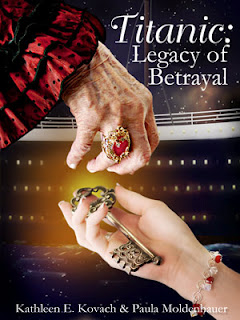
A secret. A key. Much was buried on the Titanic, but now it's time for resurrection.
Follow two intertwining stories a century apart. 1912 - Matriarch Olive Stanford protects a secret after boarding the Titanic that must go to her grave. 2012 - Portland real estate agent Ember Keaton-Jones receives the key that will unlock the mystery of her past... and her distrusting heart.
Kathleen E. Kovach is a Christian romance author published traditionally through Barbour Publishing, Inc. as well as indie. Kathleen and her husband, Jim, raised two sons while living the nomadic lifestyle for over twenty years in the Air Force. Now planted in northeast Colorado, she's a grandmother and a great-grandmother—though much too young for either. Kathleen has been a longstanding member of American Christian Fiction Writers. An award-winning author, she presents spiritual truths with a giggle, proving herself as one of God's peculiar people.
Thank you for posting today. I'm actually stunned that plays from 400 BC actually have survived and could still be performed now. Listening to that little clip you provided, some of the "comedy" doesn't differ much from what they do nowadays.



I enjoyed this post. I loved the Music Man too. I enjoyed Gilbert and Sullivan and less modern musicals. Thanks for sharing.
ReplyDeleteThank you for posting today. I'm actually stunned that plays from 400 BC actually have survived and could still be performed now. Listening to that little clip you provided, some of the "comedy" doesn't differ much from what they do nowadays.
ReplyDelete