
Tape: The Tie That Binds
By Izzy James
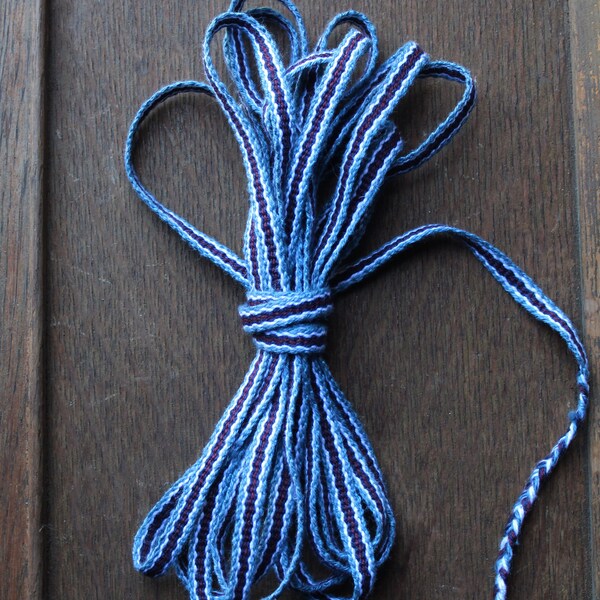 |
Reproduction of Colonial Tape Textile work. Nowadays it’s done primarily as a hobby. I have been an avid needleworker since I learned to knit when I was eight years old. It is rare to see me without my knitting, and these days tatting. It is a peaceful and useful pastime. In colonial times, a woman’s time spent with needles, yarn, and thread was working time. Today I thought I would talk about tape. Tape in colonial times refers to cloth ties that were used for closures on everything. Petticoats, pockets, hair ties, powder sacks, satchel straps, wagon cover ties, drawstrings, garters, all if these and more required tape. |
 |
| A docent demonstrates one use of tape. |
 |
| Tape had all types of uses. |
 |
Colonial Women's Pockets were tied around the waist under the skirt. There were decorative trims available for purchase from England, but most people weren’t tying their petticoats with them. The basic utilitarian tape, ubiquitous to life in the colonies was made at home. On simple looms also made at home. There were three basic types: “the paddle, lap, or knee tape loom; the box tape loom; and the standing or floor tape loom."
|


 |
| Floor Tape Looms were a bit more complex than their more portable counterparts. |
 |
| The Governor Mifflin of Pennsylvania and his wife, who is working on her box loom. |
In my book, The Road Home, Beti is a shepherdess and a weaver. She uses a rigid heddle loom that would fall in the paddle or knee tape loom category. The rigid heddle she uses was given to her by her mother. Who received it from her father on the eve of their courtship.
According to an old Nordic tradition, a young man presented a small gift at the beginning of a courtship to the girl he’d chosen to marry. The tradition says that if the woman accepted the gift the relationship began, if she returned the gift that was the end. Small band heddles with meaningful carvings were just the right type of gift for this tradition. Women often gave a gift of their own in return. Usually textile items like “knitted mittens or stockings, suspenders, or stocking bands.”
Tape was made primarily of flax (linen), hemp, wool, or cotton. The fiber would have been harvested, spun, and dyed before being woven into yarn, cloth, or tape. The process takes considerable time even today. Thankfully we have alternatives reading available so we don't HAVE to weave our own closures, but looking at the many beautiful patterns and varieties of tape I can't help but wonder about how much we have to be thankful for. So much history is hidden from us because the plain, homely things like making tape and how much tape was used was never recorded.


When Zeke and what's left of his regiment organized a wagon train west, they did not expect to encounter a woman traveling alone. Beti insists she doesn't need his help, but Zeke knows better and the strong need to protect her runs deep. Things get complicated when looters track Beti down. And emissaries from her mother’s country claim Beti is a real princess. Now Beti must choose: the hardships in Kentucky or a throne.
 Izzy James lives in the traces of history in coastal Virginia with her fabulous husband in a house brimming with books. Born with a traveling bone and an itch to knit. Izzy travels to every location where her books take place, from Williamsburg to Wyoming, popping in yarn stores along the way.
 Connect with Izzy through her website at izzyjamesauthor.com and sign up for her monthly newsletter.
Newsletter sign up: https://dashboard.mailerlite.com/forms/1431495/150792077163104252/share
Website: https://izzyjamesauthor.com
Amazon Author Page: https://www.amazon.com/stores/Izzy-James/author/B08DRW4JY3
BookBub: https://www.bookbub.com/authors/izzy-james
Goodreads: https://www.goodreads.com/author/show/9815799.Izzy_James
References:
Handwoven Tape: Understanding Weaving and Early American and Contemporary Tape, by Susan Faulkner Weaver, Shiffer Publishing, LTD, Atglen, PA, 2016.
Norwegian Pick-Up Bandweaving, by Heather Torgenrud, Shiffer Publishing, LTD, Atglen, PA, 2014
Images:
Pocket: https://i.pinimg.com/736x/a8/ed/2b/a8ed2b213a21ecc6030751413ebb4ea7.jpg
Tape: https://i.etsystatic.com/7762935/r/il/585045/5419240255/il_600x600.5419240255_b229.jpg
PA Governor and wife: https://i.pinimg.com/236x/e0/a7/6b/e0a76b73423db7ab496177a76acd8d4e--morris-th-century.jpg
Loom: https://i.pinimg.com/736x/08/bb/5c/08bb5cb78f76ae6a65e1f572a685896c.jpg
Loom: https://i.pinimg.com/originals/20/da/11/20da11d1a63232774199f26d5dbb597e.jpg
Loom: https://1.bp.blogspot.com/-dvu9dy5wEOs/VqvmxycQ-9I/AAAAAAAAAaA/njL5Qea1kKY/s1600/Jonathan%2BSeidel%2Btape%2Bloom.jpg
Thanks for posting. This was interesting!
ReplyDeleteThanks! I always find myself fascinated by the little things that different from our way of life when researching for my books. Of course we still use drawstrings and tapes, but I bet our predecessors would have been happy for a zipper or velcro :-)
ReplyDelete