
By Camille Elliot/Camy Tang
In my Christian Regency romantic suspense, The Spinster's Christmas, my hero, former naval captain Gerard Foremont, lent the heroine his red-and-black knitted scarf:
Miranda pulled her cloak more tightly around her. “I am happy the weather turned cold enough for the skating party. Ellie was quite looking forward to today.”
It was then that Gerard noticed her neck was bare. “Where is your scarf?” He remembered the gray one she’d worn during the greenery hunting party, which she’d used to staunch the blood on Ellie’s forehead.
“It was too stained.”
“Have you no other? Here.” He unwound the red and black scarf from his neck and draped it around hers.
“I cannot take your scarf.”
“My valet, like a mother hen, gave me two.” He pulled back the edge of his cloak to show the other scarf wound underneath. He then proceeded to tie it under her chin.
She had become still, as if she had stopped breathing, although she did not look at him. He was close enough to her to smell lavender and a hint of lemon. He might have taken longer than necessary to fasten the scarf, but he was reluctant to draw away from her.
He felt both rested and vibrantly alive when he touched her, even with the bulky scarf between them. It reminded him of the night of the Christmas ball, and the kiss they’d shared.
He wanted to kiss her again.
While writing the scene, I wondered: What would a gentleman’s knitted scarf actually have looked like in the early nineteenth century?
Alas, it sent me down a research hole—not a rabbit hole, no, it sent me hurtling into a black hole of antique knitting patterns from which I have not yet escaped.
I eventually found the pattern, “A Gentleman’s Comforter” in Miss Watts’s The Ladies’ Knitting and Netting Book, first published in 1837 (the link goes to the 5th edition published in 1840, which you can read for free online).
It was one of the first knitting books of its kind, although other women such as Jane Gaugain and Frances Lambert would go on to publish other such handiwork books from that year onward.
That date puts the pattern just beyond the Regency period in which my story is set. But knitting itself was hardly new.
For centuries, knitting knowledge was taught from one person to another rather than learned from books (or YouTube videos) like modern knitters. Most of the patterns were passed orally by largely illiterate rural knitters and memorized. The patterns were called “receipts” because they had been “received” from someone.
From Miss Watts’s book through the Victorian era, women began collecting and publishing knitting patterns. These books were supported by royalty and the aristocracy—partly because Queen Victoria herself knit, and partly because these patterns had never before been written and distributed in publications.
I can’t say for certain that Gerard’s scarf would have been made from this exact pattern, but it might be possible the “receipt,” passed down orally, was in use in the Regency era.
For fun, I decided to knit Gerard’s scarf from Miss Watts’s original pattern. Here it is:
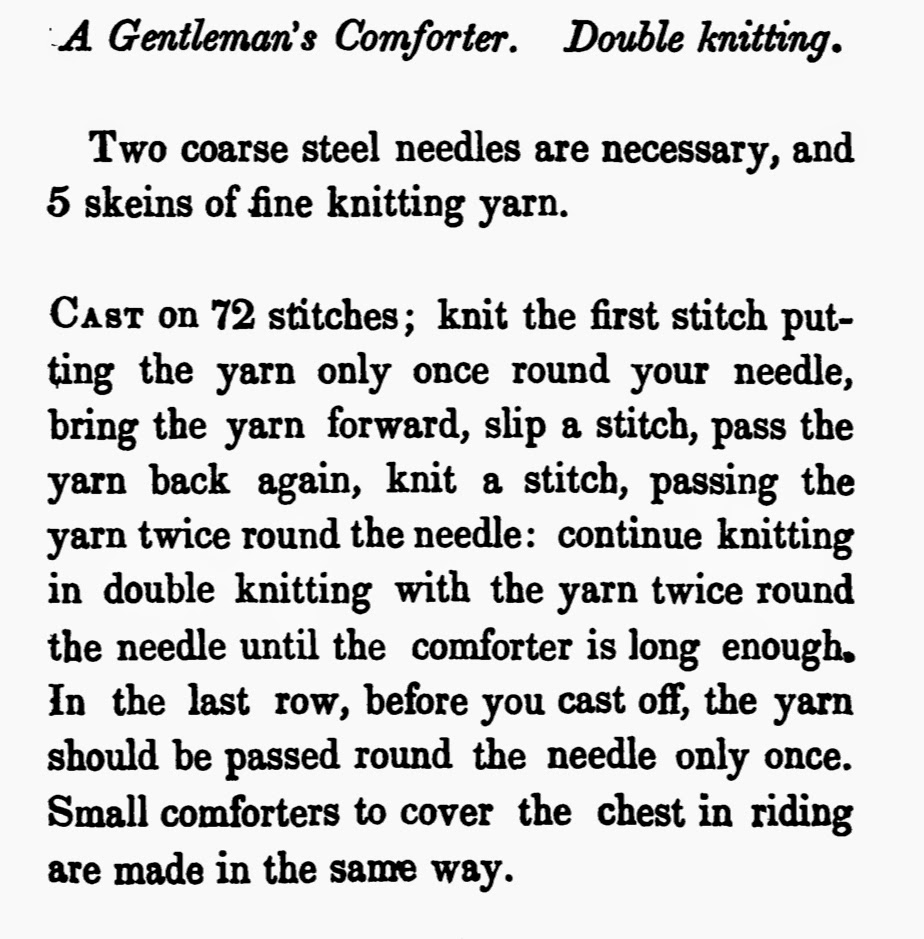
I wasn't entirely certain what “coarse steel needles” and “5 skeins of fine wool yarn” mean, so I just guessed. I used US 1 needles and fingering weight wool yarn, but you could use anything you want, including larger needles and yarn. Just cast on fewer stitches, making sure it’s an even number.
I got my yarn from KnitPicks.com, and was thrilled to find a “Hollyberry” color way. Very Christmasy!

If you’re interested, here’s my project on Ravelry.
I cast on 72 stitches. I used the same cast on I do when I make top down socks, which is the Norwegian cast on with two needles held together. However, you can use whatever cast on you want. I would suggest, however, that you cast on either with a larger needle or two needles held together.
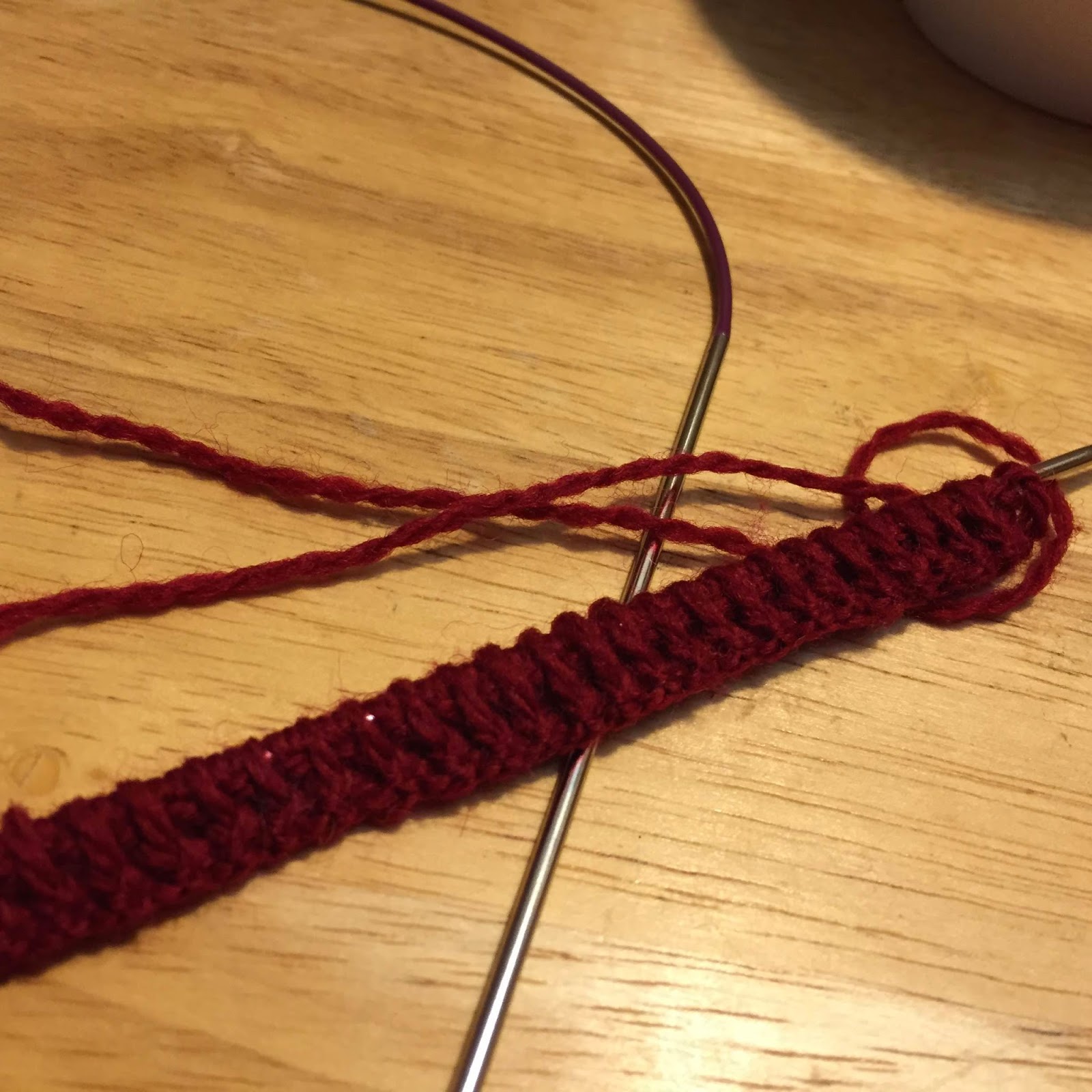
First row:
Knit 1, move the yarn to the front, slip one stitch purl wise, move yarn to the back
(knit 1 but instead of throwing the yarn once around the needle, throw it twice around before pulling the loop through, move the yarn to the front, slip one stitch purl wise, move yarn to the back) repeat to the last 2 stitches in the row,
knit 1 with the yarn twice around the needle, knit 1 with the yarn only once around the needle.
Next row:
Knit 1 (with yarn only once around needle), slip stitch purl wise with yarn in front, dropping the extra loop, (knit with the yarn twice around the needle, slip stitch purl wise with yarn in front, dropping the extra loop) repeat to the last two stitches, knit 1 with the yarn twice around the needle, knit 1 with the yarn only once around the needle.
Repeat this last row until your scarf is long enough.
It’s basic double knitting, but with a drop stitch, which makes the stitches a bit poofy and airy. It makes the scarf soft even if the wool is a bit tightly spun. A tightly spun yarn is typically more durable, and that would make the scarf durable, soft, and warm all at once.
The original pattern calls for one color, but I did 4" long red and black blocks.

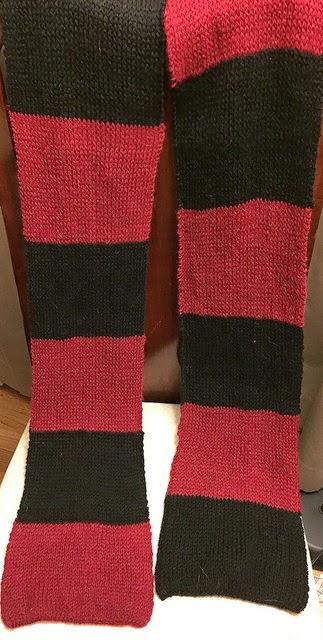
And that’s how I made Gerard’s scarf! Here's a bit more about the story it's from:
In The Spinster's Christmas, naval Captain Gerard Foremont and poor relation Miranda Belmoore, old childhood friends, meet again for a large Christmas party at Wintrell Hall. However, an enemy has infiltrated the family party, bent on revenge and determined that Twelfth Night will end in someone’s death …
If you’d like to read more of Gerard and Miranda's story (and see whether Gerard ever gets that kiss), you can read The Spinster's Christmas completely free to read on my blog. Or if you’d like your own copy, the book is also available on my website.

About the Author

Camy Tang writes Christian historical and contemporary romance filled with intrigue, adventure, and faith. Under the pen name Camille Elliot, she writes the Christian Regency romantic suspense series Lady Wynwood’s Spies, set in 1811 London where secrets, espionage, and slow-burn romance unfold against the glittering backdrop of high society.
References:
The Ladies’ Knitting and Netting Book by Miss Watts, 1837
Victorian Lace Today by Jane Sowerby, 2006
An earlier version of this article, including the knitting instructions and photographs, originally appeared on my personal blog in 2015. This version has been revised and expanded with additional historical research.
No comments:
Post a Comment