
 |
| The Greatest Gift, book cover, eBay |
Imagine you’re a 4,100-word short story titled, “The Greatest Gift: A Christmas Tale,” loosely based on the 1843 Charles Dickens novella, A Christmas Carol. Your author, Philip Van Doren Stern, envisions you the morning of February 12 in 1938 while shaving. He asks himself: What if a family man is on the verge of suicide on Christmas Eve and is rescued by a stranger who shows him what life would be like without him?
You, the little story, have a ton of potential, but nobody wants you. You’re rejected by several publishers, but your author refuses to give up. By 1943, he ultimately makes 200 copies and sends the booklets out as Christmas presents, reserving two to send to the Library of Congress and the U.S. Copyright Office.

In 1944, Stern’s eight-year-old daughter answers the home telephone. The caller asks to speak with her father. Even at that age, she fears it might be bad news regarding the war. However, it turns out to be Stern’s Hollywood agent with fantastic news. RKO Radio Pictures has just bought you, the story, for $10,000 as a vehicle for Cary Grant.
The film rights prompt a buzz, and you are published in the magazines Reader’s Scope and Good Housekeeping. The latter publishes a longer and darker version under the pseudonym, Peter Storme, and title it “The Man Who Was Never Born.” You, the original story, also find a book publisher in David McKay.

Now in RKO’s hands, three different scripts are written, but none work out for the studio. Frank Capra had recently formed a new production company, Liberty Films, and he buys the rights for $10,000. He hires a husband and wife team, Albert Hackett and Frances Goodrich, to write a completely new screenplay, piecing together you, the original story, and the previous three scripts. They add backstory and additional characters. Capra sends the finished script to his longtime collaborator, actor Jimmy Stewart, who enthusiastically agrees to play the lead, George Bailey.

The film, now titled, It’s a Wonderful Life, premiers in New York City, December of 1946 with its wide release in January of 1947, eventually winning a Golden Globe for best director and receiving five Academy Award nominations. A special scientific achievement award is also captured due to the ingenious invention of artificial snow. Made from fire-extinguisher foam, sugar, water, and soap flakes, the “snow” floats naturally, and doesn’t make as much noise when walked upon as the white painted cornflakes previously used. The movie had been filmed during a heatwave in California, making realistic cold weather a challenge.

At this point, you, the now re-vamped and beautiful story, should be on top of the world, just as George Bailey is when he marries Mary and they hop in the jalopy to see the world on their honeymoon. However, darkness descends. George’s plans and dreams are squashed when he learns that the Building and Loan is in trouble.
And you, the story, become embroiled in political mayhem.
You, the little story, have a ton of potential, but nobody wants you. You’re rejected by several publishers, but your author refuses to give up. By 1943, he ultimately makes 200 copies and sends the booklets out as Christmas presents, reserving two to send to the Library of Congress and the U.S. Copyright Office.
In 1944, Stern’s eight-year-old daughter answers the home telephone. The caller asks to speak with her father. Even at that age, she fears it might be bad news regarding the war. However, it turns out to be Stern’s Hollywood agent with fantastic news. RKO Radio Pictures has just bought you, the story, for $10,000 as a vehicle for Cary Grant.
The film rights prompt a buzz, and you are published in the magazines Reader’s Scope and Good Housekeeping. The latter publishes a longer and darker version under the pseudonym, Peter Storme, and title it “The Man Who Was Never Born.” You, the original story, also find a book publisher in David McKay.
Now in RKO’s hands, three different scripts are written, but none work out for the studio. Frank Capra had recently formed a new production company, Liberty Films, and he buys the rights for $10,000. He hires a husband and wife team, Albert Hackett and Frances Goodrich, to write a completely new screenplay, piecing together you, the original story, and the previous three scripts. They add backstory and additional characters. Capra sends the finished script to his longtime collaborator, actor Jimmy Stewart, who enthusiastically agrees to play the lead, George Bailey.
The film, now titled, It’s a Wonderful Life, premiers in New York City, December of 1946 with its wide release in January of 1947, eventually winning a Golden Globe for best director and receiving five Academy Award nominations. A special scientific achievement award is also captured due to the ingenious invention of artificial snow. Made from fire-extinguisher foam, sugar, water, and soap flakes, the “snow” floats naturally, and doesn’t make as much noise when walked upon as the white painted cornflakes previously used. The movie had been filmed during a heatwave in California, making realistic cold weather a challenge.
At this point, you, the now re-vamped and beautiful story, should be on top of the world, just as George Bailey is when he marries Mary and they hop in the jalopy to see the world on their honeymoon. However, darkness descends. George’s plans and dreams are squashed when he learns that the Building and Loan is in trouble.
And you, the story, become embroiled in political mayhem.
 |
| Blacklist tract |
Alas, the communist controversy squelches the audience’s desire to attend. Some also attribute the poor timing of a Christmas movie released in January. Another contributing factor is that post-war audiences want something lighter. It’s a Wonderful Life fails to earn back what it cost to produce the film. Box office returns disappear by way of a classic fade out, and you are doomed to be forgotten, as if you never existed.
The devastation hits so hard that Frank Capra sells Liberty films to Paramount Pictures.

American movie-goers are given the opportunity to see what the world would be like without Frank Capra’s It’s a Wonderful Life starring James Stewart and Donna Reed showing every Christmas season. They will go through the rest of the 1940s, 50s, 60s, and half of the 70s without knowing the joy of watching George and Mary’s romance. They never see them fall into the swimming pool or hear George’s offkey rendition of “Buffalo Gal Won’t You Come Out Tonight.” They never agonize over Uncle Billy’s ineptitude of losing the Building and Loan’s $8,000. And Mr. Potter? Not even a thought of him being a warped, frustrated old man. Clarence Oddbody, AS2 (Angel Second Class), remains in the heavens with Joseph and never gets his wings.
But then something miraculous happens in the mid-1970s. After being sold to several companies, the final one, National Telefilm Associates, fails to renew the copyright due to a clerical error. This error—Or is it divine intervention?—puts the rights and all the film negatives in public domain. Television stations jump on the chance to air it royalty free. Home video companies snatch it, as well, making sure every home in America has the chance to rejoice over Zuzu’s petals.
After nearly three decades, a new audience, and ultimately everyone up to this day, come to appreciate you, the little story that wouldn’t die.

And Clarence gets his wings.
A TIME-SLIP NOVEL
A secret. A key. Much was buried on the Titanic, but now it's time for resurrection.
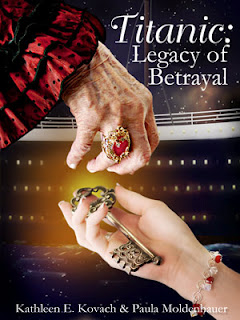
To buy: Amazon


Super well written and what a wonderful tale of how we all received the gift of "It's a Wonderful Life " Thank you so much for writing and sharing this with us. 💚❤️🙏
ReplyDeleteThank you!
DeleteThank you for posting today. I didn't know about this, and the length of time it wasn't shown is a tragedy.
ReplyDeleteI was shocked, as well.
DeleteGood one
ReplyDeleteThank you!
ReplyDelete