

By Mary Davis
We all know what an envelope is and what it’s used for. If you go back in time, envelopes were once a luxury, not as common as we have today.

Envelopes might be thought of as a fairly recent invention, right? Invented in the last 300-500 years, right?
Surprisingly, not. They go back to antiquity. Though they might not have gone by the name of “envelope”, the concept of them dates back to between 3500-3200 BC.
Back then, people didn’t write on paper, parchment, or animal skin because those writing surfaces didn’t exist yet. So, what did they write on?
Soft clay, of course. It was abundant in Mesopotamia. A lump of this moldable earth was rolled into a small slab, then with a stylus, information was drawn into it, in the form of symbols. After the message was complete or the slab was full, it would be left out in the sun to dry.
But how to send these so that everyone along the way to their destinations didn’t read it?

A clay envelope, of course. A slab of would be gently folded around the dry tablet and sealed, then dried in the sun. This guaranteed that no one could read it secretly. No steaming this puppy open and resealing it. It had to be cracked open. Because of the laborious effort and length of time clay “paper” and “envelopes” took, it was almost exclusively used by the elite, governments, and historians.
Fortunately, along came a crude form of paper in roughly 1200 BC invented by the Chinese. Japan followed close behind.

Early envelopes were created from a kite/diamond shape or something that resembled a short-armed cross, folding the tips or ends toward the center to form a rectangle or square. Then the message could be put inside the envelope, secured in some fashion, often a wax seal, but sometimes string.
Not everyone had the luxury of owning the supplies for a wax seal, nor wasting a whole piece of paper to enclose it. People without these items could use letterlocking, a form of folds, tucks, slits, and strips. My article on letterlocking can be found HERE.

Each envelope had to be hand cut, folded by hand, and glued one by one, a slow laborious process. This made them expensive and not readily available to the masses.
The next major advancement came in 1840 when George Wilson of London got a patent for an envelope-cutting machine.

Then in 1845, a steam-powered, letter-folding machine was patented in England by Edwin Hill and Warren de la Rue that also cut them first.
After that, a faster way of gluing was needed. This came in 1879 when a gum dryer feature was added to the machine.
 |
| Envelope making machine |
The final major innovation came in 1901 with the invention of the window envelope by Americus F. Callahan.

I’m sure my mail carrier is grateful we no longer write on clay tablets.
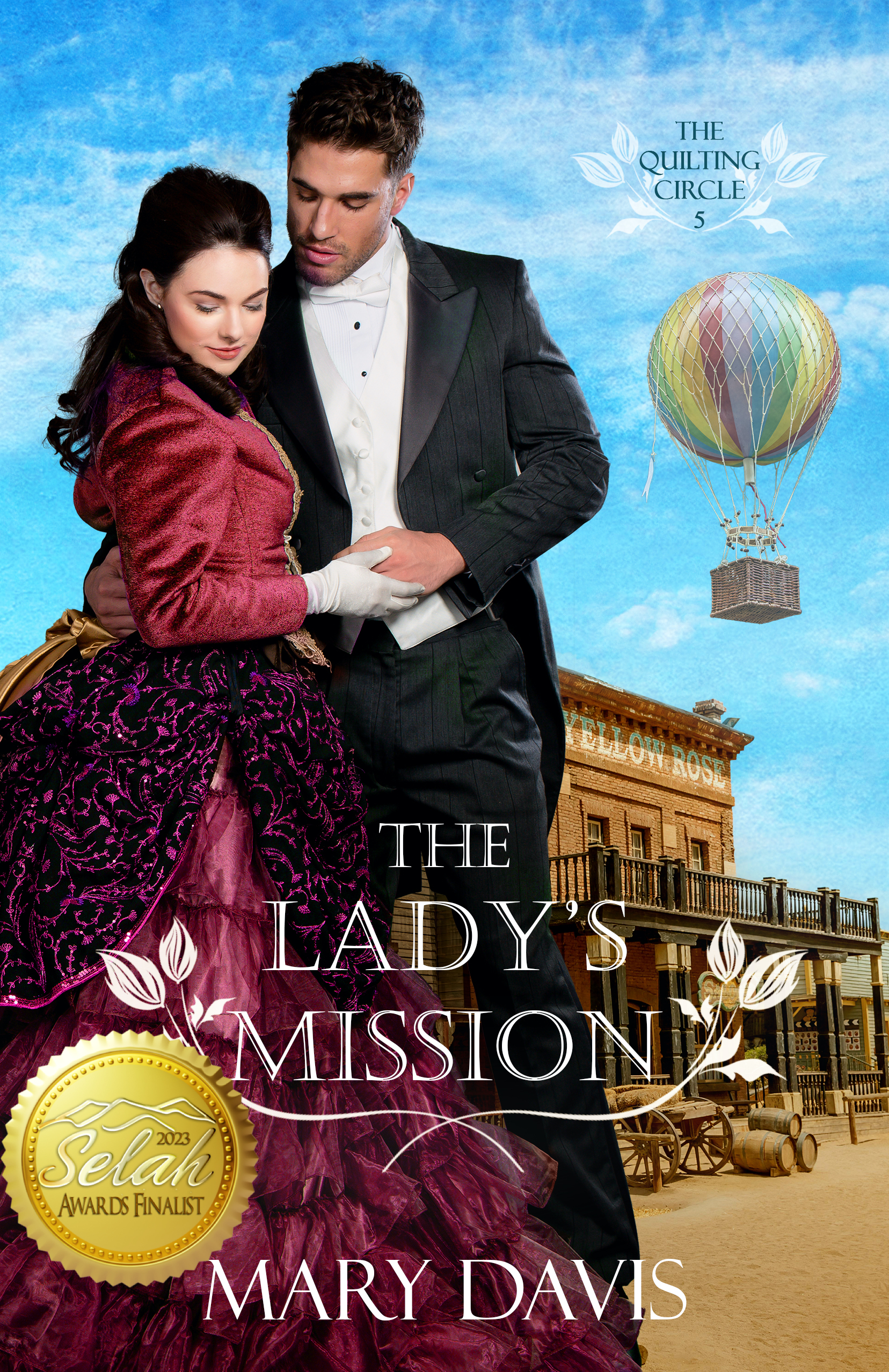
THE LADY’S MISSION (Quilting Circle 5)
2023 SELAH Award Finalist
Will Cordelia abandon her calling for love? Cordelia Armstrong wants nothing more than to escape the social norms for her station in society. Unless she can skillfully maneuver her father into giving up control of her trust fund, she might have to concede defeat—as well as her freedom—and marry. Every time Lamar Kesner finds a fascinating lady, her heart belongs to another. When a vapid socialite is offered up as a prospective bride, he contemplates flying off in his hot air balloon instead. Is Lamar the one to finally break the determination of Cordelia’s parents to marry her off? Or will this charming bachelor fly away with her heart?

Mary lives in the Rocky Mountains with her Carolina dog, Shelby. She has three adult children and three incredibly adorable grandchildren. Find her online at:
Books2Read Newsletter Blog FB FB Readers Group Amazon GoodReads BookBub
Sources
https://www.backthenhistory.com/articles/the-history-of-envelopes
https://en.wikipedia.org/wiki/Envelope
https://baddeleybrothers.com/the-history-of-envelopes/
https://www.paperpapers.com/news/more-than-a-wrapper-the-5000-year-history-of-the-envelope/
https://medium.com/@mecoberbo/a-brief-history-of-the-envelope-eec25011d98f
https://www.youtube.com/watch?v=6NZA8XpNs0w
https://www.youtube.com/shorts/7KfMS5N5zJU

Thanks for posting today, and I'm glad for the evolution of the envelope!
ReplyDelete