By Kathy Kovach

The Renaissance, coming from the French word meaning rebirth, came about after the bleak Middle Ages that began around 476 AD. During this time, the Dark Ages clouded the social landscape. Arts and sciences were disregarded, while wars, famine, and the Black Death became the focus for 500 years.
Still, it was another three centuries until creative expression finally reemerged, kicking off the Renaissance period.
 |
| Portrait of Petrarch, circa 1376, the Father of Humanism |
Florence, Italy was the first to attempt the restoration of beauty in many forms of creative endeavors, from paintings to poets. A cultural movement called Humanism, the belief that man is the center of his own universe, allowed one to explore and embrace one’s own achievements in science, education, classical arts, and literature.
Unfortunately, in terms of theater, their plays were merely a regurgitation of the Greek and Roman scripts of old. Nothing spectacular came out of Italy until a couple of centuries later.
 |
| Commedia dell’Arte |
One form of performance that originated in Italy in 1545 was Commedia dell'Arte. Translated, it means Comedy of Art. The players performed off a particular plot, then improvised from there. It’s fun to think that improv theater existed, and that they traveled from town to town. This form became popular across Europe. It’s estimated that over 1000 short commedia scenarios exist today.
 |
| Queen Elizabeth I, circa 1575 |
Enter the Elizabethan era, 1558-1603, also known as the Golden Age of Renaissance. During this time of flourishing culture, Her Majesty Queen Elizabeth I loved the theater and often hosted performers at her royal residences. In 1574, the amateur performances that scrabbled to find spaces to entertain became legitimized due to the queen’s encouragement.
 |
| Stefano Erardi - Annunciation, 17th century painting |
Morality plays became a staple during the 15th – 16th centuries. These were plays performed in churches depicting Biblical allegories centered around the social aspects of good versus evil, angels versus demons, and miracles. By the 1570s, religious plays were banned due to the English Reformation. However, performing artists were now free to explore their creativity and present entertainment with a variety of themes.
 |
| The Masque |
By the 16th and early 17th centuries, another style of theater emerged among the nobility in England. The Masque was an extravaganza of music, dancing, singing, and acting. The elaborate sets were often designed by professional architects. Reminds me of the musical theater we enjoy today with one exception. Rather than stories and myths, each performance depicted the birth, wedding, death, etc. of a noble. They were only performed at court, which limited their exposure to the general population.
 |
| William Shakespeare |
Playwrights Ben Jonson, Christopher Marlowe, and William Shakespeare were most notable in promoting this artform. During the age of strolling actors and open-air venues, their influence with the Queen prompted the construction of several permanent structures. The first such was built in 1576 and named—to no one’s surprise—The Theatre. This amphitheater was made of wood over a circular seating area and an open roof. The design paid tribute to the travelling troupes as the stage resembled that of a town square where the folk could gather round and watch the actors' antics. After the death of its builder, James Burbage in February 1597, The Theatre was dismantled by Burbage’s sons, Cuthbert and Richard, due to a dispute with the landlord. They then used the timbers to build Shakespeare’s Globe Theatre, also an amphitheater.
The original Globe Theatre burned down in 1613. The culprit? A cannon set off during a performance of Henry VIII, resulting in a fire that caught onto the thatch roof. Thankfully, there were no casualties. Kids today would say that play was lit. A new Globe Theatre was eventually built in 1997.
Unlike the constrictions of royal theater played only within the court, and morality plays in churches, the Elizabethan theaters allowed the commoner to partake as it only charged a penny to a sixpence to enter. And unlike the masque, the trimmed down scenery allowed the actors to become more intimate with the audience.
During this time, in 1576, an alternative emerged, private indoor theaters. The first was located in an abandoned monastery near St. Paul’s Cathedral. Converted by Richard Farrant, composer, choir master, and theatrical producer, it was renamed the Blackfriars Theatre and became home to the outstanding children’s theater of that era. It housed a smaller audience, and thus became more attractive to an elitist crowd. Wealthy and influential people attended, which affected the style of writing. The refined scripts became less bawdy and gritty than those enjoyed by the masses. Ben Jonson wrote many of these plays.
 |
| The Puritans |
Live theater in its many forms was enjoyed up until the Puritan movement gained strength. By this time, Elizabeth I had died as of 1603, and Charles I sat on the throne. On September 2, 1642, after England’s First Civil War broke out, the Puritans, who had gained much influence, were instrumental in shutting down all forms of theater. They deemed them frivolous and incompatible with their religious views.
It wasn’t clear if the directive to shut down theaters was permanent or only meant to temporarily halt them through the tumultuous times that culminated with the trial and execution of Charles I. However, when the Second Civil War broke out just five years later, another, more severe decree stated that all actors be treated as rogues, any spectators be fined, and all theaters be demolished. This included the Globe Theatre in 1644.
 |
| King Charles II, reign 1660-1685 |
In 1660, a new king was in town, Charles II, and with him, the Restoration. The Monarchy was restored along with the Church of England. Arts and culture were now allowed to thrive as Charles lifted the theatrical ban. A new licensing system made allowances for two entities, the King’s Company and the Duke’s Company. New practices were established, including the acceptance of female performers, which had been strictly forbidden prior to 1642.
The next time I enjoy live theater, which, ironically, is today, (Water for Elephants at the Buell Theater in Denver,) I’ll remember all it had to go through to survive.
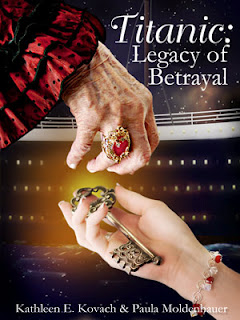
A TIME-SLIP NOVEL
A secret. A key. Much was buried on the Titanic, but now it's time for resurrection.
Follow two intertwining stories a century apart. 1912 - Matriarch Olive Stanford protects a secret after boarding the Titanic that must go to her grave. 2012 - Portland real estate agent Ember Keaton-Jones receives the key that will unlock the mystery of her past... and her distrusting heart.
Kathleen E. Kovach is a Christian romance author published traditionally through Barbour Publishing, Inc. as well as indie. Kathleen and her husband, Jim, raised two sons while living the nomadic lifestyle for over twenty years in the Air Force. Now planted in northeast Colorado, she's a grandmother and a great-grandmother—though much too young for either. Kathleen has been a longstanding member of American Christian Fiction Writers. An award-winning author, she presents spiritual truths with a giggle, proving herself as one of God's peculiar people.



Thanks for posting today. This was interesting. Hope you love the performance you are seeing.
ReplyDelete