The Strange Traditions of Live Theater
By Kathy Kovach
Whenever creatives get together, one can expect imaginations to collide, creating a burst of prismatic color. This is my explanation for the wild and beautiful traditions that have sprung from live theater.
Such as, you can never say the name “Macbeth”, but you can wish someone to “break a leg.” Never ever whistle, but bad dress rehearsals are encouraged. Let’s enter the stage—with the right foot only, please—and explore the origins of theater traditions and so-called superstitions.
The big no-no that is widely accepted is to never say the name “Macbeth” inside the theater. It is only to be referred to as “The Scottish Play” or “The Bard’s Play.” So powerful was Shakespeare’s authoring of the tale, that it’s believed the spells the three witches invoked actually cursed the play itself. Could this really be the reason for the multiple mishaps over the years? Such as nearly losing the beloved actor Lawrence Olivier in 1937 when some stage weights narrowly missed him. Or, in 1942, when three performers died during the play’s run at the Piccadilly Theater in London.
Was it really a curse, or would these things have happened regardless of a slip of the tongue? Those who are a slave to superstition have a simple remedy. If the name “Macbeth” is invoked, one need only to step outside of the theater, turn around three times, spit, curse, and knock three times on the stage door. Whew! Who knew disaster could be avoided by doing a bizarre version of the Hokey-Pokey?
What about the “no whistling” rule? Was that the result of the underworld playing cruel games? Not at all. Sailors, while on leave, often worked backstage to earn extra money and used the same system while at sea to give instruction. I imagine the sound cut through the wind and waves easier than a voice. The “no whistling” rule didn’t apply to them, but to everyone else.
If someone decided to whistle a happy tune, it could, for instance, confuse the one waiting to drop a set, and thus cause injury. Therefore, the stagehands were the only ones allowed to whistle while they worked. (Sorry, it needed to be said.)
How often have you told a performer to “break a leg?” No one? Just me? Well, this tradition has a plethora of theories. Ancient Greek patrons would stomp their feet so hard in their enthusiasm that they would break their tibias. Another theory was that the space between the wings and the stage was called the “leg line.” Someone waiting in the wings to fill in for an injured actor would be instructed to “break” the line. The phrase “break a leg” was meant to wish for a performer the good fortune of being on stage.
Let’s talk flowers. How many times have you seen the leading lady clutching a bouquet to her breast and bowing as single roses are tossed at her feet? The tradition started when someone would steal flowers from a graveyard and present them to the director or actors at the final performance, thus representing the final curtain call, the death of the production. It morphed into the rule of only giving flowers after a show because it could be considered bad luck, causing the performance to go badly.
I don’t know how many times in my “performance” era—we’re talking school plays and church choir productions—that I’ve heard the encouraging words, “It will be okay. Bad dress rehearsal, good performance.” Where did that come from? No one knows the origin, but it makes sense. What are the odds that something would go off the rails two nights in a row? It’s better to make mistakes in an empty theater, where they can be fixed, than in front of a live audience.
You’ve seen it before. The single lamp, lit, sitting in the middle of the barren stage. (Again, just me?) This single bulb has the unfortunate moniker of Ghost Light. Some say that every theater is haunted, and the light gives the spirits the opportunity to enjoy the space without livings milling about. Others say it’s supposed to keep the specters away. Yet another theory is when the light goes out, the ghost will cause mischief. See how superstitions get skewed?
There are more practical reasons, however. Back when gas lights were used, the pressure on the gas valves needed to be relieved. I don’t know much about gas lamps, but I remember in historical movies the lamps on the wall always had a dim glow. My favorite source of the Ghost Light stems from a myth. It seems a thief had broken into some theater somewhere, stumbled around in the dark, and broke his leg. I’m thinking by falling in the orchestra pit. He then sued the theater for damages.
We’re always encouraged to put our best foot forward. In the theater world, that foot is the one on the right. Of course, that old “good luck/bad luck” thing has to infiltrate everything one does. However, it comes down to the right side being the dominant one for most people. In European culture, it’s said that the right side symbolizes righteousness—It’s right there in the name!—and correctness.
My favorite tradition of all is the time-honored serenading of the cast and crew singing Roy Roger’s “Happy Trails To You” after the final performance of the run and after the audience has filed out. The sweet farewell wishes those who gave their time to make the production successful a blessing and a fond adieu.
https://youtu.be/eEqUyNaSdvg?si=8JcfMm8xOp78RrjV
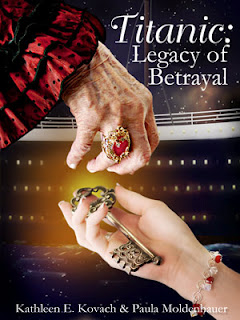
A TIME-SLIP NOVEL
A secret. A key. Much was buried on the Titanic, but now it's time for resurrection.
Follow two intertwining stories a century apart. 1912 - Matriarch Olive Stanford protects a secret after boarding the Titanic that must go to her grave. 2012 - Portland real estate agent Ember Keaton-Jones receives the key that will unlock the mystery of her past... and her distrusting heart.
Kathleen E. Kovach is a Christian romance author published traditionally through Barbour Publishing, Inc. as well as indie. Kathleen and her husband, Jim, raised two sons while living the nomadic lifestyle for over twenty years in the Air Force. Now planted in northeast Colorado, she's a grandmother and a great-grandmother—though much too young for either. Kathleen has been a longstanding member of American Christian Fiction Writers. An award-winning author, she presents spiritual truths with a giggle, proving herself as one of God's peculiar people.




Interesting.
ReplyDelete