Monday, October 12, 2026

Give My Regards to Brede Weg

By Kathy Kovach

Streets named Broadway are plentiful in America. From Los Angeles, California to Paduka, Kentucky—even my hometown of Denver, Colorado. Yet, any mention of Broadway elicits high-stepping dance routines, belting tunes, and bright footlights.

Broadway is synonymous with live theater.
Jennie Bobb, with her daughter, Nellie Longhat, both Delaware (Lenape)
Long before the theaters were built, Broadway’s location was a native American Lenape trading trail cutting through the heart of Manhattan Island. Known as the Wickquasgeck Trail, named for the Wecquaesgeck people, it followed a ridge of dry ground that passed by swamps, boulders, and fields.

In the 17th century, the Dutch moved in. They named their settlement, located in the southern tip of the island, New Amsterdam. By February 2, 1653, New Amsterdam officially became a city after receiving municipal rights.
Utilizing the existing trail to link trade with the rest of Manhattan, they broadened it in 1658 in order to get wagons through. This became de Heere Straet, or Gentleman’s Way. Most people simply referred to it as brede weg, or the broad road. From there, it morphed into Broad Street which eventually rolled off the tongue as Broadway.

As a side note, New Amsterdam became New York in 1664 when the British began to rule.

To think this infamous street went from a dusty native American trail to essentially the very pulse of bustling Manhattan boggles the mind. It has, in fact, escorted an assortment of New York’s population for hundreds of years.

Now that commerce could flow freely, businesses and houses for the elite popped up faster than a standing ovation. Broadway became a social hub, which naturally ushered in various forms of entertainment. Theaters were built. Everything from pantomime to Shakespeare were offered.
The Park Theatre
In 1798, the first world-class theater showed up at the southern end of Broadway, known as the Park Theatre. It hosted highly regarded performers from all over the globe. The Astor Place Theatre was built further uptown in 1847. It was around this area that many other venues clustered, and it is now known as the Broadway theater district.

Then came electricity.
Times Square today
At the dawn of the 20th century, all up and down Broadway, signage announced the next big thing. But no one could see them at night. Colorful lights made them shine . . . temporarily . . . until they burned out at an alarming rate. White lights seemed to last longer. Thus, all bulbs were changed to clear, and Broadway went from being known as a tiny trading trail to The Great White Way in 1901.
Ziegfeld Girls
Over the next two decades, a shining star arose shaping the Broadway musicals that we know of today. Utilizing glitzy music and dance, untamed humor, elaborate sets, and extravagant costumes, Impresario Florenz Ziegfeld managed and produced revues hosting such talents as W.C. Fields, Fanny Bryce, Will Rogers and countless others. Irving Berlin created music for the Ziegfeld Follies, including “A Pretty Girl Is Like a Melody”, that became the theme song for the popular Ziegfeld Girls. These were a host of up to forty women dressed in glamorous costumes who moved about the stage, often as a backdrop to the performers. Enjoy Dennis Morgan singing the Hollywood version in 1936:
By 1920, the area around Broadway and 42nd Street had firmly established itself. Over eighty theaters sprang up and created what we now know as Manhattan’s Theater District.

Who knew Broadway was simply that? A broad street. Yet it has elicited so much more emotion. Broadway is the rhythm and harmony winding through each heart that loves the kicking high step and a serenading tenor. It’s the storyteller that makes us laugh and cry . . . and forget. An escape into another world, if only for three hours.

You know what they say. If you can make it there, you can make it anywhere. And if you do make it there, give my regards.


A TIME-SLIP NOVEL

A secret. A key. Much was buried on the Titanic, but now it's time for resurrection.
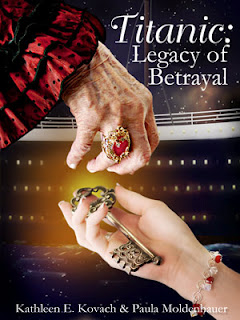

Follow two intertwining stories a century apart. 1912 - Matriarch Olive Stanford protects a secret after boarding the Titanic that must go to her grave. 2012 - Portland real estate agent Ember Keaton-Jones receives the key that will unlock the mystery of her past... and her distrusting heart.
To buy: Amazon


Kathleen E. Kovach is a Christian romance author published traditionally through Barbour Publishing, Inc. as well as indie. Kathleen and her husband, Jim, raised two sons while living the nomadic lifestyle for over twenty years in the Air Force. Now planted in northeast Colorado, she's a grandmother and a great-grandmother—though much too young for either. Kathleen has been a longstanding member of American Christian Fiction Writers. An award-winning author, she presents spiritual truths with a giggle, proving herself as one of God's peculiar people.


No comments:

Post a Comment