Showing posts with label #chateaus #ChâteaudeChambord #LouisXIV. Show all posts

Thursday, July 4, 2024

A Real Life Story of Faith and Valor

By Donna Wichelman

If you’ve read my HHH blogs for any length of time, you may remember my series on French Chateaux and one in particular called Le Château De Lourmarin. Located in the region of Provence and the Luberon (hill country), I became fascinated by Le Château De Lourmarin when I discovered its history involving a community of pre-reformation Protestants known as Waldensians in the village of Lourmarin, France. The allure was based on having written two books in a romantic suspense series called the Waldensian Series.

Le Château De Lourmarin, May 2023 Donna's Gallery


Le Château De Lourmarin Gardens, May 2023 Donna's Gallery

Foxe’s Book of Martyrs dedicates less than a page to the Waldensians of the Cottian Alps west of Turin, Italy. Yet, their real-life story of valor and enduring faith in the midst of persecution in Europe throughout the second millennium AD touched and encouraged my heart so much, that I wanted to bring their story to life in a contemporary suspense novel that would give wings to courage and enduring faith in our time.

Historians debate the exact date and origins of the Waldensians, also known as the Vaudois or Valley Dwellers. Some have a compelling argument for the existence of this ancient sect, which originated with the first-century fathers, who settled in the Cottian Alps between France and Italy during a period of great persecution over the next two centuries. They continued to carry out their traditions into the second millennium.

The official Waldensian Church position says the movement began in 1170 A.D., when a rich merchant from Lyons, France converted to Christianity and took a vow of poverty. Others banded around Peter Waldo, and they became known as the Poor Men of Lyons. 

Regardless of which history is correct, a division arose between the Roman Catholic Church and the Waldensians by the end of the twelfth century. Though the Waldensians didn’t want to secede from the Roman Church, they hoped to sway the papacy to cease certain practices they said contradicted the Bible and the pure teachings of Christ.

The Waldensians also petitioned the papacy for various reforms, foremost among them were translating the Bible into the vernacular and allowing clergy to marry. The papacy would not concede to their position, calling Waldensians and any other Protestant sect heretics. Thus began centuries of martyrdom and persecution that helped set the stage for the Reformation in the sixteenth century.

Ancient School of the Barba Where Waldensians Translated the Bible into the Vernacular: Pra del Torno, Italy: Donna's Gallery 2006

Fast forward to the seventeenth century when Louis XIV became King of France in 1643. Believing he was God’s representative on earth and supported in that view by his mother, Louis brought on a renewed vigor to rid Europe of Protestant sects everywhere in Europe.

In 1655, a great persecution ensued, known as the Spring of Blood or the Piedmontese Easter. Men and women were flayed alive, burned at the stake, and drowned in lakes and ponds. Hundreds of Waldensian faithful were martyred for their faith.

By 1685, the Waldensians were forced from their homes in exile and fled over the mountains to Switzerland. Most wanted to return to their Alpine valleys and devised ways to make that happen. It wasn’t until the height of the Nine Year’s War in August 1689, when the tide of Europe turned against France, that William of Orange commissioned a militia made up of Waldensian and Huguenot soldiers to cross back over the mountains into their homelands in the Waldensian Valleys.


A Depiction of Waldensian Militia, Balziglia, Italy: Donna's Gallery, September 2015
Some of the French Peaks the Militia had to Cross Near Iseran, France During the Mini Ice Age: Donna's Gallery, September 2015
A Notable Ancient Bridge the Militia Crossed near Cluses, France: Donna's Gallery, September 2015

Under the leadership of Pastor Henri Arnaud, the soldiers braved not only French militia but the rains and snows of a mini ice age in the Alps, marching on foot for more than ten days from Yvoire on the south shore of Lake Geneva to their home valleys. They spent the better part of another year in Balziglia before they succeeded in defeating the French. At war’s end, the Protestant world hailed the Waldensians for their persevering faith and undying valor against all odds. They also received the honor and distinction of bringing their people back home in what became known as the Glorious Return.

A Copy of Henri Arnaud's Book on the History of the Glorious Return
Museum at Balziglia, Italy: Donna's Gallery, September 2015

Fortress and Museum at Balziglia, Italy: Donna's Gallery, September 2015
Waldensians lived in their ghetto valleys west of Turin for more than a hundred and fifty years under persecution. Then on 16, February 1848, the unified Italian government finally granted the Protestant church freedom to worship and assemble under the Declaration of Emancipation. On the seventeenth of February, local Waldensian assemblies lit bonfires in celebration of their civil liberties. Waldensians worldwide still light bonfires each year in commemoration of their freedoms.

A Typical Waldesnian House Furnished Simply in a Rodoretto: Donna's Gallery, September 2015
The largest group of Waldensians outside of Italy resides in Valdese, North Carolina. Each summer, the community puts on a festival of heritage, which includes a production called From This Day Forward in an amphitheater to honor the Waldensian's history. They’ve also constructed an outdoor replica of historical sites in Italy on their Trail of Faith. You can find more information about Valdese at www.visitvaldese.com.

Replica of the Cave of Faith in the Angrogna Valley, Italy in Valdese, North Carolina: Donna's Gallery, 
The Waldensian story lives on as a testimony of a people whose valor and enduring faith withstood the test of time. This ought to encourage and strengthen Christians as we hear and read stories about those who are persecuted and martyred around the world in our time.

Post Script: In the summer of 2015, four months after I published Light Out of Darkness, the first book in my Waldensian Series, Pope Frances apologized to the Waldensians for a millennium of religious persecution. It was a momentous occasion for the descendants of this pre-reformation group.

More About the History of the Waldensians:
The History of the Waldenses by J.A. Wylie
You are My Witnesses: The Waldensians Across 800 Years by Giorgio Tourn
The Glorious Recovery by The Vaudois of their Valleys, by Henri Arnaud
Waldensian Cultural Centre, Torre Pellice, Italy www.fondazionevaldese.org


Weaving history and faith into stories of intrigue and redemption grew out of Donna's love of travel, history, and literature as a young adult while attending the United World College of the Atlantic--an international college in Wales, U.K. She enjoys exploring people and cultures of the world and developing plots that show how God's love abounds even in the profoundly difficult circumstances of our lives. Her stories reflect the hunger in all of us for love, belonging, and forgiveness.

Donna received her master's degree in mass communication/journalism from San Jose State University and became a communications professional before writing full-time. Her short stories and articles have appeared in inspirational publications. She has two indie-published romantic suspense novels, Light Out of Darkness and Undaunted Valor, in her Waldensian Series. Her Gilded Age historical romance, A Song of Deliverance, will be released by Scrivenings Press in December 2024.

Donna and her husband of forty years participate in ministry at their local church in Colorado. The love spending time with their grandchildren and bike, kayak, and travel whenever possible.

Beginning July 4th in honor of Independence Day and through July, Donna is running a Giveaway of The Last Will and Testament of Anne Charbonnier, a seventeenth-century short story prequel to her Waldensian Series. Of those who sign up for Donna's newsletter, one person will also receive four full-length contemporary and historical novels written by Scrivenings Press authors. Visit Donna's website at www.donnawichelman.com to receive your copy of The Last Will and Testament of Anne Charbonnier and enter the contest.


Tuesday, July 4, 2023

How a Sixteenth-Century French Château Became a Repository for French Art During World War Two

By Donna Wichelman

Over the last months, we’ve talked about King Louis XIV of France—the Palace of Versailles, his excesses, and the divine rights of the king. Yet these characteristics of the monarchy were not exclusive to Louis XIV, nor was the Palace of Versailles the only extravagant royal residence. More than forty thousand castles exist throughout France, some of which have appeared in this blog. The oldest, Château de Thil, began construction in 850 A.D. The youngest, Château Louis XIV, was completed in 2011.

Royal Chateau de Amboise, Loire Valley, France--Constructed by François I and Place where Leonardo Da Vinci is Laid to Rest: Donna's Gallery

Today, we frown at such overindulgences as wasteful. But some of the world’s most spectacular artwork and architecture exists because kings, queens, and aristocracy commissioned them. What would Leonardo Da Vinci and Michaelangelo have done without their patrons? Millions of us flock yearly to ogle these feats of architecture and museums filled with acclaimed artwork spanning millennia across the globe.

We also admire and applaud the Monuments Men—those men and women who, at the close of World War II, sacrificed their families and careers for a time to recover the lost artwork of Europe after the Nazis absconded with them. Long-time readers of this blog remember Johnnie Alexender’s 2022 series on lost and stolen art.

But do you know that even before the Nazis occupied France, an effort was underway to preserve some of France’s most priceless possessions? Deep in the Loire Valley, another royal château became the hiding place for these treasures from The Louvre and other Paris museums, including the Mona Lisa.

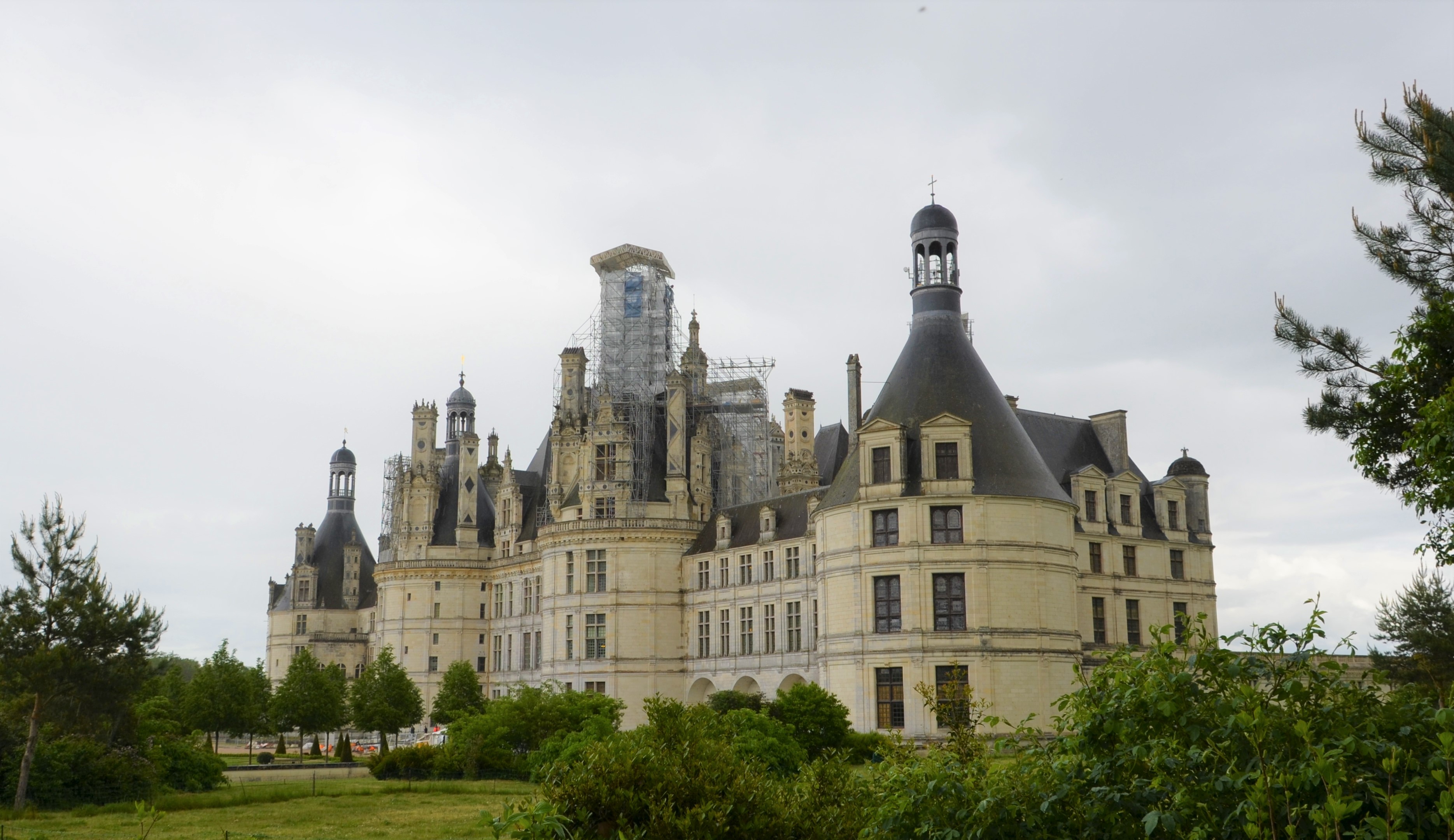
Architectural experts view Château de Chambord as one of the world’s marvels of engineering. Commissioned by François I in 1519 at the height of the Renaissance, this uniquely designed château was meant to glorify François and impress the world. Debate continues around who fashioned the magnificent edifice. But most agree it was a collaboration of Italian and French master artists, architects, and masons, including Da Vinci himself.

Château de Chambord Full View, Loire Valley, France: Donna's Gallery

The Château de Chambord website says of the design, "It is a remarkable architectural achievement that the king is proud to show to sovereigns and ambassadors as a symbol of his power engraved in stone. The plan of the castle and its decors stem from a central axis, the renowned double helix staircase, inspired by Leonard Da Vince, an ascending spiral leading to a profusion of chimneys and sculpted capitals on the terraces."

Château Lanter Tower: Donna's Gallery

Double Helix Stairway: Donna's Gallery

François never meant for the château to be a permanent residence and only lived there for a few weeks. Eighty years after his death, parts of the château fell into disrepair. King Louis XXXIII gave it to his brother Gaston d’Orleans, who instigated restoration work to stave off complete ruin.

Finally, characteristic of King Louis XIV, whose predisposition was to do everything in the most ostentatious manner, restored the great keep, furnished the royal apartments, and developed the extensive gardens. He also added a 1,200-horse stable, using the château as a hunting lodge and a place to give grand parties. Louis also invited Moliere to perform his premiere of Le Bourgeois Gentihomme at Château de Chambord.

Louis XIV Apartment and Bed Chamber: Donna's Gallery

Royal Carriage: Donna's Gallery

Royal Estate and Gardens: Donna's Gallery

In the eighteenth and nineteenth centuries, relatives of the Bourbons occasionally used the residence. The last was Henri, the Count of Chambord. Finally, in 1930, France bought Château de Chambord to preserve the castle as a “jewel” of the State, setting the stage for how the château became front and center as a repository for France’s great artworks during World War II.

Having observed the events occurring across Europe in the mid-1930s, the French feared German attacks and the loss of their most prized pieces. Paris museums organized an evacuation plan. On August 28, 1939, a convoy of trucks set out with 5,446 cases to deliver to the Chambord.

Film of the Return of the Mona Lisa to The Louvre, Château de Chambord, Loire Valley, France
Donna's Gallery

When France declared war, the public could no longer visit the château. But curators and custodians guarded the cache, ensuring its safety and preventing damage from insects and dampness. Though an American bomber plane crashed into the château, causing a fire, not one piece of art perished. After the war, the artwork was returned to the museums from which they were rescued in Paris, and the château was later renovated.

Rose Vallard Kept the Secret Cache of Artwork Hiden at Chambord: Donna's Gallery

By 1981, Château de Chambord became listed as a UNESCO World Heritage site. Today, Château de Chambord is open to the public and receives nearly two million visitors per year. Discover more about the Château de Chambord


Donna worked as a communications professional before turning to full-time writing. Her short stories, essays, and articles have appeared in various inspirational publications, and she has two indie-published Christian contemporary suspense novels in her Waldensian Series, Light Out of Darkness  and Undaunted Valor. 

Weaving history and faith into stories of intrigue and redemption grew out of her love of history and English literature as a young adult while attending the United World College of the Atlantic--an international college in Wales, U.K. She loves to explore peoples and cultures of the world and enjoys developing plots that show how God's love abounds even in the profoundly difficult circumstances of our lives. Her stories reflect the hunger in all of us for love, forgiveness, and redemption in a world that often withholds second chances.

You can find out more about Donna at www.donnawichelman.com.