As the economy improved with the onset of World War II, the FSA became less important while the need for collecting and disseminating information about the war became evident. The Office of War Information (OWI) was created, incorporating the FSA Information Division and various other offices, with the goal of informing the public about the war efforts and portraying the United States in a positive manner both domestically and overseas.
 |
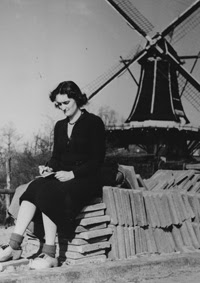
| Marjory Collins Photo Library of Congress Collection |
When she began her career in the 1930s, women magazine photographers were rare. Collins worked for such magazines as PM and US Camera, and her photos was represented by major agencies, including Associated Press and Time, Inc.
Shortly after the OWI was created in 1941, Collins joined the team of photographers hired to document home front activities of the war. According to the Library of Congress, Collins “created remarkable visual stories of small town life, ethnic communities, and women war workers.”
From January 1942 to June 1943, she took more than 3,000 photographs while on about 50 different assignments. Most of these are preserved in the FSA/OWI Collection in the Library of Congress Prints and Photographs Division.
 |
| Waiting for trains at Pennsylvania Station, New York City --Marjory Collins Photo Library of Congress FSA/OWI Collection |
For one assignment on women in industry, Collins was told to capture “representative types actually at work rather than posed 'cuties,'" and to show "the very important contribution made towards final victory and how they have adapted themselves to wartime conditions."
This was in contrast to another OWI objective of making wartime jobs seem glamorous to encourage more women to join the workforce. As a result, Collins received criticism from some of her fellow photographers, who wanted the OWI photographs to show only the positive aspects of American life.
One of Collins’ stories showed a young widow, whom Collins called “Mrs. Grimm,” and her six children under the age of twelve. Collins considered these images among her best work, as they portrayed “life as it really is.”
 |
| Patsy Grimm, age 6, dusting and Mary Grimm, 8, sweeping in the front room. Their mother, a 26-year-old widow, was a crane operator during WWII. Buffalo, NY --Marjory Collins Photo Library of Congress FSA.OWI Collection |
Collins left OWI in 1943 and went on to work as a freelance photographer in Alaska, Egypt, Ireland, Ethiopia, Kenya, Rwanda, and Italy for U.S. government agencies and the commercial press.
Sadly, she also married and divorced three times. In the third divorce, sometime between 1948 and 1950, her husband destroyed many of the prints and negatives from those years abroad.
Her OWI assignments had raised her social awareness. To support various causes, she became a writer and editor, as well as photojournalist. Throughout her life, she participated in such social and political causes as civil rights, Vietnam War protests, and women's movements.
Around 1970, she experienced ageism and sexism when she found herself out of a job and in need of an operation. To address the needs of mature women like herself, she founded Prime Time, the first magazine for older women. It continued until 1976 and reached a circulation of 3,000.
Collins continued to study women’s history and the role of older women in society until 1985, when she died of cancer at the age of seventy-three.
Historians consider the FSA/OWI collection one of the largest photographic projects ever. One researcher, referring specifically to the women, stated, “it can be argued that these socially conscious photographers used the camera lens and the darkroom to create images that reflected their opposition to racial, economic and gender discrimination, shaping their audience's perception as well as our historical view of injustice in American society.”*
Sources:
*Sharon Rodriguez, Women Photographers of the FSA and OWI
Marjory Collins Biographical Essay by Beverly Brannan, Women Photojournalists: Marjory Collins - Biographical Essay (Prints and Photographs Reading Room, Library of Congress)
Oral history interview with Roy Emerson Stryker, 1963-1965 | Archives of American Art, Smithsonian Institution | Archives of American Art, Smithsonian Institution
United States Office of War Information - Wikipedia
Oral history interview with Roy Emerson Stryker, 1963-1965 | Archives of American Art, Smithsonian Institution | Archives of American Art, Smithsonian Institution
United States Office of War Information - Wikipedia
Marjory_Collins - Wikipedia
Multi-award-winning author Marie Wells Coutu finds beauty in surprising places, like undiscovered treasures, old houses, and gnarly trees. All three books in her Mended Vessels series, contemporary stories based on the lives of biblical women, have won awards in multiple contests.
She is currently working on historical romances set in her native western Kentucky in the 1930s and 1940s. Her historical short story, “All That Glistens,” won honorable mention in the 2023 Saturday Evening Post Great American Fiction Contest. In her newsletter, she shares about her writing, historical tidbits, recommended books, and sometimes recipes.

Another historical short story tells of a cafe waitress who waits for the love of her life to come back to her after the war. “A Song for Annie,” is available free when you sign up for Marie's newsletter here.
Multi-award-winning author Marie Wells Coutu finds beauty in surprising places, like undiscovered treasures, old houses, and gnarly trees. All three books in her Mended Vessels series, contemporary stories based on the lives of biblical women, have won awards in multiple contests.
She is currently working on historical romances set in her native western Kentucky in the 1930s and 1940s. Her historical short story, “All That Glistens,” won honorable mention in the 2023 Saturday Evening Post Great American Fiction Contest. In her newsletter, she shares about her writing, historical tidbits, recommended books, and sometimes recipes.

Another historical short story tells of a cafe waitress who waits for the love of her life to come back to her after the war. “A Song for Annie,” is available free when you sign up for Marie's newsletter here.