By Nancy J. Farrier
 |
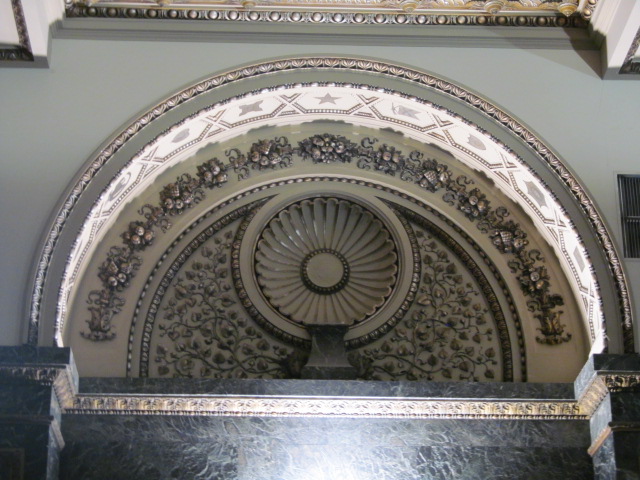
| Inset in Library Wall |
A few years ago I blogged about visiting Chicago Cultural Center and what a treat it was to visit there. I hope that posting this again will encourage someone to stop by on their vacation. If you're in Chicago, you will love seeing this hidden beauty.
 |
| Victor Hugo Quote |
The architecture is wonderful in Chicago. The old buildings
downtown are worth the trip to admire. While we were in Millennium Park, I
decided it might be worthwhile to go back up the street and see if we could take
a look inside the building that housed the old Chicago library. I told the kids
that sometimes the inside of old buildings can be even more beautiful than the outside.
Little did I know how true that statement would be.
 |
| Column Decoration Inset Glass |
After the Chicago fire of 1871, the first library, also a
cultural center, with a reading room containing 30,000 books, was destroyed. Not
long after the devastation of the fire Chicago began to receive book donations,
but had no place to house the volumes. For years, the library had only
temporary places to house their collection, which grew to 120,000 books by
1891.
 |
| Civil War Room Dome |
By 1893, the year of the Chicago World’s Fair, the Library
Board had selected a place for the new building, Dearborn Park. Due a conflict
in priorities, an unusual decision was made. The State Legislature had awarded
the American Civil War veterans part of Dearborn Park for a memorial. It was
decided to tax the citizens for the new building which
would house both the library and the Civil
War memorial. That way the building would belong to the people of Chicago.
 |
| Civil War Memorial Architecture |
The People’s Palace ended up having two different types of
architecture. The north side of the building, which houses the Civil War
Memorial, is inspired by Greek architecture, with military-influenced
decorations. Inside there are carvings of shields, swords, helmets and flags. The
designs were meant to remind the viewer of the loss that comes with war.
Everything is very somber, but breathtaking at the same time.
 |
| Wall Decoration Inset Glass |
The south side of the building, which housed the library, is
inspired by Roman architecture. The lobby has different types of marble, white
Italian Carrara marble, from the same marble used by Michelangelo for his
sculpture, and green Irish Connemara marble.
 |
| Inlaid Author's Names in Arch |
Throughout the hallways, staircases and rooms are decorative
touches of stained glass and mosaics done by the Tiffany Glass company. Inlaid
are the names of famous authors and quotes from many of them.
 |
| Tiffany Room Dome |
The room we enjoyed the most is now referred to as “The Tiffany Room.” The
decorations were all done by the Tiffany Glass Company and are incredible. The dome
is 38 feet in diameter and made of Tiffany Favrile glass. The wall sconces and
chandeliers were also made by Tiffany. The effect is dazzling, and it’s hard to
imagine reading in a room where you want to take in all the surrounding beauty.
 |
| Tiffany Room Dome Center |
 |
| Tiffany Room Dome Pattern |
There are quotes in ten different languages around the room;
Hebrew, Italian, French, German,
Greek,
Chinese, Arabic, Latin, Spanish, and Egyptian hieroglyphics. The archways in the
room have inlaid names of famous authors.
 |
| Tiffany Room Clock |
By 1915, cultural programs were a regular feature at the
library, and the building became a true landmark to Chicagoans. By the 1920’s
the number of volumes and visitors began to overwhelm the space. As early as
1930, discussion began about what to do about expansion or rehousing the library.
 |
| Tiffany Room Glass Decoration |
In the 1970’s the library was moved to other locations as
renovations began. At one point, the building was in danger of being torn down.
Due to the efforts of many people, including Mayor Richard J. Daley and his
wife, Eleanor, the building was placed on the National Register of Historic
Places and is now protected.
 |
| Steinway Piano in Tiffany Room |
Today, there are many cultural programs held in the south
end of the building that once house the library. My family and I attended a
free concert held in the Tiffany Room. The acoustics were beautiful making this a highlight of our trip. There were also several art exhibits
throughout the building. If you are ever in Chicago, take the time to visit
this incredible historic landmark.
Have you ever visited the Chicago Cultural Center? What 1800's buildings have you been inside and what impressed you about them? Have you ever seen Tiffany glass in a ceiling like this? I would love to hear your comments.
Nancy J Farrier is an award-winning author who lives in Southern Arizona in the Sonoran Desert. She loves the Southwest with its interesting historical past. When Nancy isn’t writing, she loves to read, do needlecraft, play with her cats, and spend time with her family. Nancy is represented by Tamela Hancock Murray of The Steve Laube Literary Agency. You can read more about Nancy and her books on her website:
nancyjfarrier.com.