Showing posts with label Christmas customs. Show all posts

Friday, December 9, 2016

Christmas on Chincoteague Island

By Tiffany Amber Stockton


Last month, we sloshed through the flood waters along the Delmarva Peninsula, and I shared a bit about Pony Penning Day still taking place even with the fairgrounds seeing water levels several nearly a foot deep! If you missed that post, you can read it here: http://www.hhhistory.com/2016/11/rains-are-still-pouring-down.html. This month, it's December, and I'm in a Christmas mood, so it's time for some island traditions.

CHRISTMAS ON CHINCOTEAGUE ISLAND

Voted the #1 beach town in America, Chincoteague Island might not seem like the place to go when the cold weather hits and temperatures start turning to freezing. But getting in the water isn't the only appeal about the beach. My family recently visited the island when gathering with family for Thanksgiving, and I decided it would be a great time to take my children there to showcase some of their family heritage. Here is a photo of the two of them posing in front of the movie theater with Misty of Chincoteague's footprints in cement.

Second only to the annual Pony Penning Day festivities at the end of July each summer, the holiday season has been next best time of year to visit Chincoteague Island for generations. The average air temperature in December is about 50 degrees with sunny skies. Just imagine yourself, in a cozy warm sweater, listening to the laughing gulls while walking along the beach to the rhythm of the ocean waves, gathering shells and driftwood for holiday ornaments.

That's what residents of the island have been doing for over a century, and even today, they invite visitors to join them in the casual and traditional fun. You can experience a beautiful sunset at the dock just like thousands of others before you, and when it disappears on the horizon, you can savor a bowl of clam chowder with warm bread, or feast on roast turkey and oyster stuffing.

The day after Thanksgiving became the start of this holiday season back in 1925 with what is now the annual lighting of the town Christmas tree. Not long after, the island theater began showing It's a Wonderful Life, and that tradition continues today. Residents and visitors alike gather in the historic theater every year to enjoy this classic film on the big screen. Have you ever watched this film?

What Christmas festivities are complete without a good old-fashioned parade? Chincoteague Island does it up in style! Complete with marching bands, floats, color guard, fire department companies from around the area, Saltwater Cowboys, and of course Santa Claus with his "reindeer" ponies leading his sleigh. :) For many years, this parade also paid homage to the sea by featuring King Neptune and his Mermaid Queen. More recently, this tribute was left out of the parade, but it is seeing a return this year...back by popular demand.

Another big event is the annual Holiday Treats Sale, where everyone is invited to sample treats and goodies baked by island residents and sold, with the profits benefiting a charity of choice each year.

The second is the Children's Tea Party with Mrs. Claus, where Mrs. Claus and a select group of her favorite elves show the children a scrapbook of her life with Santa. She offers a sing-a-long of Christmas songs, games, and gifts. After the children have had their hot cocoa, kid-sized sandwiches, and Christmas cookies, they have an opportunity to have their photo taken with the Queen of the North Pole. From black-and-white treasures to the more modern digital captures, this tradition has long been enjoyed by children for decades.

Christmas Eve is celebrated with a breakfast offered to anyone on the island and a traditional candlelight service in the evening. Christmas morning is shared with families and friends in the many homes on the island, but you might also find some taking a peaceful stroll along the beach and enjoying a silent night.

The island rounds out the holidays with the annual Pony Island Horseshoe Drop. It's not made of Swarovski Crystals, but it's lighted and it sure does sparkle! And what's more invigorating than starting your new year with a plunge in the frigid waters of the Atlantic Ocean? That's right. It's called the Polar Pony Plunge, and in recent years, it's been commemorated with t-shirts and other souvenirs to brag about your feat!

So, if you want to be part of the festivities and traditions, bring your camera to capture everything, dress warm, wear a hat and gloves for sure, and comfortable shoes so you can shimmy and dance to the musical beats, but most importantly; bring family and friends with you to enjoy the grand fun that is all Chincoteague!


NOW IT'S YOUR TURN:

* What are some traditions in your own home that have survived generations in your family? What is a new tradition developed by you with the current generation?

* Have you ever experienced a small-town Christmas? If so, where? What were some of the unique things that took place?

* What is your favorite part of the Christmas season?

Leave answers to these questions or any comments on the post below. Next month, it's a new year, and I haven't yet determined my new theme for the year. Come back on the 9th of January to find out more.


BIO

Tiffany Amber Stockton has been crafting and embellishing stories since childhood, when she was accused of having a very active imagination and cited with talking entirely too much. Today, she has honed those childhood skills to become an author and speaker who has partnered with Nerium International in the anti-aging, wellness, and personal development industry, helping others become their best from the inside out.

She lives with her husband and fellow author, Stuart Vaughn Stockton, in Colorado. They have one girl and one boy, and a Retriever mix named Roxie. She has sold twenty (21) books so far and is represented by Tamela Hancock Murray of the Steve Laube Agency. You can also find her on FacebookTwitterPinterest, and LinkedIn.

Sunday, December 4, 2016

Light That Tree


While researching the availability of electric lights for a story set in 1890 America, I came across a reference to a letter from Montana pioneer Elizabeth Chester Fisk who wrote to her parents on December 29, 1891 that " . . . we lit the tree using electric lights. The effect was good and we had no candles to watch and no wax drippings to clear from the carpet or gifts." (Travers, Sam. Christmas in the Old West, Missoula, MT: Mountain Press Publishing Co., 2003. Page 155. ISBN 0-87842-460-1)

Electric lights on a Christmas tree in 1891? Clearly, this needed investigating. What I found was that Christmas lights back then were a lot more complicated that just looking for one burnt out bulb in a string. Check out this photo from GE Reports.


A box of GE Christmas tree lights from 1905. Image credit: The Schenectady Museum of Innovation and Science.

My research led me to Mr. E. H. Johnston, President of the Edison Company for Electric Lighting, who was the first person to use electric lights on a Christmas tree when he lit his 1882 tree with 120 globes of different colors. He then attached them to a dynamo, or crank, in the cellar which caused the tree to revolve, delighting his children and people who passed his window. Read the detailed newspaper article written about it here. (In and About the City: How an Electrician Amused his Children". New York Times. December 27, 1884. Retrieved July 17, 2015)


Early GE Christmas tree lights advertisements. Image credit: Museum of Innovation and Science Schenectady. Courtesy GE Reports
The White House tried them out in 1894 when Frances Cleveland decorated the library tree with "Tiny parti-colored electric lamps instead of the old-time wax candles." (Courtesy wikipedia.)

I've read that the public was leery of them and stuck with candles despite the fire danger, but the site Envisioning the American Dream has the explanation that it was due to cost and practicality. It shows that when the first General Electric (GE) Christmas light set came out in 1903, it cost $12, while at the time, the average wage earner brought home a weekly paycheck of about $13.20. 


And you couldn't just plug them into a socket like we do today. Back then, all electric appliances like toasters, irons, and extras like Christmas lights had to be connected to an existing wall or ceiling light socket, like you see in the above ad. Sometimes you had to choose between the light, or the appliance in the dark. 


Edwardian Drawing Room. Courtesy of The Cambridge Historical Society, Cambridge, MA

Can you see how the table lamp is hooked up to the ceiling light in the above photo? It kind of stands out, doesn't it?

I couldn't find a photo of an interior White House Christmas tree, but here's one of President Calvin Coolidge illuminating the community Christmas tree south of the White House on the Monument Grounds on December 24, 1923. Courtesy the Library of Congress National Photo Company Collection.

President Coolidge illuminating the community Christmas tree south of the White House on the Monument Grounds on December 24, 1923. Courtesy Library of Congress

Over the years there have been many different colors and shapes of bulbs to pretty your tree. Here are some of the earlier ones, courtesy of GE Reports.


Several shapes and colors of GE lights, 1910. Image credit: The Schenectady Museum of Innovation and Science.

By 1916, the price of Christmas lights had decreased by half, followed by another large cut in the 1920s which finally made them affordable to everyone. 


1916 Sears Roebuck and Company catalogue 

There have also been numerous other lighted decorations, such as these tree stands...


1926 3-Bulb Belmont Treeliter Metal Christmas Tree Stand sold by Etsy


1936 NOMA Lithographed Tin Lighted Tree Stand sold by Etsy

The tree stands look like they would highlight the tree wonderfully from the bottom up since the middle is usually the darkest part. However, the thought of water leakage onto the unprotected wires gives me the willies. Death by fire or electrocution? 


1904 General Electric advertising

I've steered clear of the technical aspects of electricity, however if you're really interested, check out the links I've scattered throughout this post. Whether or not you celebrate Christmas with a tree, I hope you've enjoyed this short walk through the brightly lit world Thomas Edison gave us. 

I'd love to hear your thoughts and memories of old Christmas lights, or any other decorations of days gone by. 


~~~~~~~~~~~~~~~~~~~~

Anita Mae Draper's historical romances are woven under the western skies of the Saskatchewan prairie where her love of research and genealogy yields fascinating truths that layer her stories with rich historical details.  Anita's short story, Here We Come A-Wassailing, was a finalist for the Word Guild's 2015 Word Awards. Her novellas are included in Austen in Austin Volume 1, and The American Heiress Brides Collection. Readers can check out Anita's Pinterest boards for a visual idea of her stories to enrich their reading experience.  Discover more at:


Thursday, December 1, 2016

The Star of Castle Rock - A Community Symbol of Hope


Blogger: Amber Schamel


Castle Rock in 1917
Most of my growing up years were spent in the vicinity of Castle Rock, Colorado. This is a quaint town along the I-25 corridor between Denver and Colorado Springs. The town is named after a large rock structure that is visible for some time before and after you drive through the town. To me, it never quite looked like a castle, but apparently to the early settlers, it did.

Around this time of year, one of the things that my siblings and I looked forward to the most was seeing the Christmas star shining from the top of Castle Rock. As we were driving, we'd always watch for it to come into sight. The star is quite an icon for the community, but until recently, I didn't know the interesting history behind it.

During the height of the Depression and Dustbowl, the community around Castle Rock, Colorado was desperate. Besides the terrible economy, there was also a drought. Out of work and watching their crops dry up and the soil blow away, the farmers in the area were losing hope. In 1936, community leaders in Castle Rock came up with a plan to give the town a boost. They would build a huge star and light it up for all to see, which would hopefully draw the attention of travelers and bring more business to the area.


The man who owned "The Rock" happily donated the portion of land for the giant star to set on. The people of the community pulled together to make the project happen. The Town Council donated the funds for the material, the design was drafted by the Works Progress Administration, and local businesses supplied gas and electrical work. The work on the Castle Rock star had begun. 

The most difficult part of the project was tackled by the Volunteer firemen. The Castle Rock was 290 foot tall at the time and there was no road or trail. The men lugged forty foot steel rods to the top and welded them together. The local electric and telephone company donated the poles and wire to run electricity to the top. 

Castle Rock Star - 1940
Photo
Courtesy of the Douglas County
History Research Center used under Creative Commons
At last, the star was finished. At forty-five feet tall with almost 100 light bulbs, the star would shine from 5pm to midnight throughout the Christmas season. This tradition carried on from 1936 until 1940, but in 1941, the hope that shined forth from that star was challenged again.

As the United States committed every resource to the efforts of WWII, the rationing of electricity extinguished the star of Castle Rock, though the structure remained. Even during its dim years, the star symbolized the sacrifice of a community for the war effort.

Finally, on August 14,1954, the war was over. That night, the community transformed the star and lit it up in a giant "V" as the people celebrated victory late into the night. 

In 1965, new community leaders began a star lighting ceremony. This ceremony has been an intricate part of the Castle Rock community ever since. Multiple times it has been threatened by energy crisises and community hardships, but it has stood the test of time. 
Photo by Jeff Albright


This year is the star's 80th birthday.  It is lit the week before Thanksgiving and stays illuminated until after the National Western Stock Show. 


To me, the star represents hope and the strength of a community when we work together. Does your community have a symbol like this? I'd love to hear about it!


*****

Author of over half a dozen books, Amber Schamel writes riveting stories that bring HIStory to life. She has a passion for travel, history, books and her Savior. This combination results in what her readers call "historical fiction at its finest".  She lives in Colorado and spends half her time volunteering in the Ozarks. Visit her online at www.AmberSchamel.com/ and download a FREE story by subscribing to her Newsletter!

Wednesday, December 2, 2015

Christmas Kisses: The Kissing Bough in Jane Austen's England

The mistletoe hung from the castle walls,
The holly bough hung in the old oak hall
And the Baron’s retainers were blithe and gay,
All keeping their Christmas holiday…
        -Thomas Bayly (1797-1839), “The Mistletoe Bough

During the time of England's Jane Austen (1775-1817), Kissing Boughs had been around in one form or another for centuries. In the Middle Ages (and perhaps even further back, to pagan observations), households in Britain hung evergreen boughs or sprigs in public rooms such as the hall or entry during the winter months. Visitors and the master of the house could declare a truce or embrace under the bough in a symbolic gesture of benevolence and goodwill--with a symbolic kiss of peace.
Reproduction of a Georgian Kissing Bough hung in the kitchen of Fairfax House in York

As time went on, however, something changed. The kisses exchanged beneath such boughs took on new meaning, so that by Austen’s day, the Kissing Bough offered a socially acceptable excuse for young couples to engage in flirtation. 


Hung by a ribbon from a chandelier or door frame, a Kissing Bough could be as simple as a sprig of mistletoe or as complex as the greenery-wrapped wire sphere a-flutter with ribbons many of us are familiar with. In a wealthy household, the Kissing Bough might even include paper decorations, apples, and candles--or even dolls of the Holy Family, like a Nativity set.

Traditions may have varied by region. Some households used berry-laden mistletoe, so that a gentleman might pluck a berry from the bough whenever he stole a kiss. When the berries were gone, the time for kissing was over. It was also believed to be bad luck for a lady to refuse a kiss.

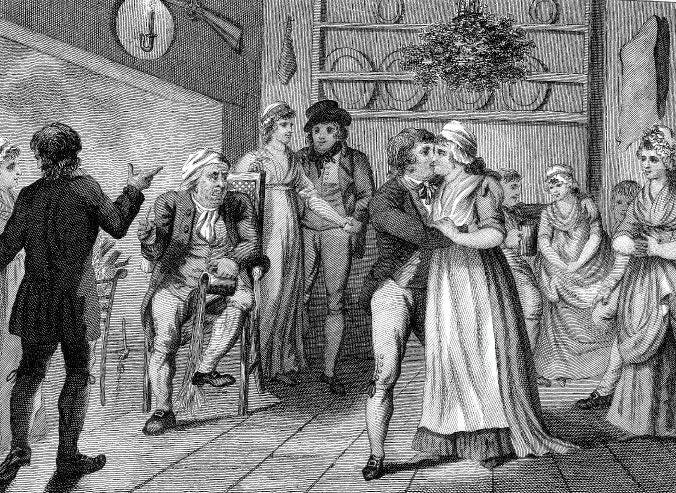
And just who did the kissing? Some sources (such as Washington Irving) claim only servants or the lower classes engaged in such revelry. The image below depicts a chimney sweep making an overture at a maid.

The YOUNG SWEEP giving BETTY her CHRISTMAS BOX, 1770-1780, Winterthur 1973.0584:
"The Young Sweep Giving Betty Her Christmas Box" circa 1770, Bowls and Carver
It seems, however, many upstairs folks enjoyed merrymaking under the mistletoe as well, depending on the family. 
Mr. Fezziwig's Ball by John Leech in Dickens' A Christmas Carol. Note the handheld mistletoe being put to use on the left. 

Sometimes, members of the household participated in crafting the Kissing Bough and other holiday décor, while others relegated the task to servants. Greens used in the bough’s construction included holly, ivy, pine, hellebore, and, of course, mistletoe—not all of which grow throughout England. These items were traded from one district to another during December (note the holly in the donkey cart below).

Mistletoe, however, seems the most crucial ingredient in a Kissing Bough. Reasons for this are unclear, although in several European countries, mistletoe was reputed to contain the power to heal or ward off misfortune. In Celtic, mistletoe is literally called “all-healer.”

Once completed, the bough would be hung on Christmas Eve, and would remain in place through the Twelve Days of Christmas. On the Feast of the Epiphany, January 6, boughs were promptly removed to the outdoors, lest they bring bad luck into the home.

Kissing boughs declined in popularity after the introduction of Christmas trees to England, but they still serve a festive purpose in many a household, within Britain and without.

WHAT ABOUT YOU?

Will your home boast a Kissing Bough this year? Mine will...it's artificial, but it hangs in the entry hall!

**

ABOUT SUSANNE:

Susanne Dietze began writing love stories in high school, casting her friends in the starring roles. Today, she’s a Genesis Award winner and author of four novellas. Her most recent is included in The Most Eligible Bachelor Collection. Married to a pastor and the mom of two, Susanne loves fancy-schmancy tea parties, travel, and curling up on the couch with a costume drama and a plate of nachos. You can visit her on her website, www.susannedietze.com.

Wednesday, December 17, 2014

CHRISTMAS CUSTOMS IN 17TH CENTURY FRANCE

By Golden Keyes Parsons
My first series, Darkness to Lightis based loosely on my ancestors and takes place in 17th century France. The Clavell family escaped the religious persecution under Louis XIV and eventually came to this country, settling in Pennsylvania. I thought it would be fun to take a look at the Christmas customs which were being celebrated in 17th century France and how they have developed through the years. 
In France, Christmas is called Noel. This comes from the French phrase les bonnes nouvelles," which means "the good news" and refers to the gospel. On Christmas Eve, children leave their shoes by the fireplace to be filled with gifts from Pere Noel. In the morning they also find that sweets, fruit, nuts and small toys have been hung on the tree.
santonsNearly every French home at Christmastime displays a Nativity scene or creche, which serves as the focus for the Christmas celebration. The creche is often peopled with little clay figures called santons or "little saints." In addition to the usual Holy Family, shepherds, and Magi, the craftsmen also produce figures in the form of local dignitaries and characters. This came about because in the late 18th century the new revolutionary government outlawed religion. The traditional creche was forbidden. The creative French peasants came up with the solution of molding clay figures, dressed in the different occupations of the country and used in place of the traditional figures of the Christ Child, the wise men and the shepherds. The craftsmanship involved in creating the gaily colored santons is quite astounding and the molds have been passed from generation to generation since the 17th century.
The French also make a traditional Yule log-shaped cake called the buche de Nol, which means yule_log_cake"Christmas Log." The cake, among other food in great abundance is served at the grand feast of the season, which is called le reveillon. Le reveillon is a very late supper held after midnight mass on Christmas Eve. The menu for the meal varies according to regional culinary tradition. In Alsace, goose is the main course, in Burgundy it is turkey with chestnuts, and the Parisians feast upon oysters and pat de foie gras. Le Revellion may consist of poultry, ham, salads, cake, fruit and wine.
yule-log2_s600x600 My ancestors were from Southern France around Grenoble where the burning of the Yule Log was very popular. Families would burn yule logs continuously from Christmas Eve to New Year's Day and once the new year came, a part of this log was used to make the wedge for the plough as a good luck omen and plenty of harvest in the coming year.
I wish I had something from my ancestors Christmas celebrations, like a creche or some of the little clay figures, but if anyone in my family has any of those treasures, I have no knowledge of it. I am reminded to thank God for His faithfulness through the generations. Who knows where we would be if it were not for the faith of our forefathers? Blessings to all for a very Merry Christmas!
Golden Keyes Parsons writes historical fiction, and is also a popular retreat/conference speaker. Her highly acclaimed Darkness to Light Series (Thomas Nelson) chronicled the journey of her French Huguenot ancestors in 17th century France. Her fourth novel, His Steadfast Love, is a Civil War novel set in Texas. Her latest release is a compilation of four novellas (WhiteFire Publishing) – a biblical fiction series entitled Hidden Faces, Portraits of Nameless Women in the Gospels. Golden lives in Waco, TX, with her husband, Blaine, where they enjoy their children, grandchildren and are avid sports fans of their alma mater, Baylor University. You can contact her at www.goldenkeyesparsons.com.


Friday, December 20, 2013

Christmas without Christmas Cookies? Bah humbug!

Debbie Lynne here again! Merry Christmas!

Sometimes I get in this mindset where I feel like something has always been. Christmas cookies are one of those things. I mean can you imagine Christmas with out candy cane sugar cookies or gingerbread men all decked out with frosting? 

By Gandydancer - Own work, CC BY-SA 3.0, https://commons.wikimedia.org/w/index.php?curid=24750543

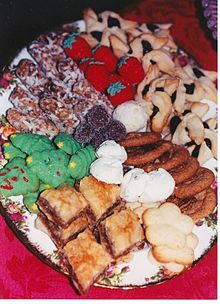
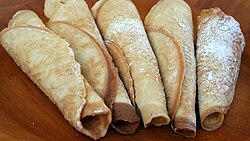
Christmas cookies can be traced all the way back to Medieval times. Cookie origins comes from Medieval Europe biscuits.  Lebkuchen, also known as gingerbread, was probably the first cookie to be traditionally related with Christmas. By the 1500's cookies had spread across all of Europe. Different cookies were popular according to geographics. Germany favored Lebkuchen, while papparkakor  (spicy ginger and black-pepper delights) was popular in Sweden and krumkake (thin lemon and cardamom-scented wafers) was the preferred cookie in Norway.

Krumkake
By Jonathunder - Own work, CC BY-SA 3.0, https://commons.wikimedia.org/w/index.php?curid=8043761

The Dutch are attributed with bringing the Christmas cookie to United States early in the 17th century. But when did those cute little gingerbread men, candy canes, and Christmas tree cookies come around? In the late 1800's to early 1900's when import laws changed, Germany began importing inexpensive products, such as cookie cutters, to the United States. Different from homemade types and the tinsmith's wares, these cutters were highly stylized images. They were originally sold to hang on Christmas trees, but because of their availability cookbooks began adding recipes designed to use them.

 I thought I'd leave with you a simple, but yummy shortbread cookie since my family tree has been traced back to Medieval Scotland. Here is the Scottish Shortbread recipe. Enjoy!

Cream together:
3/4 cup butter (you must use real butter)
1/2 cup sugar
2 cups all purpose flour

Put into cake pans or a small jelly roll pan and press down with your hands to 1/2". With a fork, prick all over making sure the fork hits the bottom of the pan.

Bake for 10 minutes at 350. Reduce the heat to 300 and continue cooking for 40 more minutes (or until lightly brown. Do NOT overcook). Wait 2 minutes then cut into finger size bars. Cool thoroughly in pan.

Debbie Lynne Costello is represented by Tamela Hancock Murray of the Steve Laube Agency. She attended Heritage University, where she studied Journalism and worked in the editing department. She has completed five full length novels set in the Charleston, SC and Savannah, GA area in the late 19th century and is now seeking homes for them.
She and her husband have four children. They live in upstate South Carolina with their family. In her spare time, she sews, paints, knits, camps (in a fifth wheel) and plays with the grandbabies.
WEBSITE: www.debbielynnecostello.com BLOG:  www.theswordandspirit.blogspot.com BLOG: www.fictionaddictionfix.blogspot.com 


Pictures from Wikipedia
  

Tuesday, December 17, 2013

CIVIL WAR CHRISTMAS

When I was writing a Christmas scene into my Civil War novel, His Steadfast Love, I began to wonder how many of the Christmas observances we celebrate today would have been celebrated by my characters. What I found was many of the Christmas traditions we practice today were in place by the time of the Civil War--Santa Claus, the Christmas tree, mistletoe, gift giving--but it was the Civil War that, strangely enough served as a catalyst to meld it into a national holiday.

Just as the populace was varied in cultures in our nation, the various traditions came from differing cultures. Santa Claus was originally a Turkish bishop; the Dutch brought hanging of the green; the Christmas tree was originally a German custom brought to Virginia by a German immigrant. The Scandavians introduced the mistletoe "kissing ball" to us.

In 1861 as the war was just beginning, the first Christmas for the Confederates was a relatively celebratory
time. The South was faring well in the conflict. Neighboring farmers took meals of turkey and minced pie to the men in the field. The soldiers held greased pig chases. The bands played, and the troops fired their guns into the air. Boxes from home arrived with woolen socks and mufflers.

By 1862, the cost of food had skyrocketed, so the men in the field didn't get the generous portions of meals as they did the year before. Even the cost of coffee had risen to the point of being almost prohibitive. There was widespread drunkenness among the troops. The men were missing home. They'd watched many of their friends die. They were ready for the war to be over. Children were afraid that Santa Claus would not be able to get through the blockades. Most of the gifts were handmade and were for the children.

When the Christmas of 1863 rolled around, the price of a turkey had risen to $100. Eggnog was $100 a gallon. The men were growing glum finding very little to celebrate. The visions of home with family around a Christmas tree, a cracking fire, stockings hung on the mantel, waiting for Santa Claus, tables laden with lavish feasts and drink served to seal the memories of Christmas into a vivid reality.

The last Christmas of the Civil War in 1864 dawned upon a weary nation. General Sherman had recently taken the city of Savannah, which he presented to President Lincoln as a Christmas present.

In June of 1870, Christmas was officially made a national holiday largely due to the sentiment of the men returning to their homes after the Civil War with their longing for the warmth of family and home.

Aren't we blessed that as we approach this Christmas season and celebrate the birth of our Savior, the Lord Jesus Christ, our nation is free. The War Between the States was a horrible conflict of brother against brother. May it never happen again.

Visit my website at www.goldenkeyesparsons.com and Merry Christmas!