by Kathleen L. Maher
Who remembers grabbing a handful of wooden clothespins from their mom's or grandmother's apron, maybe even directly from the clothesline, and making an
afternoon of fun? So many possibilities beckoned in the almost-human form of these common wooden pegs. With some imagination, a whole army of soldiers could be made--a little red and blue paint, hats made of black yarn pompoms, and Hoozah, you'd have a proper British infantry. Or with a flourish of scrap material and ribbon, a dress for a miniature wooden lady. Of course when mother went looking for her clothespins, the party scattered as you scrambled to return the purloined laundry staples to their rightful place.
A pleasant and seemingly ever-present part of my earliest memories, clothespins summon moments of helping mom and sisters hang the wash, or evoke visions of my grandmother's kitchen towels drying on her square aluminum backyard laundry pole. They are inextricably linked in my mind and heart to simpler times, like the aroma of cinnamon and coffee on a Sunday morning, or the refrain of the music of my childhood.
A bit of sleuthing led me to discover their likely origins. The fascinating fact is that these pins have been around since at least the 1700’s in their simplest
form, the one-piece wooden pin with two prongs and a knob at the top, created by the Shaker community. More interesting history involves the Romani folk, or Gypsies, who made them out of hickory, ash, or willow branches and sold them throughout the 19th and into the 20th centuries. Sometimes with a metal clasp, and sometimes without.
The laundress heroine in my Civil War novel The Chaplain’s Daughter
would have draped wash over bushes or low tree branches, or utilized lines strung in the army camps, but she very well could have had a form of clothespin at her disposal. The first recorded patent for the clothespin or clothes peg was in 1809 by Jeremie Victor Opdebek, and the first American patent on a slightly improved version was taken out in 1832. Louisa May Alcott in her beloved novel LITTLE WOMEN references a clip which her character Meg uses on her nose, ostensibly to make it pert and dainty. So these Small laundry hanging tools appear to be in common use at least through the 1800’s.
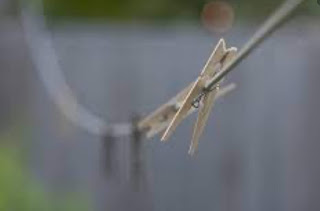
In 1852, a patent for the two-piece laundry clip emerged, utilizing a small connecting wire and spring. This invention is attributed to Vermont violinist David M. Smith, who credits the soothing creativity of his instrument playing with solving everyday challenges, such as safeguarding clean clothes from the wind scattering a hard days work over muddy fields. This version of the clothespin has enjoyed great popularity and slight changes for 170 years. Sometimes made from plastic instead of wood, it seems its wooden origins are experiencing a revival with the eco-friendly consciousness of this generation.
In 1887, another Vermonter, Salon E. Moore, added the ‘coiled fulcrum’ to Smith’s design. Vermont suddenly became the clothespin manufacturing capital of the world, cranking out tens of thousands of these indispensable laundry aides every day.
What about you? Do you still hang your wash, or have you succumbed to the ease of modern conveniences such as the tumble dryer? CONTEST Share your answer or a favorite memory involving clothespins/washday in the comments for a chance to win an e-copy of one of my Civil War novels, or a $5 Amazon gift certificate. Winner drawn Friday Jan 10 by 8 pm eastern.

Kathleen L. Maher’s first crush was Peter Rabbit, and she’s had an infatuation with literary heroes ever since. Her most recent novella, "Something Old, Something New’ released October 2019 in Barbour’s school teacher romance collection LESSONS ON LOVE. Her indie Civil War series Sons of the Shenandoah includes Genesis Award winner THE ABOLITIONIST’S DAUGHTER (2018) and THE CHAPLAIN’S DAUGHTER (2019). Another Barbour novella collection, VICTORIAN CHRISTMAS BRIDES (2018) included her story "Love Brick by Brick" which showcased her hometown history. Kathleen and her husband raised their three children and a small zoo of pets in their upstate New York historic farmhouse.
Visit Kathleen at
https://www.bookbub.com/profile/Kathleen-l-Maher
Https://www.goodreads.com/author/show/7074205.Kathleen_L_Maher
Https://www.facebook.com/KLMaherAuthor/


