Showing posts with label log cabin. Show all posts

Tuesday, June 10, 2025

Colonial Log Cabins in the South

by Denise Weimer

The first structure a settler hastily constructed at a Colonial- or Federal-era homestead site in the Southeast was usually a log cabin. Georgia woods used for this purpose included hardwoods, poplar, pine and cyprus, with cyprus more common in South Georgia. Settlers from Georgia’s Piedmont up to the Appalachians mostly used pine. Sometimes a settler might use poplar, which was lighter and easier to square, for the main beams, and pine for the rest of the house.

Basic cabins were built quickly, usually with a dirt floor and a clay-over-log chimney. The outside of the logs might even be left rounded with the bark still on. Size of a cabin could range from 15x12 to 30x18. 16x20 was also common. Suitable trees longer than twenty feet were difficult to locate, transport, and handle.

Log houses featured a more permanent design. The logs were hewn square or "skelped" with a broad axe and adze and notched with a crosscut saw. The chimney would be brick or stone. Later, an addition, or second "pen," could be built on the end of the house opposite the chimney. The breezeway connecting the two sections was called a dogtrot. Lots of work and living went on in that covered but cooler section.

The Elijah Clarke house shows double pen design.

Since log houses and cabins were made of untreated, air-dried wood, the logs would shrink as the house settled. The spaces were chinked...packed with a mixture of straw and mud or clay, or clay, sand, and horse hair. In places where the gap between logs was too large, sticks could be wedged in prior to chinking. Raised foundation construction helped keep the wood dry and reduce rot and insect damage.


Carefully crafted notches were cut at the corner of each log, thus eliminating the need for nails. Nails were costly and heavy to transport to the construction site. When notching, a settler could choose between several styles: saddle, half dove tail, and full dove tail. The saddle notch was mostly used by Cherokee and Creek Indians, while European settlers favored the other styles because they locked the logs more firmly in place. Half dovetail notches were the most stable.

Cabin floors were often swept dirt or sand. If a constructed floor existed, it might be made of hewn and hand-split planks which were pegged to the floor joist. The earliest type of flooring that appeared in log construction was known as puncheon. Logs were split in half with flat side up. Puncheons were short, thick, split or hewn-log pieces of timber roughly finished on one or more surfaces and laid directly on the ground. As time went on, puncheons were replaced by 1¼”–thick boards, tongue-and-grooved and planed by hand.

Hand-cut shakes of oak or chestnut composed the roof. In cold weather, animal skins or wooden shutters on wooden or leather hinges covered the windows.

Log cabins abound in my Colonial- and Federal-era stories, The Witness Tree, Bent Tree Bride, and The Scouts of the Georgia Frontier Series.

Denise Weimer writes historical and contemporary romance from her home in North Georgia and also serves as a freelance editor and the Acquisitions & Editorial Liaison for Wild Heart Books. A mother of two young adult daughters, she always pauses for coffee, chocolate, and old houses.


Connect with Denise here:

Monthly Newsletter Sign-up

Website

Facebook

Twitter

BookBub


Wednesday, November 6, 2019

The Mysterious Walker Sisters of Gatlinburg, TN

By Michelle Shocklee


My husband and I recently visited the Great Smoky Mountain National Park. Considering I'm a Rocky Mountain Girl -- born and raised in Santa Fe, New Mexico, with the Sangre de Cristos out my back window -- I must admit the Smokies are bee-u-ti-ful! Factor in glorious autumn colors, chilly weather, and a snuggly sweater, and I'm pretty much in paradise!

One of the most fascinating tidbits in the park, however, has nothing to do with the beauty or the changing leaves. It has to do with a family named Walker who called these mountains home in the 1800s and 1900s. When the government came knocking on their cabin door in the 1930s, with plans to create a national park that included their property, well, let's just say the Walkers weren't too keen on the idea.

Let me tell you a little tale about a dream, a cabin, and some mysterious sisters...
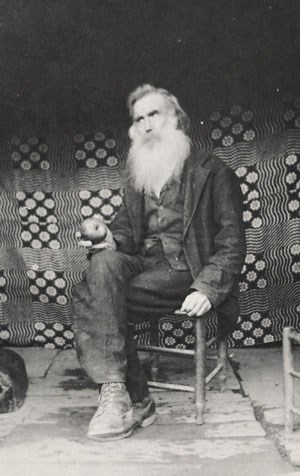
John Walker sits on a wooden chair with an apple in his hand
John Walker, father of the Walker sisters
During the Civil War, a young man named John Walker fought for the Union Army and was even captured and held prisoner. He survived, and after the war ended John married his sweetheart, Margaret Jane King, whose family came from Little Greenbrier, an area near present-day Gatlinburg, Tennessee. He purchased property from Margaret's father that already had a cabin on it, the original section built in the 1840s and the larger two-story section built by Mr. King in the 1850s.  Being a very industrious man, John built a barn, corn crib, smokehouse, pig pen, apple barn, and blacksmith shop. A spring-house situated on a nearby creek kept dairy products such as milk and butter cool throughout the year, as well as provided storage room for pickled root vegetables. John was also a skilled carpenter and crafted ladderback chairs, looms, tools, and a small cotton gin. He planted orchards that included more than 20 kinds of apples, as well as peaches, cherries, and plums. Chickens, sheep, goats, and hogs were all raised on the farm. 

In the midst of all this building and settling, Margaret gave birth to eleven children -- seven girls and four boys. All eleven children survived into adulthood, a feat not many families could boast back in those days. The boys grew up and left home, but only one sister--Sarah Caroline--married. The other six sisters remained unmarried "spinsters" and lived out their lives in their childhood mountain home. 
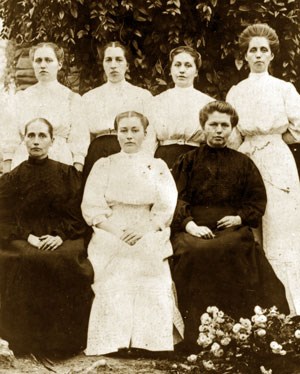
The seven Walker Sisters: Front L-R: Margaret, Louisa, Polly.
Back L-R: Hettie, Martha, Nancy, & Caroline.
Photo: Jim Shelton, 1909

John Walker was 80 years old when he passed away in 1921. His six unmarried daughters, as well as his youngest son Giles, inherited the property. One of the sisters, Nancy, died ten years later, and Giles deeded his share over to his remaining sisters. For the next 43 years, the five Walker sisters would make a name for themselves in the community--and in the public's eye--as hardworking, if not odd, mountain women. Instead of looking to modern-day conveniences, they did all the farm work themselves, including tending livestock as well as a huge garden that provided their food for years. They raised sheep and washed, carded, spun, and wove the wool into clothing. Cotton and flax were also grown on the farm, and the sisters produced their own textiles using the cotton gin their father had built.  Following in their mother Margaret's footsteps, the daughters also kept a herbal garden for mountain remedies, including horseradish, boneset, and peppermint for healing teas. Natural plants in the forests were collected, too. One of the sisters was quoted, saying, "Our land produces everything we need except sugar, soda, coffee, and salt."

Martha and Hettie on the porch; Louisa churning butter
But their little chunk of paradise was threatened when the US Government decided to create what is known today as the Smoky Mountain National Park. The states of Tennessee and North Carolina were given permission by Congress to begin raising money to purchase nearly a half million acres for the park, most of which was privately owned. Parcels of land collected from families and timber companies alike were bargained for, haggled over, and eventually purchased. Refusing to leave their 122-acre mountain home, the sisters held out until 1940. Once the park was officially dedicated, the sisters struck a bargain with the government: they received $4,750 for the land WITH the stipulation that they could live out their lives in their home.

Living in the national park, however, meant their daily practices of hunting and fishing, cutting wood, and grazing livestock were now prohibited. The sisters were forced to find a new lifestyle in order to survive. People from all over the country flocked to the park and visited what became known as "Five Sisters Cove". The Walkers welcomed the curious newcomers and saw them as an opportunity to sell handmade items such as children's toys, crocheted doilies, fried apple pies, and even Louisa's hand-written poems.The sisters were even featured in the Saturday Evening Post in April 1946, showcasing their mountain lifestyle to the rest of the country.


The Walker Sisters Cabin (notice the stone steps are still there!)

Over the next few years, the sisters began to die off. In 1951, with only two sisters remaining--Margaret, 80, and Louisa, 70-- they wrote a letter to the park superintendent asking that the "Visitors Welcome" sign be taken down. Margaret passed away in 1962 at the age of 92, and Louisa remained in the house alone until she died in July 1964.


Today, the homestead is a quiet place, tucked way back in the woods, a mile from the old Little Greenbrier school house that John Walker helped build in 1881. The old spring house greets you as you arrive, and I couldn't help but imagine all the butter, milk, and yummy garden goodies the sisters kept there over the years. John's corn crib is also still standing, and hubby and I were quite flummoxed over its design--no doors; only a small opening on the side to reach in and grab some corn that surely must have been loaded from a gap at the top of the far (covered) wall.


The old house, of course, was my favorite. We sat on the porch where the Walker family must have spent countless hours (as the picture above of the sisters reflects). Enjoying the solitude and quietness of the forest that surrounds it, I could certainly see why the sisters refused to sellout and move away. Home, they say, is where the heart is, and I believe the hearts of the Walker Sisters were very much at peace in this beautiful place.
John's corn crib
Old Little Greenbrier school house John helped build in 1881.
The school house also housed a church, and a small fenced graveyard
is off to the left.


Your turn: Have you been to the Great Smoky Mountain National Park? What was your favorite part?


Michelle Shocklee is the author of several historical novels, including Count the Nights by Stars, winner of the 2023 Christianity Today Book Award, and Under the Tulip Tree, a Christy Awards and Selah Awards finalist. Her work has been included in numerous Chicken Soup for the Soul books, magazines, and blogs. Married to her college sweetheart and the mother of two grown sons, she makes her home in Tennessee, not far from the historical sites she writes about. Visit her online at www.MichelleShocklee.com


APPALACHIAN SONG

Forever within the memories of my heart.
Always remember, you are perfectly loved.


Bertie Jenkins has spent forty years serving as a midwife for her community in the Great Smoky Mountains of East Tennessee. Out of all the mothers she’s tended, none affects her more than the young teenager who shows up on her doorstep, injured, afraid, and expecting, one warm June day in 1943. As Bertie and her four sisters tenderly nurture Songbird back to health, the bond between the childless midwife and the motherless teen grows strong. But soon Songbird is forced to make a heartbreaking decision that will tear this little family apart.

Thirty years later, the day after his father’s funeral, Walker Wylie is stunned to learn he was adopted as an infant. The famous country singer enlists the help of adoption advocate Reese Chandler in the hopes of learning why he was abandoned by his birth parents. With the only clue he has in hand, Walker and Reese head deep into the Appalachian Mountains to track down Bertie Jenkins, the midwife who holds the secrets to Walker’s past.

https://www.tyndale.com/p/appalachian-song/9781496472441


Wednesday, January 16, 2019

Harriet and Anson Rudd, "Father and Mother" of Canon City, Colorado


As an author of historical fiction, I create characters and stories based on actual events because truth is so incredibly interesting.

Take, for instance, a New Hampshire woman named Harriet, who, after a whirlwind courtship of eighteen years, married her blacksmith, poetry-writing, albeit in-no-hurry sweetheart, Anson Rudd, and struck out for California in 1859.
Harriet Spencer in 1849, ten years before she 
headed west from New Hampshire with her husband Anson.
Photo courtesy of Royal Gorge Regional Museum and History Center.
In those days, the West was indeed wild. No telephones, electricity, washing machines, or gas stoves. No running water. No bathrooms as we know them.

Not many women traveled across the country at the time, watching the undulating rumps of horses, oxen, or mules from the wagon seat. But Harriet had waited eighteen long years for her beloved to fish or cut bait, and she wasn’t letting him out of her sight.

After crossing endless plains, Harriet and her Anson reached the Rocky Mountains rising like a rampart before them. They camped at the mouth of a great canyon, next to the singing Arkansas River bordered by cottonwood trees and a meadow. Two cabins were already there. One was vacant, and they moved Harriet’s cook stove inside, right next door to the Middleton family who occupied the other cabin.

With that simple act, tiny tendrils of hope pushed into the soil of their dirt-floor cabin and took root, and Harriet may have said, “This is it, Anson. No more undulating animal rumps for me. We’re home.”

Three days later on Sunday, a Southern Methodist minister fixed up a few boards in another cabin, and five souls met with the preacher to thank God for their safe passage – the first church service held in what was to become Cañon City, Colorado.

An enterprising man by the name of Millet began publishing the Cañon City Times, a saw mill and several businesses went up, and the Mountain Ute tribe soon returned to their winter camp near the hot springs and mineral waters, where they found Harriet and her mouth-watering biscuits. They often came to her cabin and waited. Waited until she had time to stir up a batch of biscuits and pass them out to her native neighbors.

One hundred and sixty years later, here I am writing not only historical fiction, but Western romance about people like Harriet and her Anson. Some folks argue that there was nothing remotely romantic about those early days of the West, but I disagree.

Consider the smithy poet, Anson, who later had a cabin with a wooden floor built for his bride—the first cabin in Cañon City, it is said, to have a wooden floor. That doesn’t sound very romantic either, but consider the critters Harriet would have dealt with in those early, floor-less days: spiders, mice, scorpions, snakes, and other multi-legged creatures. Imagine keeping them out of one’s food, bed, and clothing.

Makes me shudder.

Actions have always spoken louder than words, and it sounds to me like Anson was a romantic man in love with his wife, and gladly went to the trouble of giving her a wooden floor.

Either that, or Anson knew, “If Mama ain’t happy, ain’t nobody happy.”
Anson R. Rudd with son Anson S. Rudd, 1867. Photo courtesy of
Royal Gorge Regional Museum and History Center.
When the Rudd’s second child was born, Harriet gave the boy her maiden name as his middle name, a name I am particularly fond of—Spencer. Anson Spencer Rudd was reportedly the first Anglo child born in the area that survived.

Anson and Harriet entertained all comers in those early years, including Territorial Governor John Evans. But Ute Chief Ouray was a frequent visitor and he developed a deep friendship with Anson.
The Rudd's original square-log cabin, reassembled with a new roof 
on the property of the Royal Gorge Regional Museum and History Center.
Unlike many other villages in the territory, Cañon City was not a boom town springing up along a gold-scattered gully. There was no gold in Cañon City, but there was land in the area rich for farming crops and planting orchards. There was water and open grassland for herds of cattle and horses, and there were merchants ready and willing to load freight wagons that carried food and goods to the mountain mining camps.

Life wasn’t easy, but it was good, the future bright. To keep the rowdies under control, Cañon City’s local leaders appointed a magistrate. A People’s Court was established, convening conveniently in the room above Bill Murray’s saloon.

And Harriet had a few friends of her own. Out of a population of around 700, roughly 120 were women.

What started out as a rendezvous site for hunters, trappers, and Native Americans prior to 1859 was, by 1861, an almost civilized town.

But as sure as the promise of gold and prosperity lured miners to the gold camps and merchants to the great canyon gateway city, so the rumblings of civil war dragged them away, one man at a time.

By late 1861, not only the leaves were falling around the town, so was the population. Anson, Harriet, and their family remained – whether out of desire or duress is uncertain. Some historians argue that Anson didn’t have the wherewithal to load up and head back to civilization. Others say he chose to maintain the feeble thread that would hold the settlement together.

The deserted town stood eerily silent, with half-finished cabins and buildings, empty and lonely, until 1864 when a wagon train rolled into town with twenty or so families looking for a different kind of gold. Their names identify some of the city’s residential streets to this day.

Cañon City officially incorporated in 1872, and the re-named Territory of Colorado became the 38th state in the Union four years later.

The town had nearly died in its infancy – like Harriet and Anson’s first child – but it didn’t. Thanks to a couple who saw that Cañon City was worth fighting for.
The Rudd's stone house, built in 1881 with three original stories and four bedrooms,
relocated to the property of the Royal Gorge Regional Museum and History Center.
Although he was a blacksmith by trade, Anson served Cañon City as the first postmaster, though there was no post office, as provost marshal during the Civil War, warden of the Colorado Territorial Penitentiary, and later as the first sheriff of Fremont County. He also served two terms as county commissioner.
All in all, I’d say Anson Rudd was well-chosen for all these positions, considering he knew how to keep both his wife and the Ute Indian chief happy.

~

Davalynn Spencer is the award-winning author of eleven inspirational Western romance titles, both contemporary and historical. She is a former rodeo journalist, crime-beat reporter, and the wife and mother of professional rodeo bullfighters. When she’s not #lovingthecowboy, she’s wrangling Blue the Cowdog and mouse detectors Annie and Oakley. Contact her via her website at https://www.davalynnspencer.com