
 |
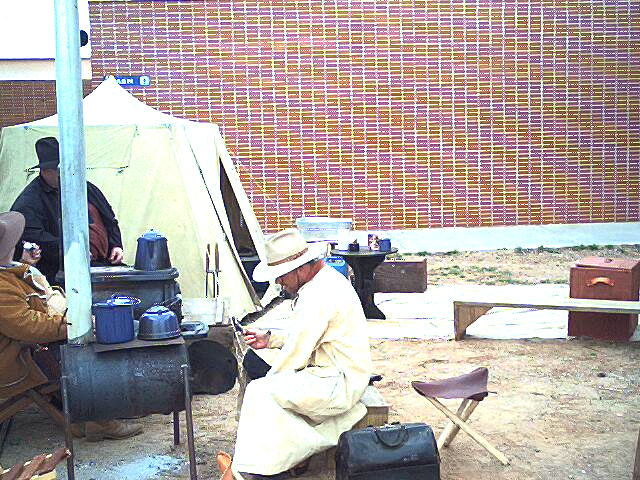
| Old West Reenactment Camp |
By Alanna Radle Rodriguez
Last month, Linore Rose Burkard did a blog on Ye Old Renaissance Faire, and it got me to thinking. What is the difference between a reenactment and living history? And where does the Medieval/Renaissance faire fall?
We have all tried to relive the past in different forms and fashion: The old kids’ game Cowboys and Indians, school Thanksgiving plays, movies and TV series, books, paintings, reenactments, museums and living history. Here in the State of Oklahoma, during the third or fourth grade, some students get to reenact the state’s land run. But why couldn’t this school “land run” be called living history? The terms reenactment and living history are very similar and are sometimes used interchangeably. Most may say there isn’t a difference, but to the historians, there is a difference.
 |
| Hayes, Ohio 2015 Civil War Reenactment |
 |
| Reenactment of the Roman Legion XV "Apollinaris", taking place in Austria-Wikipedia |
Today, people gather to celebrate Medieval or Renaissance times across the globe. Of course, these assemblies are aptly called Medieval or Renaissance Faires. This is where the line can blur between reenactment and living history. Generally, a faire is a celebratory gathering—a festival. You usually have groups that frequent these faires. The Society of Creative Anachronism (SCA) is a worldwide organization that provides reenactment encampments and sometimes living history. But most who visit a faire consider it a chance to dress up like a princess, Robin Hood, or a pirate. For others, it’s a perfect cosplay opportunity. A contraction of the two words “costume and play,” cosplay is the practice of dressing up like your favorite fictional character or even a different you from an alternate universe. While these “reenactors” stay in their cosplay character during an event, most living historians are just that. Historians. They have researched and confirmed their material, the process, the very way of life of their ancestors or the people they portray. Simply put, while living historians are playing a role in the overall scheme of an event or museum, they are still first and foremost, a student of history.
 |
| Video Cosplayer-google search |
 | ||
| Interesting Cosplay: "Snowba Fett" Mix between Snow White and Bobba Fett from Star Wars |
 |
| Viking re-enactors at the Battle of Clontarf millennium commeration, Saint Anne's Park, Dublin-by Hibernian, Wikipedia |
My husband and I are both re-enactors and living historians. When we volunteer at the 1889 Territorial Schoolhouse in Edmond, Oklahoma, we come alive, not only for the adults who come in but for the children too. It is so fun to ask children what they think I, as the schoolmarm, would use to heat my schoolhouse. “Wood!” they enthusiastically reply. At that time, Edmond was tall prairie grassland. There were no trees! I show them a picture of historic Edmond and ask them what’s missing. When they tell me a popular fast-food restaurant directly across the street, I can’t help but laugh. I tell them trees are missing! Early settlers would use cow chips to fuel the fire! “If you were in my classroom, once in a while it would be your responsibility to bring fuel for the stove for a week,” I tell them. Of course, I get a good, “EEEEEEEWWWWWW!!!!” and I laugh with the parents.
 |
| Husband and I at the Schoolhouse |
We love being asked questions as living historians! “Is that a real stove?” Yes, it is. This was our heater when we didn’t have electricity. “Where’s your smart board?” Well, see the big black board behind my desk? That’s our smart board. You have to write on it with chalk. “Where are your Ipads?” Slates were our Ipads. “Did you make your skirt?” Yes, I did. In living history situations real firearms are allowed, my husband is always asked, “Is that gun real? Can you use that knife? Why is your holster so high up?” My favorite one he gets asked a lot is, “Are you a REAL cowboy?” I can’t help but smile. Yes, my computer IT husband is a real cowboy.
 |
| Part of my crew. Medieval Fair in Norman, OK 2011 |
So where do the Medieval/Renaissance Faires fit? Well, it depends on the faire. In Oklahoma, there are two famous faires: The Medieval Faire in Norman and The Renaissance Faire in Muskogee, and there are differences even between the two! The Medieval Faire does have the historical jousting put on by the SCA, but it has more of a modern market. The Renaissance Faire is to preserve the culture, fashion, goods and celebrations. While there are reenactments at most, if not all faires, re-enactors, living historians, and cosplayers all are intermingled at the faire!
 |
| Tinker Bell Cosplay |
 Born and raised in Edmond, Oklahoma, Alanna Radle Rodriguez
is the great-great granddaughter of one of the first pioneers to settle
in Indian Territory. Alanna loves the history of the state and relishes
in volunteering at the 1889 Territorial Schoolhouse in Edmond. Her
first published story, part of a collaborative novella titled Legacy
Letters, came out September 2016. Alanna lives with her husband and
parents in the Edmond area. She is currently working on a historical
fiction series that takes place in pre-statehood Waterloo, Oklahoma.
Born and raised in Edmond, Oklahoma, Alanna Radle Rodriguez
is the great-great granddaughter of one of the first pioneers to settle
in Indian Territory. Alanna loves the history of the state and relishes
in volunteering at the 1889 Territorial Schoolhouse in Edmond. Her
first published story, part of a collaborative novella titled Legacy
Letters, came out September 2016. Alanna lives with her husband and
parents in the Edmond area. She is currently working on a historical
fiction series that takes place in pre-statehood Waterloo, Oklahoma. Facebook.com/AlannaRadleRodriguez
Pinterest.com/alannaradlerodr/


