By Kathy Kovach
As one who enjoys live performances, from my dabbling in the
acting world to watching my son perform in high school, college, and community
theaters, I find the evolution of performance art fascinating.
 |
Joey Kovach (on left) as King Oberon in Midsummer Night’s Dream, Okaloosa-Walton Community College, Valparaiso, FL, 1998
|
From the Greek and Roman influences, to the Renaissance, and on into the 1700s, live theater boomed in Europe during the 18th century. Only
two theaters had been licensed in England during the reign of Charles II, but by
the end of the 18th century, seven more had been added. Two were extended to
accommodate three thousand people. The First Industrial Revolution contributed
heavily to this growth as the population moved from the country into the
growing urban areas, taking advantage of the manufacturing boom. As a result,
they sought out cultural entertainment.
Enter the different styles of performance art.
 |
The Misanthrope, a comedy in five acts by Moliere |
The grandiose spectacle of Baroque Theater used special
effects via elaborate stage machinery. The sets were intricate and ornate, the
plots multi-layered and complex, with an overabundance of emotional intensity
and dramatic tension. The monarch and aristocrats powered the Baroque engine, fueling
it with their wealth to produce artistic and technical wonders reflective of
the Age of Enlightenment.You know what they say: If it ain’t Baroque, don’t fix it.
 |
Teatro Palladiano, a neoclassical theatre in Vicenza |
However, some did feel the need to fix it, and as the
grandness of the theater wore out its welcome, a new movement, Neoclassicism,
emerged. Going back to basics, it recalled, once again, the Greek and Roman
models. Simple performances, scaled down designs, and a call back to reason and
morality became the focus.
Melodrama took the simplicity of the Neoclassic drama and
added intense emotion and exaggerated reactions. Music played a huge part in
raising the heart rate of theater goers. Melodrama became the prototype for Hollywood
movies in the infancy of film. The trope of the damsel in distress comes to mind,
calling out for her hero while the dastardly villain ties her to the railroad
tracks. Such intensity! But it worked. So much so, that from the early 1900s to today, nearly 500 films can be categorized with the Melodramatic style.
 |
The Payne Brothers – Harry as Clown and Fred as Harlequin, c. 1875 |
One avantgarde form was Pantomime. Hugely popular from the
mid-1600s into the 1800s. Large gestures, physical comedy, and often elaborate
costumes and makeup delighted audiences. Characterized by two figures, Clown
and Harlequin, the Payne Brothers (Harry and Frederick, sons of classic
Pantomime artist William Payne) popularized the act. The mime of today has
brought this unique form of entertainment into contemporary times.
 |
The Beggar’s Opera, Painting based on scene 11, act 3 by William Hogarth, c. 1728, Librettist John Gay, Wikipedia |
With the rise of the middle class, Ballad Opera became
popular. It incorporated well-known songs with spoken dialogue. A precursor to
musical comedy, this was a farce of the traditional Italian operas and
incorporated humor and satire, making it more relatable than the pretentious
form of opera.
The style of the building itself saw changes that lasted for
the next few centuries and are still the standard.
 |
The Orchestra Pit on the floor |
Live theater went from roving bands of actors, performing
under the trees or in the town square, to large buildings with solid roofs. The
stage itself was once close enough to the audience for interaction. However,
when the orchestra began taking over a large percentage of the stage, sometimes
with fifty musicians crowding the actors, it was moved to the front onto the
floor, separating the audience from the stage. The main floor is still called
the Orchestra Level. This worked fine for sophisticated audiences, but too
often, a rowdy crowd would pelt the musicians with rotten fruit if they heard
a sour note.
 |
The Orchestra Pit under the stage |
Still, it wouldn’t be until a century later that Richard
Wagner came up with an innovative design to not only protect the musicians but hide them. Lowering the floor just in front of the stage and utilizing the
space underneath, this was called, appropriately, the Orchestra Pit.
 |
Note the five candelabras lighting the stage |
Lighting changed as the auditoriums grew larger. At the
beginning of the 18th century, the seating area was as bright as the stage, lit
with candelabra rings. When the audience moved farther from their focal point,
it became increasingly hard to see the performance. Thus, the house was
darkened, and five rings of candelabras lit the actors.
 |
Lighting the footlights |
Footlights with tin reflectors, an invention of the previous
century, were originally lit by candles and later with kerosene and oil. In the
Haymarket Theatre in London, colored glass was raised and lowered to enhance
effects on stage. As one would imagine, theaters were prone to burning down.
As live theater developed in Western civilization, it was
inevitable that it would cross the pond and end up in America. However, Puritan
settlers prohibited its development until the early 18th century. Surprisingly,
Williamsburg, Virginia was the first to introduce this form of entertainment in
1716. Charleston, South Carolina adopted it in 1730, when several English
actors began performing in various venues. By the mid-1730s, New York caught
the vision and opened several theaters. New England legislatures attempted to prohibit
live performances on moral grounds. One touring company, however, broke through
with its presentation of Shakespeare’s Othello, arguing it to be a “moral
dialogue in five acts”.
The Hallam Company, organized by actor-manager William
Hallam and led by his brother Lewis Hallam, arrived by boat at Yorktown,
Virginia June 2, 1752. When they moved to New York, they changed the name to
The American Company (1758-1785), and later to The Old American Company
(1785-1805).
If it weren’t for the ancient peoples, the driven creatives,
and the royal lovers of live theater, I’d never have been able to enjoy seeing
my son in the dozens of performances in which he’s participated over the years.
He now teaches Theater Education at City College in New York as an Adjunct
Professor.
 |
Joey Kovach as Bottom in Midsummer Night’s Dream, Choctawhatchee High School 1997. |
 |
I’m a proud mom! 😊
|
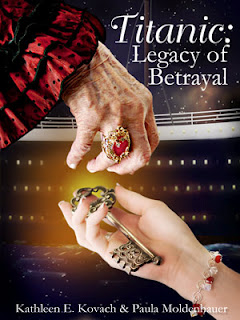
A TIME-SLIP NOVEL
A secret. A key. Much was buried on the Titanic, but now it's time for resurrection.
Follow two intertwining stories a century apart. 1912 - Matriarch Olive Stanford protects a secret after boarding the Titanic that must go to her grave. 2012 - Portland real estate agent Ember Keaton-Jones receives the key that will unlock the mystery of her past... and her distrusting heart.
Kathleen E. Kovach is a Christian romance author published traditionally through Barbour Publishing, Inc. as well as indie. Kathleen and her husband, Jim, raised two sons while living the nomadic lifestyle for over twenty years in the Air Force. Now planted in northeast Colorado, she's a grandmother and a great-grandmother—though much too young for either. Kathleen has been a longstanding member of American Christian Fiction Writers. An award-winning author, she presents spiritual truths with a giggle, proving herself as one of God's peculiar people.




Thank you for posting. This has been a very interesting study!
ReplyDelete