Showing posts with label 1860's. Show all posts

Friday, April 19, 2019

Unmarried Women Homesteaders

Photograph of a Female Homesteader Standing in the Doorway of a Cabin
Unmarried Women Homesteaders

Think of homesteading, and you’ll probably picture a family outside a sod home with possibly a cow or two grazing on the roof. Keep the cows but remove everyone but the woman and you’ll have an accurate representation of thousands of women who claimed free land under the Homestead Act of 1862.

Married women could not take land in their own name unless they qualified as head of their household, but unmarried women of all ilks (those who had never married, widows, divorcees, or those who had been abandoned) learned they could forge a new destiny for themselves. The largest demographic of these women to homestead were both single and young. They succumbed to the same temptations that lured men westward – the twin possibilities of adventure and financial opportunity.

In order to receive the title to their land, homesteaders needed to reside on their land for five years, at least at the inception of the Homestead Act. The number of years necessary changed with time. While many remained on their land full-time, residency was interpreted loosely by some. They might leave for extended periods to visit family members, work, or simply to escape conditions on the homestead. Later adjustments to the Homestead Act eased this requirement. Amendments allowed homesteaders to commute claims by other means, including payment after a certain amount of time living on their land.

Women homesteaders often supported themselves as teachers, seamstresses, or in other jobs. Widows particularly benefited from homesteading. During my research for Hills of Nevermore (Montana Gold, book 1), in which the heroine is a widow, I came to understand how difficult it was for a widow to take care of herself in the West. Those who didn’t remarry had to support themselves in a culture that allowed few opportunities for single women. They were often widowed while young and often had children to support. Homesteading offered a way for them to provide for themselves and their children that would not have existed otherwise.

Unmarried women who homesteaded learned to survive in the West on their own. That was a remarkable feat. Some female homesteaders remained single, but many found husbands.


About the Author

Janalyn Voigt's unique blend of adventure, romance, suspense, and whimsy creates breathtaking fictional worlds for readers. Known for her vivid writing, this multi-faceted author writes in the western historical romance, medieval epic fantasy, and romantic suspense genres.

Janalyn is represented by Wordserve Literary Agency. Her memberships include ACFW and NCWA. When she's not writing, she loves to garden and explore the great outdoors with her family.

Explore Janalyn Voigt's interactive website.

About the Book

In Hills of Nevermore. America Reed’s husband died during an early blizzard that piled up quickly. Winter set in, and America was forced to give birth alone of the homestead. Some pioneer women actually gave birth alone. Can you imagine? When America was finally able to leave home, another widow befriends her. Addie lost her husband during a river crossing when their wagon capsized. He was taking his family along to the Montana gold fields. Addie needs to find another way to support herself and her son. America and Addie are strong women faced with difficult circumstances like the unmarried homesteaders described in this article.

I'm excited to announce that Hills of Nevermore is included in the Heartbeats in Time collection of western historical romance novels from seven award-winning and bestselling authors. It's free to read in Kindle Unlimited or just 99¢ per ebook to purchase. Claim this limited-time collection today!


Saturday, July 7, 2018

Elmira Civil War Memorial Rendezvous and Prison Camp

original building plus barracks replica under construction 2017
This past month, on June 9, 2018, I spent some time exploring history from 154 years ago, right in my own hometown. Elmira lies in upstate New York, right on the border of Pennsylvania, smack dab in the middle of the Twin Tiers. It is the county seat for Chemung County, where approximately 85,000 people live. It is a city in transition from a past manufacturing town to rediscovering itself as a history hub and tourist destination. And history it has, aplenty. I have written previous posts on some if its claims to fame, including its Underground Railroad activity, a post about John W. Jones--a male Harriet Tubman figure, and Rachel Gleason, the fourth woman in the U.S. to get her MD. Elmira was also the home to the first college to offer women a baccalaureate degree equal to men's. Nearby was the site of a major Revolutionary War battle, the Battle of Newtown, where Continental Army General Sullivan defeated Mohawk Chief Joseph Brant and his allied British forces. Mark Twain resided in Elmira, writing several of his works here including The Adventures of Huckleberry Finn. 
barracks replica completed 2018

But the focus on this sultry late spring afternoon near the banks of the Chemung River was the Civil War prison camp which had housed over 12,000 Confederates from July 6, 1864 until mustering out after the end of the war. On this day last month, a replica of one of the barracks was dedicated, and the public was invited to partake in the efforts of dedicated history lovers who have gone to great efforts to preserve this important chapter of our country's story. 

miniature model of barracks
interior of barracks showing sleeping bunks
Construction of the memorial site began in 2016 when private citizens purchased a piece of property near where the original prison camp footprint had been. At the beginning of the Civil War, acreage along the banks of the Chemung River, leased by the Federal government from a gentleman by the name of Foster, had been designated as one of three barracks in Elmira used for a recruiting and training ground for new soldiers. Elmira was only one of three recruiting rendezvous in the state due to its railroad connections. In 1864, when the War Department put an end to prisoner exchange, barracks number three was chosen to house the burgeoning prisoner of war population. Infamous for the highest death rates of any prison camp during the Civil War, Elmira had an overcrowding problem as well as rampant disease from a stagnant water issue at Foster's Pond. 

 Federal uniform coat and rifle
Interestingly, Mark Twain's father-in-law, the local businessman and erstwhile abolitionist Jervis Langdon, was commissioned to build the original barracks for the U. S government for $200 per building. The interior photos show the board and batten construction of the barracks, at 88' long and 12' high. Each bunk slept 2-3 prisoners, and there were two rows of bunks on each side, top and bottom. Wood burning stoves, two each barrack, were hardly sufficient to keep prisoners warm during the brutal winters. 
patron memorial brick walkway

At the conclusion of the war in 1865, the government's lease of Foster's land expired, and the buildings remaining were auctioned off. A local citizen had the foresight to preserve the wood from an original building purchased from the prison camp grounds, and it has remained in storage for these 154 years. In 2017 it was reconstructed, and the barracks replica started alongside, which is now complete. (see top photo, building on left with sliding barn door)

Also part of the memorial site, a garden has been planted, featuring the state flower from each of the eleven states in the Confederacy. North Carolina's Flowering Dogwood, South Carolina's Flowering Jasmine, and Alabama's Camellia grow here, to name a few. A memorial brick walkway, with the names of the patrons and friends, Lays alongside the garden. Plans are underway to provide a reading room with historical documents and other related literature at the nearby Foster House, which housed Union officers during the war.


Kathleen L. Maher has had an infatuation with books and fictional heroes ever since her preschool crush, Peter Rabbit. She has a novella releasing with BARBOUR in the 2018 Victorian Christmas Brides collection, featuring her hometown of Elmira, New York. Her debut historical, Bachelor Buttons, blends her Irish heritage and love of the American Civil War. She won the American Christian Fiction Writers Genesis contest in 2012. Kathleen shares an old farmhouse in upstate New York with her husband, children, and a small zoo of rescued animals.


Friday, April 6, 2018

Carnton Plantation

By Michelle Shocklee

I have a secret obsession. Well, it may not be so secret if you've read my books or follow my blog posts. For those of you still in the dark, I'll make my confession public here for all the world to see.

I'm obsessed with plantations!

I'm fascinated with all aspects of plantation life. From the big house to the slave quarter, I have an insatiable appetite to learn everything I can about that period in time and the people who lived through it. Perhaps it's because I grew up in Santa Fe, New Mexico where such things don't exist. Ask me about dashing Spaniards, Pueblo Indians, or adobe homes, and I'm a wealth of information! But plantations and slavery were not on my radar until a few years ago. Hubby and I took an anniversary trip to the southern part of Texas where I learned, much to my amazement, plantations once existed. You might recall my post from last November took us to Liendo Plantation in Hempstead, Texas, a beautiful historic home I used for inspiration as I wrote about life on a Texas plantation in my historical novels The Planter's Daughter and The Widow of Rose Hill.

Today I'm taking you to Tennessee where hubby and I moved last October. To say this state is a plantation-lovers haven is an understatement! Just a few miles from my home is one of the most famous plantations in the Nashville area. Carnton. I'd love to take you on a little virtual tour of this lovely and oh-so-interesting historical house and share some of the fascinating events that happened here.

Photos: Carnton

Carnton was completed in 1826 by southern planter Randal McGavock. It won't surprise anyone to learn slave labor was used to build this lovely Federal-style home. What did surprise me on my first visit to the house was that the beautiful "front" of the house pictured above is now actually the back. Visitors to Carnton arrive on the opposite side of the house, pictured below. Either way, it's a gorgeous, gorgeous building. Some features, like the Greek-revival styled portico and rear gallery, were added later by McGavock's son, John.


It was John and his wife who redecorated the home, adding fashionable wallpapers, elaborate fireplace mantels, and carpets in nearly every room. Visitors to the plantation can see a lovely 200-piece set of china used by the McGavock's as well as other furnishings original to the home. A staircase in the airy foyer leads to bedrooms where I could almost picture Carrie Winder McGavock tucking her children into bed. A portrait of three of their children hangs in one of the rooms. Sadly, all three of the children died fairly young. 
In 1860, John McGavock owned 39 slaves.
Because a census was taken that year, we know that slaves actually outnumbered white residents of Williamson County, Tennessee. It's estimated that nearly 300,000 slaves resided in the state at that time, with slightly under four million across the entire country. That number is staggering to me. Shameful and staggering.

There is a small house on the property where some of the slaves lived. It's stark and drafty and cheerless. It's actually roomier than other slave quarter houses I've seen, but when compared to the grandeur of the main house ... well, we'll just leave it at that. There is no comparison. 

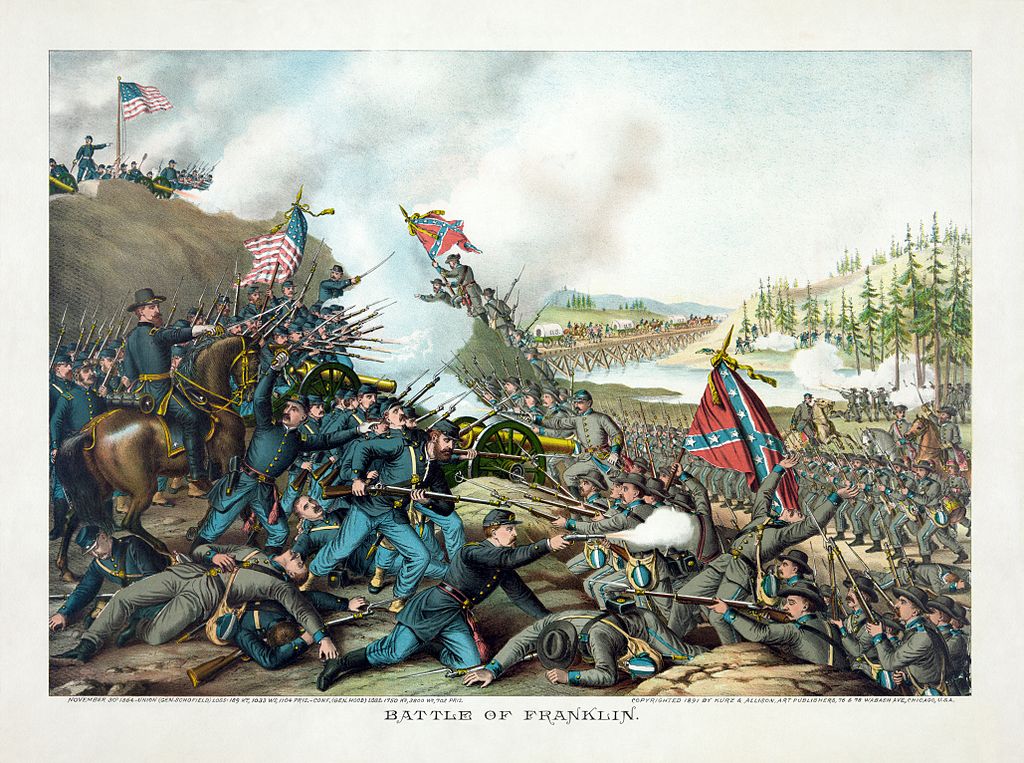
The Civil War arrived on the doorsteps of Carnton in November 1864. General John Bell Hood and his Confederate troops were encamped just outside of Franklin, a small town twenty-five or so miles south of Nashville. Union forces were well fortified two miles to their north, and Bell's men were unable to break through or prevent Union General Schofield's plan to withdraw to Nashville. 

Kurz and Allison - Battle of Franklin, November 30, 1864.jpg
The Battle of Franklin
On November 30, 1864, one of the bloodiest battles of the war was fought, resulting in nearly 10,000 casualties. The carnage was unimaginable. Bodies of dead, dying, and injured soldiers lay strewn over fields and farmland. Many private homes and businesses in town were commandeered as hospitals, and Carnton was one of them. 

As many as 300 Confederate soldiers eventually made their way to Carnton, whether carried and dragged there by fellow soldiers, or arriving in the dozens of wagons used to transport the injured. Every room and every inch of the porches and yard was filled with bleeding and moaning men. By this time the McGavock slaves were gone, having been relocated to a more southern property, but Carrie and her remaining maid helped tend the wounded. In one of the upstairs rooms, a large stain remains on the floor where the blood of dozens of men dripped while a surgeon worked to save their lives, often resorting to the amputation of limbs. 

Stained floor at Carnton


After the battle, men were buried on the battlefield with their graves marked with wooden markers. As these markers began to fade, the citizens of Franklin raised funds to exhume and re-inter the soldiers on land the McGavock's donated. The cemetery is the final resting place for 1,480 men who died in the Battle of Franklin. One definitely feels a sense of reverence and sadness walking through the markers, knowing how horrific and fierce the fighting was. 

Last November, hubby and I attended events to honor the memory of the fallen on both sides. It was very moving to see 10,000 luminaries lit at dusk, the time the battle began. They do this every year on November 30, so if you're in the area, I encourage you to attend. 

Well, folks, that concludes our mini tour of Carnton plantation. Now you know my obsession. What's yours?

Luminaries lit on the battlefield of the Battle of Franklin, with the
town of Franklin in the background.

Michelle Shocklee is the award-winning author of The Planter's Daughter and The Widow of Rose Hill, historical sagas set on a Texas cotton plantation before and after the Civil War. Her historical novella set in the New Mexico Territory is included in The Mail-Order Brides Collection. Michelle and her husband of 30+ years make their home in Tennessee. Connect with her at www.MichelleShocklee.com.


THE WIDOW OF ROSE HILL

Widowed during the war, Natalie Ellis finds herself solely responsible for Rose Hill plantation. When Union troops arrive with a proclamation freeing the slaves, all seems lost. How can she run the plantation without slaves? In order to save her son’s inheritance she strikes a deal with the arrogant, albeit handsome, Colonel Maish. In exchange for use of her family’s property, the army will provide workers to bring in her cotton crop. But as her admiration for the colonel grows, a shocking secret is uncovered. Can she trust him with her heart and her young, fatherless son?

Saturday, January 6, 2018

Civil War Widows

By Michelle Shocklee

The numbers are staggering.

It is said that over 620,000 men died in the American Civil War. Between 1861 and 1865, approximately three million husbands, fathers, sons, uncles, and brothers left for war. Thousands of American families would never see their loved one’s face again as the men died, often far from home. At Gettysburg alone, there were over 51,000 casualties. As a result of four long years of battle, hundreds of thousands of women became widows.

It's hard to imagine that kind of loss. In the span of four short years, so many, many lives were changed.

In both of my upcoming February releases, I touch on the subject of war widows. In The Widow of Rose Hillbook 2 in the historical romance series The Women of Rose Hill, our heroine, Natalie, is left to run the plantation alone after her husband dies shortly after joining the Confederate Army. Like the war widows of 1865, Natalie must forge a new future for herself and her young son. A future that often looked frighteningly uncertain. 


In my novella, To Heal Thy Heart, included in The Mail-Order Brides Collection,  Phoebe was engaged to a young Confederate soldier who perished in battle. Left without means or family, she must put her life and future in the hands of a stranger by answering a mail-order bride ad. Sadly, many real war widows were left with little choice but to marry again, usually without love and often to total strangers. In the South, especially, life as they had known before the war was forever changed. With so many men gone, women far outnumbered men of marrying age. Ads began to appear in newspaper "matrimonial columns" from both women and men seeking matrimony. Many men went West after the war, which is where Phoebe and Luke begin their life together, and widows were forced to leave behind everything familiar. While we can dream of the romance between a war widow and her handsome hero, the reality was most assuredly terrifying.

Hetty Cary, one of Richmond, Virginia's most beautiful belles, became a widow three weeks after she married Confederate Brigadier General, John Pegram. Pergram returned to battle after their brief honeymoon on February 5, 1865. He was shot and died instantly. Exactly three weeks from the date of her wedding, Hetty found herself in the same church, with the same people, the same minister, walking down the same aisle, for the funeral. “Again has St. Paul’s, his own beloved church,” wrote one female diarist, “receive[d] the soldier and his bride—the one coffined for a hero’s grave, the other, pale and trembling, though still by his side, in widow’s garb.” Hetty was so heartbroken she had to be torn from the body, almost by force. Unlike many women left alone, she would remain a widow for over 15 years.

One of the saddest tasks a war widow faced was that of retrieving her husband's body. The idea of their loved one's final resting place being far from home and perhaps on enemy lands was unacceptable. Some husbands even went so far as to write instructions to their wives about what should be done if the worst happened. A Union soldier named William F. Vermilion wrote this to his wife on June 30, 1863: "You have often asked what I want you to do if I should not get home. Get me home if you can,” he penned, “bury me on some nice loyal spot of ground, plant flowers over the grave. I don’t want to sleep in the land of traitors. I couldn’t rest well.”

I do believe there were happily ever after stories for many of these widows, although I'm sure the healing process wasn't easy. I hope I've done them justice through my storytelling and imagination. They, like their husbands, need to be remembered as the real people they were, living, loving, and eventually dying.


Michelle Shocklee is an award-winning author of historical fiction and is a contributor in six Chicken Soup for the Soul books. The Widow of Rose Hill,  Book 2 in the historical romance series The Women of Rose Hill, releases February 12, 2018 and is available for pre-order on Amazon. Book 1, The Planter's Daughter, is available now. Her historical novella set in the New Mexico Territory is included in The Mail-Order Brides Collection, releasing February 1, 2018. Connect with her at www.MichelleShocklee.com.

Thursday, October 26, 2017

Civil War Dances, Balls and Gatherings


Who hasn’t watched the movie Gone with the Wind and swooned over the
dance-ball scenes? It just appears as if everyone is beautiful, graceful, talented—everything we romanticize about the Civil War era.

There were some rules when a folks attended balls that we rarely hear of. One of the biggies: A woman shouldn’t dance more than one dance with her husband. And preferably, that dance should be the first of the evening. She was expected to socialize with all men in attendance as long as they didn’t get too friendly—it was a fine line—and considered rude to cross that line in either direction. In addition, if following proper etiquette rules, the married couple should refer to one another as Mrs. and Mr. while in the company of the other attendees. First names were rarely used by anyone at the ball.
  
Another etiquette rule concerning women; an unmarried woman couldn’t attend the dance unless escorted by either their parents, an elderly gentleman, a married couple or a married woman. This was for the young lady’s protection.

Children of affluent families were often sent to finishing schools to learn the important skills of the wealthy elite, like, decorative sewing, table/dinner manners, the delicate art of catching a rich husband, and ballroom dancing.

Though many children were taught dance steps at a young age, a “Dance Master” would be available at balls to teach dance steps to those who needed instruction. This could include those unfamiliar with common dance steps or if a new dance was being introduced, the Dance Master would demonstrate the moves to the crowd.   

The dance ball position of “Floor Manager” was a prestigious one. This person—almost always a man—would keep the dances flowing in an orderly fashion. He would also keep the dancers moving to avoid back-ups on the dance floor. Without a Dance Master and Floor Manager, one could not give a proper dance.

There were actually dances for all levels of the social-economic tier. Many cities threw a Mayor’s Ball, Christmas Ball, Easter Ball—city officials would use any excuse for a dance hoping to sway the vote their way of those who attended.
    
During the Civil War, soldiers would put on dances in their camp to boost morale and chase away the loneliness and homesickness that plagued the men. Simple instruments or even battlefield instruments would provide the music. Harmonicas and jaw harps emerged from deep in the fighting men’s pockets to play a waltz, or drums, bugles, and fifes that perhaps, mere hours before, played marching orders on the battlefield, now played a peppy quadrille. To solve the problem of a lack of female dance partners, men would dance with one another or in some cases, would dress as woman to fill the role.

Dances, balls, and social gatherings were an important part of people’s lives during the Civil War. These social events were the Facebook, Instagram, CNN, and E-Harmony of the day. People caught up on local and political news, found true love, and were reacquainted with family while twirling on the dance floor.

If you could, would you go back to the days of dances and balls? Would you be able to give up access to constant news, instant “love” by swiping right, and pictures Aunt Mary’s dinner last night? Share your thoughts in the comments below and thank you for stopping by Heroes, Heroines and History today. Be blessed, my friends.

                       __________________________________________________

Multi award-winning author, Michele K. Morris’s love for historical fiction began when she first read Laura Ingalls Wilder’s Little House book series. She grew up riding horses and spending her free time in the woods of mid-Michigan. Married to her high school sweetheart, they are living happily-ever-after with their six children, three in-loves, and eight grandchildren in Florida, the sunshine state. Michele loves to hear from readers on Facebook, Twitter, and here through the group blog, Heroes, Heroines, and History at HHHistory.com.

Tuesday, September 26, 2017

Women POW's of the Civil War


Women POW's in the Civil War? 


Certainly.

A surprising number of women dressed as men and went to war in 1860’s. It’s not known exactly how many, but there is documentation, by means of hospital records, diaries, and prison records, that women fought beside their male counter parts in one way or another . . . perhaps in the hundreds.
 
Castle Thunder
       
The Civil War era prison, Castle Thunder, was located in Richmond Virginia. It was, like most other prisons of this time period, filthy, disease ridden, overcrowded, and lacked in food and medical care. Over the course of the war, Castle Thunder imprisoned over one hundred women, and had one area specifically for female inmates—calling them “deprived and abandoned” women. Some inmates were prostitutes, but most where smugglers, spies and political prisoners. The most famous prisoner of war was Doctor Mary Edwards.

Dr. Edwards was the second college trained, female doctor in the nation. After
Dr. Mary Edwards
obtaining a second medical degree, she worked as a field surgeon near the Union front lines after the Battle of Chickamauga, the first female surgeon in the United States Army. After being taken prisoner by the Confederates, while treating a confederate soldier on the battlefield, Mary championed better prison conditions at Castle Thunder and indeed, the inmates received an increase of grains and the addition of cabbage to their diets. Four months after being taken prisoner, Mary was released in a prisoner exchange. (for more information about this extremely interesting lady, check out yesterday's blog on Heroes, Heroines, and History.)

Andersonville Prison in Georgia is famous for its brutal living conditions. Here are the abbreviated stories of three known women prisoners who were imprisoned in Andersonville. 

Depiction of Andersonville Prison
One soldier, who was not discovered to be a woman until after her death, is buried in a grave marked with “Unknown”. I can’t help but wonder who this woman was. Did her family know she fought in the war? Was she missed? 

The second, Florena Budwin, (it’s unknown if this is her real name) decided she didn’t want her husband to go to war alone. So, she dressed as a man and enlisted. It is believed that Florena’s husband was killed in battle, though there is speculation that he died in Andersonville by the hand of the guards. Regardless, Florena was captured and sent to Andersonville. She kept her identity hidden during her stay. It’s unknown why she decided to remain in disguise, had she told the truth she would’ve probably been released. Florena died after being transferred to Florence Stockade in Florence, SC. She was only twenty years old.   
Andersonville Cemetary


The third, Janie Hunt, married Captain Harry Hunt in the New England area. After their wedding the bride and groom, along with their wedding guests, boarded Captain Hunt’s boat for a short pleasure cruise. After a few hours, a Federal revenue cutter stopped the vessel and ordered Captain Hunt to pick up a load of corn in North Carolina. For whatever reason, all stayed aboard and sailed to North Carolina. While picking up the corn, Confederates seized the ship. The wedding guests were soon released but the new Mrs. Hunt chose to stay with her husband in hopes he’d soon be set free. Her hopes were dashed when she learned her new husband would be sent to the new prison, Andersonville. Janie Hunt was allowed, after much begging and bribing, to dress as a man and accompany her husband to prison. To help conceal her identity, the newlyweds made camp in a far corner of the open prison yard. upon their
What a tent in Andersonville might look like
arrival to Andersonville, Janie was four months pregnant. After giving birth to a baby boy in the couple’s tent, the prison doctor heard the cry of the baby and the family was discovered. The doctor took pity on the young Hunt family and arranged for Janie and her son to stay at a local farmer’s home close to the prison. The doctor also made Captain Hunt his assistant and therefore kept him safe through the war.

These stories just touch the surface of women who served time in Civil War prisons. Some had happy ending, some ended very tragically. What do think? Do you admire what these women did? Were their actions acts of bravery or foolishness? Please, leave your comments below.


Please note: All the above photos were obtained from WikiCommons and are free to use.


Award winning author, Michele K. Morris’s love for historical fiction began when    she first read Laura Ingalls Wilder’s Little House book series. She grew up riding horses and spending her free time in the woods of mid-Michigan. Married to her high school sweetheart, they are living happily-ever-after with their six children, three in-loves, and eight grandchildren in Florida, the sunshine state. Michele loves to hear from readers on Facebook, Twitter, and through the group blog, Heroes, Heroines, and History at HHHistory.com

Wednesday, July 26, 2017

Elizabeth Stiles~Union Spy


1862, late October. The day started out as any other in the life of Elizabeth W. Stiles. Household chores to complete, her three, adopted children and her husband to care for, until a gang of men arrived on the Stiles farm.
         
Union uniform. 
            
Confederate uniform
The men, dressed in Union uniforms, approached Jacob Stiles and his friend Mr. Becker (or Baker). George Todd stepped up to Mr. Stiles and asked him where his politics lay. Mr. Stiles answered the man—Union. Todd raised his gun and fatally shot Jacob Stiles. Then to be sure the deed was complete, a former neighbor of the Stiles’ stepped to Jacob’s prone body, placed the muzzle of his gun to his mouth, and pulled the trigger.

Elizabeth ran for the house and her children. But leader of the marauding gang, Charles Quantrill, and a few of his men, cornered Elizabeth in her home. As one of the men placed his pistol to her temple, Quantrill halted him, saying Elizabeth was too pretty to shoot. Quantrill’s gang left without any further killing.                            

Fearing for her children’s safety, Elizabeth moved her family to        
Boston Library, Fort Leavenworth
              
Fort Leavenworth. There she received a letter from General James H. Lane, Kansas Senator and friend of President Abraham Lincoln. The letter stated that President Lincoln had important work for Elizabeth to do. She accepted, moved to Washington D.C., put two of her children in boarding school, and took her daughter Clara (13) with her as she carried out her duties as a spy for the Union Army.
 
President Lincoln
                                 
Dressed as a pipe-smoking elderly, Southern woman, Elizabeth Stiles, a nurse and teacher before her career as a spy, traveled throughout the South gathering information for the North. Part of her disguise included her daughter, Clara, playing the part of Elizabeth’s granddaughter. The pair claimed to be searching for Clara’s father, a wounded Confederate soldier.
           
Elizabeth was arrested in Missouri on the suspicion of being a Union spy. During her incarceration, she convinced General Sterling Price that she was a Confederate spy instead of a Union spy and he personally equipped both Elizabeth and Clara with better horses, firearms, and supplies before he sent them on their way.

Throughout the year and half that Elizabeth and Clara worked as spies, they collected valuable information that contributed to the victory of the North, but more than the contribution of the information, Elizabeth’s story shows how the strength, fortitude, and intelligence of one woman can help change the world.

Elizabeth and Clara retired in November of 1864 after the President decided the pair had become too well known to the “rebel sympathizers”. 

She died July, 1898. When Elizabeth passed away, her beloved letter from President Abraham Lincoln was found among her belongings. A family member sold the letter to The Western Reserve Historical Society in the 1940's. 

If given the chance, would you be able to do this things Elizabeth did? Would you leave two of your children and put another in the path of danger? I admire Elizabeth for her bravery, but I'm not sure I'd make the same choice. How about you, what do you think? Leave a comment below and share your thoughts and ideas.  

________________________________________________________________

Award winning author, Michele K. Morris’s love for historical fiction began when she first read Laura Ingalls Wilder’s Little House book series. She grew up riding horses and spending her free time in the woods of mid-Michigan. Married to her high school sweetheart, they are living happily-ever-after with their six children, three in-loves, and eight grandchildren in Florida, the sunshine state. Michele loves to hear from readers on Facebook, Twitter, and here, through the group blog, Heroes, Heroines, and History at HHHistory.com

Sunday, July 2, 2017

Batter Up, Ladies! The Beginnings of Women's Baseball


Baseball is said to be America's greatest past time, and it's as old as America itself--if not older. While Abner Doubleday is attributed with inventing baseball in New York in 1839, some scholars think people were playing a sport much like it on US soil by the 1790's, and that game was based on another played in medieval Europe, People have apparently been hitting balls with a stick for a long, long time!


"Medieval Baseball"` Cantigas de Santa Maria, circa 1280. Public Domain

Regardless of its origins, baseball was extremely popular in the mid 1800's--not just among men, but women, too, despite many people's beliefs at that time that ladies shouldn't partake of vigorous exercise.

One source of evidence for females playing "base ball" (as it was called back then) comes from the first women's colleges in America. Students asked for teams and space to play in the 1860's, implying they already knew the rules and what to do. Vassar College formed two teams in 1866, but provided no instruction, supervision, or equipment.(Click here to see a wonderful photo of one of the teams!) 

Other colleges had teams, as well. Baseball was a little rougher than it is now (it included shoving, tripping, etc.), and the play at Smith College was apparently so unmannerly the administration banned it from campus for a time.

Baseball fever among females wasn't limited to women's colleges, of course. In September of 1875, Springfield, Illinois hosted an exhibition game between the Blondes and the Brunettes. The Blondes won, 42-38, but from that point forward, teams with those names comprised of blondes squaring off against brunette players toured the country for several years.

The Dolly Vardens of Philadelphia was an African American ladies' team. (There were several teams of white male players in Pennsylvania who went by this name in baseball's early days, and the two teams are sometimes confused.) In 1883, the New York Times reported that Miss Ella Harris was team captain of the calico-clad Dolly Vardens, and on a game day, the opposing team missed the train and had to forfeit. 
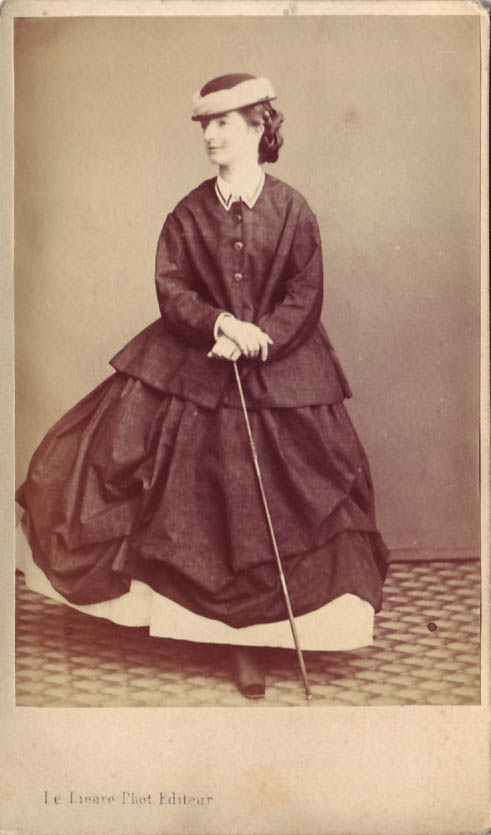
Late 1860's fashion, not ideal for playing baseball! by Henri le Leure, Carte-de-visite portrait of Margherita of Savoy-Genoa. Public Domain {{PD-1923}}


Uniforms were not worn by female players then, nor were gloves (by male or female players). Women wore their every day clothing, which could mean up to thirty pounds of fabric: slips, corset, dress, stockings, etc., and heeled shoes.

In the 1890s, things got a little more comfortable, clothes-wise, when players began to wear Bloomers. The Boston Bloomer Girls club found it far easier to run in the loose pants instead of a skirt. The Bloomer Girls toured America in 1897, playing (and often beating) men's clubs. 
Palisade, CO women's baseball team, around 1910. Public Domain.
It wasn't until the 1930's, however, when female baseball players toured out of the country and signed minor league contracts. In 1943, Philip Wrigley (owner of the Chicago Cubs and Wrigley's Gum) founded the All-American Girls Professional Baseball League, a precursor to today's modern leagues and clubs.

Thanks to the female pioneers of yesteryear, women and girls all over the world play baseball and softball for enjoyment and exercise. 

***

BIO:

Susanne Dietze began writing love stories in high school, casting her friends in the starring roles. Today, she's the award-winning author of over a dozen historical romances who's seen her work on the ECPA and Publisher's Weekly Bestseller Lists for Inspirational Fiction. Married to a pastor and the mom of two, Susanne lives in California and enjoys fancy-schmancy tea parties, genealogy, the beach, and curling up on the couch with a costume drama and a plate of nachos. You can learn more on her website, www.susannedietze.com. 

Her new novella, The Right Pitch from July's Of Rags and Riches Romance Collection, features a 4th of July exhibition game between two ladies' baseball teams during the Centennial Celebration of 1876.