
 |
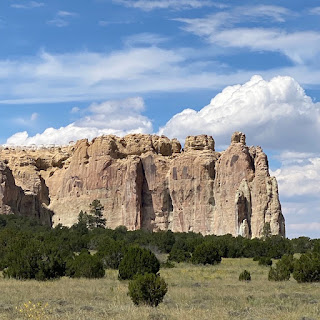
| El Morro National Monument, Martha Hutchens |
Now, imagine moving from that climate to New Mexico. The air is dry, and even today you are wise to take water with you if you are driving through the more rural areas. Now stretch your imagination a little further. What if you are traveling by horse and wagon, or by foot. Water stops that are only an hour or two apart today would be up to a week apart in those conditions.

Then you see El Morro (headland or bluff) standing in the distance, and you know water lies at the foot of it. The pool at the base of this mesa collected water run off from the cliffs around it. Because the pool is in the shade of the cliffs, the water is cool and even more refreshing.
 |
| Inscriptions at El Morro, Martha Hutchens |
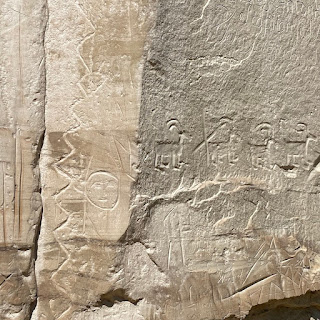 |
| Petroglyphs at El Morro, Martha Hutchens |

Juan de Oñate signed the rock in 1605 (15 years before the Pilgrims landed on Plymouth Rock.) He was the first governor of New Mexico under Spain, and is rightly reviled by the Native Americans in the area, for his massacre of the the Acoma people in 1599. He passed El Morro on his way back from what he thought was the Pacific Ocean. In fact, he only got as far as the Gulf of California. It is perhaps a signal of his feelings toward the Native Americans that he wrote his inscription over a pre-existing petroglyph.
Two more Spanish governors signed El Morro in the early 1600’s, Don Juan de Eulate in 1620 and Francisco Manuel de Silva Nieto in 1629. Eulate’s inscription describes himself as a gentleman, but the word was later scratched out. Unfortunately, this editor didn’t sign his name.
In 1632, a Spanish soldier named Luján wrote in stone that he “they passed by . . . to the avenging of the death of Father Letrado,” a priest killed by the Zuni people.
In 1680, the Pueblo people revolted against Spanish rule and the Spaniards retreated from New Mexico. In 1692, General Don Diego de Vargas returned to Santa Fe and reconquered New Mexico, mostly peacefully. He commemorates the event by signing El Morro, where he notes that he has “conquered . . . all of New Mexico at his own expense.” Maybe he thought the Spanish crown should have paid for it?
Several other Spanish inscriptions appear on the rock, with the last dated 1774.
The first American inscription reads, “O. R. March 19, 1836. His simple initials remind us of the many signatures of average people.
In 1848, Mexico ceded New Mexico to the United States as part of the settlement of the Mexican-American War, and in 1850 it was officially organized as a territory. This led to a whole new set of inscriptions on El Morro. Traders, emigrants, soldiers, and others passed by this bluff with its inscriptions and added their own names.
In 1849, Lt. J. H. Simpson and R. H. Kern visited and copied the inscriptions present at that time. Of course, they felt compelled to note their own presence. They carved the following, “Lt. J. H. Simpson & R. H. Kern artist visited and copied these insciptions, September 17 & 18, 1849” After they finished the their writing, they realized they left out the “r” in inscriptions, and inserted it with a editing mark. Talk about your long-lived typos!
Two more Spanish governors signed El Morro in the early 1600’s, Don Juan de Eulate in 1620 and Francisco Manuel de Silva Nieto in 1629. Eulate’s inscription describes himself as a gentleman, but the word was later scratched out. Unfortunately, this editor didn’t sign his name.
In 1632, a Spanish soldier named Luján wrote in stone that he “they passed by . . . to the avenging of the death of Father Letrado,” a priest killed by the Zuni people.
In 1680, the Pueblo people revolted against Spanish rule and the Spaniards retreated from New Mexico. In 1692, General Don Diego de Vargas returned to Santa Fe and reconquered New Mexico, mostly peacefully. He commemorates the event by signing El Morro, where he notes that he has “conquered . . . all of New Mexico at his own expense.” Maybe he thought the Spanish crown should have paid for it?
Several other Spanish inscriptions appear on the rock, with the last dated 1774.
The first American inscription reads, “O. R. March 19, 1836. His simple initials remind us of the many signatures of average people.
In 1848, Mexico ceded New Mexico to the United States as part of the settlement of the Mexican-American War, and in 1850 it was officially organized as a territory. This led to a whole new set of inscriptions on El Morro. Traders, emigrants, soldiers, and others passed by this bluff with its inscriptions and added their own names.
In 1849, Lt. J. H. Simpson and R. H. Kern visited and copied the inscriptions present at that time. Of course, they felt compelled to note their own presence. They carved the following, “Lt. J. H. Simpson & R. H. Kern artist visited and copied these insciptions, September 17 & 18, 1849” After they finished the their writing, they realized they left out the “r” in inscriptions, and inserted it with a editing mark. Talk about your long-lived typos!
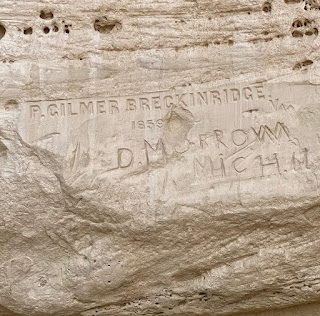 |
| Breckinridge inscription at El Morro, Martha Hutchens |
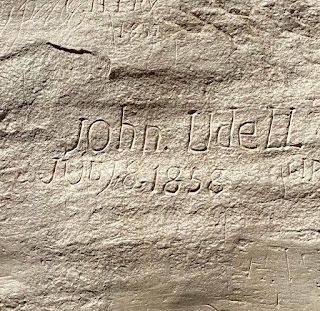 |
| Udell inscription at El Morro, Martha Hutchens |
L. J. Rose led the first wagon train along a new trail crossing New Mexico territory to reach California in 1858. They stopped at the water pool by El Morro, and ten of them signed the wall, including Rose, John Udell, and America Frances Baley, and Sarah Fox, who was only twelve years old at the time. Nearly 500 miles farther along the trail, this train would be attacked by Mojave warriors. Sarah Fox was shot with an arrow and witnessed her father’s death. The caravan’s wagons were burned and the people passed El Morro again on their return to Albuquerque. However, the next year they completed their journey to California along a different trail.
In 1906, Teddy Roosevelt designated El Morro as a national monument, though New Mexico would not become a state for another six years. Since then, much work has been done to protect the inscriptions on the rock, because this soft rock that is so easy to carve also erodes easily. During the depression, Franklin Delano Roosevelt created the Civilian Works Administration, which hired men to make a path to the top of El Morro so that visitors could see the remains of the village that once occupied this area. These 48 men also left their mark on the bluff, though not in writing.
If you visit New Mexico, I highly recommend a stop at El Morro, where a thousand years of history is written in rock.
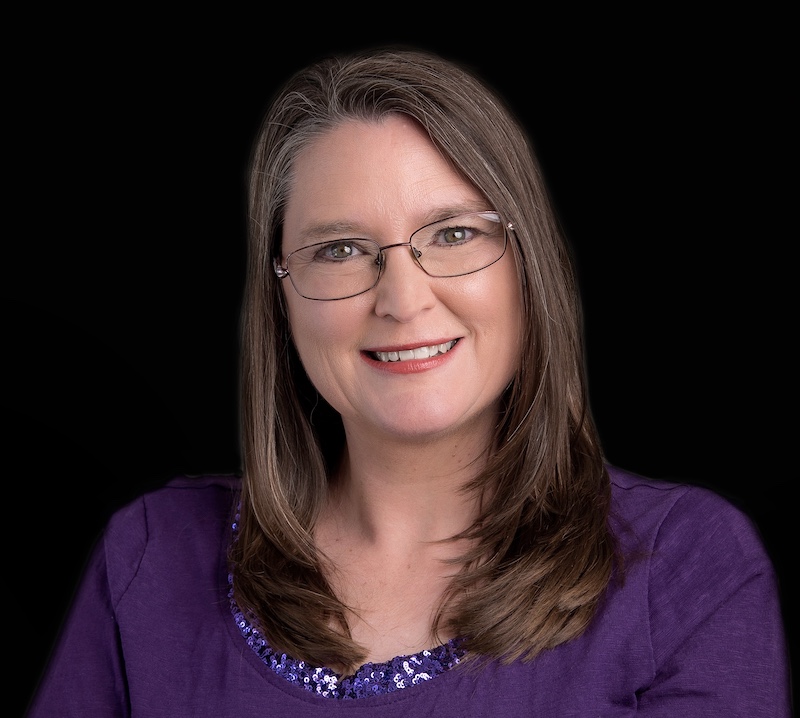
Martha Hutchens is a transplanted southerner who lives in Los Alamos, NM where she is surrounded by history so unbelievable it can only be true. She won the 2019 Golden Heart for Romance with Religious and Spiritual Elements. A former analytical chemist and retired homeschool mom, Martha is frequently found working on her latest knitting project when she isn’t writing.
Martha’s current novella is set in southeast Missouri during World War II. It is free to her newsletter subscribers. You can subscribe to my newsletter at my website, www.marthahutchens.com

Nate Armstrong has all the land he can manage, especially if he wants any time to spend with his four-year-old daughter. Still, he can't stand by and watch the Finley family lose their dream. Especially after he learns that the banker's nephew has arranged to have their loan called.
Necessity forces them to work together. Can love grow along with crops?


