Showing posts with label Betsy Wetsy. Show all posts

Thursday, December 12, 2024

Betsy Wetsy and the Doll Wetting Wars

By Kathy Kovach

What is the most popular gift every little girl in the world has wanted to find under the Christmas tree for centuries? A baby doll. One of their very own that they could cuddle, nurture, sing lullabies to, and love. Then we had children of our own and asked ourselves, “What were we thinking?” Babies are hard!

Throughout the past decades, toy makers tried to warn us. They made dolls that gurgled and cooed. They made dolls that blew bubbles and moved in our arms. And around the first half of the 20th century, they introduced dolls we could feed and inevitably change—because real babies wet themselves.

A lot.

The first such doll was created by the Effanbee Doll Co., named for Bernard Fleischaker and Hugo Baum, (the F and B came from their last names). They were innovative in their doll design. Their tagline was “dolls that touch your heart.” In 1930, they were the first to produce a realistically proportioned doll named Patsy Joan. At 16”, she was the size of a real newborn baby with blue or brown eyes that had lashes and a tiny closed mouth. Sixteen years later, they made one with dark skin, quite groundbreaking in the mid-1940s.

Other doll designs from Effanbee followed, but the one that would truly train little girls to become mommies was their 1933 creation, the Dy-Dee doll. As the name would imply, Dy-Dee needed diapers.

A lot.

Dy-Dee doll
Dy-Dee was made with a tube inside her infantile body, running from her mouth to . . . well . . . you know. The more she ate, the more she . . . you know. Effanbee’s determination to produce realistic dolls also produced much controversy. Many parents found the doll offensive, but others, who no doubt embraced the adage "someday you’ll have a child just like you", were thrilled to bring the sweet little sprinkler into their home. Montgomery Ward sold the dolls in record numbers and Dy-Dee became a best-seller, attributing largely to Effanbee’s success.

What followed was the Wetting Doll Wars.

Dy-Dee’s achievement got the attention of other doll companies, in particular, the American Character Company who had been making dolls since 1919. With the success of the wetting doll, they came up with Wee-Wee in 1935. Even the most astute doll manufacturer could see the similarity in the names, Dy-Dee and Wee-Wee, if not in their unique functions. Effanbee successfully sued American Character and Wee-Wee went bye-bye.

In a sneak attack, another company entered the fray. The Ideal Toy Company of New York had already been in the doll business thirty years by the time Betsy Wetsy hit the market in 1937 to the delight of future mamas everywhere. Once again, Effanbee attempted to protect their product by suing Ideal. However, this time a different judge ruled in Ideal’s favor, stating that drinking and wetting were natural bodily functions and thus could not be patented. As a result, Betsy Wetsy became the most iconic toy of the post WWII era.

Betsy Wetsy ad
The Wetting Doll Wars were far from over, however, with the introduction of Tiny Tears in 1950. She could not only soak a diaper, but she could cry. Tiny Tears was my doll. She trained me well for when my first child suffered from colic. However, I couldn’t toss him in the toy box to make it stop.

But I digress.

Tiny Tears ad
With the innovation of a crying doll, Ideal, who had been previously sued for bodily function infringement, now went on to make a Betsy Wetsy doll who could cry. The manufacturers of Tiny Tears, American Character, took them to court. The suit must have been tossed as American Character still had the doll when they filed for bankruptcy in 1968. Seeing this as their chance to own the nation’s most popular doll, Ideal swooped in and saved Tiny Tears from annihilation, at least until 1985, when production of the beloved toy ceased.

Now, my babies are in their forties, (even my colicky one) with babies and grandbabies of their own. But I still remember fondly my wetting doll, and as I reminisce, I whisper to myself, “What was I thinking?”

I couldn’t find a picture of me with my Tiny Tears, but here is one of a good friend with hers that she posted on Facebook.

Dec 25, 1956, age 13 months

A TIME-SLIP NOVEL

A secret. A key. Much was buried on the Titanic, but now it's time for resurrection.
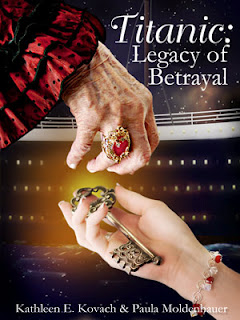

Follow two intertwining stories a century apart. 1912 - Matriarch Olive Stanford protects a secret after boarding the Titanic that must go to her grave. 2012 - Portland real estate agent Ember Keaton-Jones receives the key that will unlock the mystery of her past... and her distrusting heart.
To buy: Amazon


Kathleen E. Kovach is a Christian romance author published traditionally through Barbour Publishing, Inc. as well as indie. Kathleen and her husband, Jim, raised two sons while living the nomadic lifestyle for over twenty years in the Air Force. Now planted in northeast Colorado, she's a grandmother and a great-grandmother—though much too young for either. Kathleen has been a longstanding member of American Christian Fiction Writers. An award-winning author, she presents spiritual truths with a giggle, proving herself as one of God's peculiar people.


Friday, July 4, 2014

Before Barbie, There Was Patsy

by Pamela S. Meyers


Happy Fourth of July everyone!

While researching toy dolls of the 1920’s, to see what was popular back then, I was reminded of a porcelain head doll that had been handed down through my family and had to be from the late 1800s or early 1900s. She came complete with a small trunk of handmade clothes of her era. When I was around eight or nine years old, my mother told me I could play with her, but I needed to be very careful to not drop her because her head would break.

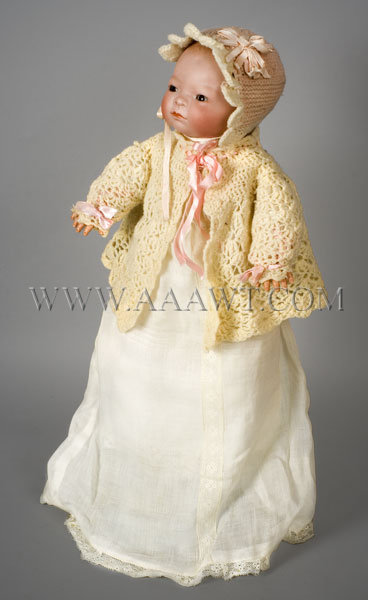
This is similar to the doll I broke
Of course that’s exactly what happened.

My heart crushed as I saw her beautiful face shatter into what seemed a bazillion pieces. At the time, I was more afraid of my mother’s ire than regret over breaking such a treasure, but now I realize how much my mom must have berated herself for giving me the doll. It makes me wonder how often were little girls given such fragile dolls to play with back in the day. I’m sure I wasn’t the first child to break a doll's head.

According to Collectors Weekly’s website, in the 1920s, doll makers were using a composite material that Lazarus Reichmann developed. The substance was inexpensive and flexible for molding doll bodies. And little girls couldn’t break it, which had to be a plus.

At that time, the Patsy Doll became the rage, much the way Cabbage Patch dolls and Barbies shot up the popularity list in more recent times. Does anyone remember the long lines of shoppers waiting to purchase a Cabbage Patch doll? According to several websites, the Patsy doll, made by the Effanbee Doll Company, is one of the most popular dolls ever made. She came in a variety of sizes, each size with its own name. The original design was that of a typical three-year-old girl.
The Patsy Doll


Patsy was one of the first dolls to have her own wardrobe of outfits and accessories, along with her own newsletter. 

When World War II began, the doll's popularity declined and Effanbee nearly went out of business, until the company was purchased by Noma Electric, and Patsy continued to live on.

Nowadays, the Robert Tonner Doll Company owns the rights to Patsy and she's still around some 90 years after she first made the scene.


Reading all this information, brought to mind my Betsy Wetsy doll which I still have. Betsy could be fed a real bottle and a moment later she'd wet her diaper. As I recall, I was only allowed to feed her water. :-)

Betsy Wetsy
The years have been unkind to Betsy and she has lost both her legs. Well, I actually still have them. They just aren't attached to Betsy anymore. Some time ago, my mom surprised me at Christmas with Betsy. She'd given her a makeover, complete with a new dress, bonnet, and booties that she had made (at the time the legs were still attached). She now sits on a shelf in my bedroom, her full skirt covering the space where her legs should be.


Your turn! Do you have any antique dolls handed down in your family? Are you a doll collector? Please share!


A native of Lake Geneva, Wisconsin, author Pamela S. Meyers lives in suburban Chicago, an hour's drive away from her hometown which she visits often to dig into its historical legacy. Her novels include Thyme for Love, and Love Will Find a Way,  contemporary romantic mysteries and her 1933 historical romance, Love Finds You in Lake Geneva,Wisconsin, released in April, 2013. She can often be found speaking at events around Lake Geneva or nosing in microfilms and historical records about Wisconsin and other Midwestern spots for new story ideas.