Showing posts with label Antique Toys. Show all posts

Saturday, April 19, 2025

Toys of the 1900s - From Wooden Tops to Whirligigs

By Susan G Mathis

At the turn of the 20th century, children's playtime was filled with the simple joys of handmade toys. In 1900, an array of charming and timeless playthings captivated the imagination of youngsters across the globe. From the humble wooden tops to the whimsical jumping jack man, these toys were not just sources of entertainment but also treasured artifacts of a bygone era.

Wooden tops were a ubiquitous sight in the hands of children during the early 1900s. Crafted from wood and often hand-painted with vibrant colors, these spinning marvels were propelled into action with the help of a string and a quick twist of the fingers.

Games of chance and skill were prevalent in the 1900s, with dice and teetotum being popular choices. Wooden dice were used in various games that tested luck and strategy. The teetotum, a spinning top with numbered sides, added an element of unpredictability to games, making them both entertaining and educational.

The yo-yo, with its timeless appeal, quickly became a sensation. The whirligig, a delightful and whimsical toy consisting of a spinning propeller mounted on a stick, the whirligig was set in motion by the wind or a twirling motion from the child.

The bilbo catcher, a skill-based toy, challenged children to improve their hand-eye coordination. Consisting of a wooden cup attached to a handle by a string, players aimed to catch a small wooden ball in the cup as it swung back and forth. The bilbo catcher not only entertained but also honed motor skills, making it a valuable plaything for development.

The jumping jack man added a touch of theatricality to playtime. Comprising a jointed figure attached to strings, pulling a cord caused the limbs to move, creating a whimsical dance. The jumping jack man brought a sense of animation to the toy box, allowing children to bring their imaginations to life. In A Summer at Thousand Island House, the children play with these toys.

What’s your favorite childhood toy? Leave your answer or comments on the post below and join me on February 19th for my next post.


ABOUT A SUMMER AT THOUSAND ISLAND HOUSE


Addison Bell serves children of the Thousand Island House guests on Staple’s Island. While thriving in her work, Addi’s vivacity attracts the attention of the recreation pavilion’s manager, Liam Donovan, as well as the handsome Navy Officer Lt. Worthington, a lighthouse inspector, hotel patron, and single father of mischievous little Jimmy. When Jimmy goes missing while in Addi’s care and former President Chester Arthur finds the child a stowaway on his fishing boat, her job and reputation are endangered. How can she calm the churning waters of Liam, Lt. Worthington, and the President, clear her name, and avoid becoming the scorn of the community?


ABOUT SUSAN


Susan G Mathis is an international award-winning, multi-published author of stories set in the beautiful Thousand Islands in upstate NY. Susan has been published more than thirty times in full-length novels, novellas, and non-fiction books. She has fourteen in her fiction line. Susan is also a published author of two premarital books, stories in a dozen compilations, and hundreds of published articles. Susan lives in Colorado Springs and enjoys traveling the world. Visit www.SusanGMathis.com/fiction for more.


Sunday, June 4, 2017

Late 19th Century Toys - and a Giveaway


The books and TV shows which most often draw my attention portray settlers and people in transition. Characters who have more love than money, and where essential necessities came first. Toys made with whatever was on hand, such as a doll made with leftover fabric scraps, or a pair of stilts made with wood salvaged from the woodpile.


Two boys playing on stilts, ca. 1890-1916. Source: Glenbow Archives NC-39-293


In some of those stories, children with toys were usually from affluent families where children had time on their hands and more often than not, were spoiled. In my own childhood, we were raised with the ridiculous notion that your bank account dictated your character. I could write a sermon on that point of view, but I'd rather talk about toys.

In 1890, trains were crossing North America with rapid regularity and towns with amenities were springing up every 10 miles or so along the railroad tracks. Although the land was still being settled, a settler could find almost anything in a nearby town, including toys, and what wasn't readily available could be ordered by catalog.

Because I've already mentioned dolls, I wanted to show you an assortment of dolls ca. 1890s with a photograph held at the Glenbow Archives in Calgary, Alberta. There is no mention of what type of dolls, nor their age, but to my untrained eye, some of them look like ones you'd buy in a store due to their porcelain/bisque heads and hands.


Group of Dolls, ca. 1890s. Source: Glenbow Archives NC-22-43


Doll houses have been fashionable for centuries with females of all ages, with its size and construction dependent on materials and ability to create and furnish. A quick search on the internet shows doll houses in many museums built for noble and royal women with stunningly exquisite pieces. 

The following photograph is from the McCord Museum with the following information: "Special toys represent a microcosm of daily life. This doll's house, photographed for Captain Howard around 1873-74, is divided into four main rooms: the kitchen, dining room, parlour and bedroom or play room. The open front has four windows decorated with lace-like curtains, similar to those in the music room seen earlier. There are miniature mirrors on the sideboard and dresser, metal kitchen implements hanging on the wall and centrally suspended lights. Doll's houses give children ideas about how the domestic interior should be arranged and decorated, but are also owned as adult amusements."


The Ladies' Home Journal included detailed instructions on making a doll house in the article, A Little Girl's Play-House. The article is too long to paste here, but it's available as part of a free eBook on GooglePlay. After downloading, find page 7 of the December 1887 issue. 

With thoughts of little girls in mind, I searched for one of my favorite childhood toys, the tea set, and chose this next modern photo of a tea set dated 1890-1920 which was gifted to the McCord Museum by Mrs. Raymond Caron.


I love everything about this tea set, from its dainty design to its hexagon cups and saucers. 

The boy is this next photo has an assortment of books and toys, including what looks like lithographed blocks. I thought perhaps he'd be a good representative of a family with a little extra money to spend on toys until I realized he was the son of Charles Selby Haultain, Assistant-Surgeon for the North-West Mounted Police depot in Regina, Saskatchewan. As such, his father would have been higher on the pay scale than the average man, whether lawman, settler, or somewhere in between.


Robert Mitchell "Robin" Haultain with his blocks and other toys, Regina, Saskatchewan, ca. 1891-1894. Source: Glenbow Archives ND-37-3

My search for outdoor fun toys led me to look for photographs of kids and wagons which were difficult to make at home due to the metal parts. I thought perhaps I'd find metal wheels and a wood body, like the adult-size versions, but it seems the ones I found were all-metal construction except possibly for the handle. This particular one has the information that it was probably photographed in Montana.


Herbert and Phoebe Kimball hauling wood in their wagon, ca. 1890-1905. Source: Glenbow Archives NC-39-301

Of course, when you digest the content of the above image, you see that the children are doing chores with their wagon. If that's a doll on the wood pile beside the little girl though, perhaps she was able to give it a ride as they went along, or afterward. 


Portrait of Arthur Patterson blowing bubbles, Maple Creek, Saskatchewan, ca. 1897-1900. Source: Glenbow Archives NA-5733-10


I was surprised to find an image of a boy blowing bubbles dated ca. 1897-1900, probably because I associate bubble-blowing with dish-washing liquid and that doesn't strike me as something you'd find at the turn of the century. Location-wise, the Maple Creek area is across the border from Fort Benton, Montana which makes me wonder if they were blowing bubbles down there at that time, too. Would his bubble-making pipe be store-bought? 

Which brings us to a toy I always wanted, but never received as a child . . . the regal rocking horse. Like a doll house, expense depended on size, materials, and workmanship, although it required a skilled craftsman to carve it.


There are many images of children and their rocking horses, most of them studio images like the glass negative shown here. I chose this one from the McCord Museum however, because it includes this tidbit of photographic history:
"If you look behind Thomas Crathern's feet, you can see a pole. In Miss Pominville's picture, did you notice a curtain draped behind her feet? That was to hide the base of the posing stand, against which both of them are leaning, to help them stay still for the photograph. Master Thomas must have had a harder time of it than Miss Pominville, because he is sitting on a rocking horse, which is made to move. The photographer has jammed one of the feet of the posing stand under the rocker on the far side, so Thomas has a hope of staying still." Source : In the Eye of the Camera [Web tour], by Nora Hague, McCord Museum


For the last image we have a rocking horse suitable for younger children. Although we don't use these any longer due to the safety aspect, I thought this type of rocking horse was more of a vintage style, rather than an antique. 

Lawrence and Watson Dunbar, west of Fort Macleod, Alberta, ca. 1893. Source: Glenbow Archives NA-2033-3

The images in this post are representative of items a person might find in a general store, mercantile, and emporium in the Old West. If not physically in the store, they could be ordered through a catalog.

In my novella, Love in Store, my hero has set up a toy corner in his Emporium where a person might find any or all of the items on this page, and then he has to defend his position of why he's selling them.

Other posts here on HHH that show more images pertaining to my Love in Store novella are:
- General Stores, Mercantiles & Emporiums
- Early Typists at Work


#Giveaway - If you'd like a chance to win a copy of The Secret Admirer Romance Collection which contains nine novellas including, Love in Store, leave a comment on this post before midnight, Sunday June 11, 2017. 


~~~~~~~~~~~~~~~~~~~~~~~~~~~~~~~~~


Anita Mae Draper writes her historical romances under the western skies of the Saskatchewan prairie where her love of research and genealogy yield fascinating truths that layer her stories with rich historical details. Her Christian faith is reflected in her stories of forgiveness and redemption as her characters struggle to find their way to that place we call home. Anita loves to correspond with her readers through any of the social media links found at
Readers can enrich their reading experience by checking out Anita's Pinterest boards for a visual idea of her stories at www.pinterest.com/anitamaedraper.


Monday, November 28, 2016

How Marbles Changed Christmas

by Tamera Lynn Kraft


When we think about Christmas, one of the first things that come to mind is children opening up presents and being delighted by the newest toy. But in the past, toys weren’t always affordable for the average child. One toymaker from Akron, Ohio changed all of that.

In 1884, Samuel C. Dyke created the first mass produced inexpensive toy in the world, a clay marble. Marbles had been around for centuries, but they were expensive to make and buy because they were hand made one at a time. Dyke changed all of that with the Akron Marble and Toy Manufacturing  Company, and overnight, the company became the largest in the 19th century because children could now afford to buy toys. A penny would buy a handful of marbles.

Soon, he began producing miniature replicas of common household items for children to play with. The rubber companies in Akron took notice and began producing rubber balls, balloons, duckies, and rubber baby buggy bumpers. Soon other companies were producing cast iron toys, tin toys, bicycles, peddle toys, tops, and children’s books. A whole new industry had opened up, and now even poor children had toys to play with.

32 more toy marble companies opened in the greater Akron area between 1884 and 1951. Toys became such a profitable industry that by 1920 there were 120 toy companies in Akron alone. So on Christmas when your children are playing with their new toys, remember it all began with making mass produced marbles in Akron, Ohio.

Tamera Lynn Kraft has always loved adventures and writes Christian historical fiction set in America because there are so many adventures in American history. She has received 2nd place in the NOCW contest, 3rd place TARA writer’s contest, and is a finalist in the Frasier Writing Contest.

Her novellas Resurrection of Hope and A Christmas Promise are available on Amazon and Barnes and Noble.
 

Friday, July 4, 2014

Before Barbie, There Was Patsy

by Pamela S. Meyers


Happy Fourth of July everyone!

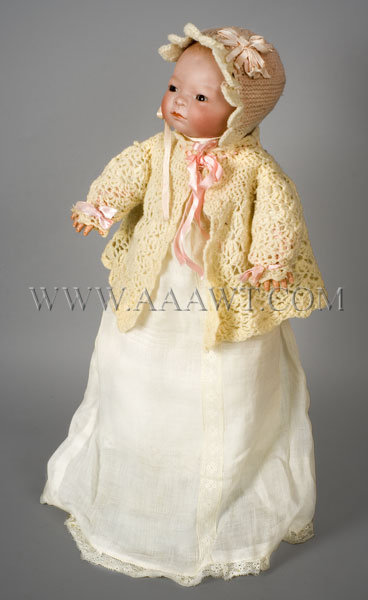
While researching toy dolls of the 1920’s, to see what was popular back then, I was reminded of a porcelain head doll that had been handed down through my family and had to be from the late 1800s or early 1900s. She came complete with a small trunk of handmade clothes of her era. When I was around eight or nine years old, my mother told me I could play with her, but I needed to be very careful to not drop her because her head would break.

This is similar to the doll I broke
Of course that’s exactly what happened.

My heart crushed as I saw her beautiful face shatter into what seemed a bazillion pieces. At the time, I was more afraid of my mother’s ire than regret over breaking such a treasure, but now I realize how much my mom must have berated herself for giving me the doll. It makes me wonder how often were little girls given such fragile dolls to play with back in the day. I’m sure I wasn’t the first child to break a doll's head.

According to Collectors Weekly’s website, in the 1920s, doll makers were using a composite material that Lazarus Reichmann developed. The substance was inexpensive and flexible for molding doll bodies. And little girls couldn’t break it, which had to be a plus.

At that time, the Patsy Doll became the rage, much the way Cabbage Patch dolls and Barbies shot up the popularity list in more recent times. Does anyone remember the long lines of shoppers waiting to purchase a Cabbage Patch doll? According to several websites, the Patsy doll, made by the Effanbee Doll Company, is one of the most popular dolls ever made. She came in a variety of sizes, each size with its own name. The original design was that of a typical three-year-old girl.
The Patsy Doll


Patsy was one of the first dolls to have her own wardrobe of outfits and accessories, along with her own newsletter. 

When World War II began, the doll's popularity declined and Effanbee nearly went out of business, until the company was purchased by Noma Electric, and Patsy continued to live on.

Nowadays, the Robert Tonner Doll Company owns the rights to Patsy and she's still around some 90 years after she first made the scene.


Reading all this information, brought to mind my Betsy Wetsy doll which I still have. Betsy could be fed a real bottle and a moment later she'd wet her diaper. As I recall, I was only allowed to feed her water. :-)

Betsy Wetsy
The years have been unkind to Betsy and she has lost both her legs. Well, I actually still have them. They just aren't attached to Betsy anymore. Some time ago, my mom surprised me at Christmas with Betsy. She'd given her a makeover, complete with a new dress, bonnet, and booties that she had made (at the time the legs were still attached). She now sits on a shelf in my bedroom, her full skirt covering the space where her legs should be.


Your turn! Do you have any antique dolls handed down in your family? Are you a doll collector? Please share!


A native of Lake Geneva, Wisconsin, author Pamela S. Meyers lives in suburban Chicago, an hour's drive away from her hometown which she visits often to dig into its historical legacy. Her novels include Thyme for Love, and Love Will Find a Way,  contemporary romantic mysteries and her 1933 historical romance, Love Finds You in Lake Geneva,Wisconsin, released in April, 2013. She can often be found speaking at events around Lake Geneva or nosing in microfilms and historical records about Wisconsin and other Midwestern spots for new story ideas.