Showing posts with label Christmas Card history. Show all posts

Wednesday, December 24, 2025

The History of Christmas Cards

By Terrie Todd

In December, 1611, England’s King James I and his son, Prince Henry Frederick, received a hand-made card from someone named Michael Maier. The message said, “Greeting on the birthday of the Sacred King, to the most worshipful and energetic lord and most eminent James, King of Great Britain and Ireland, and Defender of the true faith, with a gesture of joyful celebration of the Birthday of the Lord, in most joy and fortune, we enter into the new auspicious year 1612.”

The card was not discovered until 1979, in the Scottish Records Office, by Adam McLean, but the date makes it the oldest known Christmas card ever sent.

Fast forward over two hundred years to 1843. Sir Henry Cole got a brilliant idea. Three years earlier, he’d introduced the Penny Post—a scheme whereby letters could be mailed for a penny each. Now, he commissioned John Callcott Horsley of London to create a design for what would become the first commercially printed Christmas card. The central image portrays a family raising a toast. On either side are depicted acts of charity. Cole had 2,050 cards printed that year and they sold for a shilling each.

Cole's card. Public Domain, https://commons.wikimedia.org/w/index.php?curid=3095682
The tradition began to take off, although cards did not display Christmas or winter scenes so much as flowers and signs of spring.

By 1874, the lithograph firm Prang and Mayer began selling Christmas cards in America, earning Prang the nickname, “Father of the American Christmas Card.” By the 1880s, Prang’s production had reached over five million elaborate, Victorian-style cards a year. By this time, the cards displayed nativity scenes, Christmas trees, and winter wonderlands, creating a job market for artists.

A Victorian-style card from 1885. Public Domain, https://commons.wikimedia.org/w/index.php?curid=4340233
In 1913, Joyce Hall and her brother Rollie established the Hallmark Cards company and strove to meet the demand for more personalized cards for every occasion. During the war years, Christmas cards began to take on patriotic themes and Hallmark produced cards specifically for sending to soldiers.

President Johnson’s 1967 White House Christmas Card, By Robert Laessig, commissioned by the Johnson Administration, Public Domain, https://commons.wikimedia.org/w/index.php?curid=46951492

Along the way, the Family Newsletter became a tradition for many. Often tucked into a Christmas card, the author would include an annual update on the lives of family members for friends who may not connect from one December to another. With the advent of email, the sending of eCards and electronic newsletters has become a much less expensive way to accomplish this goal. Modern methods, however, will never replace the long string of colorful Christmas cards displayed across windows or around Christmas trees, nor can technology duplicate the nostalgia those cards evoke.


Terrie is the award-winning author of eight historical and two split-time novels, many of which have won Word Awards through The Word Guild. Her 2023 release, April’s Promise, was a finalist in the ACFW Carol Awards. She lives with her husband, Jon, on the Canadian prairies.


Todd (Even If We Cry) delivers a pulse-pounding tale of survival at sea during WWII. Withdrawn 41-year-old piano teacher Mary Cornish is an unlikely candidate for wartime heroics, but when her reverend encourages her to apply for a program seeking adults to accompany children out of war-torn England to Canada, she finds unexpected purpose in the task. Fans of Historical Fiction will be rapt." (Publisher's Weekly Review)

Follow Terrie here:

Blog

Facebook

Quarterly Newsletter Sign-up

Sunday, July 31, 2022

Christmas in July - The History of Christmas Cards


During the 1840s England, one custom at Christmastime was to send out the Christmas letter to all your friends. It had to be delivered between December 25th and New Year's. Thanks to a recent expansion of the British postal system, the sender could mail a letter or card anywhere in the country by affixing a penny stamp to the correspondence--and many people were doing just that.

Sir Henry Cole - Wikicommons

Sir Henry Cole, who traveled in the elite social circles of early Victorian England, had the misfortune of having too many friends—and this was a problem. As the founder of the Victoria and Albert Museum in London and an enthusiastic supporter of the new postal system, Sir Cole was a busy man.

As he watched the stacks of unanswered Christmas correspondence piled up and he fretted over what to do. In Victorian England, it was considered impolite not to answer mail. He simply had to figure out a way to respond to all of these people in a timely manner.


Cole hit on an ingenious idea. He asked artist friend, J.C. Horsley, to design an idea that Cole had sketched out in his mind. Cole then took Horsley’s illustration—a triptych showing a family celebrating the holiday flanked by images of people helping the poor—and he had a thousand copies made by a London printer. The image was printed on a piece of stiff cardboard 5 1/8 x 3 1/4 inches in size. At the top of each was the salutation, “TO:_____” allowing Cole to personalize his responses, which included the generic greeting “A Merry Christmas and A Happy New Year To You.” At the bottom was a "From" line where he could sign his name—and the first Christmas card had just been created.
Henry Cole sounds like a practical and clever man.

Since it's still July, and I'm talking Christmas in July, I thought I'd share one of my heart-warming Christmas stories with you.


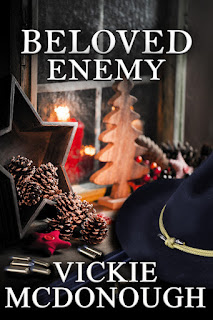
As a Union sniper, killing has become easy for Captain Christmas “Chris” Haley. After four long years of fighting against his own countrymen, the once naïve farm boy is now a war-hardened soldier whose faith in God is shaken. Chris is ready to set aside his rifle and return to his Kansas farm. But will his family accept the man he’s become—angry and unsure if he still believes in God? His mother's pretty caregiver catches his eye and begins to give him a reason to go on each day. In spite of his bitterness, his heart is softening. But what happens when he learns the secret Hannah is keeping?

Available on Amazon / Free KU


Vickie McDonough is the CBA, EPCA, and Amazon best-selling author of 50 books and novellas. Vickie grew up wanting to marry a rancher, but instead, she married a computer geek who is scared of horses. She now lives out her dreams penning romance stories about ranchers, cowboys, lawmen, and others living in the Old West. Vickie’s books have won numerous awards including the Booksellers Best, OWFI Best Fiction Novel Award, and the Inspirational Readers’
Choice awards. 


Monday, December 12, 2016

Christmas Angst and two free Christmas books

Stephanie Grace Whitson


A footnote from history


by Stephanie Grace Whitson


Only 13 days until Christmas, and some of us are feeling the pressure. Did you know that holiday stress produced the first Christmas card? Neither did I ... until reading a Smithsonian article about the first published card (pictured below.) 


The first Christmas card. 1843.
Not answering mail was a serious social faux pas in Victorian England, and as Sir Henry Cole watched his mail pile up--thanks to a new "penny post" that made it possible for nearly anyone to use the postal service--his stress mounted. 

The answer, Sir Cole decided, was to have an artist friend sketch a scene and then have 1,000 copies printed on stiff cardboard. Adding "To" at the top and "From" at the bottom, allowed Sir Cole to personalize the greeting. 

An industry began--as did controversy (everyone has an opinion about everything, and that's not new). The temperance movement folks thought Cole was encouraging underage drinking (note the child in the foreground sipping from what looks like a wine glass). But the idea caught on, and within a few years, other Victorians had copied Sir Henry's idea and were sending cards of their own.

Our American Christmas card industry began back in the early 1900s, when Joyce Hall's postcard-printing company produced its first holiday post card. We all know about the Halls, who changed the company name to Hallmark about ten years after producing that first holiday post card. 

You can see a lovely online exhibit of vintage Christmas post cards here: http://www.indiana.edu/~liblilly/xmas2/

The card at left from my personal collection, is postmarked 1915. The message told the recipient that she had received a subscription to "Comfort" as a gift and wished "that its monthly visits may never cease to cheer and comfort you." 

In the spirit of the gift-giving season, I'll send a copy of either A Patchwork Christmas or A Basket Brigade Christmas to two readers who join the conversation (and who provide a way to contact them for their shipping address). 

Here's the topic:

Do you send real or virtual Christmas cards? How do you decide on a design or a message? 


__________________________________________

Stephanie Grace Whitson is the author of nearly thirty books, including two Christmas novellas featured in these collections published by Barbour.
Learn more at www.stephaniewhitson.com


http://bit.ly/2ghzrph

http://amzn.to/2h2Dt3R