Showing posts with label Herrenchiemsee. Show all posts

Sunday, March 12, 2023

King Ludwig II: The Mad King

 By Kathy Kovach


In this third and last installment of King Ludwig II’s life, I'll explore yet another name he was known for. If you missed the first two, please click on these links: The Fairytale King, because of his fanciful and romantic nature, and The Moon King, due to his adoration of King Louis XIV, known as the Sun King. Now, let’s delve into what made the Mad King appear insane. Or was he? The jury is still out on that. At any rate, Ludwig had such a large personality, one name simply couldn't contain his many facets.

Herrenchiemsee

Boat to Herrenchiemsee with Fraueninsel Island and Frauenworth Abbey in the background.

He'd built three castles, two of which he barely lived in. Please follow the links where I've written about Neuschwanstein, and Linderhof. Herrenchiemsee, (pronounced hare-en-keem-say,) the third one Ludwig commissioned, sits on the large island known as Herreninsel in Lake Chiemsee. The only way to this most opulent edifice was, and still is, by boat. As I stated in the previous articles, my husband, two sons, and I vacationed in Bavaria while hubs was serving in the Air Force and stationed at Frankfurt. Not only did we travel to the island by boat, but we also took a carriage ride three-and-a-half miles to the castle. However, we did walk back through the beautiful countryside.

Hall of Mirrors Herrenchiemsee

Domed ceiling in the Herrenchiemsee Hall of Mirrors

To contrast, this is the Hall of Mirrors in the Palace of Versailles
Construction on Herrenchiemsee started in May of 1878 and was his most ambitious venture yet. He modeled the architecture and the grounds after the Palace of Versailles as a tribute to King Louis XIV. The most prominent feature was the Hall of Mirrors where twenty-five frescos with paintings of his idol’s most glorious days were framed by mirrors. Lots of mirrors. The Hall of War is on one side, and the Hall of Peace is on the other, with each having six windows. The domed ceiling also has paintings of the French king.

Smaller than Versailles, Herrenchiemsee is notably the largest of the three castles Ludwig built. It was never meant to become a government seat nor to be home to the royal court. Its purpose was to be a personal residence for the reclusive king who thought a palace set in a forest in the middle of an island the ideal retreat. As is the case with Neuschwanstein, this third of Ludwig’s efforts also remained unfinished. In fact, Ludwig only spent a total of ten days in his new residence.

Memorial Cross at the site where the body of Ludwig II was found in Lake Starnberg
Wikipedia

Among King Ludwig’s numerous monikers, the Mad King of Bavaria is what clung on like the smell of sauerkraut. The question of the ages, however: Was he really insane or simply eccentric? His enemies would say the former as they worked to bring him down, which seemed the case when he was eventually deposed and put under the care of a psychiatrist who declared him insane. Both men met their end in a mysterious manner after taking a walk around a lake. Ludwig’s supporters seemed to enable his quirkiness and attributed it to his past. The boy prince with a sad family life—overbearing Bavarian father and distant Prussian mother—became the boy king much too young at the age of eighteen.

Then two years later, he suffered a devastating defeat when Prussia conquered Austria and Bavaria. Bavaria’s foreign policy was then dictated solely by the dominant government, leaving Ludwig at the mercy of his Prussian uncle. Is it any wonder he succumbed to his childhood means of escape and lost himself in a fantasy world he could control?
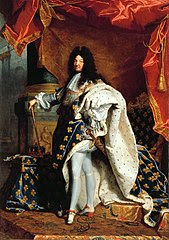
King Louis XIV of France
His obsession with King Louis XIV and the opera composer Richard Wagner didn’t help his case as he spent millions on expensive tributes, including Versailles-like castles and a large grotto dedicated to one act of an opera.

Even though he was friendly enough to those he ruled, often handing out cash to those who befriended him, he was also reclusive—to the point of bizarre. In both Linderhof and Herrenchiemsee, he had installed a “wishing table” based on a Grimm fairytale where the dining table disappeared into the floor and reappeared fully set. In the castle, gears and mechanisms lowered the elevator table to the kitchen where servants set it and then raised it up to the dining hall. This was to prevent Ludwig from having to see his servants, thus perpetrating the illusion of solitude. However, they were instructed to set the table for three or more people so the king could imagine himself feasting with people of importance, no doubt the king of France and his favorite composer would be “in attendance” at the fictional dinner.

Ludwig and Wagner
Speaking of Wagner, Ludwig started to fancy himself as characters in the operas he loved. He dressed like them and then would venture out in the night in costume. This, of course, led to the habit of sleeping only in the day. The fairytale king allowed himself to be consumed by his fancy.


King Ludwig II of Bavaria once told his governess, "I want to remain an eternal mystery to myself and others." It seems he made good on that promise, and the world has created its own obsession with the Mad King of Bavaria.


PLEASE VISIT THE BLOG TO COMMENT ON THIS POST

A TIME-SLIP NOVEL

A secret. A key. Much was buried on the Titanic, but now it's time for resurrection.


Follow two intertwining stories a century apart. 1912 - Matriarch Olive Stanford protects a secret after boarding the Titanic that must go to her grave. 2012 - Portland real estate agent Ember Keaton-Jones receives the key that will unlock the mystery of her past... and her distrusting heart.
To buy: Amazon


Kathleen E. Kovach is a Christian romance author published traditionally through Barbour Publishing, Inc. as well as indie. Kathleen and her husband, Jim, raised two sons while living the nomadic lifestyle for over twenty years in the Air Force. Now planted in northeast Colorado, she's a grandmother—and soon-to-be great-grandmother—though much too young for that. Kathleen has been a longstanding member of American Christian Fiction Writers. An award-winning author, she presents spiritual truths with a giggle, proving herself as one of God's peculiar people.


Thursday, January 12, 2023

King Ludwig II: The Fairytale King of Bavaria


By Kathy Kovach

King Ludwig II
Years ago, my family had the privilege of living in Frankfurt, Germany via the U. S. Air Force. In fact, we moved there twice, encompassing six-and-a-half years in that beautiful country.

One of our favorite things to do was “castle hopping”. Germany has a plethora of palaces, fortresses, castles, and burgs. Some more lavish than others. Some forbidding stone structures made for defense. And some, built after the age of such fantastic opulence. Three of these were the architectural marvels of King Ludwig II.

Ludwig Otto Friedrich Wilhelm von Wittelsbach (1845-1886) ascended to the throne at 18 years of age in 1864 and ruled for 22 years until his death. Perhaps because he’d begun his reign at such an early age, he became known by many monikers. The Dream King, Swan King, Fairytale King, and eventually, Mad King Ludwig. These names should tell you all you need to know about this man’s character. He lived in his own reality and had the means to implement it.

King Louis XIV
Heavily influenced by King Louis XIV and the Palace of Versailles, as well as the composer Richard Wagner, Ludwig went on to build three castles in Bavaria, all very different from each other, but equally over the top. In an age where these types of architecture were outdated, and no longer needed for strategic or defensive purposes, Ludwig ventured on.

Neuschwanstein Castle


Disney's Sleeping Beauty Castle
1959
Walt Disney Pictures and Buena Vista Distribution
The first castle, Neuschwanstein, was started in 1869 on a mountaintop just above his childhood home. He’d had visions as a boy to build a structure up on the peak with soaring fairytale towers. Is it any wonder that our modern-day Imagineer Walt Disney would use this castle as the backdrop for his production Sleeping Beauty and would also adopt it as his personal icon? Neuschwanstein literally translates to “New Swan Castle” in honor of one of Wagner’s operas referencing “the Swan Knight”. 
In addition, the swan was the family’s royal bird, and its likeness can be seen everywhere on the grounds.

A cave room, or small grotto, was artificially built between the salon and study. Sporting colored lights, stalactites, and a waterfall, one could enter as if simply walking through a hallway. At one point, however, a glass door slides into the “rock” and opens into the conservatory, a small room with a chair and table and a large window with a perfect view of the alpine foothills. This site has a couple of good images of the grotto and conservatory.

If the outside of the castle with its pristine white limestone walls and sky-blue spires recalls the age of German knights and damsels in distress, the inside invokes thoughts of romance. Gilded opulence and art murals depicting Wagner’s most famous operas meet the eye at every turn.

Throne Room

Singer's Hall

Ludwig's bedroom

Cupola

Drawing Room

Study

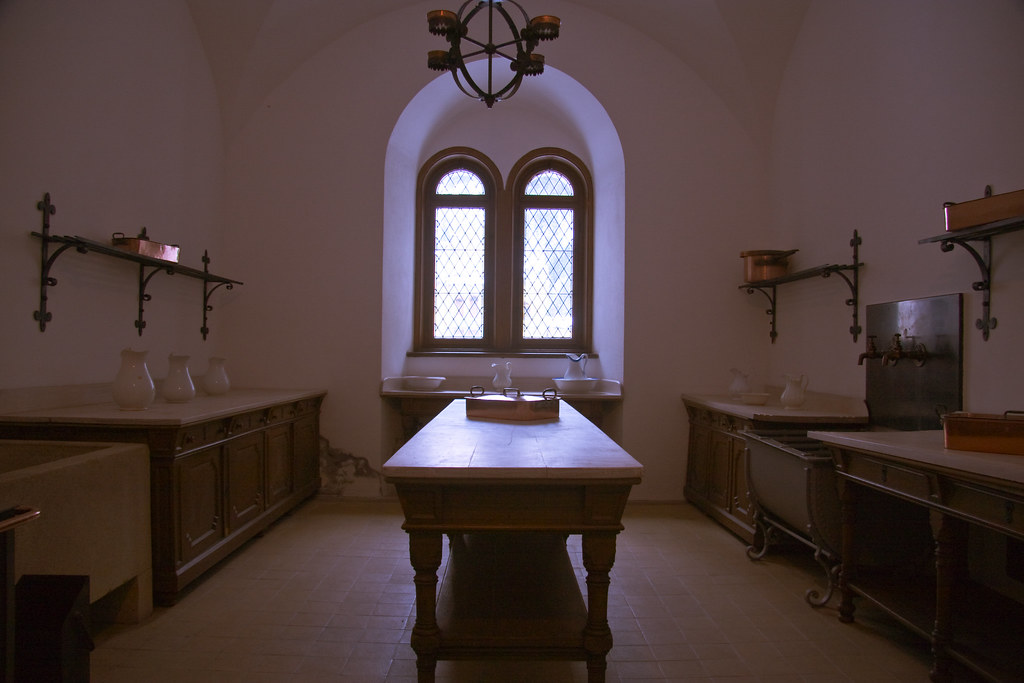
Kitchen
Quite a stark change from the opulence in the rest of the castle!
Only fourteen rooms were finished by the time of Ludwig’s death, and he had only stayed there a total of 186 days. Mere weeks after he died, the castle was opened for visitors to help pay off his enormous debt realized while building his three projects. He never used state funds but dwindled his personal royal account to the point where he had to borrow money.

King Ludwig II was deposed and declared mad due to his overspending on fanciful projects. One evening in 1886, he and Dr. Bernhard von Gudden—chief of the Munich Asylum
 and the psychiatrist tasked to supervise him—went on a walk and never came back. They were both found drowned in the nearby lake. There are several theories surrounding the events of that night. Some say Ludwig killed the doctor and then, in a suicidal act, threw himself into the lake. It was also reported that even though the official cause of death for Ludwig was suicidal drowning, the autopsy showed no water in his lungs. Some say Gudden had been hit on the head and strangled. Another theory states that Ludwig was getting into a boat that would take him to another point along the lake where loyalists would help him escape. However, when he stepped into the boat he was shot and died. Political coverups ensued. At this time, the deaths of both men remain a mystery.
Coronation Portrait
I'll be highlighting King Ludwig's other two castles, Linderhof and Herrenchiemsee, later in the year. He certainly led a fairytale life, but it's sad that he never had his happily ever after.


A TIME-SLIP NOVEL

A secret. A key. Much was buried on the Titanic, but now it's time for resurrection.


Follow two intertwining stories a century apart. 1912 - Matriarch Olive Stanford protects a secret after boarding the Titanic that must go to her grave. 2012 - Portland real estate agent Ember Keaton-Jones receives the key that will unlock the mystery of her past... and her distrusting heart.
To buy: Amazon


Kathleen E. Kovach is a Christian romance author published traditionally through Barbour Publishing, Inc. as well as indie. Kathleen and her husband, Jim, raised two sons while living the nomadic lifestyle for over twenty years in the Air Force. Now planted in northeast Colorado, she's a grandmother—and soon-to-be great-grandmother—though much too young for that. Kathleen has been a longstanding member of American Christian Fiction Writers. An award-winning author, she presents spiritual truths with a giggle, proving herself as one of God's peculiar people.