Showing posts with label King Ludwig II. Show all posts

Saturday, August 12, 2023

Don’t Lick the Walls - Salt Mine Berchtesgaden

By Kathy Kovach

Watzmann Mountain above Berchtesgaden
One of my favorite places to visit in Bavaria, Germany is the town of Berchtesgaden. Rich with history and lush with beauty, it’s nestled within the folds of rolling alpine forests and bejeweled by crystal clear lakes and rivers. Towering above in majesty is Watzmann Mountain, named after a nefarious king whose exploits I’ll leave for another day.

The little village has undergone many changes of ownership, from Augustine monks beginning in 1300 A.D. to an Austrian annexation in 1805. After a brief period of French rule in 1809, it finally found its legs as it came into the kingdom of Bavaria in 1810.

Even before the monks, the area was rich in salt deposits, and mining began in the early 12th Century. This sparked rivalry with two other salt-bearing, Austrian towns, now known as Hallein and Salzburg.
Mine entrance
The Berchtesgaden Salt Mine of today was actually created in the 1500s but didn’t become a fully developed state operation until the mid-1800s.

The salt, encased in composite rock, is flushed out with fresh water, leaving behind beautiful caverns. Although the mine is still in operation today, yielding 900,000 cubic meters of brine annually, (that’s over two million gallons!) it is now open to tourists. And might I say, even though a salt mine sounds dull, it’s far from it.

Visiting there was like taking a step back in time. Ushered into a room, our group was instructed to don period coveralls made of heavy material and cloth hats. Not only would these keep us warm as we ventured into the depth of the 54-degree Fahrenheit mine, but they, also, gave us a sense of history.
My family is toward the back. I'm not there as this was the second time we visited the mine, and I stayed back with my mother-in-law who had no desire to go underground.
From there, a small train, with a bench down the center that we straddled, took us into the mine. We soon disembarked and followed our tour guide into a dimly lit tunnel. On our way, we were told about the salt in the stone walls. Curious children moistened their fingers and slid them along the rock. Then they licked the salt off of them. Okay, some adults did it too. Fine. I did it, as well, but only after peer pressure from the others on the tour. I’d be surprised if they allowed that today now that we’re more germ aware.
First of two slides
Eventually, we came to the first of two slides, this one being 34 meters high. It descends to another level into a cavern that has opened up before us. This, we’re told, is how the miners would enter the mine quickly, much like a fireman’s pole, I would image. Other avenues, a path and a staircase, were provided for the less adventurous or for those with physical constraints. My husband and I were much younger then. We grouped our family of four, held on to each other, and swooshed to the bottom, much like the miners of old, except we squealed all the way to the bottom. The 250-year-old cavern, dubbed the Salt Cathedral, had, at one time, been filled with water.
Dedication plaque at grotto
Around the corner, a beautiful grotto, a tribute to the “Fairytale King” Ludwig II, created a small sanctuary with stacked square stones and blocks of backlit salt. I could find no pictures in public domain to use, showing the beauty of this little room. However, it can be viewed on this interactive map. Just click on #5. Truly breathtaking.
Lake at bottom of cavern
Moving on, there were other points of interest, which you can see on the aforementioned map link. Eventually, we came to the second slide which provided a 40-meter drop down to a small crystal clear mirror lake—earning the name by mirroring the ceiling above—at the bottom of a large cavern. A raft awaited us, and we boarded in small groups to be pulled to the other side. This cavern had been solid rock at one time, but as the water was pumped in, the salt was dissolved and extracted, forming a cave with the lake at the bottom.

The Berchtesgaden Salt Mine tourist attraction has been updated since we visited forty years ago. A light show has been added to the lake, and there are other high-tech stops along the 800-meter path. I’m happy, though, to have experienced it in the purer form.

Before our final exit, we came to the 14-ton bronze Reichenbach pump that once moved the brine uphill 356 meters (1168 feet) through wooden pipes. Ingenious in its design, it was one of two pumps commissioned in 1816 and was fully operational by Dec 22, 1817. It remained in constant operation until February 19, 1927.

This interactive map, as I mentioned above, shows all of the stops in the mine. The pictures are well done and beautiful.
Outside of mine
The contemporary town of Berchtesgaden is proud of its “white gold” legacy as the industry still thrives today.


A TIME-SLIP NOVEL

A secret. A key. Much was buried on the Titanic, but now it's time for resurrection.


Follow two intertwining stories a century apart. 1912 - Matriarch Olive Stanford protects a secret after boarding the Titanic that must go to her grave. 2012 - Portland real estate agent Ember Keaton-Jones receives the key that will unlock the mystery of her past... and her distrusting heart.
To buy: Amazon


Kathleen E. Kovach is a Christian romance author published traditionally through Barbour Publishing, Inc. as well as indie. Kathleen and her husband, Jim, raised two sons while living the nomadic lifestyle for over twenty years in the Air Force. Now planted in northeast Colorado, she's a grandmother and a great-grandmother—though much too young for either. Kathleen has been a longstanding member of American Christian Fiction Writers. An award-winning author, she presents spiritual truths with a giggle, proving herself as one of God's peculiar people.


Sunday, March 12, 2023

King Ludwig II: The Mad King

 By Kathy Kovach


In this third and last installment of King Ludwig II’s life, I'll explore yet another name he was known for. If you missed the first two, please click on these links: The Fairytale King, because of his fanciful and romantic nature, and The Moon King, due to his adoration of King Louis XIV, known as the Sun King. Now, let’s delve into what made the Mad King appear insane. Or was he? The jury is still out on that. At any rate, Ludwig had such a large personality, one name simply couldn't contain his many facets.

Herrenchiemsee

Boat to Herrenchiemsee with Fraueninsel Island and Frauenworth Abbey in the background.

He'd built three castles, two of which he barely lived in. Please follow the links where I've written about Neuschwanstein, and Linderhof. Herrenchiemsee, (pronounced hare-en-keem-say,) the third one Ludwig commissioned, sits on the large island known as Herreninsel in Lake Chiemsee. The only way to this most opulent edifice was, and still is, by boat. As I stated in the previous articles, my husband, two sons, and I vacationed in Bavaria while hubs was serving in the Air Force and stationed at Frankfurt. Not only did we travel to the island by boat, but we also took a carriage ride three-and-a-half miles to the castle. However, we did walk back through the beautiful countryside.

Hall of Mirrors Herrenchiemsee

Domed ceiling in the Herrenchiemsee Hall of Mirrors

To contrast, this is the Hall of Mirrors in the Palace of Versailles
Construction on Herrenchiemsee started in May of 1878 and was his most ambitious venture yet. He modeled the architecture and the grounds after the Palace of Versailles as a tribute to King Louis XIV. The most prominent feature was the Hall of Mirrors where twenty-five frescos with paintings of his idol’s most glorious days were framed by mirrors. Lots of mirrors. The Hall of War is on one side, and the Hall of Peace is on the other, with each having six windows. The domed ceiling also has paintings of the French king.

Smaller than Versailles, Herrenchiemsee is notably the largest of the three castles Ludwig built. It was never meant to become a government seat nor to be home to the royal court. Its purpose was to be a personal residence for the reclusive king who thought a palace set in a forest in the middle of an island the ideal retreat. As is the case with Neuschwanstein, this third of Ludwig’s efforts also remained unfinished. In fact, Ludwig only spent a total of ten days in his new residence.

Memorial Cross at the site where the body of Ludwig II was found in Lake Starnberg
Wikipedia

Among King Ludwig’s numerous monikers, the Mad King of Bavaria is what clung on like the smell of sauerkraut. The question of the ages, however: Was he really insane or simply eccentric? His enemies would say the former as they worked to bring him down, which seemed the case when he was eventually deposed and put under the care of a psychiatrist who declared him insane. Both men met their end in a mysterious manner after taking a walk around a lake. Ludwig’s supporters seemed to enable his quirkiness and attributed it to his past. The boy prince with a sad family life—overbearing Bavarian father and distant Prussian mother—became the boy king much too young at the age of eighteen.

Then two years later, he suffered a devastating defeat when Prussia conquered Austria and Bavaria. Bavaria’s foreign policy was then dictated solely by the dominant government, leaving Ludwig at the mercy of his Prussian uncle. Is it any wonder he succumbed to his childhood means of escape and lost himself in a fantasy world he could control?

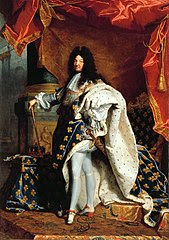
King Louis XIV of France
His obsession with King Louis XIV and the opera composer Richard Wagner didn’t help his case as he spent millions on expensive tributes, including Versailles-like castles and a large grotto dedicated to one act of an opera.

Even though he was friendly enough to those he ruled, often handing out cash to those who befriended him, he was also reclusive—to the point of bizarre. In both Linderhof and Herrenchiemsee, he had installed a “wishing table” based on a Grimm fairytale where the dining table disappeared into the floor and reappeared fully set. In the castle, gears and mechanisms lowered the elevator table to the kitchen where servants set it and then raised it up to the dining hall. This was to prevent Ludwig from having to see his servants, thus perpetrating the illusion of solitude. However, they were instructed to set the table for three or more people so the king could imagine himself feasting with people of importance, no doubt the king of France and his favorite composer would be “in attendance” at the fictional dinner.

Ludwig and Wagner
Speaking of Wagner, Ludwig started to fancy himself as characters in the operas he loved. He dressed like them and then would venture out in the night in costume. This, of course, led to the habit of sleeping only in the day. The fairytale king allowed himself to be consumed by his fancy.


King Ludwig II of Bavaria once told his governess, "I want to remain an eternal mystery to myself and others." It seems he made good on that promise, and the world has created its own obsession with the Mad King of Bavaria.


PLEASE VISIT THE BLOG TO COMMENT ON THIS POST

A TIME-SLIP NOVEL

A secret. A key. Much was buried on the Titanic, but now it's time for resurrection.


Follow two intertwining stories a century apart. 1912 - Matriarch Olive Stanford protects a secret after boarding the Titanic that must go to her grave. 2012 - Portland real estate agent Ember Keaton-Jones receives the key that will unlock the mystery of her past... and her distrusting heart.
To buy: Amazon


Kathleen E. Kovach is a Christian romance author published traditionally through Barbour Publishing, Inc. as well as indie. Kathleen and her husband, Jim, raised two sons while living the nomadic lifestyle for over twenty years in the Air Force. Now planted in northeast Colorado, she's a grandmother—and soon-to-be great-grandmother—though much too young for that. Kathleen has been a longstanding member of American Christian Fiction Writers. An award-winning author, she presents spiritual truths with a giggle, proving herself as one of God's peculiar people.


Sunday, February 12, 2023

King Ludwig II: The Moon King of Bavaria

By Kathy Kovach


Last month, I introduced King Ludwig II, who ascended to the throne at the tender age of eighteen in 1864. He ruled for twenty-two years until his mysterious death in 1886. The first of three castles he had built was Neuschwanstein. If you missed my take on it, you can find it HERE.

Today, I take you on a tour of the second of his three castles, Schloss Linderhof, the only one he saw to completion. Located near his first masterpiece in the Bavarian alps, Linderhof was where Ludwig would spend most of his childhood at his father’s hunting lodge, or Königshäuschen (King’s Cottage). Once he ascended to the throne after his father’s untimely death due to sepsis, he proceeded to tear down much of the lodge. He created a relatively small building, taking inspiration from his idol, King Louis XIV and his Petit Trianon of Versailles. This was a Neoclassical style château located on the grounds of the Palace of Versailles.


Ludwig’s garden designer created a sculpted park that swept up to the white palace walls. Behind the castle, a waterfall cascaded down thirty marble steps to a Neptune fountain.


The grounds and the interior were designed in the Neo-Rococo expression. Wikipedia defines this as “an exceptionally ornamental and theatrical style of architecture, art and decoration which combines asymmetry, scrolling curves, gilding, white and pastel colours, sculpted moulding, and trompe-l'Å“il frescoes to create surprise and the illusion of motion and drama. It is often described as the final expression of the Baroque movement.” The rooms were smaller than Ludwig’s previous grand castle up the hill but no less grandiose.


Ludwig must have been nocturnal, as he would stay up all night and sleep during the day. Louis XIV was known as the “Sun King”, but Ludwig proclaimed himself a “Moon King”, a shadow of the French monarch. He was known to take long carriage rides at night through the beautiful Bavarian forest surrounding his home. In addition, he would use the Hall of Mirrors as a drawing room where he’d sit in the niche and read until dawn, enjoying the light of countless candles and their infinite reflections.

Hall of Mirrors

Tapestry Room

Dining Room

King's Bedroom

Second Bedroom

Music Room

Venus Grotto

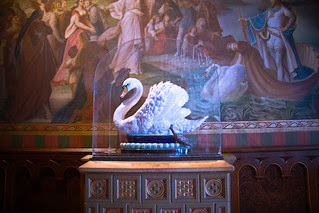
Another person with whom Ludwig obsessed was the operatic composer, Richard Wagner. The king built a grotto just to showcase the first act of his opera Tannhäuser. The man-made cave contained a small lake upon which he rode in a gold-gilded swan boat to the middle where he could watch the performers on a stage. The grotto was the first in Germany to utilize electricity, and colored lights glowed on artificial stalactites hanging from the thirty-three-foot ceiling. A moon was also illuminated that could change colors upon the whim of the king himself. A wave machine created movement upon the water below. These effects were possible due to the first electrical station built in Bavaria with Ludwig being the initial one to utilize it. Heated bricks kept the space warm for the comfort of the king. Pictures can’t even begin to capture the beauty of this grotto, or even of the castle itself. I feel so blessed to have visited Linderhof, as well as the other two castles, in person. As for the purpose of the synthetic cavern, here is an excellent description.
Dr. Michael Petzet, writing in Wilfrid Blunt’s book The Dream King: Ludwig II of Bavaria, describes the grotto’s space as one which allows the visitor an encircled mirage where “stage and auditorium are blended into one,” creating a total theatre as it “did not separate the onlooker from the stage.” -White Hot Magazine 
Beyond the experience of theater-in-the-round, this technique of entertainment only emphasized Ludwig’s desire to immerse himself in the dream and to live outside of his reality.

Of which I identify. The writers reading this article are no doubt nodding their heads. Nocturnal tendencies and the desire to escape reality? It’s why I became an author.


PLEASE VISIT THE BLOG TO COMMENT ON THIS POST

A TIME-SLIP NOVEL

A secret. A key. Much was buried on the Titanic, but now it's time for resurrection.


Follow two intertwining stories a century apart. 1912 - Matriarch Olive Stanford protects a secret after boarding the Titanic that must go to her grave. 2012 - Portland real estate agent Ember Keaton-Jones receives the key that will unlock the mystery of her past... and her distrusting heart.
To buy: Amazon


Kathleen E. Kovach is a Christian romance author published traditionally through Barbour Publishing, Inc. as well as indie. Kathleen and her husband, Jim, raised two sons while living the nomadic lifestyle for over twenty years in the Air Force. Now planted in northeast Colorado, she's a grandmother—and soon-to-be great-grandmother—though much too young for that. Kathleen has been a longstanding member of American Christian Fiction Writers. An award-winning author, she presents spiritual truths with a giggle, proving herself as one of God's peculiar people.


Thursday, January 12, 2023

King Ludwig II: The Fairytale King of Bavaria


By Kathy Kovach

King Ludwig II
Years ago, my family had the privilege of living in Frankfurt, Germany via the U. S. Air Force. In fact, we moved there twice, encompassing six-and-a-half years in that beautiful country.

One of our favorite things to do was “castle hopping”. Germany has a plethora of palaces, fortresses, castles, and burgs. Some more lavish than others. Some forbidding stone structures made for defense. And some, built after the age of such fantastic opulence. Three of these were the architectural marvels of King Ludwig II.

Ludwig Otto Friedrich Wilhelm von Wittelsbach (1845-1886) ascended to the throne at 18 years of age in 1864 and ruled for 22 years until his death. Perhaps because he’d begun his reign at such an early age, he became known by many monikers. The Dream King, Swan King, Fairytale King, and eventually, Mad King Ludwig. These names should tell you all you need to know about this man’s character. He lived in his own reality and had the means to implement it.

King Louis XIV
Heavily influenced by King Louis XIV and the Palace of Versailles, as well as the composer Richard Wagner, Ludwig went on to build three castles in Bavaria, all very different from each other, but equally over the top. In an age where these types of architecture were outdated, and no longer needed for strategic or defensive purposes, Ludwig ventured on.

Neuschwanstein Castle


Disney's Sleeping Beauty Castle
1959
Walt Disney Pictures and Buena Vista Distribution
The first castle, Neuschwanstein, was started in 1869 on a mountaintop just above his childhood home. He’d had visions as a boy to build a structure up on the peak with soaring fairytale towers. Is it any wonder that our modern-day Imagineer Walt Disney would use this castle as the backdrop for his production Sleeping Beauty and would also adopt it as his personal icon? Neuschwanstein literally translates to “New Swan Castle” in honor of one of Wagner’s operas referencing “the Swan Knight”. 
In addition, the swan was the family’s royal bird, and its likeness can be seen everywhere on the grounds.

A cave room, or small grotto, was artificially built between the salon and study. Sporting colored lights, stalactites, and a waterfall, one could enter as if simply walking through a hallway. At one point, however, a glass door slides into the “rock” and opens into the conservatory, a small room with a chair and table and a large window with a perfect view of the alpine foothills. This site has a couple of good images of the grotto and conservatory.

If the outside of the castle with its pristine white limestone walls and sky-blue spires recalls the age of German knights and damsels in distress, the inside invokes thoughts of romance. Gilded opulence and art murals depicting Wagner’s most famous operas meet the eye at every turn.

Throne Room

Singer's Hall

Ludwig's bedroom

Cupola

Drawing Room

Study

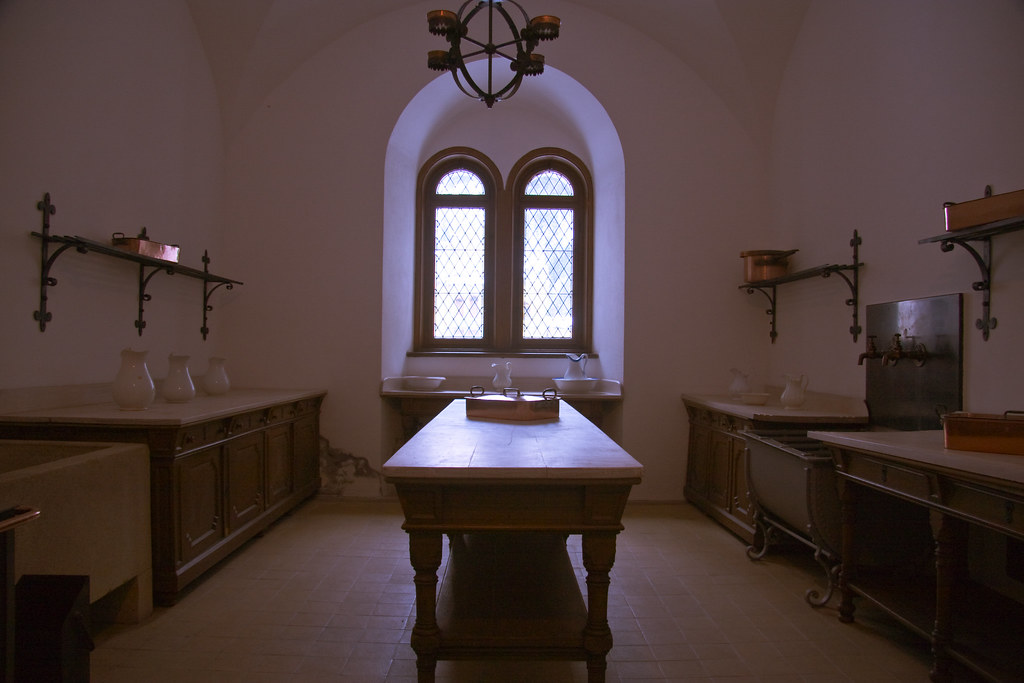
Kitchen
Quite a stark change from the opulence in the rest of the castle!
Only fourteen rooms were finished by the time of Ludwig’s death, and he had only stayed there a total of 186 days. Mere weeks after he died, the castle was opened for visitors to help pay off his enormous debt realized while building his three projects. He never used state funds but dwindled his personal royal account to the point where he had to borrow money.

King Ludwig II was deposed and declared mad due to his overspending on fanciful projects. One evening in 1886, he and Dr. Bernhard von Gudden—chief of the Munich Asylum
 and the psychiatrist tasked to supervise him—went on a walk and never came back. They were both found drowned in the nearby lake. There are several theories surrounding the events of that night. Some say Ludwig killed the doctor and then, in a suicidal act, threw himself into the lake. It was also reported that even though the official cause of death for Ludwig was suicidal drowning, the autopsy showed no water in his lungs. Some say Gudden had been hit on the head and strangled. Another theory states that Ludwig was getting into a boat that would take him to another point along the lake where loyalists would help him escape. However, when he stepped into the boat he was shot and died. Political coverups ensued. At this time, the deaths of both men remain a mystery.
Coronation Portrait
I'll be highlighting King Ludwig's other two castles, Linderhof and Herrenchiemsee, later in the year. He certainly led a fairytale life, but it's sad that he never had his happily ever after.


A TIME-SLIP NOVEL

A secret. A key. Much was buried on the Titanic, but now it's time for resurrection.


Follow two intertwining stories a century apart. 1912 - Matriarch Olive Stanford protects a secret after boarding the Titanic that must go to her grave. 2012 - Portland real estate agent Ember Keaton-Jones receives the key that will unlock the mystery of her past... and her distrusting heart.
To buy: Amazon


Kathleen E. Kovach is a Christian romance author published traditionally through Barbour Publishing, Inc. as well as indie. Kathleen and her husband, Jim, raised two sons while living the nomadic lifestyle for over twenty years in the Air Force. Now planted in northeast Colorado, she's a grandmother—and soon-to-be great-grandmother—though much too young for that. Kathleen has been a longstanding member of American Christian Fiction Writers. An award-winning author, she presents spiritual truths with a giggle, proving herself as one of God's peculiar people.