Showing posts with label King George III. Show all posts

Friday, April 13, 2018

No Taxation Without Representation!


"It was now evening, and I immediately dressed myself in the costume of an Indian, equipped with a small hatchet, which I and my associates denominated the tomahawk, with which, and a club, after having painted my face and hands with coal dust in the shop of a blacksmith, I repaired to Griffin's wharf, where the ships lay that contained the tea. When I first appeared in the street after being thus disguised, I fell in with many who were dressed, equipped and painted as I was, and who fell in with me and marched in order to the place of our destination."


—George Hewes, one of the Sons of Liberty, describing his participation in the Boston Tea Party of December 16, 1773


To be blunt, I hate tax season, which is now upon us. Perhaps it’s in my DNA or caused by family prejudice since my ancestors fought in the American Revolution. Nevertheless, it is the most stressful time of year for me.


Taxation without representation in British Parliament sparked the war that led to our freedom. Englishmen who had carved out the original thirteen colonies might have been content to remain part of the British Empire had Parliament and King George III not levied onerous taxes on the colonists. 

But the treasury in England had been depleted by the costly French and Indian War that ended in 1763. Why should citizens of the mother country pay for the defense of the far-off territory?


Portrait of King George III by Johann Zoffany, 1771
www.royalcollection.org.uk


An incompetent British government and king focused their eyes on the colonies. Taxes were the answer. Levy taxes on the subjects who benefited from peace. Tax stamps (1765) and then levy duties on glass, lead, paints, paper, and tea imported into the colonies (1767).

Americans were up in arms! They protested in the streets. They argued that because they were English citizens who had no representation in Parliament, they were not obliged to pay the taxes. One day in 1770, the British fired on a group of taxation protesters, killing five in the Boston Massacre.

Finally, Parliament was forced to retract all the taxes…except on tea. They made an end run around the colonists and gave the East India Company a monopoly to import tea into the colonies. The Americans could no longer buy their tea from other sources. The men in Parliament thought they were so clever. They even reduced the tax on the tea to make it cheaper than their competitors. If the colonies accepted the deal, they would have admitted that Britain could tax them without representation and then levy taxes on other products.


Flag of the East India Company

That was the last straw.

The Sons of Liberty organized to block the acceptance of tea from the East India Company. In Philadelphia and New York, the tea ships were not allowed to land. In Charleston, the cargo was seized and stored in a warehouse. Three years later, the American Revolutionaries would sell the tea to help fund the war effort.

That brings the story back to Boston. When three ships carrying tea sailed into Boston Harbor and docked, more than 7,000 colonists descended on the wharf to protest. A meeting was called, and Bostonians refused to pay the duty (tax) on the tea. Instead, they insisted the ships leave the harbor. The Customs House (run by the British) would not allow the ships to leave until the duty was paid.


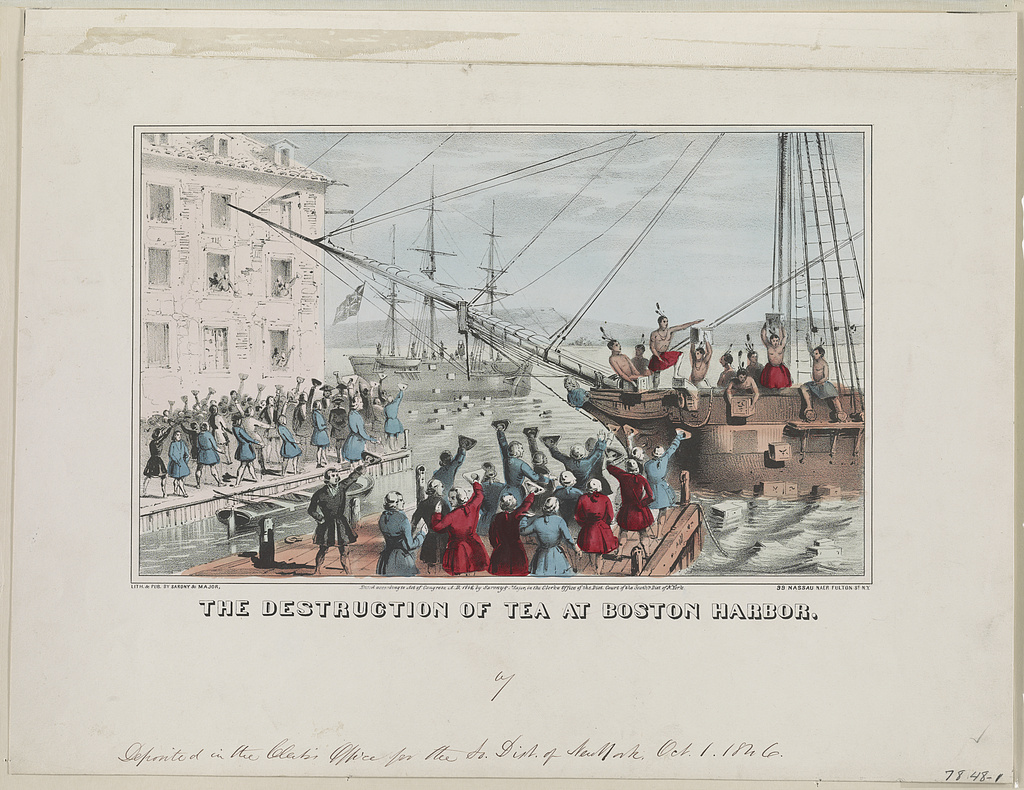
Three cargos of tea destroyed in Boston Harbor


Outraged, on December 16, 1773, Samuel Adams and between 100 and 200 men dressed as Mohawk Indians with soot-blackened faces, whooped war chants on a nearby hill and marched two-by-two to board the ships and dump the tea in the harbor.

It took them three hours to break up the boxes with hatchets and throw the cargo overboard. The boxes that didn’t sink were destroyed by people in small boats that broke open the wooden chests with oars and other implements.

Forty-five tons of tea worth about a million dollars in today’s currency now lay at the bottom of Boston Harbor. It took about a month for the news to reach England on January 20, 1774, and the hammer of the British crown came down hard. Meant to only punish the Massachusetts Bay Colony, they instituted the Intolerable Acts that took away self-governance.


First Continental Congress


That enraged all thirteen colonies, and they united with the First Continental Congress in September 5, 1774, vowing to join the fight if Massachusetts was invaded, which came to pass.

Only a month later, the British were met with force at Lexington and Concord near Boston on October 20, 1774—the first battle of the Revolutionary War. The colonists boycotted all British goods, and on July 4, 1776, the leaders of our country signed the Declaration of Independence at the Second Continental Congress at the Pennsylvania State House, now known as Independence Hall.

All because of taxation without representation. 


United States Declaration of Independence - 1823 William Stone facsimile

All photos in this post are public domain.


***


My feisty Irish bride Kate O'Brien McKean asks her Texas cattleman husband Buck for an annulment in Dreams of My Heart, book 1 of The Reluctant Brides series, setting off a chain reaction of events that endangers them both. The historical romance set in 1875 Montana Territory released April 1 from Mountain Brook Ink. The print and e-book are available on Amazon.


After a career spent acquiring and editing books by numerous bestselling Christian authors, Barbara J. Scott has returned to her true love—writing. Barbara and her husband Mike live in the Nashville area, with their two Chihuahuas, Riley and Sissy, both rescued from puppy mills. They’ll soon be relocating to the Ft. Lauderdale area to be closer to their kids and grandkids. Reading, writing, and research are her passions. Want to know more? Connect with Barbara at www.BarbaraJScott.com.

Thursday, January 29, 2015

George III Dies January 29, 1820 by Jillian Kent

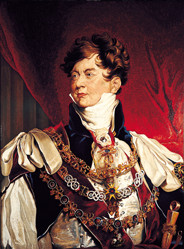
King George III in his coronation robes
If you're a fan of the Regency then you know that when George III died on this date in 1820 his son, The Prince of Wales, who had served as Regent became King George IV. But before I get ahead of myself I want to share some history with you about this George III who may not have been popular but had the longest reign of all the monarchs who came prior to him.

The Prince Regent
George the III was born on June 4, 1738 and died on January 29, 1820. He had been unable to reign the last ten years of his life and that's where the term Regency comes in to play in this instance. His son ruled in his stead because the King was unable to carry out his duties, thus the Prince of Wales became the Regent and thus was born a span of time from 1811-1820 that has been written about by historians and novelists because the Regent and future King of England led a dissolute life and wasted the taxpayers money.

He's most well known for losing the American Colonies (that was our American Revolution) and losing his mind. But from the British standpoint the man should also be known for many other things including the kindness he showed to his fifteen children and the devotion to his wife, Charlotte of Mecklenburg-Strelitz. He was the third of the Hanovarian Monarchs and the first to use English as his first language. George's direct responsibility for the loss of the colonies is not great. He opposed their bid for independence to the end, but he did not develop the policies (such as the Stamp Act of 1765 and the Townshend duties of 1767 on tea, paper and other products) which led to war in 1775-76 and which had the support of Parliament. 

 Of course The American Revolution took the wind out of George III's sails. I'd always thought that was why he'd probably gone insane but now we know that porphyria or possibly arsenic poisoning from wigs worn at the time could have caused George III's mental instability.

You can read more about his mental illness at my previous post on the subject here and also this month at HHH here. In the extensive biography by Christopher Hibbert, George III looks at the King's life from different dimensions including his love for his country and many interests that covered: architecture, music, literature, astronomy and more.

Did you know that John Adams met King George III? 

I thought these Revolutionary War Facts were interesting. Did you know that John Hancock and Benjamin Franklin were both in London in 1761 and witnessed the coronation of King George III, the same king they would later rebel against?


Jillian is employed as a counselor for nursing students in Cincinnati, Ohio and possesses a masters degree in social work. She is a member of the American Association of Christian Counselors and passionate about mental health, wellness, and stomping out the stigma of mental illness. She also coordinates and frequently contributes to The Well Writer within Christian Fiction Online Magazine. Learn more about Jillian and her novels at www.jilliankent.com


Friday, August 29, 2014

The Madness of King George


I work in the mental health field and I'm  fascinated and frequently appalled by the treatment of those who suffered from mental disorders throughout history. Whether or not you are familiar with what happened to King George III you might find this post interesting.

The Madness of King George
Nigel Hawthorne and Helen Mirren star in this incredible movie that released in 1994.


Some of my favorite lines from the movie. You can find more at the Internet Movie Data Base

George III: Six hours of sleep is enough for a man, seven for a woman, and eight for a fool.

[Pitt has given the King some papers to sign]
George III: What is this? America, I suppose.
Pitt: No, sir.
George III: Oh, America's not to be spoken of, is that it?
Pitt: For your peace of mind, sir. But it's not America.
George III: Peace of mind! I have no peace of mind. I've had no peace of mind since we lost America. Forests, old as the world itself... meadows... plains... strange delicate flowers... immense solitudes... and all nature new to art... all ours... Mine. Gone. A paradise... lost.

I found this next scene between the King and his doctor very sad and unfortunately accurate for the day.

Dr. Willis: If the King refuses food, He will be restrained. If He claims to have no appetite, He will be restrained. If He swears and indulges in MEANINGLESS DISCOURSE... He will be restrained. If He throws off his bed-clothes, tears away His bandages, scratches at His sores, and if He does not strive EVERY day and ALWAYS towards His OWN RECOVERY... then He must be restrained.

George III: I am the King of England.
Dr. Willis: NO, sir. You are the PATIENT.

How sad to think that King George may have actually been suffering the effects of arsenic poisoning. Read this: King George III: Mad or Misunderstood? and this: Porphyria or Arsenic?

Whether you are a reader or writer have you ever stumbled across something in history that just grabbed you by the throat and wouldn't let go? Your own magnificent obsession so to speak? That's me and the Regency era. What's your favorite time period in history? What country?


 Jillian is employed as a counselor for nursing students in Cincinnati, Ohio and possesses a masters degree in social work. She is a member of the American Association of Christian Counselors and passionate about mental health, wellness, and stomping out the stigma of mental illness. You can also read her August article of The Well Writer which is titled, Writer as Caregiver. You can explore further at her website www.jilliankent.com.She invites you to join her on Twitter @JillKentAuthor and Facebook https://www.facebook.com/JillianKent