by: Rebecca May Davie
From the early 12th century through nearly 1350 A.D., an estimated 1,000+ Stave churches were built in Norway. In 1346, the Black Plague halted construction of further churches. The lack of population, use, and maintenance took a toll on the buildings over the span of 200 years. By 1650, about 270 Stave churches existed. In the 1800s, there were 70 standing. The reason the Stave churches in the northern part of Norway did not survive is due to the harsher climate. The milder and drier regions provided areas for churches to thrive. Today, 29 remain. 28 are in Norway and one in Poland. Vang Stave church was purchased by the Prussian King, Fridrich Wilhelm IV. Vang was disassembled and stored until it was rebuilt in German territory at that time, now Poland.
What is a “Stave” church and why is it significant that 29 churches exist? Multitudes of cathedralsstood the test of time throughout the world. In Norway, of the 300 stone churches built in the Middle Ages, 150 stand to this day. The reason Stave churches contribute to the architectural heritage of Norway and are studied is that these sentinels are built with wood! How does a wood structure survive for 900 years? That seems an impossible feat. The builders used pine core, hundreds of years old because of the high concentration of resin. The trees were not felled until they had several summers to dry on the root. The longevity of the churches could be attributed also to the foundations of stone as the wood does not rest on the ground.
If the fact that a wood church still stands for 90% of a millennium isn’t shocking enough, consider that they are comprised of nearly 2,000 parts. Many of these components were created and shaped ahead of the build. These pieces were all joined without nails. How could they be strong enough without the reinforcement of nails? Knee brackets and braces give the churches stability. The columns, known as staves, bare the weight of the structure and give the churches their name.
In appearance, the style most attributed to Stave churches features a cascading tier-roof, dormers that protrude, galleries, and carved dragons on the roof. They can have a raised center room, mid-masts – the Møre type, or are a bit larger with a narrow chancel. The latter was the most prevalent in the Middle Ages.


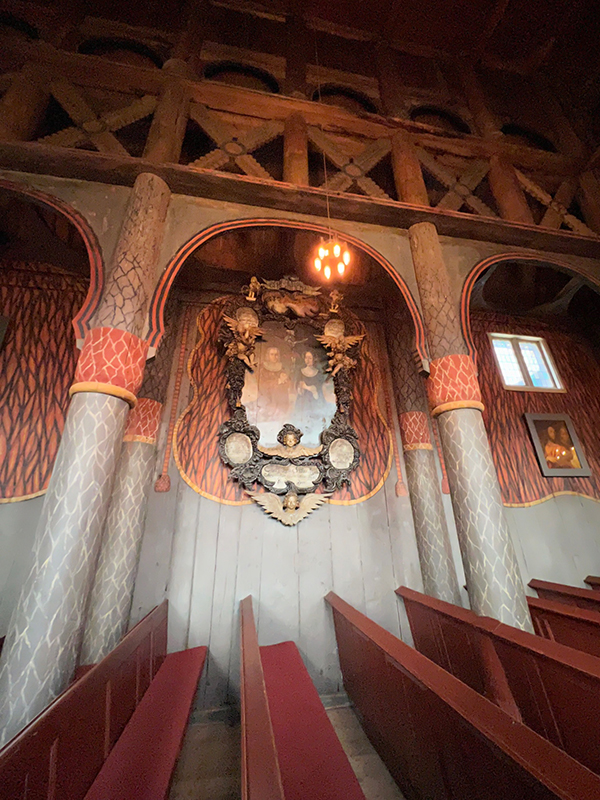
There is no documentation of how the interiors of the Stave churches appeared in the Middle Ages. Over the years the Stave churches that survived endured alterations and additions that reflected the styles of those times.
Surprisingly, half of the churches today are in use as regular parish churches. The remainder of the Stave churches serve as museums or venues for special occasions such as weddings and christenings. Imagine sitting in a pew, listening to a message, and singing, all the while pondering the number of individuals who worshipped in that very spot for 900 years. Humbling. Awe inspiring.
These churches are treasured in Norway. They are preserved by the Directorate for Cultural Heritage as well as The Society for the Preservation of Norwegian Ancient Monuments. Tourists, architects, engineers, and historians visit to marvel at their structures and resilience.
Cindy Kay Stewart, fellow Heroes, Heroines, and History blogger and I stopped at Ringebu and Garmo on a research trip during the summer of 2022. Read about
The Stave Church in Garmo. I shot the photos included in this post on that journey.
Have you ever visited a Stave church?
Also, this tree (at left) was in the Ringebu graveyard. Google indicated it is a Lilac tree. Do you agree? I wonder how old this tree is. According to Farmer’s Almanac, a Lilac tree can live over 100 years. How many people passed by this lonely Lilac over the years? Makes you wonder, doesn’t it?
As a child, Rebecca loved to write. She nurtured this skill as an educator and later as an editor for anonline magazine. Rebecca then joined the Cru Ministry - NBS2GO/Neighbor Bible Studies 2GO, at its inception. She serves as the YouVersion Content Creator, with over 75 Plans on the Bible.com app.
Rebecca lives in the mountains with her husband and a rescued dog named Ranger. If it were up to her, she would be traveling - right now. As a member of ACFW and FHLCW, Rebecca learns the craft of fiction while networking with a host of generous writers. She is working on her first fiction novel. This story unfolds from the 1830s in Northern Georgia.
Connect with Rebecca:
Clubhouse Facebook Goodreads Instagram Pinterest Twitter Website: