Showing posts with label Polly by Naomi Musch. Show all posts

Sunday, June 29, 2025

Music for Our Souls - C. Austin Miles - "In the Garden"


A few days ago, my husband Jeff asked me if I ever sing "I come to the garden alone. . ." while I'm out in our garden, toiling away at tilling and tending.

My answer, "Yes, absolutely."

"In the Garden" has been a hymn favorite for generations. A song popularized especially for how it's often been sung during funerals and at Easter services, harkens back to the story of Mary Magdalene coming to the garden tomb to mourn her Savior. And then! She hears His voice, and He reveals Himself to her first. Our risen Lord! Oh, what sweet swells that scene conjures in our breasts!

C. Austin Miles must have visualized it well as he penned the lyrics, for according to his great-granddaughter, the verses were penned in a New Jersey basement, where not even a window allowed the daylight in, much less a garden view.


Image by wirestock on Freepik

But who was C. Austin Miles, and what inspired him to write such a beautiful, timeless hymn?

Charles Austin Miles (January 7, 1868-March 10, 1946) studied at the Philadelphia College of Pharmacy and the University of Pennsylvania. However, in 1892, he gave up his career to purse the writing of Gospel songs. His first Gospel song, "List! ’Tis Jesus’ Voice", was published by the Hall-Mack Company, where he later became editor and manager of the music publishing company for 37 years.

He is quoted as saying, "It is as a writer of gospel songs I am proud to be known, for in that way I may be of the most use to my master, whom I serve willingly although not as efficiently as is my desire."

I love that! Writers of fiction drawn from a Christian world view are prone to questioning whether or not their work serves any larger purpose. We sometimes even feel like it's a guilty pleasure (even though there are days we want to pull our hair out over a plotting or character development issue). Yet, we feel God's pleasure when we write the things that are pleasing to Him. This is how Mr. Miles must have felt, to believe so strongly in his calling. He wrote 398 songs in his lifetime, and he wrote the music to at least eight others. In the Garden was the result of personal quiet time spent with God.

A hobby of Miles' was photography, and he created a darkroom for developing film in his New Jersey basement. With the ability to see well enough to read his Bible in the red lighting of the darkroom, he would often spend the time awaiting his developing process to finish by reading his Bible. Sometimes he purposely read with the desire of creating worshipful songs from Scripture.

I confess that I have often read my Bible with an eye to themes that resonate in stories I want to write. Now and then, God places one directly into my heart.

It was on a day in 1912, while reading in his darkroom, that Miles opened his Bible to John, chapter 20, and read again the story of Mary Magdalene coming to the tomb of Jesus. Discovering he was no longer there, her heart sank, for she feared his body had been stolen. Then she heard his voice behind her. When she thought it was the gardener speaking, He said her name. "Mary."

Have you ever heard the Lord speaking your name to your heart? Calling your attention to him?

I think that maybe that's what happened to C. Austin Miles at that moment. So touched by the thought of what had happened, he didn't need a garden outside his window to imagine it.

Miles' recalled how he gripped his Bible, his muscles vibrating with the urgency to write the lyrics to the poem, thinking, This is not an experience limited to a happening almost 2,000 years ago. It is the daily companionship with the Lord that makes up the Christian's life.

Later, Miles said that the lyrics came quickly. That evening he composed them for a musical setting that became the song we love today.

Do you go to the garden alone to hear the voice of Jesus?


The Garden of Gethsemane at Jerusalem (Deposit Photos)

In the Garden

I come to the garden alone
While the dew is still on the roses
And the voice I hear falling on my ear
The Son of God discloses.

Refrain

And He walks with me, and He talks with me,
And He tells me I am His own;
And the joy we share as we tarry there,
None other has ever known.

He speaks, and the sound of His voice,
Is so sweet the birds hush their singing,
And the melody that He gave to me
Within my heart is ringing.

Refrain

I'd stay in the garden with Him
Though the night around me be falling,
But He bids me go; through the voice of woe
His voice to me is calling.


Refrain

Sing along:

Discover more hymn history on Cindy Ervin Huff's recent post telling the story of Just As I Am

Thursday, February 29, 2024

A Dreamy Look at Historic Houses in a Small Town


Do you ever go wandering down the rabbit hole of looking at old houses online? Do you hop onto Pinterest or Facebook into those pages that have you wandering through photographs of the insides of homes and castles and all the cool old buildings? Or do you yourself live in one of those Victorian masterpieces? If you do, I'd love to hear about it!

Occasionally, while writing a novel, I spend time either online or by driving around neighborhoods in my story setting, hoping for likely homes my characters might reside in, or deciding where an imaginary home could be placed. This was especially fun to do when I wrote Polly (Apron Strings, Book One), and part of the reason why I chose Hudson, Wisconsin, as my story's location, rather than one of the other small towns along the northern Mississippi. 

In fact, Hudson is located on the St. Croix River, where it flows from northern Wisconsin and then meets the mighty Mississippi. The Willow River is a tributary of the St. Croix which also conjoins there, offering a state park with scenic trails and views of graceful waterfalls, as well as good fishing.

This confluence of navigable rivers is the location early settlers chose to establish a trading post first, and later, lumber mills. As the setting was so prime for the development of the lumber and railroad industries, and so conveniently located to nearby developing St. Paul, it became a natural place for wealthy businessmen and founders to build stately homes, a number of which have been added to the Register of Historic Places. Let's take a look at a few of them.

Fredric L. Darling House / Darling-O'Brien House

The first we'll visit is the Fredric L. Darling House, built in 1857 by architects Amasah and Ammah Andrews. The Andrews twins were transplants from New York, and it was said that their style "Hellenized Hudson". They built this home for Mr. Silas Staples the same year that Hudson was incorporated into a city. 

Staples had immigrated from Maine and became engaged in the St. Croix Valley lumber industry. He eventually became Hudson's third mayor, but sold the house to Fredric Darling in 1865. Darling had arrived from Vermont and came to Hudson to open a dry goods store.

When Darling died in 1899, having become known as a gentleman merchant and one of the last pioneer merchants of the county, the home came into the hands of cigarmaker and insurance man-turned-county sheriff, Cornelius O'Brien, and has remained in the O'Brien family. So the home eventually became known as the Darling-O'Brien House.

The home's style is Greek Revival. It stands in an L-shape two stories above a stone foundation. The style is most notable for it's gable portico and four octagonal columns.

Herman L. Humphrey House

 
William Dwelley House

Less imposing but important because they showed the mid-18th century influence of the Italianate style of architecture at the time, are the Herman L. Humphrey House, home to U.S. Representative Herman L. Humphrey, and the William Dwelley House, another pioneer who made his fortune in Wisconsin's pine lumber industry after he arrived from Maine in 1850.

And then there are the Grand Dames of the town. First, there's the Phipps mansion:

William H. Phipps House - Phipps Inn Bed & Breakfast

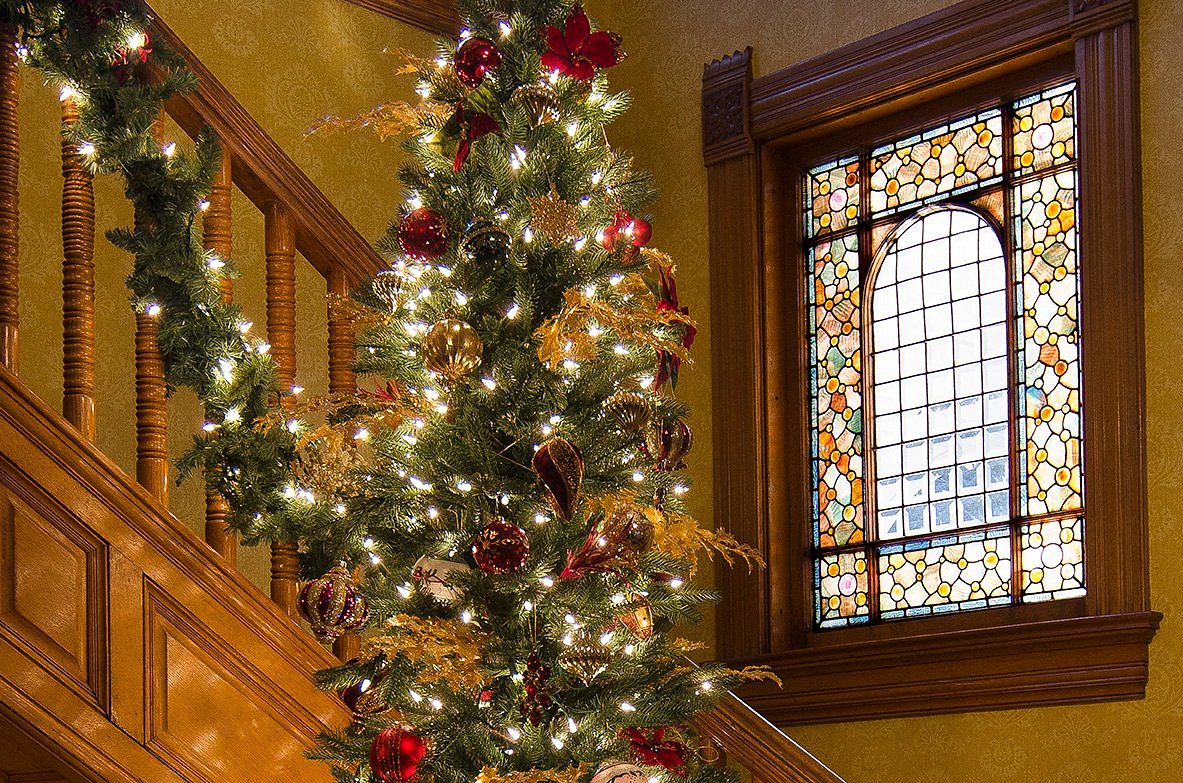
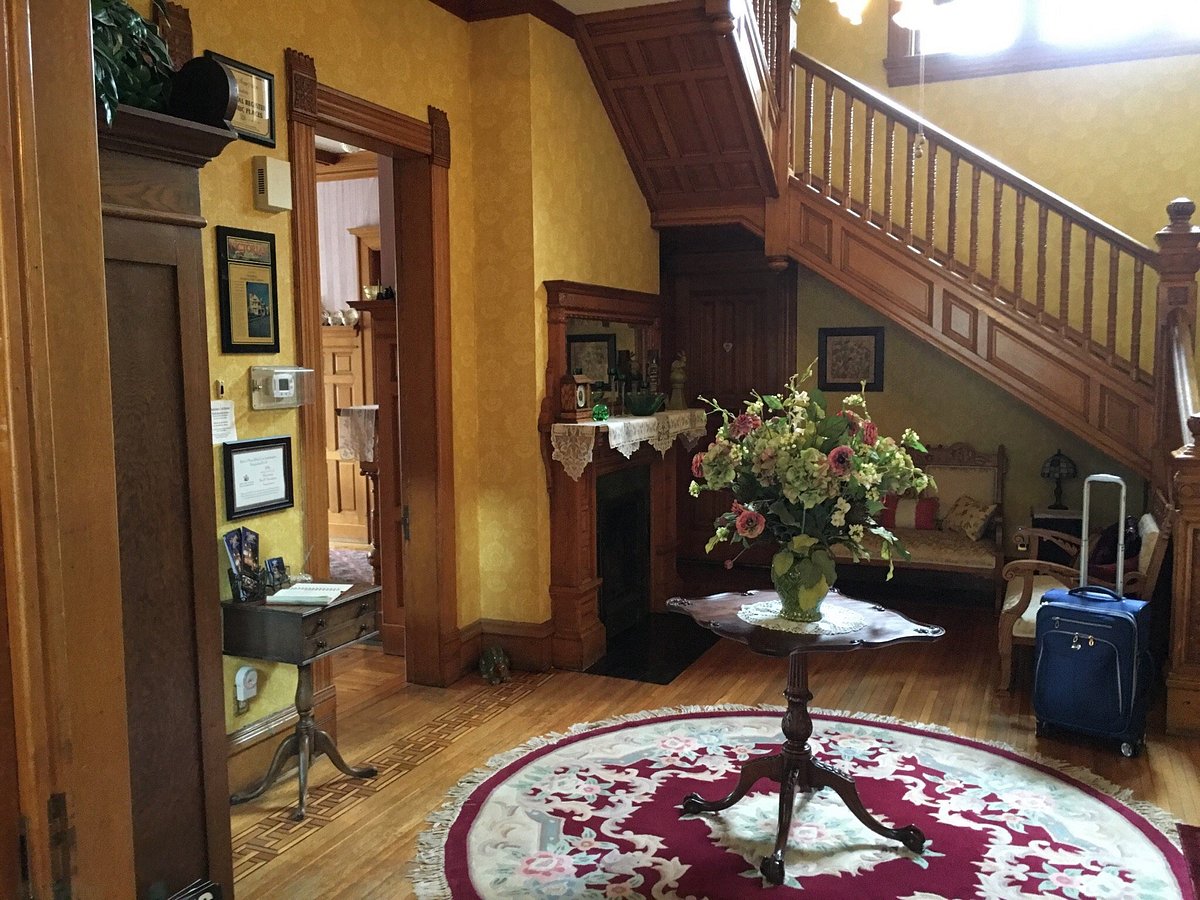
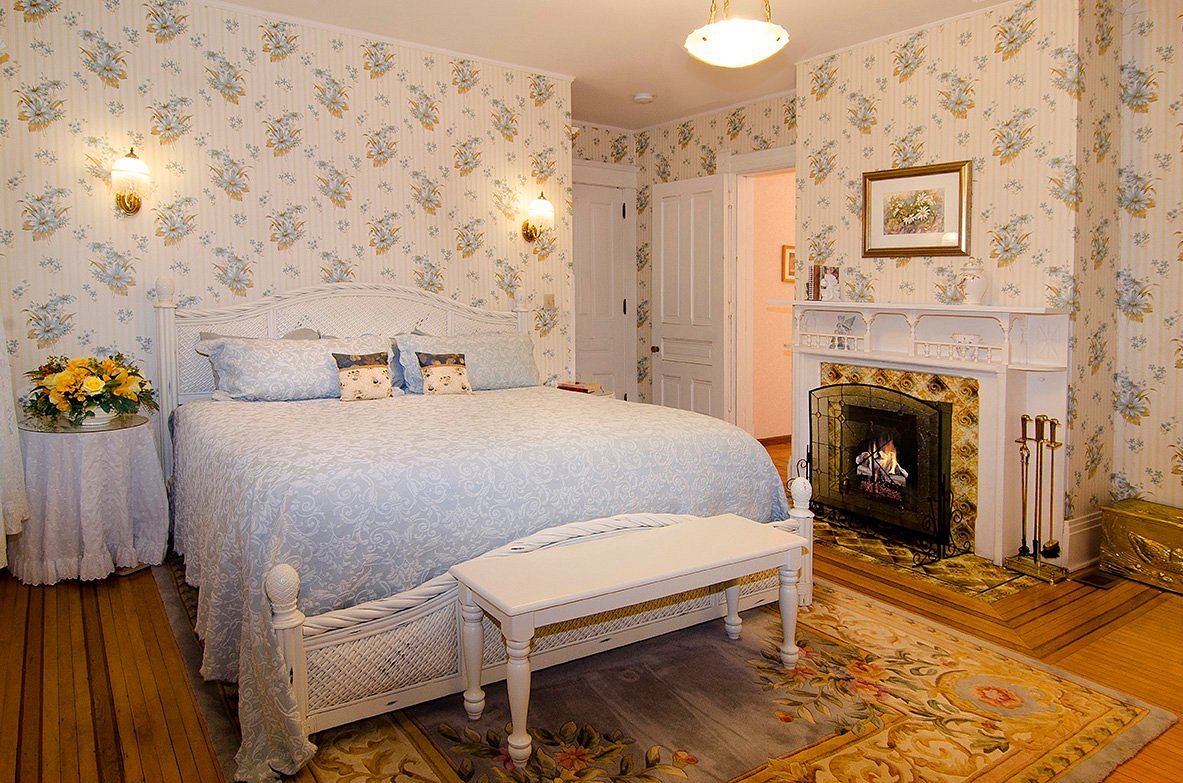
One of Hudson's prizes is the William H. Phipps house, a beautiful, Queen Anne Victorian now operating as a B&B. Here are a just a few of the interior photos from Trip Advisor


With it's verandas, balconies, and octagonal tower, it's hard to not have fanciful dreams about living in such a house, and it makes me wonder what it would have been like back in 1884, when it was first constructed, although it is said that not too many alterations were made between then and the time it landed on the National Register a hundred years later. The butlers pantry became a laundry room, the kitchen was updated, and both fire alarm and sprinkler systems were added for safety. The front sidewalk was replaced with brick. 

As one of the most significant residents of the home, it was named after William Henry Phipps for his many contributions to the welfare of Hudson. Both he and his son were known for their philanthropies. Of Phipps, it is said, he was an "energetic, progressive citizen, never doing things by halves but a believer in the doctrine that what is worth doing is worth doing with one's might." 

Phipps was born in England, but he and his family emigrated to Manitowoc, Wisconsin in 1855. After several years, he took a position in the state's treasury office in Madison. In 1875 he became a land commissioner of the North Wisconsin Railroad Company, and settled in Hudson. In Hudson, William acquired considerable wealth as a land commissioner and lumberman.

During his time in Hudson, William also served in a number of governmental capacities, from county board of commissioners, to mayor, and to Wisconsin State Senate. He held other town board offices as well, including bank president to the First National Bank of Hudson for thirty years.

Phipps was also involved in his church as Sunday School Superintendent, and when he saw the need for a public library, he took action. In 1904, after meeting with Andrew Carnegie, he led the way to Hudson having one of the earliest Carnegie-funded libraries completed in the state.

There were many other contributions to Hudson made by William Henry Phipps, industrialist, lumber barren, politician, and philanthropist. Benevolent, religious, and civic-minded, Phipps died in the garden of his home in July, 1924.

He would have been an elderly man, enjoying his residence at the time my heroine Polly lived in Hudson. I wish I'd written him into the story!

There are many historic homes in Hudson, but let's look at one more iconic work of architecture.
The John S. Moffat House - Octagon House Museum

The John S. Moffat House, Hudson's Octagon House (not to be confused with the Watertown, Wisconsin Octagon House) was built in 1855 by Judge John Shaw Moffet. It is on beautiful grounds directly across the road from the Phipps house, and is surrounded by garden landscape, garden house, and carriage house. 

John Shaw Moffet worked in New York primarily as a storekeeper until 1854. Then, on the advice of his brother-in-law he emigrated to Hudson, Wisconsin. He arrived with his wife and ten-year-old daughter by train, riverboat, and lastly horse and wagon (much like the journey of characters in my novel The Green Veil, Empire in Pine, Book One, who came from Michigan to the Wisconsin woods).

Shortly after arriving, he became a police justice in Hudson
. In 1867, he was admitted to the bar, and he became a county judge in 1869, a position he held until 1877. While a judge, in 1871, he went into a law partnership with his son-in-law, Thomas Hughes. Moffat practiced law until his death in 1903. But that's not all. He also became director and later president of the Hudson/St. Croix Valley Produce Company. 

If you tour the Moffat Octagon House Museum, you will find many of the artifacts, family photos, and historic furnishings intact. To see more pictures of this interesting home, visit the St. Croix Valley Historical site.

In writing Polly, I imagined that her grandfather had also gained his financial success in the lumber industry. He too "built" his lovely Queen Anne Victorian in Hudson--all imaginary of course!

Just for fun, would you like to see how I imagined Polly's home, with a few modifications?


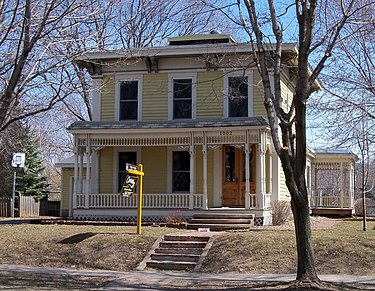
I wanted Polly's home to have a porch, but not a wrap-around. I wanted her home to be big and beautiful, but not grander than the Phipps House. If you look at the plan for the lower level, it was nearly just so, with her sitting room and dining room to the left of the entry hall becoming serving rooms in Polly's Tea House, and the Parlor becoming her gift shop. I put reversed the kitchen and back porch, and allowed the hall to continue straight out the back. I visualized a small butler's pantry between the dining room and kitchen. 

The second floor was just as in the novel. I don't think I spell it out directly, as to which room belongs to whom, but I would imagine the largest room with the bay window to have been her grandfather's room, the one she turns into a sitting room for her and Mrs. Adams and where she shares invites Ross to rest after his personal tragedy. 

The exterior of Polly's Queen Anne is a painted in various shades of beige with white trim. Do you find the Queen Anne style to be romantic, or would you prefer something more like the Italianate, or something as unique as an octagon house? Or something else entirely? 

If a Queen Anne suits you, or you just like to daydream, you might enjoy this picture gallery of Queen Anne architecture


Have you read Polly yet? I hope you'll enjoy wandering through her stately home and Holloway House, the name of her tea house. Nellie, book two, in the Apron Strings series just released on February 15, and Book Three, Priscilla, comes out on March 15. Get ready to follow Mrs. Canfield's Cookery Book through the decades from 2020-1920, one new title each month!


Monday, January 29, 2024

Hudson, Wisconsin - History of a Storybook Town


Every town and village has its history, it's humble beginnings. Thousands upon thousands of romantic novels have been crafted around the growth and communities of such towns. Let me tell you about one of them that I have a special interest in.

Hudson, Wisconsin is a town of around 15,000 people nestled in the bluffs along the idyllic St. Croix and Willow rivers as part of Wisconsin's most western boundary. The St. Croix is a tributary that winds down from the north country and joins the Mississippi only a few of miles south of town. The town is the county seat of St. Croix County. Sounds pretty, doesn't it? It is.

Looking across the St. Croix river at Minnesota from Wisconsin at Interstate Park, Wisconsin

Hudson was merely a dot in the wilderness in 1840 when two French fur traders, the brothers-in-law Louis Massey and Peter Bouchea, paddled into the mouth of the Willow River, saw the land's position and bounty, and settled there. They named the place simply Willow River. But only a few years later, another settler by the name of Joel Foster didn't think it was enough to describe the beautiful views afforded the settlement, and he renamed it Buena Vista which does mean "beautiful view". Another Wisconsin town would come to claim that name, however, in commemoration of the Battle of Buena Vista in the Mexican-American war. 

The name would come to rest as Hudson in 1852, when the town's first mayor, A.D. Gray, who hailed originally from New York, claimed that the St. Croix's views so reminded him of the Hudson River back home, he re-designated the town as Hudson, and so it has remained.

Hudson's Humble Beginnings, photo credit unknown

By this time, lumber was becoming a booming industry in the new state, and Hudson's sawmill become a hub of activity where logs were floated down from the big northern pineries and sent on their way to the Mississippi and beyond. Then came the railroads and greater growth and, well, that's history, folks. 

Downtown Hudson in the 1920s, photo credit unknown

Hudson lays claim to having birthed professionals from politicians to football players, but one of the bits of history I found interesting was that it was considered in 1914-1915 to be the boxing capitol of the northwest. At that time, the population of Hudson was a mere 2800 or so souls, yet as many as 15,000 people might descend upon the small town on a Saturday night to watch the matches. They could do that too, because Hudson was also one of the only towns to have it's own toll bridge, making it quickly accessible to the Twin Cities  in Minnesota (Minneapolis & St. Paul).

Postcard of Hudson's Interstate Toll Bridge, 1913-1951

Why my interest in Hudson?

Quaint and beautiful Hudson, Wisconsin is the setting of my just-released novel Polly (Apron Strings, Book One). I spend a lot of time choosing the settings for my stories, and for this one I even took an informal poll among my Facebook friends and family. So I thought it would be fun to take a look into this story setting, since Polly takes place in 1920 during an era of change for small towns everywhere.

Polly hoped to see her small city grow, but it was closer to the middle of the 20th century before the population of this small city really began to shift. It's become the tourist destination Polly envisioned, especially known for some fabulous restaurants. Therefore, it seemed to me to be the perfect setting for a girl who'd been wounded in love to get a fresh start--and since Hudson was not far by train to the Minnesota Twin Cities of Minneapolis and St. Paul, she could be connected to the changing culture and moods of the nation.

Alas, I am not the only writer to find Hudson to be an interesting story location. There are other stories set there, and at least two Hallmark movies were filmed in modern-day Hudson. If you are still nurturing your Christmas spirit (or just never tire of holiday Hallmark movies) check them out. You can find "A Christmas Wish in Hudson" written by Lisa Hepner and "Christmas Lovers Anonymous" by Lexi Giovagnoli, Lisa Hepner, and Elizabeth Snoderly streaming online.

The St. Croix River at Hudson Today (photo: Wikimedia by Alexius Horatius)

Downtown Hudson Today (photo by 123dieinafire at English Wikipedia)

Hudson has been known for other things over the years, including the brewery caves I mention in Polly, it's riverboating, Food Walk tour, museums, and historic Octagon House and it's B&Bs including one in a Victorian mansion like Polly's. 

If you enjoy exploring the history of older homes, I'll tell you about those in my post next month.

In the meantime, I hope you get a taste of Hudson here, and in the pages of Polly, Apron Strings, Book One, available now! Also, be sure and preview Nellie, Apron Springs book two (1930s), releasing in mid-February. Each book in the series takes on the next decade, as Mrs. Canfield's Cookery Book changes hands to a new heroine.

Until next time,

Naomi Musch

https://naomimusch.com/


WWI is over, and Polly's had her heart crushed. Ross is home from war, but life changed him on that battlefield. Now competing neighbors with seemingly opposing goals, can a simple cookbook offer them a connection?

Polly, Apron Strings Series, Book One ~ A Vintage 1920s Romance

Friday, December 29, 2023

Passenger Pigeons, Whiskey, and the North American Landscape - What Did They Have In Common?


JOIN ME TODAY, in the Apron Strings series book group, where we are meeting several of the heroines of our series and giving away prizes in a Friday Flurry!


Last month, in my post The Birds That Turned Night Into Day, I wrote about massive flocks of passenger pigeons, once so vast that they used to blot out the sun as they passed overhead. But their extinction with the death of the very last passenger pigeon, named Martha, in 1914, has had lasting side effects that changed our landscape and many of our industries.

When I heard that statement, I was surprised. How could the extinction of these birds make for such dramatic consequences, and the answer to that--beyond the fact that we once ate a LOT more pigeon than chicken in our diets--was white oak tree.

Did you know that the beautiful fall colors for which New England and many upper Midwestern states are famous didn't used to be quite so . . . so red? Their predominant colors a hundred fifty years ago were gold, orange, and russet. In fact, did you know that red maples were almost non-existent in the northeast back then? Quite so. But why?

The answer again is the white oak. (We'll get to what changed that in a bit.)

White oak trees used to be one of the most abundant species of tree in our country. And more importantly still, the white oak was the most popular tree for building on a wide scale. From homes and barns to furniture and especially in ship building, the wood of the white oak reigned supreme.

Part of the reason for this is that there is a plastic-like substance called tyloses that helps make a White Oak Tree’s wood waterproof! Because of this waterproof 
quality – white oak was used not only in ships, but also in barrels and buckets!

However, we don't see plantations of white oak for harvest. The reason for that is that white oak takes a long time to mature. 
They grow at a rate of 1-2 feet a year (considered slow growth), and the process takes about 30 years just to reach early maturity. White oaks need a lot of wide open space to grow as well. Each white oak has a sprawling root systems covering three times as much area belowground as the width of their shady canopies above. They need about four hours of direct sunlight each day to reach their full potential in height and canopy.

But get this: an average white oak tree lives about 300 years and can live as long as 600! 


White oak bark has also been used as a medicinal. Brewed as a tea, it is used to treat arthritis (Hey, I might try that!), colds, fever, cough, bronchitis, and as an appetite stimulant and to improve digestion. 

The same cannot be said of other types of oak trees. White oak is harder than red oak

It's wood is much denser and burns longer, making it a popular firewood through the ages. Because of its hardness, the Native Americans used white oak for fashioning tool handles, corn pounding mortars, and gathering baskets. 

And remember when I said it was used to build barrels? One of the most popular uses for the wood of the white oak was in building whiskey barrels. In fact, how they did it was a closely guarded secret of coopers (barrel makers). You might say, so what? Why do I care? I don't imbibe, and isn't a barrel a barrel anyway?


Image by Bernd from Pixabay

No, it sure isn't. White oak was very specifically chosen, not only because of its imperviousness to moisture, but because the wood itself lent a pleasant-tasting ambience to the alcohol stored within, be it whiskey, wine, or scotch. This was important to brewers through the decades, and no less so during prohibition in the early 20th century. Of course, not everyone had such a barrel, but if someone got hold of liquor stored in one, they new the difference. In fact, it's said that bourbon whiskey must be stored in charred oak casks to give it its unique flavors.

SO WHAT ABOUT THE PIGEONS, NAOMI?

Oh, yeah. 

When the flocks of pigeons, called "kits", would nest, their weight would often break the branches of lesser trees, and the stuff they'd leave behind would just about drown out any remaining undergrowth. However, pigeon poo did wonders for adding nutrients to the soil of the hungry white oaks which could bear the weight of tens of thousands of plump pigeons and their young. In the fall, such nutrients made wonderful bedding for acorns to plant themselves. While pigeons loved to forage for acorns of red oaks in the spring, the acorns of white oaks didn't produce until fall, long after the nesting birds had moved on. 

People continued to harvest the white oak for its coveted wood, even after the pigeons died out. Little by little, other kinds of undergrowth began to claim the ground of the white oak, and pretty soon, trees like red maple and red oak took over much of the land that used to solely host the white oak trees. Before long, the landscape changed. And while it only takes one little acorn to produce a mighty white oak, it also takes open area and less competition with other tree species. 

And with that, I'll leave you with one of my all-time favorite sayings.

"The mightiest oak was once just a little nut that held its ground."

That speaks to me.

Happy New Year from your nutty friend, Naomi

naomimusch.com

Speaking of the era of prohibition,

THERE ARE ONLY TWO WEEKS LEFT to pre-order Polly, but today I'll be giving away a copy over at the Facebook Apron Strings readers group! And other authors have prizes too.

Apron Strings series, Book One

The Great War has ended, but Polly Holloway’s heart is shattered when her fiancé finally returns home—with a French war bride. Now her future feels desolate, until she fastens onto the idea of using her skills and a special cookbook to turn her grandfather’s Victorian house into a fashionable ladies’ tea room. Yet, how will she endure the patronage of the woman who stole her sweetheart? Moreover, the suave tavern owner down the block is interfering in her business, personal and otherwise. Heaven only knows what goes on behind his doors. Might he be a bootlegger?

Wednesday, November 29, 2023

The Birds That Turned Day Into Night


Recently, as I was reading Denise Weimer's novel, A Counterfeit Betrothal, Book One from her Scouts of the Georgia Frontier series, I came upon mention of massive flocks of pigeons darkening the sky--so massive that a flock could take a full day to pass by. I referred to such an occurrence in one of my own novels, The Green Veil. Seldom in fiction have I read of one these flocks, although immense migrations of pigeons across America were very common in centuries past. In fact, as recently as a little over a hundred years ago, the Passenger Pigeon numbered the highest  count of any bird in North America, where it lived exclusively. Although now extinct, over 3 BILLION passenger pigeons soared the skies at that time.

This morning, as I sit at my computer, my gaze flitting to the window from time to time where the only thing breaking up my vision of the vast, blue sky is a bare oak branch crossing my view, I try to imagine the site of such a flock darkening the horizon. People who lived to see such sites talked about clouds of birds blocking out the light of day so that it seemed as though night had fallen.

Depiction of a shooting in northern Louisiana, Smith Bennett, 1875/Public Domain

Space doesn't allow me to go into the history of the passenger pigeon in detail, or the depth of the reasons the bird went extinct. I suppose that the image above explains a lot. For much the same reason as the near-demise of the American buffalo heard, these pigeons slowly disappeared off the scene. In fact, some say that they weren't even considered a game bird, since they were so easily shot or captured. A fellow who was a reasonably good shot could take six birds down with one shotgun blast, and a shot fired at a roosting flock could take down as many as sixty birds--or so it is said. Even the Native Americans harvested a large amount of birds prior to European expansion. Using nets, they could capture up to 800 birds at a time. They also killed juvenile birds at night, using long poles to take them, while being careful not to disturb the nesting adults, because they didn't want them to abandon their nesting grounds. Low-flying birds could even be killed with a well-aimed rock or stick. 

Pigeons being shot to save crops in Iowa, 1867

Eventually, traps were designed as well as nets for capturing the birds. Hundreds of thousands of birds were used for sport shooting as well as to be sold on the open market. Juvenile birds were considered the choicest for flavor, and their fat was used for butter. It's worth noting, since we in the states just celebrated Thanksgiving, that the huge numbers of passenger pigeons as game birds were second only to wild turkeys.

There were a myriad of ways man found to procure the birds. Most of them, as history notes, are rather sad. Even though these pigeons were the fastest of their kin, able to fly over 60 mph, they were still easy to pluck out of the sky. While, like the American Buffalo and the giant white pine, their supply seemed limitless and was treated as such, it wasn't, of course. The advent of railroads and telegraph lines (to report their movements) made bagging the pigeons easier than ever. Attempts at conservation that finally came, proved to be too little too late.

More factors than hunting alone brought about the extinction of the passenger pigeon, however. Depending heavily upon mast--the fruit of forest trees and shrubs, such as acorns and other nuts--the pigeons competed for their declining supply as deforestation combined with farm expansion spread across the continent. Predators and disease likely also played a role, especially since passenger pigeons were not prolific egg-layers. 

The very last known passenger pigeon known as Martha, died in 1914. You can see her here in this brief Smithsonian film clip:

This is Martha, the World's Last Known Passenger Pigeon - Smithsonian Institute Channel

Your great-grandparents and mine likely either remember the pigeons that used to flock across the skies or at least they have heard the stories of them. I was happy to see them mentioned in Denise Weimer's novel. What's a tidbit of history you've read about lately that either surprised you or stirred a memory of something you'd once learned about?

Have a safe and blessed holiday season.
Naomi Musch

Don't miss this holiday drawing!

Polly releases right after the holidays, so I'm giving away some fun swag to one of my newsletter subscribers in December. If you haven't heard about Polly, here she is! Pre-orders are available for this first novel in the Apron Strings series. 


Polly wants to mend her shattered heart by using her homemaking skills and a special cookbook to open a fashionable ladies’ tea room in her Victorian house. But the interfering tavern owner down the street arouses both her suspicions and her pulse. Can her idea succeed, and is Ross Dalton really a changed man?