Showing posts with label Rudolph the Red-Nosed Reindeer. Show all posts

Monday, December 12, 2022

Dash Away All!

By Kathy Kovach


T’was two weeks before Christmas and I at my laptop
Was pondering reindeer, both flying and full stop.
When was it, thought I, that the beast became fable?
What catapulted it to sky from the stable?

A story, a poem, a coloring book?
All definitely needed a second look.
So, I proceeded to research as my deadline loomed,
And my knowledge of said reindeer bloomed and bloomed.

Remember this Christmas to look toward the moon,
For one (or eight, or nine, or ten) tiny reindeer may be flying by soon.

-A poem by Kathleen E. Kovach, December 2022
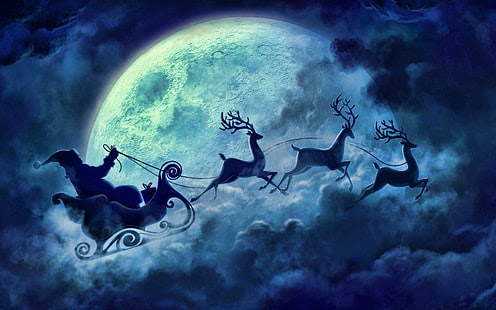

Why was it the reindeer that became legend? Why not a flying horse, goat, or dare I suggest, a flying squirrel? Okay, the last one has never typically pulled a sleigh, but it’s a fun image.

Reindeer are indigenous to Northern Europe and Asia. Norway, specifically, has the highest concentration. The thought of a flying beast may have come from their belief in the Norse god Odin who flew on a large, white, eight-legged horse named Sleipner. Odin was said to visit children. They would set out boots filled with hay and carrots for the horse. In return, Odin left them small gifts. His son Thor rode through the sky on a chariot pulled by two magical horned goats.

Sleipner

Could these myths have led to the thought of a magical gift giver and his sleigh?

We know that Saint Nicholas was a real person, a bishop in the early Christian church during the time of the Roman empire. His legend grew to where he rode a white horse from village to village to deliver presents to the children.


Recalling the earlier legend, the thought of a flying beast of burden infiltrated the imagination, and in the 1812 story, “Old Santeclaus with Much Delight: The Children's Friend: A New-Year's Present, to the Little Ones from Five to Twelve” a singular reindeer appeared on the pages. Thus, the thought of flying caribou was born. Written anonymously, the publisher revealed that the author had learned about reindeer from his mother who shared stories of indigenous people.


As printed in An American Anthology, 1787–1900, 6th impression between 1900 and 1909.
Wikipedia

Then, in 1823, another story in poem form caught hold. “A Visit from St. Nicholas”, or more popularly, “The Night Before Christmas” by Clement C. Moore, became the anthem of children everywhere. Now, not merely one reindeer would do, but eight tiny creatures escorted St. Nicholas from house to house. This poem may also have been the first suggestion that Santa was an elf, a right jolly old one to be exact. But that’s another article for another time.

The tradition of eight reindeer stuck for seventy-nine years until it was challenged by L. Frank Baum in 1902 who suggested ten would do a better job. In “The Life and Adventures of Santa Claus,” their names were different than Moore’s offering. Baum's version was never accepted because Dasher, Dancer, Prancer, Vixen, Comet, Cupid, Dunder, and Blixem, (the latter eventually changed to Donner and Blitzen,) had become entrenched in American tradition. Those who read Baum’s book simply said, “That’s a nice story,” and returned to what they knew and loved.

Rudolph the Red-Nosed Reindeer 
1948
Max Fleischer Director
Adaptation by Joe Stultz

It wasn’t until a marketing campaign in 1939 for Montgomery Ward department store did a new character emerge in the Christmas lexicon. Ward’s in-house advertising copywriter Robert L. May was approached to write a poem that could be included in coloring books and given away to customers when they made a purchase. He pulled from his childhood, a disturbing one where he’d been bullied, and created Rudolph, the red-nosed reindeer, and thus, a new favorite emerged. Rudolph, who had been ostracized by his peers (and even Santa himself, with which I take issue), snatched the hearts of every child who felt the same. And evidently, parents as well, for they bought all the Rudolph merch they could find. They still do 120 years later. The tiny, humble soul managed to become the ninth reindeer, and we are so much better for it.

And that's the evolution of imagination in flight.
Merry Christmas to all, and to all a good night.

A fun side note: My mother was working at Montgomery Ward at the age of eighteen when they introduced the marketing campaign. Of course, she couldn’t share that with me until I was older.

A TIME-SLIP NOVEL

A secret. A key. Much was buried on the Titanic, but now it's time for resurrection.


Follow two intertwining stories a century apart. 1912 - Matriarch Olive Stanford protects a secret after boarding the Titanic that must go to her grave. 2012 - Portland real estate agent Ember Keaton-Jones receives the key that will unlock the mystery of her past... and her distrusting heart.
To buy: Amazon


Kathleen E. Kovach is a Christian romance author published traditionally through Barbour Publishing, Inc. as well as indie. Kathleen and her husband, Jim, raised two sons while living the nomadic lifestyle for over twenty years in the Air Force. Now planted in northeast Colorado, she's a grandmother—and soon-to-be great-grandmother—though much too young for that. Kathleen has been a longstanding member of American Christian Fiction Writers. An award-winning author, she presents spiritual truths with a giggle, proving herself as one of God's peculiar people.


Friday, December 25, 2020

The Origins of Rudolph the Red-Nosed Reindeer


We’ve all heard the oft-played Christmas ballad about Rudolph, the poor, bullied reindeer who became a hero when Santa gave him the opportunity to lead his sleigh and save Christmas on that fateful, foggy Christmas Eve. But you may not know where the character or story came from.


An old Montgomery Ward catalogue


In 1939, the country was emerging from the Great Depression. Thirty-five-year-old Robert L. May was employed as a copywriter and ad man for the Montgomery Ward department store. He was known as a storyteller and often entertained his coworkers with limericks. Because of these qualities, his boss asked him to write a Christmas story to give away as part of the annual Christmas promotion. May thought a while and decided to model his story after The Ugly Duckling by Hans Christian Anderson, as well as his own history of being a gawky, maligned child. So Rudolph was born. End of story, right?


No. Bob May’s boss wasn’t sold on the idea, largely because having a red nose was often associated with drunkenness, and he didn’t think that would be appropriate for the Christmas promotion. According to an interview May gave in the 1970s, the man asked May if he couldn’t come up with anything better. May knew Rudolph was a winner, so he went to the artists in the Montgomery Ward art department for help. They drew up sketches and put together a package that eventually sold the boss on the idea. That year, they distributed over two million copies of the promotional story.


May's original cover


Okay, so that must be the end of the story, with May having become rich and famous…but no. In fact, May fell on hard times after writing Rudolph. His wife had developed and died from cancer in 1939, during the time May was writing Rudolph’s story. That medical crisis left May a single father deep in debt from his wife’s health expenses. Worse, when Bob May wrote Rudolph’s story, it was Montgomery Ward that benefited from the fame of the red-nosed deer. The  department store, not May, owned the rights and earned the notoriety and money from its distribution.


Drowning in his debt, May approached the store’s CEO in 1946 to ask if they might be able to help him by allowing him even a small portion of the proceeds they earned from May’s Christmas story. In a move not often seen in modern corporations, the rights to Rudolph were reverted to May. He became the sole owner of the story and could do with it as he pleased. The same year, a publisher agreed to reprint and updated version of the story, and it became a best-seller.


Robert L May, author of
Rudolph the Red-Nosed Reindeer


May’s sister was married to up-and-coming song-writer Johnny Marks. Johnny set Rudolph to music in 1946, and in 1951, singer Gene Autry recorded the now-famous version. At this point, Rudolph really took off. May quit his job with Montgomery Ward and spent the next seven years stewarding the new-found fame and fortune that came from his beloved Christmas tale. But in 1958, feeling that the Rudolph empire and legacy was in a good place, May returned to Montgomery Wards, where he worked until 1971. 


Bob May also wrote two sequels to Rudolph the Red-Nosed Reindeer, as well as four other children’s books before his death in 1976. I do believe, just like his famous reindeer, Mr. Bob May—once a gangly, disliked schoolboy—found his place of love and acceptance in the world through his most famous story.


From us all at Heroes, Heroines, and History—Merry Christmas everyone!


Jennifer Uhlarik discovered the western genre as a pre-teen when she swiped the only “horse” book she found on her older brother’s bookshelf. A new love was born. Across the next ten years, she devoured Louis L’Amour westerns and fell in love with the genre. In college at the University of Tampa, she began penning her own story of the Old West. Armed with a B.A. in writing, she has finaled and won in numerous writing competitions, and been on the ECPA best-seller list several times. In addition to writing, she has held jobs as a private business owner, a schoolteacher, a marketing director, and her favorite—a full-time homemaker. Jennifer is active in American Christian Fiction Writers, Women Writing the West, and is a lifetime member of the Florida Writers Association. She lives near Tampa, Florida, with her husband, college-aged son, and four fur children.