

* * * * * * * * * *
In July, I celebrated not one, but TWO new book releases. So, I'm going to do a drawing of TWO winners from the comments on today's post, and you'll have your choice of an autographed copy of either book. Covers and summaries are at the bottom of this post.
* * * * * * * * * *
Time is always passing, and it's always required when attempting to accomplish something. For instance, drilling manners into my children requires fortitude and a grand abundance of time to knock this kind of sense into them. *grins* It IS encouraging, though, when I hear the "please" or "thank you" or the very rare "yes, ma'am" or yes, sir" even though I answer them with those all the time. I thought it might be fun to share some rules from days gone by. Perhaps we'll realize how good we have it today.
OLD WEST MANNERS
WELLS FARGO RULES FOR RIDING THE STAGECOACH
Adherence to the Following Rules Will Insure a Pleasant Trip for All
- Abstinence from liquor is requested, but if you must drink, share the bottle. To do otherwise makes you appear selfish and un-neighborly.
- If ladies are present, gentlemen are urged to forego smoking cigars and pipes as the odor of same is repugnant to the Gentle Sex. Chewing tobacco is permitted, but spit WITH the wind, not against it.
- Gentlemen must refrain from the use of rough language in the presence of ladies and children.
- Buffalo robes are provided for your comfort during cold weather. Hogging robes will not be tolerated and the offender will be made to ride with the driver.
- Don't snore loudly while sleeping or use your fellow passenger's shoulder for a pillow; he or she may not understand and friction may result.
- Firearms may be kept on your person for use in emergencies. Do not fire them for pleasure or shoot at wild animals as the sound riles the horses.
- In the event of runaway horses, remain calm. Leaping from the coach in panic will leave you injured, at the mercy of the elements, hostile Indians and hungry wolves.
- Forbidden topics of discussion are stagecoach robberies and Indian uprisings.
- Gents guilty of unchivalrous behavior toward lady passengers will be put off the stage. It's a long walk back. A word to the wise is sufficient.

Cowboy Hat Etiquette

- Remove hat when eating.
- Removed when the national anthem is played. Hold your hat in your right hand, over your heart. This applies to women, unless their hat is held on with hat pins.
- Cowboys tip their hats to ladies when out doors, remove them when being introduced, and remove them when entering a ladies home.
- Men never tipped their hats to other men in the Old West. It was akin to calling them a woman. A nod was a common greeting when not shaking hands.
- In commercial or public buildings it's not necessary to remove your hat - but should be when entering a private office. It is generally considered polite to remove it in a private home, unless other people are wearing their hats.
- Wearing a hat to a theatre is fine but should be removed if it blocks anyone's view of the entertainment.
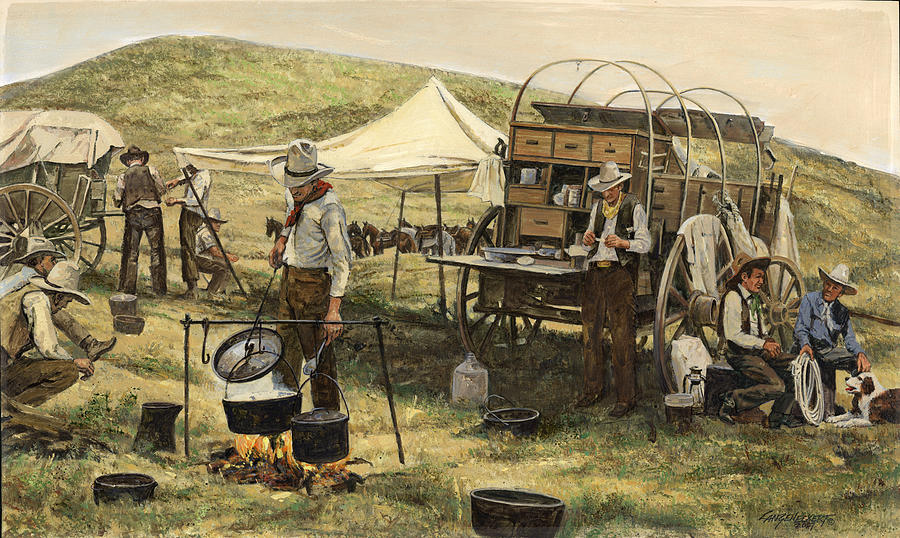
Chuckwagon Etiquette
- No one eats until Cookie calls
- When Cookie calls, everyone comes a runnin'
- Hungry cowboys wait for no man. They fill their plates, fill their bellies, and then move on so stragglers can fill their plates.
- Cowboys eat first, talk later.
- It's okay to eat with your fingers. The food is clean.
- If you're refilling the coffee cup and someone yells "Man at the pot." You're obliged to serve refills.
- Don't take the last serving unless your sure you're the last man.
- Food left on the plate is an insult to the cook.
- No running or saddling a horse near the wagon. And when you ride off, always ride down wind from the wagon.
- If you come across any decent firewood, bring it back to the wagon.
- Strangers are always welcome at the wagon.
NOW IT'S YOUR TURN:
* What is one example of manners drilled into you from a young age? Did it stick?
* Which rule(s) above do you wish were still commonplace today? Why?
* Which rule above did you find the most humorous?
* What is 1 fascinating fact about today's post which caught your eye today?
GIVEAWAY
Leave answers to the questions or any feedback on the post in the comments below to be entered into the drawing. Please also include your email address (email [at] domain [dot] com, net, us, etc.)
Comments with "please enter me" will not be qualified.
The winners will be announced on this blog and contacted privately by the 18th of August.
Don't forget to come back on the 9th of September for my next appearance.
 The Second Chance Brides Collection: Nine Historical Romances Offer New Hope for Love
From a Distance (novella #8)
Trevor Fox is on a quest to get away for a while from his job as financial adviser of his father’s company in New York. Working at a horse ranch just outside of Breckenridge, Colorado, affords him anonymity and solitude—until his fellow ranch workers decide to play a joke on him which blows out of proportion and names him as the most eligible bachelor in town. Distraught at the endless line of ladies all of a sudden vying for his attention and risking his true identity being revealed, Trevor seeks out an average girl showing no interest in him and decides to pursue her affections. Anna St. Claire always lived life in the shadow of her older, and more beautiful, sister. So she let her sister accept all the offers and didn’t give them a second glance…except for one, and he didn’t even know she existed. After taking her inheritance and moving to Breckenridge, she is shocked when Trevor walks into her life again and makes her an offer she can’t refuse. She pretends to live like an average girl in an attempt to sway Trevor’s affections. Her plan backfires, though, when he discovers her ruse, and she faces the possibility of losing him all over again.
 Magic of the Swan: A historical retelling of a classic fairy tale (Love Everlasting Book 6)
Elenora Caldwell and Trevor Davenport had been thrown together since they were children. As the years passed, a deep friendship developed. Now, as heirs to their respective family fortunes, they each attempt to find where they fit into life’s grand puzzle. When Elenora’s father dismisses a man from his employ, the man threatens to seek revenge. Charmed and fascinated by a new magician in the city who studied under the Great Houdini, Elenora sneaks out to attend a performance, but ends up a pawn in a vile scheme by the magician to take control of Caldwell Enterprises. In order to save Elenora, Trevor must first defeat Cravatta. How can he match wits with a master illusionist? And could his reunion with Elenora be the key to a brand new life?
** I only recently realized both heroes are named "Trevor." Guess I must like that name. This is also what happens when you're working on more than one book at a time, and more than a year passes between finished novels and more recent ones. **
BIO
 Tiffany Amber Stockton has been crafting and embellishing stories since childhood, when she was accused of having a very active imagination and cited with talking entirely too much. Today, she has honed those childhood skills to become an author and speaker who works in the anti-aging, health & wellness, and personal development industry, helping others become their best from the inside out.
She lives with her husband and fellow author, Stuart Vaughn Stockton, in Colorado. They have one girl and one boy, and a Retriever mix named Roxie. She has sold twenty (21) books so far and is represented by Tamela Hancock Murray of the Steve Laube Agency. You can also find her on Facebook, Twitter, Pinterest, and LinkedIn.

