| ||
| Anna Dickinson, c. 1855-1865 -- Wikipedia |
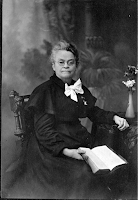
Anna Elizabeth Dickinson was born on this date in 1842 in Philadelphia. Her parents were Quakers and abolitionists, John and Mary Edmundson Dickinson. Her ancestors emigrated from England, settling with other Quakers near Evanston, Maryland in the 1660s. She was the youngest of three brothers and another sister. Their family went through difficult times and much poverty following her father’s death when she was two years old. Her mother opened a school in their home and rented rooms to boarders to support her family.
Anna was an avid student, hardworking, and whatever money she earned, she used to purchase books. When she was 14, she converted to the Methodist Church, remaining active throughout her life. It was in this same year that her first essay about slavery was published in The Liberator.
When she was 15, she worked as a copyist, replicating legal documents, letters, and more. At 17, she became a teacher in Pennsylvania, and at 19, she became a clerk at the US Mint, one of its first female employees. However, when she spoke out against General George McClellan in a public meeting, she was fired from the mint.
While today we consider the Quakers a conservative denomination, they encouraged women to speak in public at a time when such behavior was frowned upon by most Americans. Anna toured the country, speaking for the Sanitary Commission on such topics as abolition, reconstruction, women’s rights, and temperance.
Her first major speech, a two-hour discussion on women’s rights, occurred in 1861 in Philadelphia. Her mentor, Lucretia Mott, arranged a lecture tour sponsored by the Massachusetts Anti-Slavery Society, and Anna’s speeches are credited with helping the Emancipation movement.
During the Civil War, Anna visited hospitals and camps, speaking to the soldiers. During the 1863 US Senate elections and with the Civil War deepening all around her, Anna campaigned for several Republican candidates, speaking eloquently and powerfully in support of that party’s anti-slavery platform and for preservation of the union of the country. She spoke to coal miners in Pennsylvania, convincing many of her abolitionist views.
At a lecture in New York City, she held her 5,000 attendees captive for two hours, and earned a standing ovation for her impassioned speech in 1864 in the US House of Representatives, where President Lincoln was in attendance. She was the first woman to appear before Congress.
 |
| Interpines Mansion, where her mother lived, supported by Anna -- Wikipedia |
Following the Civil War, Anna continued speaking, earning the equivalent of half a million dollars a year and giving most of it to charity, friends, and relatives. It was during this time that she expanded her repertoire of topics to now include African-American rights, venereal diseases, and polygamy. And while she continued to support women’s rights, she did not speak about the suffrage movement.
Mark Twain wrote of her in a letter in 1867: “She talks fast, uses no notes what ever, never hesitates for a word…and has the most perfect confidence in herself.”
Fine praise, indeed, from a similarly famous orator himself.
Mark Twain wrote of her in a letter in 1867: “She talks fast, uses no notes what ever, never hesitates for a word…and has the most perfect confidence in herself.”
Fine praise, indeed, from a similarly famous orator himself.
 |
| Anna, c. 1870 -- Wikipedia |
Unfortunately for Anna, times changed but she didn’t. Audiences were less prone to listen to a lengthy lecture, preferring to be entertained. By 1875, she struggled to support herself through her speaking, and following one performance where she waved a bloody shirt on stage to make her point, bookings dried up and former supporters questioned her sanity.
In 1876, in an attempt to revive her career, she accepted the invitation by Ralph Meeker to visit Colorado, where she promptly climbed Pikes Peak and other mountains, often using mules or horses. She joined an expedition to survey Longs Peak, but when the Boulder County News reported her scandalous donning of trousers, her popularity dropped. However, she was the first white woman on record to climb Gray’s Peak, Lincoln Peak, and Elbert Peak; the second to summit Pike’s Peak.
In 1876, in an attempt to revive her career, she accepted the invitation by Ralph Meeker to visit Colorado, where she promptly climbed Pikes Peak and other mountains, often using mules or horses. She joined an expedition to survey Longs Peak, but when the Boulder County News reported her scandalous donning of trousers, her popularity dropped. However, she was the first white woman on record to climb Gray’s Peak, Lincoln Peak, and Elbert Peak; the second to summit Pike’s Peak.
 |
| Boston Music Hall -- Wikipedia |
As her speaking career declined, she decided to try writing, and in 1868 published the novel, What Answer? that tackled the current opposition to interracial marriage. In 1876, she penned A Paying investment: a Plea for Education that promoted technical training for workers, better treatment of prisoners, assistance for the poor, and education for all children. And, in 1879, she wrote A Ragged Register of People, Places, and Opinions. She wrote several plays, even acting in several, but her performance wasn’t received with favor in New York.
 |
| Anna, c. 1901 -- Wikipedia |
Anna’s final years were no easier than her early growing up had been. At one point, she exhibited signs of paranoia, and her sister had her committed to an insane asylum. After several years, Anna won her freedom and her court case alleging her illegal kidnapping, then she lived with a married couple for more than forty years.
She died in 1932 following a stroke, and is buried at State Hill Cemetery in Goshen, New York.
However, she left a legacy of boldly speaking out against societal wrongs, no matter how unpopular that made her. During the second world war, a Liberty ship was named after her, SS Anna Dickinson.

She died in 1932 following a stroke, and is buried at State Hill Cemetery in Goshen, New York.
However, she left a legacy of boldly speaking out against societal wrongs, no matter how unpopular that made her. During the second world war, a Liberty ship was named after her, SS Anna Dickinson.
About Donna:
A hybrid author, Donna writes squeaky clean historical and contemporary suspense. She has been published more than 60 times in books; is a member of several writers' groups; facilitates a critique group; teaches writing classes; and judges in writing contests. She loves history and research, traveling extensively for both, and is an avid oil painter. She is taking all the information she’s learned along the way about the writing and publishing process, and is coaching committed writers eager to tell their story.
www.DonnaSchlachter.com
Newsletter: https://www.thepurposefullwriter.com/newslettersignup Stay connected so you learn about new releases, preorders, and presales, as well as check out featured authors, book reviews, and a little corner of peace. Plus: Receive 2 free ebooks simply for signing up for our free newsletter!
Facebook: www.Facebook.com/DonnaschlachterAuthor
Amazon Author Page: https://www.amazon.com/stores/Donna-Schlachter/author/B01180A2EE
Bookbub: https://www.bookbub.com/authors/donna-schlachter
Goodreads: https://www.goodreads.com/search?q=donna+schlachter
The Purpose-Full Writer: https://www.facebook.com/groups/604220861766651
Resources:
https://www.joankoster.com/anna-elizabeth-dickinson-americas-shining-star/
https://civilwartalk.com/threads/anna-elizabeth-dickinson.97123/