Showing posts with label farmers. Show all posts

Friday, August 24, 2018

Sunday Houses


I've been working on a new series.  Like an old teabag I've been steeped in research since the first of the year, and just learned about Sunday houses.  

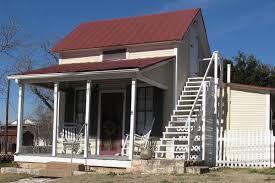
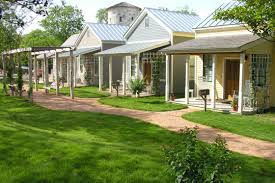
A Sunday house was a small second dwelling located next to a church. These houses were built by devout German farmers and ranchers who lived in the Texas Hill Country. 
Originally, German settlements were laid out as farm communities and farmers were given town lots. They were expected to live in town and drive out to their farms or ranches to work. Soon farmers found it less of a hassle to live on their distant farms than to travel back and forth each day.
Every Saturday they packed up their families and traveled to town. There they would purchase supplies, attend to business and, if necessary, receive medical treatment.   
Saturday nights was a time to socialize and this generally included a dance. They would then spend the night at their Sunday houses and attend church the following morning. Families would return to farms or ranches on after church on Sunday or wait till Monday.

Wood-framed Sunday houses were small and usually had only one and half rooms. Gabled attics where children slept were reached from outside staircases.  The pitched roofs were made from handmade cypress shingles and the windows and woodwork embellished with mill work.  The first floor had a lean-to kitchen and covered porch.  A fireplace provided warmth and cooking facilities, but there was no running water. 
These second dwellings fell out of favor in the 1920s.  Improved roads and the automobile made Sunday houses no longer necessary. Fortunately, many of these charming tiny houses still exist in Gillespie County. 
Now if I could just figure out how to work a Sunday house into my story….

If you had a Sunday house, where would it be located?


New, new, new!
Cowboy Charm School
(The Haywire Brides)

When buying a horse,
don't consult a pedestrian.
When courting a woman
don't ask advice of a bachelor.

B&N 


Wednesday, January 20, 2016

Waterloo Area Farm Museum - A Memorial to the Michigan Pioneer Farmer


Whenever I pass an old farmhouse on a country road, I usually start to wonder about the story behind it. How many generations lived there? They must have been so proud to build a new home. I ponder what it might be like on the inside. I usually feel a bit sad for the years long past and stories forgotten.

Visiting a place like the Waterloo Farm Museum, between Stockbridge and Chelsea, Michigan, is like looking through a window into the past, an opportunity to soak up the ambience of a weathered farmhouse.

The farm museum is called a "Memorial to the Michigan Pioneer Farmer." Michigan territory had long been thought of as uninhabitable swampland, but some took their chances where the territory became a state which boasted "If you seek a pleasant peninsula, look about you," for a motto.

Johannes Jacob Ruehle came from humble beginnings as a six-year-old German immigrant with his mother, sister and stepfather. After a visit with relatives in Ann Arbor, they boarded a train to Chelsea. Next they bought a wagon with oxen and began their journey on Native American trails
through marshy lands. They were able to purchase eighty acres and a simple log cabin in 1844.

Ten years later, a sitting room was added. This became the first room of the current farmhouse after the log cabin was torn down in the 1880s and the L frame was built.

The little boy called Jacob grew into a man and enlisted with the Union Army. He signed his name in the Americanized form, Jacob Realy. When he returned, he married the neighbor's daughter, Catherine. He opened a cider mill across the road and began his family.

The Realy's farm grew and prospered, marked by their generous sized pantry with lovely cupboards. It saw many a loaf of bread kneaded and coffee beans ground, as well as other baked goods prepared for the family there. Dishes were done in a granite tub and put away into unique pass-through drawers, which could be accessed on the other side in the dining room when it was time to set the table. Such an innovation showed off their prosperity, not to mention the fine dishes and silver in their possession.

The Realy's had seven children. Only the oldest and youngest of the daughters ever married. The
four sons lived on the farm until they were quite elderly. Their sister, Sophia, looked after them.

The father, Jacob, was disabled by a wound during the Civil War and was unable to do heavy labor. He lived on the farm until his death in 1916. His wife, Catherine, died in 1919. A member of the Realy family inhabited the farm until 1960, when Albert, the last of the third generation of Realys to live there, passed away. Sometime before that the brothers had sold their property to the state of Michigan to be included as part of the Waterloo Recreation Area.

The state tore down the cider mill and the barn, but an appeal was made to the local citizens for the preservation of the farmhouse. The Waterloo Historical Society was formed in 1962 with the interest in passing on history to the next generation. The farmhouse was lovingly restored by volunteers and many family heirlooms were given by those who wanted to remember their ancestors in a tangible way.

Over the years, the icehouse, windmill, and springhouse were restored. A log cabin was erected in 1976, to replace the original, reconstructed from a log cabin taken apart and brought from the nearby town of Stockbridge. A workshop and granary were added from nearby farms. To complete the historical experience, a few miles down the road from the farmhouse still stands a one-room schoolhouse, called the Dewey School.

The Waterloo Area Farm and Dewey School Museums are both open on summer weekends and for special events. They provide a special look into the pioneer farming days, while preserving history. Find out more about these places at: http://www.waterloofarmmuseum.org/ and their Facebook page.

Kathleen Rouser was so enthralled with books, she wanted to write stories before she could read them. A past homeschooling mom and mild-mannered dental assistant, Kathleen writes from her home in Michigan, where she lives with her husband of 34 years, who not only listens to her stories, but also cooks for her. And let’s not forget her resident muse is a sassy tail-less cat named Lilybits.

Her debut novel, Rumors and Promises, from Lighthouse Publishing of the Carolinas, is coming out in April, 2016. Connect with Kathleen at her website, Facebook author page, Twitter  and Pinterest.


Thursday, March 7, 2013

Where Would We Be Without Electricity by Debbie Lynne Costello

Giveaways everyday in March and a drawing for a Kindle and a $25 Amazon gift card at the end of March

So when was the discovery of electricity? Care to take a guess?  I bet a lot of you said 1752 when Benjamin Franklin flew his kite and key. What would you say if I told you it was actually 600 BC? A man name Thales of Miletus wrote about rubbing two amber rods together and them becoming charged. What he was describing was static electricity. Then in 1600 William Gilbert, an English scientist coined the word electricity. 1660 brought the invention of a machine that made static electricity and things just snowballed from there. Europe and America were making discoveries about this new power source by leaps and bounds.
But when did we actually start really using electricity. Although they were learning it wasn’t until the 1870’s that all their work started coming to fruition. In 1879 electric lights were first used for lighting street lamps in Cleveland, Ohio. That same year in San Francisco a power company began selling electricity to customers. But they could power less than 2 dozen arc lights.
1881 brought the electric street cars and as most know in 1882 Edison opened the Pearl Street Power Station of New York City. Edison was able to light 5000 bulbs! I find that amazing when just 2 years earlier another company could only light 21.

And from then on the inventions and improvements were coming yearly.
Electric power houses had to be built in cities in the 1880’s where they could get power to the street lights and in to very select homes. People of power and wealth were the fortunate ones to receive electricity. So technically it was the 1879 that homes got power but that was such a minute amount of the population even into the 80’s it could hardly be counted. And remember you had to live in the city for that to be a possibility.

Even as electricity progressed into the 1890’s there still was not that many homes with power, mostly the affluent. Restaurants, hotels, industry, and street lights used most of the power. But things were progressing and by the mid 90’s several power companies had laid 20 miles of wire! I think oh my goodness. I drive that far to go to the store but 20 miles was really a big deal back then and they were quite proud of those 20 miles of wire. 
The thing is most homes were already built. Can you imagine wiring a house that never had electricity? None of those holes or wires are anywhere. It’s not like today when a house needs to be rewired you just pull them through as you tug the old ones out. Nope, didn’t have that luxury. So that was a factor. But as the 19th century turned to the 20th century the new houses being built had electricity. Life was about to change forever.
                                             By Sergei Prokudin-Gorskii - This image is available from the United States Library of Congress's Prints and Photographs divisionunder the digital ID ppmsc.04414.This tag does not indicate the copyright status of the attached work. A normal copyright tag is still required. See Commons:Licensing for more information., Public Domain, https://commons.wikimedia.org/w/index.php?curid=2823428

By the 1920’s almost every major city across the nation had power stations to supply their cities with electricity and by 1930 most large city or town residents were blessed with light bulbs instead of gas lamps.
 However, if you were a rural farmer you might still be running by batteries and crude stoves as you awaited the lines to be run out to remote places. Only 10% of farmers had electricity in the 30’s.  Power companies were privately owned and they were there to make money. Running miles of wires out to a farm didn’t seem economically sound. Not to mention they didn’t believe the poor farmers would pay them. By 1939 the number of farmers with electricity had risen to 25%.

So now onto the place I love. Charleston, SC. Just a few quick tidbits of information. Okay I can’t make anything about Charleston short…but I can try..
In 1881 The Charleston Company was organized by a group of local businessmen. In the summer of 1882 they purchased land on Queen Street and by September they had completed their central-station building. Within one year the company had gained private customers, strung wires along two streets, provided electricity to two textile mills, and the Agricultural Hall. In 1883 they told the city how they could light a city street in Charleston and even demonstrated it. But alas, City Council voted to stick with the tried and true gas lamps (you don’t suppose they had lobbyists back then do you?)
A year later the company went out of business. Yikes! What happens when the only power company in town goes out of business? Yep, that’s right you don’t get power. So all those people who were relying on their electricity to run their business or light their home suddenly found themselves in the dark. ;o)  It took two years before the enlightened city of Charleston would have electricity again. A contract was given that all the principle streets would be lit by electricity and the side streets by gas.

And now for the answer you’ve all been wondering your whole life—Who invented the Christmas tree lights? The answer is—Edward Johnson an inventor and business associate of Thomas Edison was the first person to come up with the electric Christmas tree lights in 1882. J


I'm giving away a bath basket to one lucky winner and a 19th century hand made bracelet to another. Leave a comment to be entered. Follow this blog for a second entry. Tweet it and Facebook today's post for another 1 point each. Be sure and let me know if you are following, tweeted or FB so I can give you the extra entries. Four entries possible!
And don't forget we are giving away a Kindle and a $25 Amazon gift card
For each day you comment on CFHS you receive one entry in the kindle and $25 Amazon gift card giveaway. Comment on every post in the month of March and earn 31 entries!