Showing posts with label mail order bride. Show all posts

Saturday, February 8, 2025

Mail-Order Bride from Russia


image by Vitaly_Stasov, deposit photos

by Martha Hutchens

The whole point of a mail-order bride is that the prospective bride and groom don’t live near each other. However, we normally think of it being a woman in the eastern United States joining a man somewhere in the west. Sometimes, the bride travelled a much greater distance.

Such was the case for Rachel Bella Kahn. She travelled from Chvedkifka, Russia in the 1890s.

Abraham Calof wrote an advertisement for a bride to join him in North Dakota. He required a woman of strong character, and most importantly, of the Jewish faith. When his first choice decided against traveling so far from family, he asked his sister to interview Rachel Kahn.

Rachel Kahn certainly had less concerns about leaving her family. Her father and stepmother were neglectful and abusive. Her job as a maid in her aunt’s mansion involved long hours and little pay. When she almost escaped through a love match with the local butcher, her family blocked the marriage because his occupation made him “inferior.” At seventeen, Rachel had already seen her share of heartbreak.

Then she received word that Abraham Calof liked what she wrote about herself. They exchanged pictures and liked each other’s looks. Abraham commissioned his oldest sister, Chaya, to interview his prospective bride. The interview included several tests, but Rachel won Chaya over when she did not become frustrated or angry while untangling a ball of knotted yarn.

Rachel traveled by train to Hamburg, Germany, then by ship to Ellis Island. Like many of the immigrants, she was desperately seasick. She forgot the misery when she saw Abraham waiting for her when she arrived in New York City. “There’s my beloved,” she said.

They traveled by train to North Dakota, where Abraham planned to file for a homestead near his family.

image by ehrlif, deposit photos

I think we forget just how desperate life on the frontier could be. Rachel probably thought she knew what she was getting into, but her first sight of her husband’s family shocked her. They were dirty, dressed in rags, and the men were barefoot. They she arrived at her new home. It was a 12 by 14 foot shack with a dirt floor, a bed, a table, and a stove. Since the couple was not married yet, they would be sharing this palace with Abraham’s parents, brother, sister-in-law, and two children.

Abraham understood her disappointment, and took her on long walks where he reassured her that this was a temporary situation. Eventually they would be own their own and happy.

In November of 1894, the couple was married. However, to conserve their limited fuel, the couple would be forced to continue living several other people, as well as livestock.

Abraham worked long hours in the field, and Rachel worked equally hard providing food for the two of them as well as for the children that they had. After five years of marriage, Abraham had enough money to build a larger home for their family, which included four children at the time.

By 1900, the homestead appeared to be prospering, with a bumper wheat crop in the field. And then hail came. Their crop was destroyed and their house was flooded. However, they persevered. 

image by IgorStrukov, deposit photos

By 1910, their homestead had grown much larger than its original 160 acres. They had also expanded from farming to breaking wild horses. They had earned the respect of their neighbors by their tenacity and their dedication to their Jewish faith. Abraham helped new farmers in the area. They were both instrumental in founding the first school in their region. Their efforts were recognized by two presidents, William Taft and Woodrow Wilson.

They spent twenty-three years on their North Dakota farm before moving to St. Paul, Minnesota. Abraham worked in dry goods there. Rachel began writing her life story, which she described as “a life worth living.”

image by LiliGraphie, deposit photos

The Calofs were married for more than fifty years. They had nine children. They both died of natural causes in their late seventies.

I think Abraham and Rachel exemplify what we think of as a mail-order marriage.

If you are enjoying this mail-order bride stories, check out Hearts West: True Stires of Mail-Order Brides on the Frontier by Chris Enss.


Martha Hutchens is a transplanted southerner who lives in Los Alamos, NM where she is surrounded by history so unbelievable it can only be true. She won the 2019 Golden Heart for Romance with Religious and Spiritual Elements. A former analytical chemist and retired homeschool mom, Martha is frequently found working on her latest knitting project when she isn’t writing


Martha can frequently be found at the Sunrise Historical Hearts Facebook page, along with other Sunrise authors. If you would like to find out about new Sunrise releases (including a mail-order bride series), and meet other historical authors, click here to join the fun.


Thursday, October 17, 2024

A Bevy of Brides-to-Be Sail away for their chance of a Happily-ever-after


My interest in mail-order bride romance, which was the genre of my first historical romance Secrets & Charades, came from a short-lived TV show from the 1960s,
Here Come the Brides

I watched it faithfully every week on our new colored TV while in middle school. It was loosely based on a true event. Loosely, because the stories told once the women arrived were strictly fiction.

Two diaries are available in the Maritime Museum in Portland, Oregon recounting the sea voyage. And excerpts and retelling of the ladies’ adventure are in the book Hearts West: True Stories of Mail-Order Brides on the Frontier by Chris Enss, published in 2005. This book has been in my reference library for years. The anthology is fascinating.

I found the article of the brides-to-be who traveled from Elcott City, Maryland to Albany, Oregan in 1865 very interesting. Sadly, there are no photos or evidence of these ladies and their travels on the internet. But that is not unusual when it comes to historic documents such as old diaries and journals. My husband has a potential ancestor’s diary written while traveling on a wagon train, and his grand-aunt’s diary while living in the oil fields during the 1940s. Their stories are true, but unless you are a family member, you would never have read them. Sharing these women’s bold adventure might just inspire you to be bold too.

A bit of Background History

By the mid-1800s the eastern United States had an overabundance of single women, due to the Civil War, which reduced the population of single men and produced many widows. Meanwhile, the west was populated with single men who had gone west with a desire to make their fortune. Some pursued mining, some lumber and others land. These men were desperate for wives. And with the antiquated idea that a woman of 25 was an old maid, it was no wonder young ladies ‘long in the tooth’ sought marriages out west.

There were a few attempts at bringing women by the boatload to Oregon and Washington by others such as Asa Mercer. But the story of the Benton Brothers Brides showcased the determination of the brides rather than the men who put the expedition together.

The Benton Brides

Archer, Thaddeus and Samuel Benton owned a sawmill in Albany, Oregon and a group of single men from the area commissioned them to encourage women to come as potential brides.

When they arrived, in December of 1864, in Ellcott County, Maryland, they mailed their brochure, Brides Wanted, to every household. The brochure asked single women interested in marrying the man of their choosing from the eligible bachelors in the Willmette Valley to attend a meeting at the townhall.

Two of those women were Constance Ranney, a maid for a wealthy household who hated her job. And Josephine Gibney whose grandfather had owned a fishing vessel, and she’d traveled with him. After hearing Archer describe the beauty of Oregan and their option of choosing their husbands, Constance was excited. She wrote her uncle explaining all the women would be equal, no matter their station, as they were all looking for husbands. Unlike Constance’s parents who forbade her to go, Josephine Ann Gibney’s parents gave their blessing. Both women kept journals of their sea travel. On January 16, 1865, they joined over 100 women packed and waiting at the docks.

Aboard ship

The character of the women aboard ship gives us a hint of their tenacity and determination when they reached Oregon. The women boarded the schooner Osceolo. Most were so busy waving farewell and crying that they hadn’t noticed the condition of the ship. The Osceolo’s cargo was usually livestock, so when the women saw that their sleeping quarters were in animal stalls, they were upset to say the least. Josephine shared in her diary that after a lot of complaining and then discussing the possible hardships they would encounter in their new home, they decided to make the best of it. They put things in a semblance of order so they could sleep, and then the next morning would clean their new home until it was spotless.

After several days of scrubbing, they’d transformed the smelly, filthy boat into a suitable home. The women took over the cooking. Miss Gibney had cooked on her grandfather’s ship and was able to teach the others how. The sailors exclaimed they’d never eaten so well. The women endured rough seas, seasickness, and the horror of seeing a young sailor fall overboard during a fierce storm, never to be seen again.

The women were determined to change more than the appearance of the interior of the boat. They insisted that the sailors not drink alcohol, bathe regularly and have Sunday services. Archer Benton was able to persuade the reluctant sailors to comply.

After the seas quieted, following several rough stormy days, and most of the women had recovered from seasickness, the sailors entertained the women with music. A quartet of sailors sang while accompanied by a mouth harp (harmonica). Some of the brides danced with the sailors. The men took to referring to the group as “the brides”.

In March 1865, Constance mentioned in her journal that her seasickness had been replaced by homesickness. She didn’t want to return home but missed dry land.  She could hardly wait to meet her prospective groom.

On April 4, 1865, the schooner docked at an Oregon port and over 150 men, loggers and miners from Willamette Valley, were there to greet them. The brides carried only one suitcase and a letter of introduction. Letters of introduction were common when meeting strangers. The letters spoke of their good character. I’m not sure who offered the letters of introduction unless it was the Archer brothers because they would be the only mutual acquaintance between the two. Just a curious question I had as I read their story. The brides were taken to Albany, and all but seven were married within a year.

If not for the diaries, we would never know there had been a successful shipload of brides delivered to lonely single men on the west coast.  Unfortunately, that is where the journals stop. We have no idea who they married or if they had happy unions. But we can see that these women were determined, practical and not afraid of meeting the next bump in the road head-on. Just the sort of women to civilize the west and help it thrive.

Have you read a diary or journal from an ancestor or from a museum collection that gave you insights into real life in the past?

Cindy Ervin Huff is a multi-published award-winning author. A 2018 Selah Finalist. She has a passion to encourage other writers on their journey. When she isn’t writing, she feeds her addiction to reading and enjoys her retirement with her husband of 50 plus years, Charles. Visit her at www.cindyervinhuff.com.


                        Click here to learn more about Rescuing Her Heart


Friday, April 28, 2023

The History of Matrimonial Bureaus and Dating Agencies – with Giveaway By Donna Schlachter


From "A Brief History of the World's First Dating Agency"


Adam and Eve were probably the only people in history who never struggled to find a mate. After all, they were the only two people around, and God created Eve for Adam.

But from that time on, given that humans are rarely satisfied unless there’s a choice between two options, no doubt some have wondered and wandered in search of a mate. In many cultures, in the early days, the father or oldest male relative would choose a wife for his son. And fathers of daughters were always on the lookout to pair their daughter for family honor, money or land or power, and since it was done this way all the time, rarely was love or affection considered. After all, survival of the human race was more important than love, wasn’t it?

This month, we’ll explore the history of how folks who struggled to meet other folks might have solved their problem by employing a matrimonial bureau.

The first known dating agency was established in 1650, although they probably existed for years before under similar guidelines. Mr. Robinson originally set up a Citizens Advice Bureau and charged on a sliding scale according to ability to pay; peasants got advice at no charge. He was discreet, primarily because some of the advice he handed out would have gone against the largely Puritan population in the area of Threadneedle Street, London. The fact that little documentation survives about his business venture is a testimony to his choosing to stay quiet about the operations.

In the 1600s, most marriages were arranged through the immediate family. If there was none, the parish priest might be asked to recommend a suitable mate. Mr. Robinson was adept at sniffing out information on existing relationships, young men and women coming of age, deaths, and new folks in the area. Being single past the age of twenty-one carried with it a deep stigma, which is why folks often turned to a matrimonial bureau.

Courtship began once the match was found. A man could send gloves to his intended, and if she wore them to church the following Sunday, that meant she was interested. He might also carve a love spoon, complete with artwork whittled in, to send a personal message to the woman. Meetings were conducted in the presence of a chaperone.

During this time, if the relationship lasted beyond a few successful meetings, he would be invited into the woman’s room, where they could talk. Later on, this would have been scandalous, but at this time, provisions were made to ensure that no physical contact happened before marriage. Bundling provided private time for them to share their feelings, their dreams, and discuss important topics such as the number of children they preferred or how many servants he would provide.

From "A Brief History of the Worlds Fist Dating Agency"


Bundling consisted of several options, depending on the practice of the area, and might be a bolster placed between the pair; a bundle board set down the middle of the bed; special garments that they were sewed into like a sack; or the man slept on top of the covers while the woman slept underneath. If they passed this test, they were permitted to marry. Otherwise, they were separated from each other and condemned by society.

By the 1700s and 1800s, the church had become more active in promoting marriage. In the late 18th century, clergymen established practice. Ads were placed in newspapers asking men and women who desired marriage to send money and their details, including age, how much money they made or had, and the dowry required or provided.

In 1825, an agency in London opened an office three days a week so prospective spouses could subscribe in person.

Historically, matrimonial bureaus worked as a commercial business or a service of the local church. Unfortunately, in both cases, fraud happened, with parties sending money but never getting the spouse.

This especially happened when a party in the US agreed to bring a bride from Europe, as the defrauded victim had little recourse to getting either their wife or their money.

Matrimonial bureau matches were often called Mail-Order Brides or Mail-Order Husbands. The proliferous use of catalogues to order goods easily translated in the general public’s mind to ordering up a spouse.

The modern dating agency came following World War II. With economic prosperity and folks looking for new kinds of leisure and amusements, Dating Clubs were set up. Folks joined, had their photograph taken, and gave information about themselves and the type of person they hoped to meet. Prior to the widespread use of photography, an artist’s rendering of prospective mates often took a long time to create, and often physical descriptions were misleading or outright lies.

While no matrimonial bureau was officially used in my book, Kaihtlyn’s Choice, her husband left a will stipulating that she must marry one of three men he’s personally selected for her. Within 30 days. A tinker, a tailor, and a candlestick maker. Which one will she choose?


About Kaihtlyn’s Choice:


A young woman heads west to meet her wandering husband in Nugget, Colorado. On her arrival, she learns he died. But he left a gold mine and a will. With a stipulation: She must marry within 30 days. To one of three men he pre-selected before he died. But which man will win her heart? The tinker, the tailor, or the candlestick maker?

Check out Kaihtlyn's Choice here: https://www.amazon.com/dp/B0BZWTPZY1 and the rest of the series: https://www.amazon.com/dp/B09JVS5QBX


Giveaway: Leave a comment, along with your cleverly disguised email address, and I will draw randomly for one lucky reader to receive a free ebook copy of Kaihtlyn’s Choice. For example, donna AT livebytheword DOT com


About Donna:


A hybrid author, Donna writes squeaky clean historical and contemporary suspense. She has been published more than 60 times in books; is a member of several writers groups; facilitates a critique group; teaches writing classes; ghostwrites; edits; and judges in writing contests. She loves history and research, traveling extensively for both, and is an avid oil painter. She also coaches writers at any stage of their manuscript. Learn more at www.donnaschlachter.com/Tapestry


Connect Online
www.DonnaSchlachter.com Stay connected so you learn about new releases, preorders, and presales, as well as check out featured authors, book reviews, and a little corner of peace. Plus: Receive 2 free ebooks simply for signing up for our free newsletter!

www.DonnaSchlachter.com/blog

Facebook: www.Facebook.com/DonnaschlachterAuthor

Twitter: www.Twitter.com/DonnaSchlachter

Books: Amazon: http://amzn.to/2ci5Xqq

Bookbub: https://www.bookbub.com/authors/donna-schlachter

Goodreads: https://www.goodreads.com/search?utf8=%E2%9C%93&query=donna+schlachter

Looking for a Writing Coach? www.donnaschlachter.com/tapestry


Resources:

https://londnr.com/a-brief-history-of-the-worlds-first-dating-agency/

https://www.independent.co.uk/life-style/dating/advice/how-dating-evolved-through-the-years-2327549.html

https://en.wikipedia.org/wiki/Dating_agency


Monday, November 28, 2022

Mail Order Brides and Romance by Post—with Giveaway by Donna Schlachter


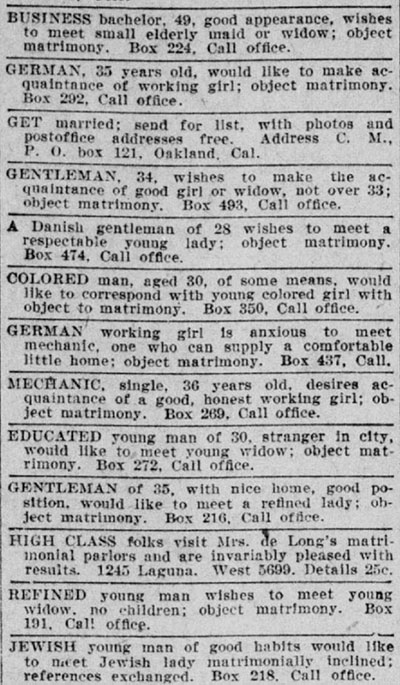
Matrimonials,” The San Francisco Call (San Francisco, CA), February 7, 1909, 44. Chronicling America: Historic American Newspapers.


When non-historians sit around with a cup of coffee and discuss American history, there are at least three favorite topics: Pony Express, orphan trains, and mail order brides.

The interesting thing about that is that they seem completely unconnected. And yet, as we consider the three, perhaps they have more in common than we first think.

The Pony Express lasted about eighteen months, while orphan trains relocated more than two hundred thousand orphaned and abandoned children in the seventy-five years the system operated. As for mail order brides—well before the United States Postal Service was formed, men sought women in America, bringing them over from England, Ireland, Scotland, and other countries in Europe. In fact, folks are still finding spouses from other countries.

Prior to the 1800s, connections between a man seeking a wife, and a woman willing to answer, came in the form of personal introductions or family or business connections. It wasn’t uncommon for parents who were close friends to betroth—or promise—their children would wed.

In the 1800s, once newspapers and printing houses were established, advertising for a spouse became much easier. Papers printed ads, and respondents indicated their interest by writing a letter in care of the newspaper. Magazines operated in a similar fashion, sometimes allocating several pages for these advertisements.


Mary and Elkanah Walker married in 1838.
Portrait of Mary Richardson Walker and Elkanah Walker, Cage 57, Elkanah and Mary Richardson Walker Papers 1830-1938, Manuscripts, Archives, and Special Collections, Washington State University Libraries, Pullman, WA.


Between the Civil War and the 1830s, a new phenomenon called “the love match” took over Western Europe and America. The idea grew that love was now necessary for a successful marriage. Perhaps perpetuated by the increase in romance novels—or perhaps the novels were a result of the notion—but either way, parties to marriage often considered love was more important. In the past, couples recognized other benefits to marriage: shared duties and responsibilities; combining businesses or land; continuing a family legacy or bloodline; and, of course, children.


These four men in Montana (near Lake McDonald in Glacier National Park) at the turn of the 20th century advertised their want for wives on the side of a cabin. From left-to-right they were: Bill Daucks, Frank Geduhn, Esli Apgar, and Dimon Apgar. Frank, and Dimon eventually married, but not mail-order brides. Courtesy of Glacier National Park Photo Archives, photo HPF 9871.


There is no evidence that love trumps loyalty, honor, family, or faith, however. Many mail order couples—and indeed, most of the marriages of the time—were not based in love. No doubt many grew to love their spouses over the course of the marriage, but overall, this love match idea was slow to take hold, particularly among older families. There is no evidence available to suggest that those who married through the mail order system were any happier, or their marriages any more—or less—successful, than couples introduced in the conventional way.

The process varied, but usually one party placed an advertisement, registered with a marriage agency, or provided information to friends and family that they desired to marry. The other party responded, which began a time of exchanging letters. This might go on for as little as a month—one letter each way—or for a year or more. Arrangements were made for the woman to travel to the man, which he paid for. Sometimes a commitment was made in writing, but occasionally it didn’t happen until they’d met and deemed each other suitable. There is an account of one couple who married four hours after they met in person, although they knew each other through family connections and had corresponded for over a year.

And then there’s the story of a woman who rejected the man after meeting him because he had red hair. In her experience, red-heads were always “cross”—angry.

Some mail-order brides never even arrived at the station. Rather, they accepted the travel fare and pocketed the money. Mail Order Marriages: Two in Spokane Turn out Differently,” East Oregonian (Pendleton, OR), March 23, 1911, 6. Historic Oregon Newspapers.


Scams were likely, and an untold number of men lost their potential mate, their money, and their pride when she never arrived. If the phrase “once bitten, twice shy” is true, many of these poor fellows likely lived out their lives as bachelors. Or chose a woman who lived nearby.

Fast forward to today, and we see that a slightly different version of marriages still takes place. Common in World War II, soldiers still bring wives home from foreign lands. The internet has opened the world to those seeking a mate. In fact, I am an internet bride. We just celebrated our twenty-third anniversary. But that’s a story for another time.

In my upcoming release, The Freedom Stage: Book 2 of Mail-Order Romance, planned for December 31st, 2022, my heroine runs from her past—straight into the arms of a stranger.

In Book 1 of this series, The New Hope Train, strangers meet on a train and fall in love, and must decide whether to fulfill their commitment to another, or to break their word and marry each other.


Giveaway: Leave a comment, and I will randomly draw one name to receive an ebook copy of The New Hope Train. Include your email so I can contact you. Comments without an email will not be included in the drawing. Please cleverly disguise your email address so the bots don’t find you. For example: donna AT livebytheword DOT com


About The New Hope Train:


October 1895

Mary Johannson has scars on her body that can’t compare with the scars on her heart. She is alone in the world, with no family, no prospects, and no home.

John Stewart is at his wit’s end. His wife of three years died in childbirth, leaving him with a toddler and an infant, both girls. Theirs was the love of fairy tales, and while he has no illusions about finding another like her, his children need a mother.

Though separated by thousands of miles, they commit to a mail-order marriage. But on their journey to New Hope, they meet and realize the life they’d planned would be a lie. Can they find their way back from the precipice and into the love of God and each other, or are they destined to keep their word and deny their heart?

Check it out here: https://www.amazon.com/Hope-Train-Mail-Order-Romance-Book-ebook/dp/B09BBQTD7M


About The Freedom Stage:


A young woman runs from her past, straight into the arms of a stranger. Was she going from bad to worse? Or did God hold her in His hands?

A death-bed promise, a family legacy, an unexpected wife--how can he turn his back on them to fulfill a vow?

Preorder here: https://www.amazon.com/dp/B0BLZMWNTD


About Donna:


A hybrid author, Donna writes squeaky clean historical and contemporary suspense. She has been published more than 50 times in books; is a member of several writers groups; facilitates a critique group; teaches writing classes; ghostwrites; edits; and judges in writing contests. She loves history and research, traveling extensively for both, and is an avid oil painter.

www.DonnaSchlachter.com Stay connected so you learn about new releases, preorders, and presales, as well as check out featured authors, book reviews, and a little corner of peace. Plus: Receive a free ebook simply for signing up for our free newsletter!

Facebook: www.Facebook.com/DonnaschlachterAuthor

Books: Amazon: http://amzn.to/2ci5Xqq

Bookbub: https://www.bookbub.com/authors/donna-schlachter

Goodreads: https://www.goodreads.com/search?utf8=%E2%9C%93&query=donna+schlachter


Resources:


https://postalmuseum.si.edu/research-articles/go-west-young-woman/

https://postalmuseum.si.edu/research-articles/go-west-young-woman/when-where-did-mail-order-brides-live

https://postalmuseum.si.edu/research-articles/go-west-young-woman/how-did-couples-find-each-other

https://postalmuseum.si.edu/research-articles/go-west-young-woman/why-did-men-and-women-marry-spouses-they-had-never-met