Showing posts with label novelist. Show all posts

Sunday, December 28, 2025

On this Day…1895 Carol Ryrie Brink by Donna Schlachter


courtesy Wikipedia


Well, my year of blogging about writers in American history comes to a close with a more contemporary author, Carol Ryrie Brink. She wrote more than 30 juvenile and adult books, and her novel, Caddie Woodlawn, won the 1936 Newberry Medal and a Lewis Carroll Shelf Award in 1958, attesting to the longevity of her books’ appeal.

Carol was born in Moscow, Idaho as Caroline Sybil Ryrie, the only child of Alexandre Ryrie and Henrietta Watkins. Her Scottish-born father also served as mayor of Moscow from 1895-1897. He died in 1900, and her mother remarried. Her step-father, Elisha Nathaniel Brown, failed, and her mother took her own life in 1904 at the age of 29, leaving Caroline to be raised by her widowed grandmother, Caroline Woodhouse Watkins. Carol later used her as a model for her character Caddie Woodlawn. Carol was inspired by her grandmother’s life and storytelling abilities, setting the stage for her future career. 

Carol's signature -- courtesy Wikipedia 
 
Carol began writing for her school newspapers, continuing in college, where she graduated from the Portland Academy in Oregon before attending the University of Idaho in Moscow from 1914-1917. She wrote for both the college newspaper and the yearbook. In 1917, she transferred to the University of California in Berkeley for her senior year, graduated the following year.

Right after graduation, she married Raymond Brink, a mathematics professor she’d met in Moscow. He now taught at the University of Minnesota, and so Carol moved to St. Paul, where they lived for 42 years, raising a son David and a daughter Nora. They loved spending summers in the Wisconsin backwoods, and traveled often to Scotland and France.

Carol’s first novel, Anything Can Happen on the River, released in 1934. She continued writing fiction, publishing more than 30 books and two plays. And she added poetry and painting to her endeavors.

She was awarded an honorary doctorate of letters from the University of Idaho in 1965, and Brink Hall, at that same university, contains the English department.

Raymond passed away in 1973 after 55 years of marriage, and Carol died eight years later in 1981 at the age of 85.

In 1995, on the centennial of her birth, the “Carol Ryrie Brink Nature Park” was dedicated. And, in the city’s north end, the refurbished Carnegie building of the city library contains the “Carol Ryrie Brink Reading Room” in the children’s area. Carol frequented that library as a child.

In her family, the oldest daughter has been named either Carol or Caroline for at least seven generations, continuing to the present.

Leaving a legacy to future generations is critical, and Carol surely has done her part.


Leave a comment about Carol Ryrie Brink and share your thoughts about her enduring legacy.


About Donna: 
A hybrid author, Donna writes squeaky clean historical and contemporary suspense. She has been published more than 60 times in books; is a member of several writers' groups; facilitates a critique group; teaches writing classes; and judges in writing contests. She loves history and research, traveling extensively for both, and is an avid oil painter. She is taking all the information she’s learned along the way about the writing and publishing process, and is coaching committed writers eager to tell their story.


www.DonnaSchlachter.com

Newsletter: https://www.thepurposefullwriter.com/newslettersignup Stay connected so you learn about new releases, preorders, and presales, as well as check out featured authors, book reviews, and a little corner of peace. Plus: Receive 2 free ebooks simply for signing up for our free newsletter!

Facebook: www.Facebook.com/DonnaschlachterAuthor

Amazon Author Page: https://www.amazon.com/stores/Donna-Schlachter/author/B01180A2EE

Bookbub: https://www.bookbub.com/authors/donna-schlachter

Goodreads: https://www.goodreads.com/author/show/14116621.Donna_Schlachter

The Purpose-Full Writer: https://www.facebook.com/groups/604220861766651

Want to learn how to leave your own legacy?
: www.ThePurposeFullWriter.com


Resources: 
https://en.wikipedia.org/wiki/Carol_Ryrie_Brink

Thursday, September 25, 2025

Celebrating Christie's Mysteries--and a Giveaway


By Jennifer Uhlarik


My April 1, 2025, release was a romantic mystery set in the Old West. While many of my novels and novellas have elements of mystery and suspense in them, I’d never specifically set out to write a mystery before, so I found myself researching the genre and those who have had successful careers in that genre. This led me to read up on the best-selling novelist of all time, Agatha Christie—and since this is her birth month, I’ll share a bit of my findings about her with you.


Childhood

Young Agatha Christie


The prolific author we know as Agatha Christie was born Agatha Mary Clarissa Miller on September 15, 1890. She was the youngest child of three—a “much-loved afterthought” (according to agathachristie.com) of her American father, Frederick and her Irish mother, Clara. Her older brother Monty and older sister Madge were ten and eleven years her senior, respectively. The family lived in Torquay, Devon, England during her early years.


Her mother, Clara, loved Agatha’s natural creativity and wanted her youngest to wait to learn to read until she was eight, but with both her older siblings away at school, young Agatha grew bored—so she taught herself to read. She devoured books. Her creativity also flourished by listening to the made-up stories of her mother, and she and Madge followed in her footsteps with imaginings and stories of their own.


At age eleven, Agatha’s father passed away unexpectedly, leaving Clara and Agatha’s lives in uncertainty. For a time, Agatha attended a girl’s school in Torquay, but she eventually went to a boarding school in Paris, France, for a few years and at age eighteen, spent her three-month debutante season in Cairo, Egypt. With the goal of finding a husband, Agatha emerged from the season with numerous marriage proposals. She turned them all down but the one from her friend, Reginald Lucy. But theirs was not the typical romance. The two struck a bargain—that they would wait for two years to marry, and if, in the meantime, anyone richer or more interesting came along, they would break their engagement and marry the other.


Agatha’s Foray Into Married Life


Reggie Lucy would not end up being Agatha’s husband after all. In 1912, she met Archibald Christie at a party, and the dashing aviator swept her off her feet. They married on Christmas Eve in 1914. However, with World War 1 in full swing, both had jobs to do. Two days later, Archie returned to France, and Agatha returned to the hospital in Torquay where she worked as a nurse.


It was during this time, while working around the dispensary, that Agatha learned of various poisons. And seeing the many Belgians who came to England to escape the horrors of the war in their home country, she began to imagine a Belgian police officer as a character for a story. When her sister challenged her to write a mystery, suggesting that Agatha couldn’t pull off such a feat, Agatha rose to the occasion and wrote The Mysterious Affair at Styles, her very first Hurcule Poirot story.


Agatha and husband Archie


In 1918, the war ended, Archie returned, and the by-now “old married couple” got to begin their marriage in earnest. In the next year—1919—Archie took a job in London, they welcomed their daughter, Rosalind, and Agatha’s first Poirot novel was picked up by a publisher with a request for five more like it. By 1924, Agatha published The Secret Adversary, The Man in the Brown Suit, and The Murder on the Links.


Tragedies Make For New Beginnings


Unhappy with her first publisher, Agatha found a new publishing house who gladly took her on as an author. In 1926, The Murder of Roger Ackroyd came out with great sales and much acclaim, but the tidal wave of newfound success was short-lived. Agatha’s mother passed away, causing Agatha to leave for Torquay to clean out the family home. Grief-stricken at the loss, she found it difficult to write. And while they were separated, Archie and Agatha drifted apart. His eye soon wandered to another woman.


One December night, Agatha found herself in terrible spirits, so she left little Rosalind in the care of the house maids and went for a drive. Her car was later found abandoned, and Agatha was nowhere to be seen. It took some ten days and a nationwide search to discover that she was, in fact, in the care of the Swan Hydropathic Hotel under an assumed name. She had no recollection of who she was, how she’d gotten there, nor did she recognize Archie when he came to see her. This episode became one of great embarrassment to her. In later years, she never spoke of this time with anyone.


Upon her return to London, she and Archie remained separated. Needing an income for herself and her daughter, Agatha compiled some of her short Hurcule Poirot stories, previously published in magazines, into a collection titled The Big Four.


In 1927, still struggling to churn out the next Poirot novel, she began toying with a new detective—Miss Jane Marple, who debuted in The Tuesday Night Club, a short story published in The Royal Magazine. Perhaps the unassuming personality of this amateur sleuth was just what Agatha needed as she continued her healing after her mother’s death, the failure of her marriage, and the mental stress she’d endured. But in 1928, she finalized her divorce, moved to the Canary Islands with Rosalind, and returned to work with her next Poirot story, The Mystery of the Blue Train.


Happiness Leads to New Purpose


Agatha loved to travel and took a trip on the Orient Express to Baghdad. From there, she visited the archeological dig at Ur, where she met the Woolleys, who led the excavation. Returning there the next year (1930), the Woolleys asked Max Mallowan to show her around the area. The two instantly became fast friends, despite the fourteen-year age difference (Agatha was the elder in the relationship). Soon after, Max proposed, and they were married on September 11, 1930. The happy couple fell into a new rhythm. Some of the year, they were on the archeological dig site, where Agatha became a valued member of the team. They summered in her family home in Torquay, spent Christmases with her sister, and the remainder of the year in London. During this time, she turned out two to three novels each year, including Murder on the Orient Express and many others.


Agatha and Max Mallowan on their honeymoon in Egypt.


Even the start of the Second World War couldn’t derail Agatha. She and Max continued in Torquay for a time, each doing their part for the war effort. Agatha returned to work in the hospital dispensary, like she had done during the earlier war, though Max was eventually sent to Cairo. Agatha hoped to find a position near her husband, but that never materialized. She continued working, moving to a different hospital as the war proceeded. Agatha’s daughter, Rosalind, married and had a son, allowing Agatha the joy of visiting her daughter and grandson often. During the course of the war, she also filled her time with writing more than ten novels.


A Prolific Career Winds Down


At the end of World War II, Agatha’s beloved Max returned home, and life resumed. The pair went back to their archaeological digs in Iraq and Syria. Agatha continued to write novels, though she slowed her pace to one novel per year. Max was elevated to new positions in the Archaeology departments of two different universities—the University of London and the British School of Archaeology in Iraq. Many of her stories were turned into stage plays (with some of the scripts being written by Agatha herself), movies, and made-for-television movies. She garnered the attention of queens and dignitaries, as well as everyday readers worldwide.


During World War II, she had penned the final novels for both Hurcule Poirot and Jane Marple, but tucked them away in her home’s safe, in case anything happened to her. In 1975, she pulled Curtain from the safe and let Poirot’s last book go to print. Upon this story’s release, the New York Times published an obituary of the fictional detective—the first time they’d ever done so for a made-up character.


Agatha Christie died on January 12, 1976, and her last novel was published later that year, along with her autobiography in 1977. All told, she wrote sixty-six detective novels and fifteen short story collections, with her sales reaching over 2 billion copies. (Only William Shakespeare and The Bible have sold more).


It’s Your Turn: Are you an Agatha Christie fan? If so, what is your favorite novel and/or character of hers? If you’ve not read her work, what element of her life do you find most interesting? Leave your answer below to be entered in a drawing for a copy of my latest novel, Love and Order: A Three-Part Old West Romantic Mystery.


At twelve, Jennifer Uhlarik swiped a western novel from her brother’s bookshelf and fell in love with the genre.  Since attaining a B.A. in writing from University of Tampa, she has published multiple westerns, finaled in and won various writing competitions, and appeared on the ECPA bestseller list numerous times. She lives near Tampa, Florida, with her husband and fur-children. www.jenniferuhlarik.com


Love and Order: A Three-Part Old West Romantic Mystery


Wanted: 

Family, Love, and Justice


One Old West Mystery Solved Throughout Three Short Romantic Stories


Separated as children when they were adopted out to different families from an orphan train, the Braddock siblings have each grown up and taken on various jobs within law enforcement and criminal justice.


Youngest child, Callie, has pushed past her insecurities to pursue a career as a Pinkerton agent. Middle child, Andi, has spent years studying law under her adoptive father’s tutelage. And the eldest and only son, Rion, is a rough-and-tumble bounty hunter. 


When the hunt for a serial killer with a long history of murders reunites the brother and sisters in Cambria Springs, Colorado, they find themselves not only in a fight for justice, but also a fight to keep their newly reunited family intact. How will they navigate these challenges when further complicated by unexpected romances?

Thursday, June 8, 2017

Greatest Novelist of Victorian Period

By Tiffany Amber Stockton


Last month, I shared about the "seven wonders of the world" both new and ancient. If you missed that post, you can read it here: http://www.hhhistory.com/2017/05/the-latest-wonder-of-world.html. Now, let's get on with the feature for the month of June. *grins*

THE GREATEST NOVELIST OF THE VICTORIAN ERA

Who comes to YOUR mind when you read that heading? Leo Tolstoy. George Orwell. G.K. Chesterton. Alexandre Dumas. Victor Hugo. Oscar Wilde. Henry James. Virginia Woolf. All of those are renowned authors and skilled literary geniuses. Although they are contemporaries of the author heralded above, none of them are in the spotlight today.

This author had a writing style marked by abundant linguistic creativity. Satire and a gift for caricature was his forte. He worked intensively to develop unique names for his characters that would reverberate with connections for his readers, giving allegorical meaning to his novels' themes. Comparing orphans to stocks and shares, people to tug boats, or dinner-party guests to furniture are just some of this man's acclaimed flights of fancy.

Want to know who it is? Of course you do.

The man's name is Charles Dickens.

Charles was an English writer and social critic. He created some of the world's best-known fictional characters and is regarded by many as the greatest novelist of the Victorian era. His works enjoyed unprecedented popularity during his lifetime, and by the twentieth century, critics and scholars had recognized him as a literary genius. His novels and short stories still enjoy lasting popularity today. I'm sure you've read at least one of them, and probably more.

Despite a lack of formal education, he edited a weekly journal for 20 years, wrote 15 novels, five novellas, hundreds of short stories and non-fiction articles, lectured and performed extensively, was a persistent and tireless letter writer, and campaigned vigorously for children's rights, education, and other social reforms. Goes to show if you have passion and a purpose, the formal training isn't always necessary.

Dickens's literary success began with the 1836 serial publication of The Pickwick Papers. Within a few years he had become an international literary celebrity, famous for his humor, satire, and keen observation of characters and society. His novels, most published in monthly or weekly installments, pioneered the serial publication of narrative fiction. This allowed Dickens to evaluate his audience's reaction, and he often modified his plot and character development based on such feedback. His plots were carefully constructed, and he often wove elements from topical events into his narratives.

Dickens was regarded as the literary colossus of his age. His 1843 novella, A Christmas Carol, remains popular and continues to inspire adaptations in every artistic genre. Oliver Twist and Great Expectations are also frequently adapted, and, like many of his novels, evoke images of early Victorian London. His 1859 novel, A Tale of Two Cities, set in London and Paris, is his best-known work of historical fiction.

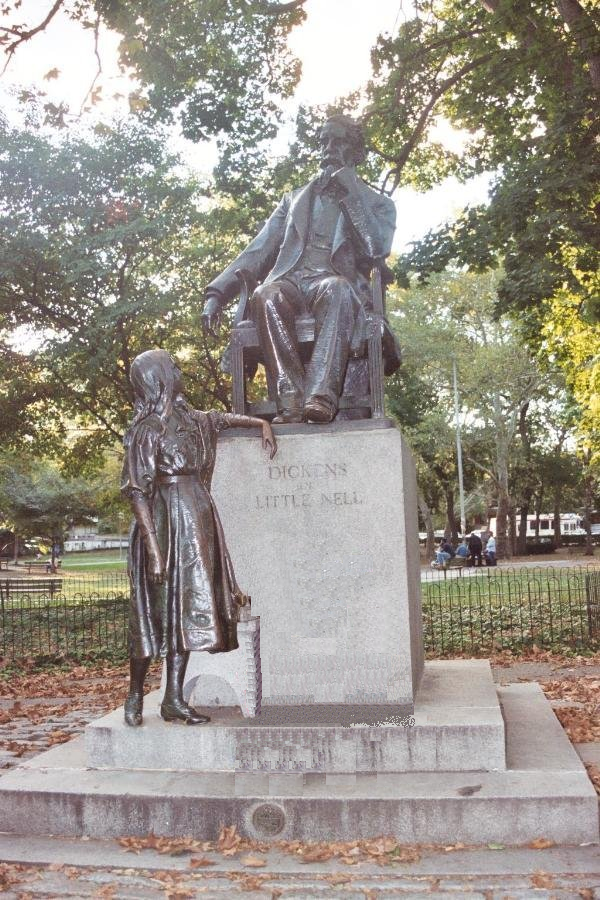
Museums and festivals celebrating Dickens's life and works exist in many places with which Dickens was associated, and several statues have been erected in his honor. He's also been featured on British currency, had a high school named after him, was #41 in a list of the 100 Greatest Britons, and 5 of his books have been named in the top 100 in the UK. He's even been featured on multiple postage stamps. I'd say he left a lasting legacy that won't disappear as long as there are readers in this world.

Published Novels:
  • The Posthumous Papers of the Pickwick Club (Known as "The Pickwick Papers")
  • The Adventures of Oliver Twist
  • The Life and Adventures of Nicholas Nickleby
  • The Old Curiosity Shop
  • Barnaby Rudge: A Tale of the Riots of Eighty
  • The Life and Adventures of Martin Chuzzlewit
  • Dombey and Son
  • David Copperfield
  • Bleak House
  • Hard Times: For These Times
  • Little Dorrit
  • A Tale of Two Cities
  • Great Expectations
  • Our Mutual Friend

NOW IT'S YOUR TURN:

* Which novel(s) have you read by Charles Dickens?

* If a novelist today published his/her book in serial form, would you read it? And how often would the installments have to be made in order to maintain your interest from start to finish? Daily? Two times a week? Weekly? Twice monthly? Monthly?

* What is 1 fascinating fact about today's post which caught your eye today?

Leave answers to these questions or any feedback on the post in the comments below. Don't forget to come back on the 9th of July for my next appearance.


BIO

Tiffany Amber Stockton has been crafting and embellishing stories since childhood, when she was accused of having a very active imagination and cited with talking entirely too much. Today, she has honed those childhood skills to become an author and speaker who has partnered with Nerium International in the anti-aging, health & wellness, and personal development industry, helping others become their best from the inside out.

She lives with her husband and fellow author, Stuart Vaughn Stockton, in Colorado. They have one girl and one boy, and a Retriever mix named Roxie. She has sold twenty (21) books so far and is represented by Tamela Hancock Murray of the Steve Laube Agency. You can also find her on Facebook, Twitter, Pinterest, and LinkedIn.