Showing posts sorted by relevance for query Oberammergau. Sort by date Show all posts

Thursday, October 12, 2023

A Fairytale City of Art


By Kathy Kovach


Oberammergau, a Bavarian municipality so ancient there is no record of its founding, is simply believed to have Celtic origins. This small fairytale borough in the Alps has at least three claims to fame. Upon entering the streets, the first becomes apparent. Nearly every building, be it a place of business, a church, or a home, has beautiful fresco artwork adorning the exterior walls. Each illustrates a story, whether it be from a Brothers Grimm fable such as “Little Red Riding Hood” or a religious tale depicting the crucifixion and resurrection of Jesus Christ. The entire town is an art museum where one simply doesn’t know where to fix their gaze.
Little Red Riding Hood house
Some artwork is elaborate, using the entire wall as a canvas. Only the wealthy could afford such opulence. In other cases, just the windows are adorned indicating someone of more modest means.
Simple fescue
This fresco technique, dating back to the 1700s, is common in Southern Germany and Austria and is known as Lüftlmalerei. The artist most notably recognized with the style is Franz Seraph Zwinck. Water based paint was applied to freshly laid plaster, which created a chemical reaction that caused the image to become part of the wall itself. As a result, many of the images have remained vibrant to this day.

As if being surrounded by an art museum isn’t enough, the town is also known for its beautiful wood crafting. Centuries ago, farmers needed to come up with another way to earn income during the harsh Bavarian winters. With ample linden and alder trees growing in the surrounding forest, many took up wood carving. These often depicted a religious theme or could also be whimsical trinkets or toys. Eventually, Oberammergau became renowned for the excellent artistry of wood carving, even establishing a trade school 150 years ago dedicated to the craft. Street traders expanded to the rest of Europe carrying the items on their backs in a kraxe, a type of wooden backpack. By the 18th and 19th centuries, many of the locals left the village and opened their own shops.
Oberammergau is my favorite tourist stop because of the artisanship literally around every corner. One last element to mention, however, is one I’ve regretted not to have taken part in. A mere 300 miles from our home at Rhein-Main Air Force Base in Frankfurt, the world-famous Passion Play was right at our fingertips in 1980. However, due to circumstances beyond our control—a new baby for one, toddler for two—we felt it best not to subject our little family to a five-hour presentation, including a three-hour dinner break in the middle.
Passion Play
The origin of the sacred play is dark. In the midst of the Thirty Years War (1618-1648), the bubonic plague reared its ugly head and swept through Europe like a dry grass fire. Oberammergau had been spared until 1632. According to legend, they had imposed a quarantine over the town, but one person broke it and left, only to return unknowingly carrying the disease with him. More than eighty people died over the next ten months, devastating the small population. The villagers then vowed to put on the Passion Play—a depiction of Jesus’s last week on earth including the resurrection and transfiguration—every ten years if the Lord would spare them from the plague.
Bubonic plague doctor
True to their word, the play was performed every decade from 1634 to 1674, then moving to 1680 and each subsequent decade ending with a zero after that. The first few performances were held in the graveyard where the victims were buried. Legend has it that the plague, known as the Black Death, never touched them after that. For nearly 400 years, the villagers have fulfilled their promise.

The following short video was taken by a tourist walking through Oberammergau. They also visit the neighboring monastery, Ettal, which I had blogged about in April. You can read that article here. Note that the play took place last year in 2022, missing the decadal date of 2020 due to the coronavirus pandemic. It has only been canceled or postponed seven times since its conception. 


From frescoes to wood carvings to performing arts, tiny Oberammergau has been a creative force for centuries. A true living fairytale.


A TIME-SLIP NOVEL

A secret. A key. Much was buried on the Titanic, but now it's time for resurrection.


Follow two intertwining stories a century apart. 1912 - Matriarch Olive Stanford protects a secret after boarding the Titanic that must go to her grave. 2012 - Portland real estate agent Ember Keaton-Jones receives the key that will unlock the mystery of her past... and her distrusting heart.
To buy: Amazon


Kathleen E. Kovach is a Christian romance author published traditionally through Barbour Publishing, Inc. as well as indie. Kathleen and her husband, Jim, raised two sons while living the nomadic lifestyle for over twenty years in the Air Force. Now planted in northeast Colorado, she's a grandmother and a great-grandmother—though much too young for either. Kathleen has been a longstanding member of American Christian Fiction Writers. An award-winning author, she presents spiritual truths with a giggle, proving herself as one of God's peculiar people.


Sunday, November 12, 2023

A Passion for the Passion Play

By Kathy Kovach


Last month, I wrote about the artsy hamlet of Oberammergau in Bavaria, Germany, which included the Passion Play that has been performed every decade for the past 400 years, with only a few exceptions. In that article, I focused on the origin, which began as an oath in exchange for the Lord’s protection during a time of plague. Go to this LINK to learn more.

The Passion of Christ, a depiction of our Savior’s suffering, death, and resurrection, is too significant to gloss over. Therefore, I’d like to spend more time on the play to which the German citizens have spent centuries dedicating their lives.

In the early years, a wooden platform had been set up at the church in the graveyard where the victims of the Bubonic Plague were buried. This is what prompted the oath to dedicate the play to God and perform it every ten years if He would spare the rest of the residents. Popularity grew, and by the mid-18th century, it was moved to a nearby field to accommodate the growing number of visitors. 

The first script in 1634 was based on 15th-century medieval manuscripts and later edited in 1664. There have been many edits and rewritten versions since then. At some point, it was decided to change the dates to those years ending in a zero. Thus, 1680 began those decadal years, culminating in what it is today with 2000 citizens involved . . . all local villagers . . . all ages and genders . . . from acting to set design. Can you imagine putting on a production like that for nearly four centuries?

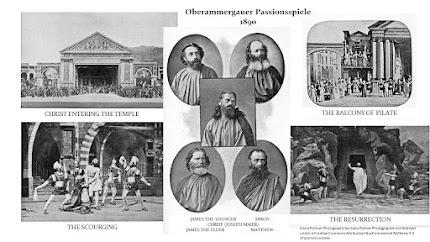
The Passion Play
1890

By 1850, more than 45,000 attendees gathered from far and wide. By 1890, The Passion Play drew in an audience of over 100,000, including famous composers such as Franz Liszt and Richard Wagner. Mad King Ludwig II was even impressed and gifted the community with a sculpture. Even so, it wasn’t until 1900 that a new, permanent stage was built, and it remains there to this day with multiple improvements, including seating, a heated floor, and a retractable glass roof to ward off the moist mountain weather.

Although the early organizers had promised to put on the play every ten years, this wasn’t always possible. Human intervention messed with the timeline a few times, but in all, the oath was fulfilled to the best of their ability. Below are some of the highlights of disruption, however, the play only had to be canceled twice and postponed four times.

-      1770, canceled due to a ban by then Prince-elector Maximillian III Joseph of the Holy Roman Empire who declared, "The theatre stage is no place for the greatest secret of our holy religion."

-      1920, postponed until 1922 due to the German’s WWI defeat and the political unrest that followed.

-      1940, canceled due to WWII.

-      2020, postponed until 2022 due to the coronavirus pandemic.

Special performances were granted in 1934 and 1984 to commemorate the 300th and 350th anniversaries respectively.

Requirements for the production have changed little over the years. Only citizens of Oberammergau who have lived there twenty years or more are allowed to participate—men, women, and children—which utilizes a good chunk of the community. The male actors must begin growing their beards the year beforehand by Ash Wednesday. There have, on occasion, been challenges to the traditions. For example, prior to 1984, all participating women were to be under the age of 35, however, three women took their equality case to court and won. Interestingly, as of 1990, Mary the mother of Jesus was to be single, but this standard was broken with much controversy when a married mom was chosen for the first time solely because of her acting skills. Also, in the early, years only Catholics could participate. Eventually, Protestants were allowed. Then, as of 1990, Muslims are now included.

Over the 4 centuries and 42 productions, the Passion Play itself has not only been revered but, alas, bruised at times due to various human egos. As aforementioned, it was canceled due to a church leader deeming it irreverent. In 1934, it was taken over by the Nazi regime during the commemorative anniversary and used as propaganda to promote their political agenda. The official poster was appropriated with the words “Germany invites you!” It also had the misfortune of being accused of antisemitism in 1960, and then three decades later was rewritten to include more of the Jewish traditions.

The fact that the Oberammergauer Passionsspiele keeps chugging along is a testament to the passion of the citizens who will not let their oath to God die. 

An excellent overview of each year the play was performed can be found HERE.

Check out this short video: “Highlights of the 2022 Passion Play at Oberammergau”


A TIME-SLIP NOVEL

A secret. A key. Much was buried on the Titanic, but now it's time for resurrection.


Follow two intertwining stories a century apart. 1912 - Matriarch Olive Stanford protects a secret after boarding the Titanic that must go to her grave. 2012 - Portland real estate agent Ember Keaton-Jones receives the key that will unlock the mystery of her past... and her distrusting heart.
To buy: Amazon


Kathleen E. Kovach is a Christian romance author published traditionally through Barbour Publishing, Inc. as well as indie. Kathleen and her husband, Jim, raised two sons while living the nomadic lifestyle for over twenty years in the Air Force. Now planted in northeast Colorado, she's a grandmother and a great-grandmother—though much too young for either. Kathleen has been a longstanding member of American Christian Fiction Writers. An award-winning author, she presents spiritual truths with a giggle, proving herself as one of God's peculiar people.


Sunday, August 11, 2013

Foods From Our German Heritage

by Martha Rogers
Several years ago I became interested in genealogy and discovered that both my paternal and maternal grandfathers were of German heritage. I should have suspected as much when I was younger as my maternal grandmother made sauerkraut from scratch and it created the most awful smell in the house. Half the time I went to a friend’s house for dinner. Of course it was always served with bratwurst.

However, she made a German Christmas Fruit Cake that I absolutely loved.

When I visited Fredericksburg, Texas, I discovered many dishes my grandmother made were of German origin, but we called them something else in our house, and most of them were much better than that sauerkraut. I learned more about foods like Gugelhupf, Spaetzle, Lebkuchen, German meat balls and dark rye bread. My maternal grandmother, Mimi, made these but I knew them simply as bread, dumplings, ginger molasses cookies, and black bread.  

Although Germany and Austria are two distinct countries, the early immigrants from either were called Germans by their neighbors here in America. The first Germans to arrive were Mennonites brought here by William Penn for his colony. Not far behind them came the Moravians and Pietists and other religious sects. By 1776 Pennsylvania was nearly half German and Austrian. They established settlements that became what we know today as the Pennsylvania Dutch.

By 1830, Germans had begun to cross over to America by the thousands. Between 1830 and 1930 about six million immigrated to America. My great-great grandfathers were among them in the early 19th century.
My latest release, Love Stays True, is loosely based on the love story of my great-grandfather and great-grandmother in Louisiana. His father came to Louisiana from Pennsylvania in the early 19th century. The German name was Weissermann which was translated to Whiteman for easier spelling. 

When I visited in Germany in 1996, I went to Munich, Augsburg, and Oberammergau. We ate at a Rathskeller which is a restaurant or bar. I found the foods there were absolutely delicious, especially the desserts.

 Dishes like apple strudel shown on the left, wiener schnitzel, German potato salad, and springerle were embraced by those who lived near or in the German colonies.

 The Germans loved their sweets. The Sacher Torte, Dobos Torte, and the Linzer Torte are prime examples as well as Black Forest Cake and Pfeffernuesse cookies shown below.


In the Pennsylvania Dutch region and in areas where we still have communities with a rich German heritage, we will find foods made from original recipes handed down through the generations. I found two of Mimi’s and I share the fruit cake one with you today. It is much more moist and more like cake than traditional fruit cake.  

German Fruit Cake
3/4 cup butter                           3/4 tsp. soda                                        Cream butter, sugar and eggs until
2 cups sugar                             1 cup buttermilk                                    light. Sift dry ingredients together.
4 eggs                                      2/3 cup cherry preserves                       Add to creamed mixture
3 cups flour                              2/3 cup apricot preserves                      alternately with buttermilk to which
1/2 tsp. allspice                        2/3 cup pineapple preserves                  soda has been added. Fold in re-
1/2 tsp. cinnamon                     1 cup chopped pecans                          maining ingredients. Bake in two
1/2 tsp. nutmeg                         1 tsp. vanilla                                         greased and floured 9x5x3 inch pan 
                                                                                                            or one large tube pan. Bake at 325
                                                                                                            degrees for 1 1/2 hours. Cool in pan
                                                                                                            15 minutes before removing.

If you'd like recipes for any of the others, let me know. If I have it, I will send it to you. 


Martha started late in life but now has multiple novels and novellas in print. She lives in Houston, Texas with her husband and is active in their church where she sings in the choir and teaches a class on Sundays and he serves as a deacon. She is a member of ACFW, The Woodlands Chapter of ACFW: WOTS and IWA! She is Co-Director and a regular member of the faculty for the Texas Christian Writers Conference held in Houston each August.


Monday, December 11, 2017

Nutcrackers

Nutcracker History by
Martha Rogers

I’ve been fascinated with nutcrackers and the story behind the ballet since I first heard the music many years ago. I decided to find out more about these beautiful Christmas decorations, and learned some interesting facts.

Before the beautiful nutcrackers were created by wood carvers in France and England, they were simple tools consisting of two pieces of wood fastened by a leather strap or metal hinge. Nuts were a common item in Europe, and by the 15th century, the nutcracker became an elaborate tool carved by great woodcrafters.

These early crafters used wood from around their locality, but boxwood was the wood of choice because of its grain and color. Many of these early
carved nutcrackers can be seen on display at the Leavenworth Nutcracker Museum in Washington. Here is a picture of the more unusual ones. 


By the 18th and 19th centuries, craftsmen in Austria, Switzerland, and northern Italy were carving nutcrackers in the likenesses of animals and humans.

In German folklore, stories can be found telling how nutcrackers were given as keepsakes to bring good luck to the family and protect the home. Legend says that nutcrackers guard the home from evil spirits and serve as a messenger of good luck and goodwill.

This is the saying surrounding the legend of the nutcracker:
“Don’t be afraid, my beard is long, my head is large, my look is grim but that matters not. I won’t bite you. In spite of my big mouth and grim appearance, I look with my heart for your happiness.”

Nutcrackers were thought to embody the “Cycle of Life” because as the seed of a nut fell to the ground, it rooted and grew into a strong tree producing more nuts and provided wood for the craftsmen. They held a feast celebrated just before harvesting the logs of the Elder trees. At the feast they ate the nuts as if to pass on the magic of the eternal cycle.

Nutcrackers also reflect ancestral dining customs and were carved into whimsical shapes to become part of the social setting and provide conversation pieces for guests as they lingered over dessert.

E.T. Amadeus Hoffman wrote a novel, The Nutcracker and the King of Mice, sometime between 1776 and 1822. Tchaikovsky took the story, set it to music in the magnificent Nutcracker Suite. The ballet with the music debuted in St. Petersburg in 1892 and has become a Christmas tradition around the world.


A family of artisans, the Steinbach family, has
produced fine wood products for over two centuries. Five generations have kept the business nutcracker carving and manufacutre going with the sixth generation being trained even now. The factory is now located at Hohenhameln in northern Germany. On the right is an example of a Steinbach creation. This one costs over $200.

They were the first to come up with the development of the limited edition nutcracker fashioned after King Ludwig II. The response was overwhelming and contributed to the collectability of the nutcrackers and increased their value.

Nutcrackers finally made their way to America in the late 1940’s and early 1950’s after service men stationed in Germany found them and brought them home. A passion ignited for these wonderful creations as the ballet captured the imagination of people and sparked a desire to collect the nutcrackers we know in the costume of soldiers and kings of earlier centuries.

Nutcrackers in the form of soldiers and kings first appeared in German in the late 1700’s and early 1800’s. In 1872, Wilhelm Fuchtner made the first commercial production of nutcrackers using the same design for many different figures. The Leavenworth Nutcracker Museum displays an 1880 miner of Fuchtner along with miners made in today’s Fuchtner family workshops.

Today, soldier and king nutcrackers are manufactured in Germany to meet the high demands
of collectors. These are expensive, authentic nutcrackers and can be purchased only from the company or from stores which feature nutcrackers by these German crafters. 

My own collection of nutcrackers began with one I purchased in Oberammergau in 1994. Here's a picture from the store there. I fell in love with this place.


Nutcracker reproductions can be found anywhere at Christmas time in many sizes and designs. When compared side by side, the craftsmanship of the authentic nutcrackers is evident. That doesn’t keep us from collecting nutcrackers from stores all over our country.


Nutcrackers based on the characters from the ballet are popular and sold at the productions. Here are Clara, her uncle, the Mouse King, the Nutcracker and one of the soldiers.


I have two nutcrackers from Germany, but the others have been purchased at the Nutcracker Ballet Christmas Market and other stores at Christmas time.


The museum at Leavenworth, Washington is a place worth visiting if you are in the area. Below are links to the museum and to information about the Steinbach family.


http://nutcrackermuseum.com/history.htm Leavenworth Museum

I'm giving away a copy of my Christmas book, Christmas at Stoney Creek.
News reporter Tom Whiteman befriends a homeless man, Joe, and brings him home to Stoney Creek. Tom’s journalistic instincts suggest there’s more to the old man than appearances tell. A carpenter by trade, Joe works at odd jobs around town and makes many new friends including Faith Delmont, a girl who grew up with Tom. Contradictions in the man’s manners and way of speaking whet Tom’s nose for news and raises even more questions. As he and Faith seek the truth, they learn that God’s love can turn tragedy and loss to triumph and true love comes to those who seek it.     

Answer one of these questions and be entered. (Sorry, US readers only) Please be sure to include your email address with your comment.

Have you ever seen The Nutcracker ballet?
Nutcrackers are a collector item. Do you have any special Christmas collections?

Martha Rogers is a free-lance writer and multi-published author from Realms Fiction of Charisma Media and Winged Publications. She is a member of ACFW and writes the weekly Verse of the Week for the ACFW Loop. She is a retired teacher and lives in Houston with her husband, Rex. 
www.marthawrogers.com