Thursday, November 12, 2026

Broadway During the War Years


By Kathy Kovach


New York’s Broadway theater district firmly established itself in the early 20th century. It was during this time that the world was gearing up for war, and we needed entertainment and a chance to forget, if only for an evening.
The Great White Way (Broadway), met the Great War (WWI) with compassion, humility, and determination through a band of six theater women led by playwright and director Rachel Crothers. Together, they formed the formidable Stage Women’s War Relief in 1917. They recruited members of the theater community to sell war bonds to the tune of $7 million dollars, nearly $200 million today. They also collected articles of clothing and performed for troops.

The Treaty of Versailles was signed on June 28, 1919, effectively ending the war between Germany and the allied powers. The war relief organization then turned its efforts to veterans and civilians suffering the effects of war.
As the country healed, the Stage Women’s War Relief eventually disbanded. However, several years later, the world was drawn once again into conflict. Two years before the US entrance into WWII, the federal government tasked Crothers to reactivate the organization. Under the new name of The American Theater Wing, they raised money and supplies to aid British civilians affected by the war.

Then the Japanese bombed Pearl Harbor in December 1941.

Thrust back into war, the US now had to concentrate on their own home front. The American Theater Wing rose to the challenge, and, with the help of actresses Jane Cowl and Selena Royale, began the search for a recreational facility where service members could relax and unwind. They found one in the basement of the 44th Street Theater. The owner, Lee Shubert, allowed the space to be remodeled, and materials were donated by theater trade unions. Seven hundred volunteers showed up with the caveat that they would work through the duration of the war. They were told if they missed a shift, they had to get someone to take their place. Cowl announced, “These men are going to the Philippines. They are going to the Burma Road. Nothing is too good for them.”
Stage and film actress Elizabeth Inglis serving donuts at the Stage Door Canteen.
(Inglis is also the mother of Sigourney Weaver.)
By March 1st, just three weeks after construction began, the Stage Door Canteen opened for preview. The only admission charged was food supplies for the kitchen. More than a half ton of sugar was collected. The canteen measured 40 by 80 feet and could contain 500 people at a time. When it opened for business the next day, a system was devised that allowed patrons in for only two hours. Thanks to donations of supplies from generous New Yorkers and various fund raising efforts, admission for US and allied service members was free.

In order to serve this many people, celebrities from the entertainment community volunteered their time. They did so in a variety of ways, from performing acts to making and serving sandwiches. At any given time, one could find a favorite stage star washing dishes. Actresses danced with the boys who craved female companionship.
During the canteen's four year run from 1942 to 1946, the radio station WMCA asked for donations of non-perishable goods. Shubert held two benefit matinee performances in his Imperial Theater to raise money. In addition, songwriter Irving Berlin wrote “I Left My Heart at the Stage Door Canteen” and contributed all of the proceeds.
Because of the success of the Stage Door Canteen, the American Theater Wing helped other similar venues to open around the country, as well as London and Paris. Hollywood got into the act and opened their own version, the Hollywood Canteen, utilizing movie celebrities to entertain and serve. I wrote about that in my article “The Hollywood Canteen – Patriotism at Its Finest”
Actor Lon McCallister in the film Stage Door Canteen
Throughout the war years, the canteens never saw decline. The Broadway Stage Door Canteen welcomed its 2 millionth guest on Valentine’s Day 1944. They gifted the lucky person tickets to see the new musical Oklahoma. And what about the food? Regarding the sandwiches during the first two years, The New York Times reported, that “if placed from end to end would stretch from here to Berlin and back if anyone wanted to feed the enemy.” As a side note, milk was the preferred beverage in the alcohol-free establishment.

In June 1945, Germany was defeated. For whatever reason, as the war wound down, the Broadway canteen had to vacate their space. They found a new home in the Crystal Room of the Hotel Diplomat on 43rd Street. Volunteers from the military and theater communities paraded all of the furnishings, decorations, and equipment around the block to the new facility. New York Mayor Fiorello LaGuardia, who had called the canteen “a great institution of which the city is very proud,” led the way carrying a chair. An 8-piece band playing marching music followed. This was accomplished in one day, and they were open for business that evening.
U.S. Veterans’ Hospital, Augusta, Georgia
After the war, all of the canteens disbanded, but the American Theater Wing remained strong in its resolve for patriotism. They helped create recreational programs for patients in the Veterans Administration hospitals and provided a theater school for military members returning from overseas. They are also responsible for the formation of the Tony Awards.

As the wife of an Air Force veteran, I salute the tenacity of the American Theater Wing, and the women who inaugurated its existence.


A TIME-SLIP NOVEL

A secret. A key. Much was buried on the Titanic, but now it's time for resurrection.
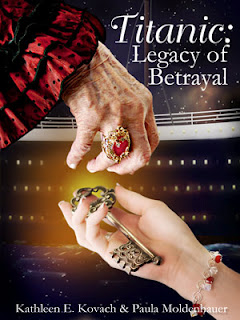

Follow two intertwining stories a century apart. 1912 - Matriarch Olive Stanford protects a secret after boarding the Titanic that must go to her grave. 2012 - Portland real estate agent Ember Keaton-Jones receives the key that will unlock the mystery of her past... and her distrusting heart.
To buy: Amazon


Kathleen E. Kovach is a Christian romance author published traditionally through Barbour Publishing, Inc. as well as indie. Kathleen and her husband, Jim, raised two sons while living the nomadic lifestyle for over twenty years in the Air Force. Now planted in northern Wyoming, she's a grandmother and a great-grandmother—though much too young for either. Kathleen has been a longstanding member of American Christian Fiction Writers. An award-winning author, she presents spiritual truths with a giggle, proving herself as one of God's peculiar people.


No comments:

Post a Comment