Showing posts with label Colonial. Show all posts

Sunday, April 9, 2023

Art Deco Architecture in Kentucky + Giveaway

   By Tiffany Amber Stockton


In March, we learned about the name origins for the first 10 of the 50 states in the U.S. I'll be doing other posts to cover the remaining 40 during other months of this year. You can read last month's post if you missed it.

Today is my son's 12th birthday, and we recently attended a homeschool field trip at the Kentucky Historical Society. So, I figured it'd be fun to delve into the history of the Historical Society. Let's chat a bit about KHS building. :)

KENTUCKY HISTORICAL SOCIETY

Historical Society Building
This place is a gem located in downtown Frankfort, Kentucky. It's been around for quite some time and has some great history behind it.

The KHS building was built in the late 1930s and early 1940s as part of a Works Progress Administration (WPA) project. If you don't know what that is, the WPA was a New Deal program created by President Franklin D. Roosevelt to provide employment for millions of Americans during the Great Depression. And boy did it do just that!
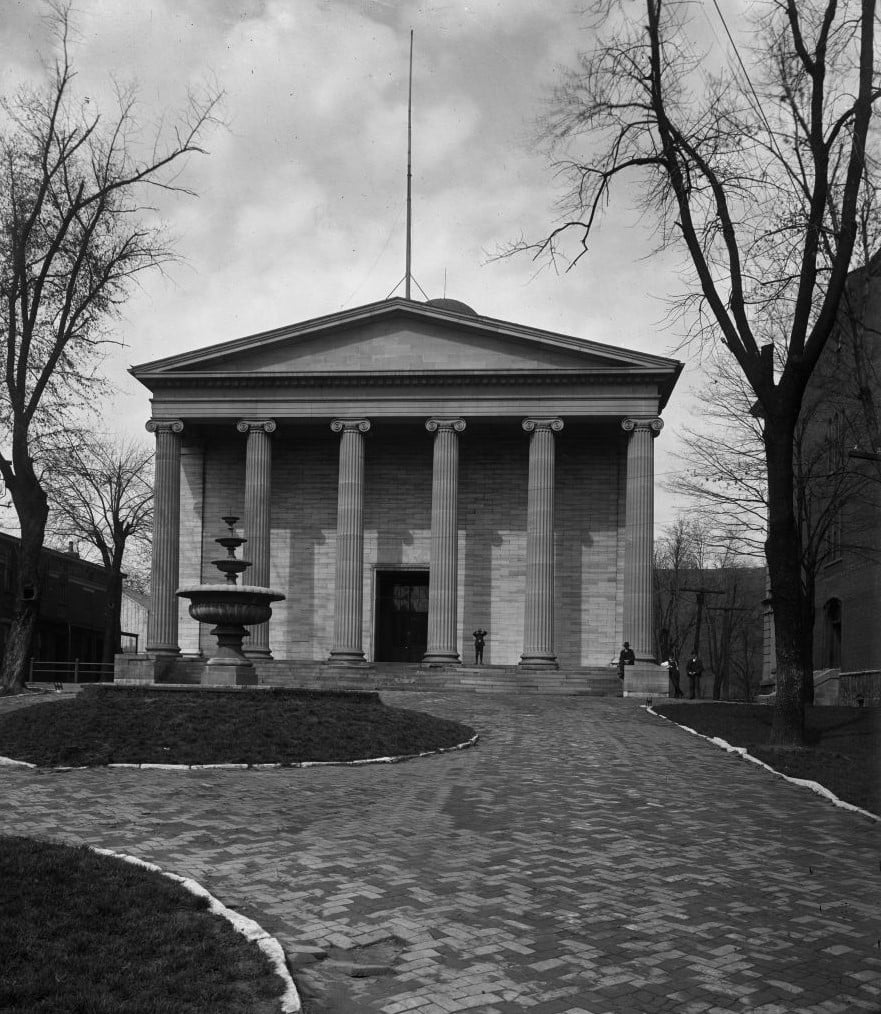
Old State Capitol - original site
The Kentucky Historical Society itself has been around since 1838, but its headquarters used to be located in the Old State Capitol building in Frankfort. However, as the KHS grew in size and popularity, they began planning for a new building. They eventually applied for a grant from the WPA, and voila, the KHS building was born.

The architect who designed the KHS building was a guy named Thomas P. Barnett. He was known for his Art Deco designs and did not disappoint with this building. The KHS building is considered one of the most significant examples of Art Deco architecture in Kentucky, and wow, does it show! It has all the classic Art Deco elements, like streamlined forms, geometric patterns, and stylized motifs. Quite a sight to see!

But Barnett didn't stop there. He also incorporated elements of the Kentucky Colonial Revival style into the building's design. This was a popular style in the early 20th century which emphasized the use of local materials and traditional craftsmanship. So, not only is the building beautiful, it also has some local flavor in there too.

Interior view of one exhibit area
The KHS building was constructed in several phases, with the first phase being completed in 1939. This included the main entrance and lobby. The second phase, which included the research and storage areas, was completed in 1941. And the final phase, which included the museum space, was completed in 1942. So it took a few years, but it was definitely worth the wait.

Over the years, the KHS building has undergone several renovations and upgrades to keep it up to date and functional. In the 1980s, the museum space was expanded to include more exhibit space.

Nowadays, the KHS building is still standing strong and is open to the public for tours and events. You can check out the KHS museum, which features exhibits on Kentucky's history, as well as a research library and archives. It's definitely worth a visit if you're ever in the area.

View of the terrazzo floor in the lobby
The KHS building has become a bit of a landmark in downtown Frankfort, and its unique design draws visitors from across the state. The building's interior is just as beautiful as its exterior, with many Art Deco details like a terrazzo floor in the lobby (in the shape of the state of Kentucky), bronze fixtures, and a beautiful mural depicting Kentucky's history. It continues to be an important cultural institution in Kentucky.

But let's talk about the real reason why the KHS building is so cool. It has history. I mean, it's a historical society building, so of course it does. It has seen a lot of changes over the years. It's seen wars, political upheaval, and social change. And yet, it's still standing. It's a testament to the resilience of the people of Kentucky.

There's something special about being in a building that's been around for over 80 years. It's like you can feel the energy of all the people who have walked through those halls over the years. Visiting the old state capitol building produces the same vibes. If only these walls could talk!

President Lincoln's pocket watch -- still ticking!


NOW IT'S YOUR TURN:

* Do you have a building in your town with intricate architecture?

* Have you ever visited Frankfort, Kentucky? For what purpose?

* Is there a building or landmark near you with significant historical influence or notoriety?


** Please do not reply via email with any comments. View the blog online and scroll down to the comments section.

Leave answers to these questions or any comments you might have on this post in the comment box below. For those of you who have stuck around this far, I'm sending a FREE autographed book to one person every month from the comments left on each of my blog posts. You never know when your comment will be a winner! Subscribe to comments so you'll know if you've won and need to get me your mailing information.

Come back on the 9th of  May for my next foray into historical tidbits to share.

For those interested in my "fictional" life as an author and industry news about other authors, subscribe to my quarterly newsletter. Receive a FREE omitted chapter from my book, A Grand Design, just for subscribing!


BIO
Tiffany Amber Stockton has been crafting and embellishing stories since childhood, when she was accused of having a very active imagination and cited with talking entirely too much. Today, she has honed those skills to become an award-winning, best-selling author and speaker who is also a professional copywriter/copyeditor. She loves to share life-changing products and ideas with others to help improve their lives in a variety of ways.

She lives with her husband and fellow author, Stuart Vaughn Stockton, along with their two children and four cats in southeastern Kentucky. In the 20 years she's been a professional writer, she has sold twenty-six (26) books so far and is represented by Tamela Murray of the Steve Laube Agency. You can find her on Facebook and GoodReads.

Sunday, January 9, 2022

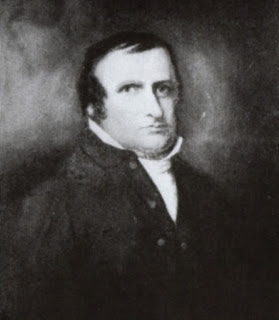
Horse Racing & Kentucky Pioneers - William Whitley

  By Tiffany Amber Stockton


Last month, in the spirit of Christmas, we learned about some of the island traditions surrounding this special holiday on Chincoteague Island. If you missed that post, you can read it here. This month, I'm beginning a new series featuring facts and people who discovered and settled what is now southeastern Kentucky.


With all the past research I have on my personal family history, and since we have recently moved to Kentucky after 15 years living in Colorado, I needed a new focus as I work on the books coming from my previous research. I'm not sure what will come of what I discover this year, but I'll be keeping my readers informed on my FB Page and VIP  readers group.

You can also stay current on my "fictional" life as an author and receive industry news every 3 months by subscribing to my newsletter. Receive a FREE omitted chapter from my book, A Grand Design, just for subscribing!

WILLIAM WHITLEY - KENTUCKY PIONEER


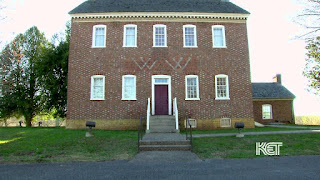
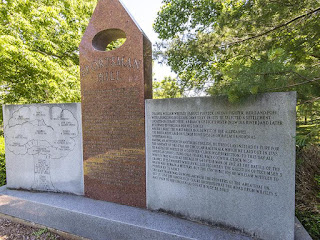
My family now lives in Whitley County in Kentucky, and as I was driving up the interstate, I saw signs for the William Whitley Historical House. That set me off on a rabbit trail of research looking up who this man was and why he was so important to the state, or commonwealth of Kentucky. I've only just begun to scratch the surface, but here is what I've learned so far.

William Whitley was born in Virginia, and his parents were immigrants from Ireland. Just before the onset of the Revolutionary War, Whitley suggested to his wife that they leave Virginia and move a little west across the Appalachians into the uncharted territory there. Following a scouting expedition, Whitley laid claim to a parcel of land and planted ten acres of corn as proof of ownership. Unfortunately, the local Shawnee and Cherokee tribes weren't too happy with Colonial settlers encroaching on the land the British had promised would be theirs, and they responded with escalated hostility.

William was quite the adventurer, though, and he wasn't one to give up easily. Although he and the other family who scouted with him sought safety inside a nearby fort, Whitley continued to fight for his land. He spent a little time after the Revolutionary War in the Northwest Territory fighting Indians, but when he returned, he again set forth with building his home.

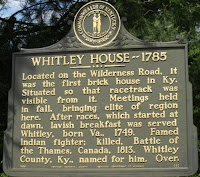
There are a lot of amazing features about the home William built. It was the first brick home west of the Allegheny Mountains, built somewhere between 1787 and 1794. The brick he used was two feet thick!  He did that to help protect his family from Indian attack. He also put the windows high above the ground so attackers couldn't shoot straight through at him, and he didn't have a porch or patio or anywhere around the home where attackers could hide. Rather ingenious of him, I'd say.

One feature I found endearing is that in addition to his own lighter bricks bearing his WW initials, he also had brick initials of EW placed in honor of his wife, Esther, to the rear of the house. He might be a famed Indian hunter, but his wife was known for being a sharpshooter herself. Guess they made quite the pair together!

Although he called his home "Sportsman Hill," friends and area residents considered it the "Guardian of Wilderness Road," so it also holds that name. It actually became a popular meeting and gathering place for other Kentucky settlers like George Rogers Clark and Daniel Boone.

Whitley County and its county seat of Williamsburg were both named after William Whitley. One of his grandsons was William L. Sublette, a fur trader who became co-owner of the Rocky Mountain Fur Company with Jedediah Smith. There's even Whitley City named after Colonel Whitley.

Another fun fact is how important William Whitley was to the establishment of horse racing in the United States. He was an avid fan of the sport, but he didn't care much for how the British designed their tracks. So, he built a track out of clay instead of turf, and he designed the track to be raced in counter-clockwise fashion instead of clockwise as it's done in England. It's why Kentucky is now world-famous for its horse-racing venue and is an integral location for the sport.

My daughter has been bitten by the horse-loving gene that flows down from my mother's side of the family, so we've already made plans to attend the Kentucky Derby and check out the various breeding farms and racing venues throughout the state, as well as the Derby Museum. She even wants to attend a summer horse camp, but we'll have to see about that. *grins*


NOW IT'S YOUR TURN:

* Have you researched anything about the area where YOU live? Are there any interesting facts or people from history who were pioneers in your area?

* What kind of person do you think you would have been had your birthday been in the 1600's or 1700's instead of the 1900's?

Leave answers to these questions or any comments you  might have on this post in the box below. Come back on the 9th of February to learn more about Daniel Boone and his trek across the Cumberland Gap.


BIO
Tiffany Amber Stockton has been crafting and embellishing stories since childhood, when she was accused of having a very active imagination and cited with talking entirely too much. Today, she has honed those skills to become an award-winning, best-selling author and speaker who is also an advocate for literacy as an educational consultant with Usborne Books. She loves to share life-changing products and ideas with others to help improve their lives in a variety of ways.

She lives with her husband and fellow author, Stuart Vaughn Stockton, along with their two children, two dogs, and two cats in Kentucky. She has sold twenty-four (24) books so far and is represented by Tamela Murray of the Steve Laube Agency. You can find her on Facebook and GoodReads.

Tuesday, May 22, 2018

PIECES OF EIGHT


Have you ever heard the term “pieces of eight”? What are they?

When I was young, I watched reruns of the original Mickey Mouse Club. As part of the shows, they had episodes of a mystery drama. I remember two things about it, the kids in the story were searching for treasure, and the song for the serial story ended in a deep voice singing “pieces of eight”.

What about “two-bits, four-bits, six-bits, a dollar”? I remember this cheer from high school. “Two-bits, four-bits, six-bits, a dollar, all for [insert school name], stand up and holler.”

“Pieces of eight” and “two-bits-four-bits-etc” refer to the same thing. Well, not the cheer.

Way back when, this started with the Spanish milled silver dollar.


England prohibited the early American colonies from minting coins. The settlers were left with bartering, using foreign coins, and trading with local currency such as wampum (cylindrical beads made from quahog shells used as money).

The American colonies, having no minted money of their own, used currency from many other countries.


The Spanish milled dollar was, by far, the most commonly circulated coin in the United States and considered legal tender until the Coinage Act of 1857.

It’s edges were “milled”, or patterned, to prevent people from shaving silver from the edges unnoticed. Coins were valued by their weight rather than “face value” as they are today.

But what’s a person to do when they wanted to buy something that costs less than a dollar?

Since the Spanish dollar was valued by weight, it was often divide into eight pieces called “reals” or “bits”.


So, this milled dollar was also known as a “Piece of Eight.”


Thus, “two bits” meant a quarter of a dollar. So, by dividing a coin like the milled dollar, a person could spend part of the coin in one place and another part elsewhere.


The coin would be divided in half and be a half dollar . . .


. . . in quarters for a quarter of a dollar . . .


. . . and eighths for one real or one bit. 


Pieces of Eight were the world’s first global currency.


Though contemporary U.S. Currency is based on the silver Spanish Milled Dollar, when the young United States began minting their own currency, they went to the decimal system and divided the dollar into one hundred.

The eight-bit Spanish dollar is not the same as a doubloon, which is what we generally associate with pirates. The doubloon, also minted by Spain, is a 32-reals/bits gold coin. Four Spanish milled silver dollars would be worth the same as one doubloon. So, if someone refers to a doubloon as “pieces of eight”, that would be incorrect.


The pictures of my coins in this post are reproductions made of pewter, but they have a similar weight and appearance of the original Spanish Miller Dollar.


I love playing with my replica Spanish Milled Dollars and pieces of eight. How would you like to have a pocket full of these sharp edges?


For more information on the background of money in recent history (1500s & forward), this site has some interesting information and can be a jumping off point for further research.


COMING SOON
THE WIDOW'S PLIGHT ~ A sweet historical romance that will tug at your heart. This is book 1 in the Quilting Circle series.
Washington State, 1893
     When Lily Lexington Bremmer arrives in Kamola with her young son, she’s reluctant to join the social center of her new community, the quilting circle, but the friendly ladies pull her in. She begins piecing a sunshine and shadows quilt because it mirrors her life. She has a secret that lurks in the shadows and hopes it doesn’t come out into the light. Dark places in her past are best forgotten, but her new life is full of sunshine. Will her secrets cast shadows on her bright future?
     Widower Edric Hammond and his father are doing their best to raise his two young daughters. He meets Lily and her son when they arrive in town and helps her find a job and a place to live. Lily resists Edric’s charms at first but finds herself falling in love with this kind, gentle man and his two darling daughters. Lily has stolen his heart with her first warm smile, but he’s cautious about bringing another woman into his girls’ lives due to the harshness of their own mother.
     Can Edric forgive Lily her past to take hold of a promising chance at love?

THE WIDOW'S PLIGHT is now available at a low, pre-order price. This book releases in ebook on July 1, and will be out in paperback by mid-June.


#ChristianRomance #HistoricalRomance #Romance


MARY DAVIS is a bestselling, award-winning novelist of over two dozen titles in both historical and contemporary themes. She has five titles releasing in 2018; "Holly & Ivy" in A Bouquet of Brides Collection in January, Courting Her Amish Heart in March, The Widow’s Plight in July, Courting Her Secret Heart September, & “Zola’s Cross-Country Adventure” in MISSAdventure Brides Collection in December. She is a member of ACFW and active in critique groups.

Mary lives in the Pacific Northwest with her husband of over thirty-three years and two cats. She has three adult children and one incredibly adorable grandchild. Find her online at:
Newsletter Blog FB FB Readers Group Pinterest Amazon GoodReads FictionFinder BookBub

Wednesday, June 7, 2017

Popular Historical Writing Periods Plus Giveaway!


I've had many people read Sword of Forgiveness as their first medieval romance and say they expected something different from a medieval book and were pleasantly surprised. I found it interesting that many people think all medieval is the dark ages. That got me to thinking about the different historical eras that we often see in fiction print and I thought I'd briefly go over each time period and mention some of the highlights of each one.

So often the word medieval congers up an image in our minds of barbaric people. But truly, medieval times covers a vast amount of years. The medieval time period started in the 5th century and went until the 15th century! That is 1000 year span when one uses the vague term medieval times. There was such great change from the 5th century to the 15th century that one can't hardly compare them. The last several hundred years had made great strides in laws, protection, rights, and much more. So as a writer of the medieval time period, I'd like to clarify this a little more.

So with good reason we need to break down the medieval time period into 3 eras-- Early Middle Ages, High Middle Ages, and Late Middle Ages.

The Early Middle Ages start in the 5th century and continue on into the 10th century. This time was called the 'Dark Ages' with lack of literary and cultural output. Up until about half way through this period population and trade in Europe declined while immigration increased. 


                                              Repaired walls of Constantinople                                              By en:User:Bigdaddy1204 - Photograph taken in June 2006 in Istanbul by en:User:Bigdaddy1204. All credits go to him., CC BY-SA 3.0, https://commons.wikimedia.org/w/index.php?curid=880970


The High Middle Ages pick up from the 11th to the 13th century. One of the huge changes was the swiftly increasing population. Such an increase like that would not be seen at such great numbers for another 600 years. Later in the era this population growth helped contribute to the economy picking up. They also saw political and social changes during this time period. 


The Late Middle Ages which I write in are usually considered the 14th and 15th century. This time period saw so much hardship. They were a part of The Great famine as well as the black plague. The combination of the famines and the plagues that hit Europe reduced the population almost in half. There was much social unrest within the country. Peasant uprisings leading to revolts, senseless warfare, and The Hundred Year War kept this era in constant turmoil.


Peasants preparing the field. Background the Louvre.

The Renaissance Period which started in the 14th century in Italy, reaching its peak in the 15th century and then spreading through out Europe in the 16th and 17th centuries. What most know about the Renaissance period is its art and architectural contributions. But the Renaissance Period also saw a scientific revolution of its kind turning to observation. It also saw its share of social and political unrest.


The School of Athens by Raphael

The Georgian Years ranged from 1714 to 1837 including the short reign of William the IV. This period began the industrial revolution and great social changes. The industrial revolution strengthened the class divisions as well as help them to see the appearance of Tory and Whig parties.


The Circus in Bath (meaning circle or ring in Latin)
Public Domain, https://commons.wikimedia.org/w/index.php?curid=1188457

The Regency Period is a sub-period of the Georgian Era, when the King was deemed unfit to rule and the Prince Regent ruled the country. Those years ranged from 1811 to 1837. The Regency period is known for its elegance but it too was a time of great change socially, politically, and even economically. 


Almack's

The Victorian Age ran from 1837 when Queen Victoria took the throne to 1901 when she died. This period for the most part was peaceful. The economics continued to increase and people gained more confidence in their queen and country. It was also a time that was considered refined sensibilities. (That made me think of the Regency period and Jane Austin's Sense and sensibility).


The Epson Derby- 1840

The Edwardian Period was a short time from 1901 to 1910. Sandwiched in between the great achievements of the Victorian Age and the first World War this period is many times romanticize as the Golden Age. One thing this time period did accomplish was the growing awareness of the working class. It saw an increase of labor unions, labor movements, and a push for better working conditions.


The American Colonial Period ranged from 1607 to 1776. This was a time of great change. Many came to America for religious purposes, while some came to get away from the reaching arm of England or to make money. There were lost colonies, starvation, growth, unrest, and finally a fight for freedom.

 
Castillo de San Marcos construction began in 1672 in St. Augustine, Florida
By National Park Service - http://www.nps.gov, Public Domain, https://commons.wikimedia.org/w/index.php?curid=1151786

19th Century 1800 to 1899. Its a time when much of the world prospered. America settled the west. The century saw wars, political growth, a fight for equality, medical break throughs, inventions, and so much more. 


The first ships sail through the Suez Canal

So to break this down:

Medieval Era  5th century to the 15th century              1000 years
(Medieval breakdown)
Early Middle Ages 5th century to the 10th century         500 years
High Middle Ages 11th century to the 13th century        300 years
Late Middle Ages 14th century and the 15th century      200 years
Renaissance Period 14th century to the 17th century     300 years
Georgian Period 1714 to 1837                                      123 years
Regency Period (sub period of Georgian) 1811 to 1837   26 years
Victorian Period 1837 to 1901                                       64 years
Edwardian Period 1901 to 1910                                     9 years
Colonial Period 1607 to 1776                                        169 years
19th Century 1800-1899                                              100 years

Interestingly enough when you look at the years of each era and think about when most books are set, the majority of books are set in the minority of eras.  

How about you? Do you have a favorite time period or periods that you like to read? Let me know for a chance to win my new release, Sword of the Matchmaker in choice of format ends June 12th.
  
Giving away a copy of my new release, Sword of the Matchmaker so be sure to leave a comment to enter for just my book AND don't forget to enter in the rafflecopter! Your comment can count toward my book giveaway and the rafflecopter give away. Be sure to share on FB and twitter for Rafflecopter entries!


Penelope Beatty made up her mind long ago she would live and die a Scottish warrior not a wife. But when nearly all her clan is killed and she is betrayed, she loathes doing the unthinkable, but must seek the help of an Englishman who owed her father his life.


Thomas Godfrey never married, but when a Scottish warrior lass shows up needing his aid, he finds her both annoying and irresistible. But the last thing he wants is to marry a woman who fights alongside him. If he was going to marry—which he isn’t—it would be to a soft, submissive woman. But when the Lady Brithwin meets the Scottish lass, she’s sure she’s found the perfect match for Thomas and nothing is going to stop her from seeing a summer wedding.


Debbie Lynne Costello has enjoyed writing stories since she was eight years old. She raised her family and then embarked on her own career of writing the stories that had been begging to be told. She and her husband have four children and live in upstate South Carolina. She has worked in many capacities in her church and is currently the Children's Director. Debbie Lynne has shown and raised Shetland Sheepdogs for eighteen years and still enjoys litters now and then. In their spare time, she and her husband take pleasure in camping and riding their Arabian and Tennessee Walking horses.


Friday, November 1, 2013

Myths of Colonial Quilting by Carla Olson Gade

There are myths that have been perpetuated about quilting in early America that kindle our fascination for the past. Yet historians have discovered that quilting in colonial times is not what we might imagine.
When I researched quilts for my Quilts of Love series novel, Pattern for Romance, which takes place in 18th century Boston, Massachusetts my preconceived thoughts of quilts and quilting we altered forever.

A quilt is not a quilt — A “quilt” in colonial times was the terminology for a garment as well as a bed covering. When a woman put on her quilt it referred to her quilted petticoat. This petticoat was often ornately designed and worn as an outer skirt to show off the patterns stitched into the fabric. Under-petticoats were also worn, but a quilted petticoat was a beautiful garment meant to be shown off. Other garments were also quilted such as banyon robes, gowns, caps, waistcoats, and children’s garments.

Piecing a quilt — A bed quilt was not pieced together with scraps of fabric. Piecework quilts were not made popular until the early 19th centuries after the trade embargoes were lifted, although by the late 18th century some quilts were embellished with cut pieces of chintz and appliqued to the bed quilt. In colonial days, whole pieces of cloth were quilted together with batting in between the top and bottom layers, thus the whole-cloth quilt. The quilting on these bed coverings were stitched with elaborate designs and highly valued.

Time to quilt — Quilting was not a daily activity during the colonial era, except for someone who was a quilter by trade…and paid little for it. Quilting was enjoyed by women of leisure and higher social standing, but most women in colonial America could not afford to spend their time on such a task with spinning, weaving, cooking, farming to do. On occasion women would get together to quilt as a group activity as many hands make light work, but it was an uncommon event. This gathering was called a party or a quilting and the men would join them in the evening for food and dancing. The term “quilting bee” was not used until about 1825.

An American invention — We often think of quilting as being as American as Apple Pie and Baseball. Although quilting has been an American pastime for centuries, it did not originate in America as a thrifty necessity. As we know, America was created of peoples from many countries, people who already had quilting traditions and unique patterns. Whole-cloth and piece-work quilting can be traced to Egyptian times, but the whole-cloth quilting was done for centuries before the first pilgrims came to our country. Knights of the middle ages even wore quilted garments beneath their armor. In Marseilles, France during the mid-18th century, machine stitching of whole-cloth quilted fabric was invented and imported, yet it was not commonly available in America during the periods of trade embargoes, thus the need for colonial women to quilt their own garments and coverings when needed.


Carla Olson Gade has been imagining stories most her life. Her love for writing and eras gone by turned her attention to writing historical Christian romance. She is the author of “Season of Love” in Mistletoe Memories (Barbour/2013) and Pattern for Romance in the Quilts of Love series (Abingdon/2013). A native New Englander, she writes from her home in beautiful rural Maine where she resides with her family. You can connect with Carla on her blog Adventures of the Heart at www.carlaolsongade.com.


 Christina Rich is giving away a 10.00 Amazon gift certificate to one commenter. Winner will be announced Saturday, November 9, 2013.

Tuesday, April 23, 2013

Those Intolerable Acts -- and e-book giveaway, by Susan Page Davis


   During the years prior to the American Revolution, the colonists found a lot to complain about. Uppermost were the laws the British Parliament seemed to delight in passing—laws that interfered with colonists’ business and made their everyday living less pleasant.

   Usually these laws caused more discomfort in some colonies than others. For instance, the Quartering Act was enacted in 1765. It required that the colonies provide housing for troops in the settled parts of North America. For places where there were no British troops, this caused no trouble at all. But in New York, it was another story.

   The British Army’s headquarters in North America was in New York City at that time, and this new law did not go over well there.

   New Yorkers hadn’t minded providing housing and some supplies during the French and Indian war—the redcoats were there to do them a service and protect them from the French. But in the mid-1760s, it was a different matter.

   Now the British requisitioned supplies from the colonists, but they were not protecting them from a foreign enemy. Parliament attempted to compel New York to build or maintain barracks. They requisitioned food, beverages, candles, and fuel for the troops. New York’s legislature refused to vote the funds in 1766.  They said they would consider the crown’s requests, but would not pledge to honor them all.

   This led to another law, forbidding the New York legislature to take any actions until it complied.

   Later, when the British troops became more active, the Quartering Act reached out to annoy more people. If public barracks, vacant buildings, or taverns were not available where the soldiers went, the colonists were still required to house them. Sometimes this meant troops staying in private homes. The colonies were required to contribute cider or beer, firewood, candles, and other supplies for the British soldiers. They had to furnish wagons and carts for military transport at prices fixed by the British.

Many colonists felt these laws went too far, stripping them of their rights as Englishmen and requiring them to pay taxes they’d had no say in (“taxation without representation”).

   After the Boston Tea Party in 1774, Parliament passed a series of laws that came to be known in the colonies as the Intolerable Acts. Some of these laws were clearly meant to punish the city of Boston.

Boston was singled out for several penalties. The colonists had dumped 342 chests of tea belonging to the British East India Company into the harbor. In response to this wanton destruction, Parliament passed the Coercive Acts. The Boston Port Bill took effect on June 1, 1774. Under this new law, the Boston harbor was closed to everything but British ships until the British East India Company was compensated for its loss. Nothing was allowed to be taken into the city but food and firewood. 

In addition, the Massachusetts Government Act said the British governor would now be in charge of all town meetings in Boston, which effectively did away with town meetings. The authority of the royal governor was increased—and General Gage, the British commander of the troops in North America, was appointed governor. There was no more self-government in Boston.

Samuel Adams wrote in a letter, “…it appears that we have been tried and condemned, and are to be punished…”

Also part of the Intolerable Acts was the Administration of Justice Act, which said British officials could not be tried for crimes in colonial courts. They would be taken back to Britain for trial. This stripped the colonists of power over the officials sent to them by Britian. Even if the officials murdered colonists, the Americans couldn’t take them to trial.

   The Quebec Act was also passed during this time, extending the boundary of Quebec into the Ohio Valley, and thus shutting off expansion by the 13 colonies south of Quebec. It recognized the Roman Catholic Church as the established church in Quebec, which many of the predominantly Protestant colonists took as an affront. Direct rule for Quebec was a further insult to the other colonies, to which it was denied.

Up and down the Atlantic coast, British colonists in America were fighting mad.
 

Thanks for stopping by! Today I’m giving away three copies of my new novella, Revolution at Barncastle Inn. Modern day folks get a glimpse of what the Quartering Act meant to the colonists when “redcoats” are quartered at their hotel. Add a little romance, faith, and fun. Comment below with your email contact info to enter. This e-book can be downloaded to your Kindle, Nook, computer, or other reading device.


Saturday, March 9, 2013

New Castle, Delaware: the original Colonial Williamsburg

All right, I know last month, I promised that I'd share a bit about the history of Mackinac Island. Since then, I realized it wouldn't make much sense, as the 2 books I'm offering as a giveaway along with this post are set in historical Delaware. Mackinac is the setting of the book I just contracted to write, but it won't release until August of 2014.

So, instead, let's chat a bit about Colonial history. How much do you know? Do you have a passion for that era, or is your interest more in the 1800's and early 1900's? Or perhaps you love the Medieval or Biblical time periods and areas before America was born. Regardless of your interest, it's always good to do the research yourself and delve into history on your own instead of leaving it to textbooks, documentaries, or teachers to give you the facts.

This was never more clear to me than when I went through school and learned a bit about Delaware history simply because I lived there at the time, and our history classes included a few units on local history as well as general American or world history. It wasn't until the time came to research the details in my first contracted novel that I discovered just how much had been left out of history books or the information the teachers presented.

For example, "The First State" is often overlooked in favor of cities like Philadelphia, Washington, D.C., Boston, or New York City. But did you know about Caesar Rodney’s ride from Dover, Delaware, to Philadelphia on July 2nd to interrupt the gathering of the Continental Congress and cast his vote in favor of independence from England? The delegates were at a stalemate, and Rodney’s vote turned the tide, causing a domino effect with the delegates which led to the signing of the Declaration of Independence. Had it not been for Rodney’s ride, we might not celebrate Independence Day on July 4th, or even at all.

And think about the last time you received a credit card statement or even an offer to sign up for a credit card. Did you happen to look at the return address on the outside of the envelope? Ten-to-one says the city postmark is from Wilmington, Delaware.

Wilmington, Delaware, has been the focal point of industry for nearly 400 years. Everything from shipbuilding, gunpowder manufacturing, pharmaceuticals, railroad cars, carriages, and leather. By the end of the Civil War, Wilmington was producing more iron than the rest of the country combined and it rated first in the production of gunpowder. Pharmaceuticals followed a close second and still remain a significant source of production today.

And then there's the original capital city of New Castle, Delaware. Up until the Revolutionary War, it was the county seat for all government, and most of the prominent citizens resided within the town limits or somewhere nearby. Because of its position on the banks of the Delaware River (a river that connected Philadelphia with the Atlantic Ocean), New Castle also became a popular stopping point for supply ships on their way up the river to Wilmington and Philadelphia.

In fact, long after the Colonial era, the 1800's and a good bit of the 1900's had past, New Castle remained a fully-functioning Colonial town, complete with cobblestone streets, and even the occasional clip-clop of horses's hooves from a horse and buggy. Not many are aware that even today, New Castle remains a restored Colonial town, but I bet most have heard of Colonial Williamsburg.

When tourism and travel industry developers were seeking out a location for a town to provide the flavor of Colonial times to tourists and be a destination for school field trips, New Castle was among the first to be considered. However, the residents declined the potential, preferring instead that their little town to remain quaint and private. As a result, Williamsburg became the international tourist site. Those who are aware of New Castle still visit for a less-crowded historical experience, and if you happen to be in the area, you should make time to pay a visit. You won't regret it.

Now, the two books I'm offering as giveaway opportunities aren't set in Colonial times. That honor belongs to my first series (Liberty's Promise), which includes Promises Promises, Quills & Promises, and Deceptive Promises. This current series remained in northern Delaware, but a little over 100 years into the future and a little further north into the Brandywine River Valley. Brandywine Brides includes Bound by Grace, Stealing Hearts, and Antique Dreams. The third book releases this month, and I've been told it's already been sighted in a few Wal-Marts across the country.

With that being said, since this series highlights some of the more prominent industries in Delaware, I have a question for you. Can you name at least one of the major companies or businesses that are incorporated in Delaware? Can be present or historical. Your choice. But it must be a proper name, not just the general industry. If you can Google, you can find at least one. What you find just might surprise you. :)

Leave your name and email address (name [at] domainname [dot] com/net), along with your answer, to be entered for a chance to win 1 of 2 FREE autographed books. Winner will be selected on Saturday, March 16th, and the name will be posted here in the comments. That gives you a full week to enter.

Here's a little more about each one:

STEALING HEARTS
When Grace Baxton comes face-to-face with the thief who broke into her uncle's home, she isn't prepared for meeting Andrew Bradenton—not a young boy out to cause trouble and no hardened criminal, either. The judge sentences Andrew Bradenton to work for the Baxton family, and being forced to see him almost daily, Grace struggles with forgiveness. Out of guilt, Andrew offers to help Grace search for an heirloom book. When a handsome stranger appears with the book in hand, warming Grace's heart and finding favor with her uncle, Grace is torn over her growing attraction for both men. Andrew tries to prove the stranger is up to no good, but after key documents and money go missing from her uncle's safe, Andrew is seen as the guilty party. Will Grace discover the truth in time?

ANTIQUE DREAMS
Lillian's brother has one last request. On a cold April night as the Titanic sinks to the ocean floor, Conrad Bradenton asks his new business partner, Aaron Stone, to fulfill a final wish: that Aaron return a well-worn book to his family and take care of his sister. Aaron seeks out Conrad's family, never imagining the depth of his commitment until he meets lovely Lillian Bradenton. Hit hard by the despair in her eyes, Aaron encourages Lillian to restore her hope by bringing a boarded-up bookstore back to life. Lillian is uncertain whether she can trust this stranger, the last link to her beloved brother. But she has faith in her brother's ability to read people. If Conrad saw something in Aaron, maybe she will in time. Then Aaron is summoned to London, and Lillian wonders if it is too late to turn hesitant friendship into undying love.

It's exciting to visit with you, the reader. Without you, we authors couldn't keep doing what we love. Thank you for joining us here at CFHS and coming along for the ride!

I'll see you  next month, where I'll share about the Nemours and DuPont families and their family dynasty in northern Delaware. In the meantime, if you'd like to know more, feel free to check me out on Twitter, Facebook, and my web site. Looking forward to sharing this journey with you. Good luck in the drawing!

And don't forget about the GRAND PRIZE drawing at the end of this month. We're giving away a Kindle to the grand prize winner and a $25 gift card to Amazon to 2nd place. For each day you comment on CFHS you receive one entry in the Kindle and $25 Amazon gift card giveaway. Comment on every post in the month of March and earn 31 entries! Good luck!


BIO
Tiffany Amber Stockton has been crafting and embellishing stories since childhood. Today, she is an award-winning author, speaker, and virtual assistant, who lives with her husband and fellow author, Stuart Vaughn Stockton, in Colorado. They have one girl and one boy, and an Aussie/retriever mix named Roxie. She has sold fourteen books so far and is represented by Sandra Bishop of MacGregor Literary Agency. Read more about her at her web site: http://www.amberstockton.com/.