Showing posts with label #nineteenthcentury. Show all posts

Monday, November 4, 2024

When A Summer Vacation on a Steam Engine Turns Into a Historical Romance Series

By Donna Wichelman

Long before my Singing Silver Mine historical romance series came to pass, our family became fans of the Georgetown Loop Railroad living museum attraction in Georgetown, Colorado. The three-foot, narrow-gauge railroad through the Rocky Mountains provided a delightful summer excursion with our then four-year-old daughter only forty-five minutes west from Denver. Little did I know its importance in the history of Colorado would take a prominent place in a series I would write many years later.


Georgetown Loop Railroad Summer 1995: Donna's Gallery
Summer Fun on the Georgetown Railroad
Summer 1995: Donna's Gallery

The find of gold by Lewis Ralston at the confluence of the Clear Creek and South Platte River in Arvada and his return to the same site in present-day Arvada eight years later touched off the gold rush to the Rockies in 1858. The discovery set off a chain of events that eventually sent Kentuckians George F. Griffith and his brother David T. Griffith up the Clear Creek Canyon to the South Fork of the Clear Creek in June 1859.

The Griffith Brothers set up a camp on June 15th and found gold two days later. Not long afterward, they built a cabin at what is now Seventeenth and Main Streets in today’s Georgetown. By June 1860, they’d created their own mining district called the Griffith Mining District, and in the spring of 1861, David Griffith surveyed and platted the town of Georgetown with approximately forty residents and two mills.

Talk of a railroad in the Territory of Colorado was already underway by the mid-1860s with the influx of immigrants and a new ore on the scene—silver! The Colorado and Clear Creek RR incorporated in 1865 and reorganized as the Colorado Central and Pacific RR in 1866.

In 1867, John Evans and David Moffat incorporate Denver Pacific Railroad to build a railroad between Denver and Cheyenne to connect with the Transcontinental between New York and San Francisco. The railroad was completed in June 1869 and more people descended on the territory.

As the mining districts of Central City-Black Hawk and Griffith Mining continued to grow, so did the desire to establish railroads to transport ore down the mountain. The Colorado Central and Pacific became the Colorado Central RR and laid 11 miles up the Clear Creek from Golden. By 1870, the Colorado Central had connected with the Denver Pacific and Kansas Pacific at Jersey Junction two miles north of Denver.

However, with the dawn of a new decade came Eastern interests and political wrangling among corporate entities, and the Union Pacific, Colorado Central, and Denver Pacific/Kansas Pacific jockeyed for control. Still, miles of track continued to be laid along the Clear Creek and into Central City and Black Hawk, and locomotives were delivered to Golden until the end of 1872.

Then the financial crisis of 1873 struck. The nation had already been hard hit, but now Colorado and the railroads were feeling the crunch. Though grading continued and routes were still laid, the Colorado Central found itself unable to pay its bills. Between financial woes, weather-related blockages, and corporate squabbling, the people of Georgetown had to wait another four years for the Colorado Central Railroad to reach them.

Despite the delay of a railroad, Georgetown continued to prosper and burst at the seams with people from all parts of the globe who’d made their fortunes in silver. There was every reason for the town to be optimistic as the train finally rode into town in August 1877. Georgetown had become the Silver Queen of Colorado.
Georgetown Narrow Gauge Railroad
iStock-471011565
As it turned out, the title was short-lived when Leadville overtook Georgetown with its rich silver veins and people began to migrate once again at the end of the decade. But the Georgetown Loop was an engineering marvel for its day, having devised “a system of curves and bridges reducing the average grade to three percent … including three hairpin turns, four bridges, and a thirty-degree horseshoe curve from Georgetown to Silver Plume,” says the Georgetown Loop RR website. The $3 train ride became one of Colorado’s “must see” attractions.

Today, the Georgetown Loop RR still amazes and attracts people from all over the world who want an “old time” experience on a narrow-gauge train through the astounding terrain of the Colorado Rockies. Along the route, the visitor can also disembark for a tour of the Lebanon Silver Mine—a once prolific source of silver in the district. They also offer a gold-panning experience. An Autumn Fest runs through the month of October when actors make the experience fun and engaging by dressing up as characters from the 1870s.  Then, beginning in November/December, they run a Santa North Pole adventure and Santa’s Lighted Forest trains.

Actors Portraying 1870s Characters, Georgetown Loop Railroad
October 2018: Donna's Gallery

Lebanon Silver Mine Tunnel, Georgetown Loop Railway
October 2018: Donna's Gallery

For more information about the Georgetown Loop Railroad and its holiday events visit https://www.georgetownlooprr.com/

And if you are a train aficionado and interested in a historically immersive experience about train travel in Colorado, visit the Colorado Railroad Museum in Golden, Colorado https://coloradorailroadmuseum.org/


Weaving history and faith into stories of intrigue and redemption grew out of Donna's love of travel, history, and literature as a young adult while attending the United World College of the Atlantic--an international college in Wales, U.K. She enjoys developing plots that show how God's love abounds even in the profoundly difficult circumstances of our lives. Her stories reflect the hunger in all of us for love, belonging, and forgiveness.

Donna was a communications professional before writing full-time. Her short stories and articles have appeared in inspirational publications. She has two indie-published romantic suspense novels, Light Out of Darkness and Undaunted Valor, in her Waldensian Series. Her Gilded Age historical romance, A Song of Deliverance, will be released by Scrivenings Press in December 2024.

Donna and her husband of forty years participate in ministry at their local church in Colorado. They love spending time with their grandchildren and bike, kayak, and travel whenever possible.

Wednesday, September 4, 2024

What Drove Many Irish Women to Immigrate to America in the Mid-Nineteenth Century?

 By Donna Wichelman

I saw the Dingle Peninsula for the first time in 2009. Its untamed beauty inspired me even then. Only in 2018, on my second trip to the Dingle Peninsula, did the extraordinary landscape, its place in the history of the Great Hunger, and the people who lived there spark a story about a poor Irish woman in the Gilded Age who left it all behind to live in the Colorado Rockies.

But what did women like Anna leave behind and why?


Dingle Peninsula Looking from Connor Pass--Donna's Gallery 2009
Dingle Peninsula at Connor Pass--Donna's Gallery 2009

The Dingle Peninsula is located in southwest County Kerry, its remote mountainous finger jutting into the Atlantic Ocean being the western-most point of mainland Ireland. Anna would have walked the undulating hills of her homeland carpeted in emerald grasses and watched the roaring ocean crash against her rugged Irish shoreline. Sheep would have also grazed in the fields, while rainbows often painted the skies.


Town of Dingle, Ireland Across the Harbor--Donna's Gallery 2018

Rugged Irish Shoreline, Dingle Peninsula--Donna's Gallery 2009
Typical Sheep Grazing in the Fields--Donna's Gallery 2018

Image by Kang-Rui LENG from Pixabay

Yet, Anna would have also experienced a land that twenty years before had been ravished by the Great Hunger of 1845 – 1851--a time when the potato blight tragically killed more than one million people in Ireland by disease and starvation. County Kerry was the hardest hit. (Click on Famine Cottages to find out more about the site at Slea Head and read a real-life story of a family who lived during that era.)

Slea Head Famine Cottage Slea Head, Ireland

The social crisis that ensued from the Great Hunger changed Irish history. From the twelfth century, the British had occupied Irish soil. For six centuries, the British population grew in Ireland, many buying land and making money off the produce. Some became wealthy landlords. In the meantime, Britain played fast and loose with the Irish, passing laws but giving the Irish Parliament a small role.

But when the Irish Rebellion of 1798 failed, Britain enacted the 1800 Act of Union, bringing Ireland under full rule by combining the United Kingdom of Great Britain with Ireland. This set the stage for what occurred during the Great Hunger and continued to affect the course of Irish history into the twentieth century.

When the Great Hunger struck between 1845 - 1852, one million Irish died, and another million emigrated, mostly to the United States or Australia. Though the potato blight, a fungus-like mold called Phytophthora infestans, affected much of Europe in the 1840s, the Irish situation was made so much more devastating, because the British Parliament put undo pressure on the Irish food supply. 

Initially, Sir Robert Peel, Prime Minister of Britain, attempted to alleviate the famine by buying £100,000 of sweet corn from the United States and having it shipped to Cork. He believed that by selling it cheaply, the cost would remain low. He also initiated a roads project to keep people employed and a relief commission to raise funds to keep the price of food low.

Though Sir Peel tried to repeal the Corn Laws that kept the price of grain artificially high, he was met with much controversy and resigned. The new Prime Minister, Lord John Russell, failed to help the situation. Worse yet, Sir Charles Trevelyan, who was in charge of the relief effort, limited government aid on the basis of laissez-faire principles and a belief that God's judgment was on the immoral Irish who needed to be taught a lesson.

Moreover, Britain refused to give aid to the Irish unless they worked in the deadly diseased workhouses or renounced their Catholic faith. In the meantime, Britain exported the bulk of Irish dairy products and wheat harvests to feed Britain and its territories and legislated a financial tax burden on Irish landowners, who evicted their tenants to save money.

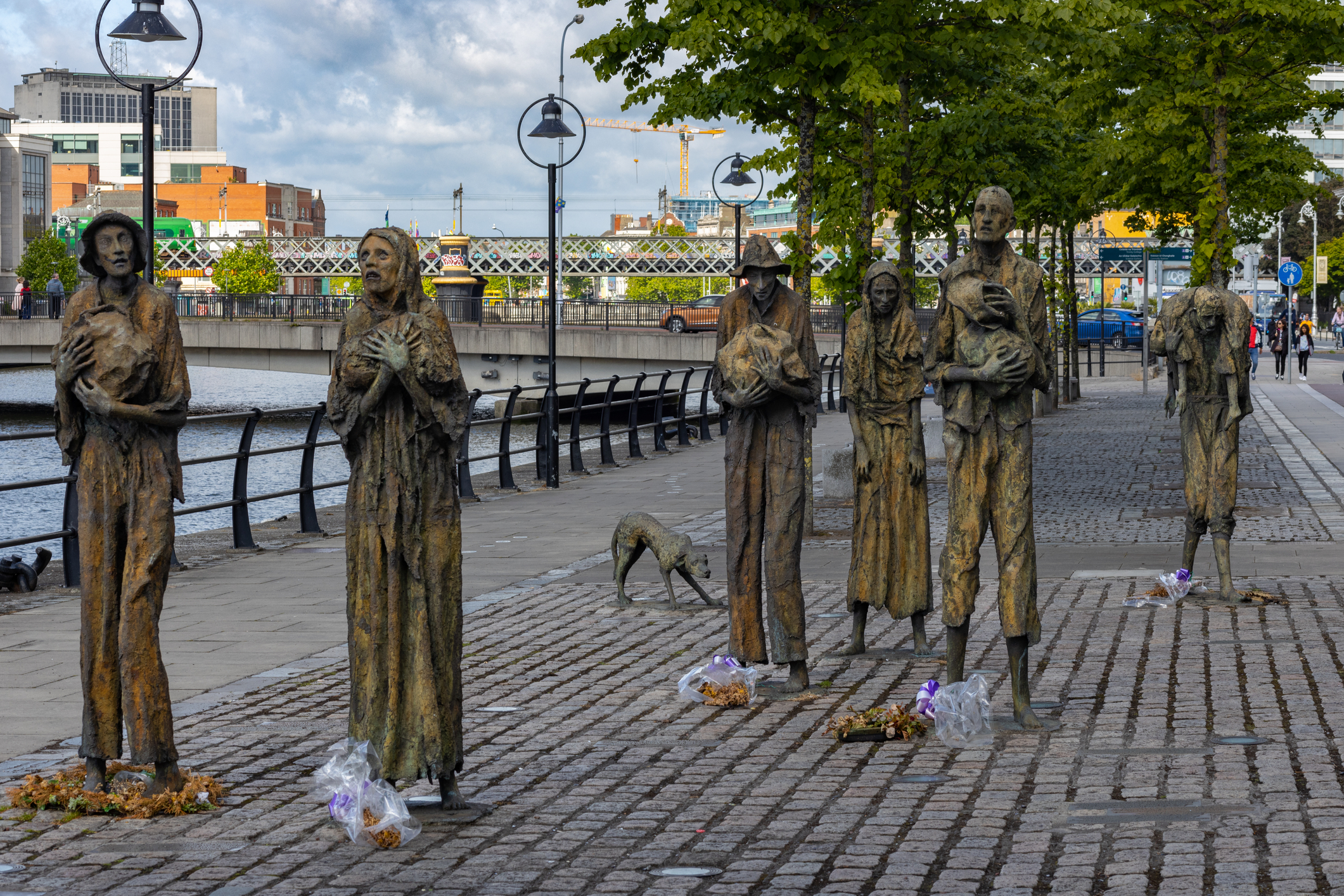
Famine Memorial in Dublin
ID 255062074 | Ireland © Piotr Koscielniak | Dreamstime.com


Famine Memorial in County Mayo of a Coffin Ship Emigrant Ship
ID 126979057 | Ireland © Debra Reschoff Ahearn | Dreamstime.com


By the end of the famine, most of the small farmers had disappeared. Landlords also lost their properties having seen their incomes fall during the famine and going bankrupt from empty rentals. Most of the estates were sold and the strong framer became the beneficiary of the famine--those farmers who acquired large acreages of land and added it to their holdings. These farmers converted from an agrarian to a grazing culture, raising sheep and cattle, and growing in prosperity. 

But not everyone prospered. Only sons could inherit property, and only the eldest son was eligible. Their siblings had to find work as laborers or become tenants of other landowners. Thus, though the system of landholding favored the wealthy class, it also unfairly rewarded some and not others. 

Women, in particular, were vulnerable. It had long been a tradition in Ireland for parents to arrange a marriage based on their ability to provide a dowry. If a woman came from a wealthy family, she could add to the other family's holdings and gain security for life. Some of these women chose to emigrate, unwilling to partake in a loveless marriage.

In addition, not all women were so fortunate as to enjoy the rewards of a wealthy family, and many of them emigrated with the hope of finding employment in the United States to earn a living. Most worked as domestics for a wealthy family. Some came with skills like tailoring and could make a considerable wage sewing clothes for those who could afford it. It was a lucky woman indeed who could also find a husband to marry.

The famine would have enduring results. As the nineteenth century drew to a close and the twentieth century began, the collective memories of those who had survived the famine affected the economic and political culture of Ireland and Irish-Americans. It would also play a contributing role in the anti-British sentiment that would lead to the Irish War of Independence, which began in January 1919 and ended on July 11, 1921. 

The Irish Free State was established on December 6, 1922, but on December 29, 1937, the constitutional name declared the nation to be known as "Ireland." The Republic of Ireland Act of 1948 described the nature of the state.

Weaving history and faith into stories of intrigue and redemption grew out of Donna's love of travel, history, and literature as a young adult while attending the United World College of the Atlantic--an international college in Wales, U.K. She enjoys developing plots that show how God's love abounds even in the profoundly difficult circumstances of our lives. Her stories reflect the hunger in all of us for love, belonging, and forgiveness.

Donna was a communications professional before writing full-time. Her short stories and articles have appeared in inspirational publications. She has two indie-published romantic suspense novels, Light Out of Darkness and Undaunted Valor, in her Waldensian Series. Her Gilded Age historical romance, A Song of Deliverance, will be released by Scrivenings Press in December 2024.

Donna and her husband of forty years participate in ministry at their local church in Colorado. The love spending time with their grandchildren and bike, kayak, and travel whenever possible.


Saturday, November 4, 2023

How One French Family Turned a Medieval Chateau into a Wine Empire

By Donna Wichelman 

In this fifth and final blog in the series on the châteaus of France, I provide one more way the French have reinvented their châteaus. As you will recall from the beginning of this blog series, many of France’s forty-five thousand châteaus have seen various transformations over the last millennium. While many have been restored and are national historical monuments, others have been repurposed as hotels, restaurants, cultural centers, and music venues. 

During a recent research trip to France in October, a friend took me to a winery with forty-four hectares (more than one hundred and eight acres) of vineyards surrounding a magnificent château. I was in awe as we drove by acres and acres of vineyard and through the ornamental wrought iron gate.

Château Saint-Georges Côte Pavie sits almost two miles (three kilometers) from the medieval village of St. Emilion in the Bordeaux region of France—a geographical area well-known for its exceptional wines. It’s impossible not to be astounded by the many “Châteaux” or wineries in the Bordeau region—7,000 of them with 57 appellations (designations), 87% of which are red blend made primarily from Merlot, Cabernet Francs, and Cabernet Sauvignon. Many have been in the same family for hundreds of years; some have turned an actual château into their administrative offices. Château Saint-Georges Côte Pavie is one of them.

Château Saint-Georges Côte Pavie: Donna's Gallery, October 2023

Château Saint-Georges's Hectares of Vineyards: Donna's Gallery, October 2023

Medieval Village of St. Emilion, France: Donna's Galley, 2023

Château Saint-Georges’s luxurious property has a long history dating back to the third century when excavations in the nineteenth century exposed a sarcophagus and Gallo-Roman pieces on the south side of the property. Beautiful mosaics also uncovered at the site proved a Gallo-Roman villa existed in the third to fourth century, overlooking a vineyard, which was owned by Latin poet Ausone. Perhaps Ausone understood what vintners would discover more than a millennium later—that the land contained all the elements—the terroir—necessary to produce some of the best wines in the world.

The château and parish of Saint Georges was constructed in the Middle Ages and established as a Barony under Henri IV. In 1602, Henri sold the property to Jean Barbot, a lawyer at the Parliament of Bordeaux, who bought it for 1,500 pounds.
In 1770, Mademoiselle de Rabar bought the estate as a dowry to Sir Bouchereau, the King’s councilor. Sir Bouchereau commissioned Louis XVI’s renowned architect, Victor Louis, in 1772 to give the château a face-lift. Having designed the Grand Théâtre de Bordeaux and the galleries of Palais Royal in Paris, the château took on the elegance of its regal presence with its four towers reminiscent of its feudal past and a neoclassical façade.


Friend Catherine Gaiotto near Château Saint-Georges's Ornamental Wrought Iron Gate: Donna's Gallery, October 2023

Two of Château Saint-Georges's Four Feudal Towers: Donna's Gallery, October 2023
 

Then, the French Revolution threw France into turmoil. Estates like Saint-Georges belonging to the nobility were seized and turned into national property. Peasants who now owned land and had seen their standard of living increase along with access to education demanded to be rid of the last vestiges of feudalism and receive their full rights as landowners. The revolution changed the cultural landscape and gave people greater latitude for personal freedoms.

Thus, Château Saint-Georges passed from hand to hand during the nineteenth century until Mr. Petrus Desbois bought it in 1891 as a summer residence. By then, the estate and its vineyards were in ruins. But Desbois determined to save it from a Phylloxera invasion—a disease that had affected most vineyards in Bordeaux.

Mr. Desbois replanted the entire estate, regenerating the vineyard by grafting French plants over American roots. His son of the same name took on the estate in 1926, and Château Saint-Georges Côte Pavie has been in the family ever since, continuing the traditions of a hundred fifty years of wine-making—a Bordeaux blend of primarily Merlot, then Cabernet Francs, and Cabernet Sauvignon.


Cellars of ChâteauSaint-Georges: Donna's Gallery, October 2023

Château Saint-Georges's Label: Donna's Gallery, October 2023

Bottle of 2015 Château Saint-Georges's Distinctive Red Blend: Donna's Gallery, October 2023

In 2013, Philippe Janoueix became a major stakeholder, joining the Desbois family in maintaining its traditions. Mr. Janoueix is currently working with local businesses to renovate the facade, vestibule, outer walls, grape pickers’ houses, and watch towers—once more refreshing this centuries-old castle and estate winery, not unlike a remodel project you or I would do on our own modest châteaus.

Renovation Project of Château Saint-Georges Front Steps: Donna's Gallery, October 2023

Donna's Husband, Son-in-law, and Friend Dean, Rebuilding our Deck During COVID, Summer 2020

Now for a sneak preview of Donna's blogs to come in 2023 and 2024: Many of you know my next writing project is a slip-time or dual-timeline novel with protagonists experiencing circumstances during the Nazi occupation of France in World War II and contemporary America and France. Stay tuned for more information in November. 

Donna worked as a communications professional before turning to full-time writing. Her short stories, essays, and articles have appeared in various inspirational publications. She also has two indie-published Christian contemporary suspense novels in her Waldensian Series Light Out of Darkness and Undaunted Valor.


Weaving history and faith into stories of intrigue and redemption grew out of her love of history and English literature as a young adult while attending the United World College of the Atlantic--an international college in Wales, U.K. She loves to explore peoples and cultures of the world and enjoys developing plots that show how God's love abounds even in the profoundly difficult circumstances of our lives. Her stories reflect the hunger in all of us for love, forgiveness, and redemption in a world that often withholds second chances. You can find out more about Donna Wichelman at www.donnawichelman.com.