Showing posts with label Adolf Hitler. Show all posts

Tuesday, January 24, 2023

Our Finest for the Fuhrer

By Terrie Todd

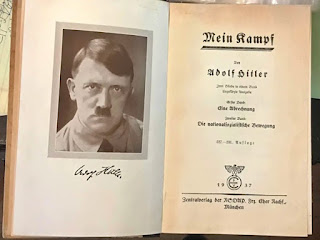
If you were getting married in Germany between 1933 and 1945, you could expect to receive a special gift, much like some couples receive a family Bible from their church today. You’d be the proud owner of the wedding edition of Adolf Hitler’s Mein Kampf (“My Struggle”), in a slipcase with the seal of the province embossed in gold on a parchment-like cover. This edition was published with a leather spine and would contain an extra presentation page in the front with blanks for the names of bride and groom and the signature of the mayor of the city, town or village. Hitler hoped that Mein Kampf would eventually replace the Bible in German households. 


Exactly eighty years ago today, Adolf Hitler ordered German troops at Stalingrad to fight to the death. To do anything other than obey was unthinkable—at least to Hitler. The word Fuhrer means “Leader” in German, but it holds much more significance, thanks to Hitler giving himself the title and all it stood for. The 13 million Germans who voted for the Nazi party in 1932 were fed up with life as they knew it. Adolf Hitler brought strength, charisma, and an “everyman” persona to the ballot with his humble origins. Voters were ready to reject privilege and embrace this “man of the people.”

Adolf Hitler

Short of food and clothing, many German soldiers were freezing or starving to death. Yet, discipline and obedience to authority prevailed. Finally, knowing that resistance no longer served any useful purpose and to save the lives of his remaining men, Field Marshal Friedrich Paulus disobeyed Hitler and surrendered.

Friedrich Paulus
Hitler had assumed that Paulus would fight on or take his own life. Nevertheless, when Soviet forces closed in on Paulus’ headquarters in a ruined department store, Paulus surrendered. The remnants of the German forces in Stalingrad surrendered on February 2, 1943. The Soviets took 91,000 tired, ill, and starving Germans captive. To their delight, and to the dismay of the Reich, the prisoners included 22 generals. Hitler, humiliated and understandably angry, stated that Field Marshal Paulus “stood at the doorstep of eternal glory but made an about-face.”

With the benefit of hindsight, we often wonder how people could have been so duped by Hitler or any other dictator. Countless books and commentaries by writers far smarter than I explain the phenomenon that allows humans to be brainwashed—oh so gradually—until it’s too late. By then, seeing the truth is too painful. Admitting we may have been wrong is too humiliating. And standing up for what’s right becomes deadly. Is anyone among us immune?


Perhaps this is another area where historical fiction can come to our aid in understanding. If you’ve read The German Wife by Kelly Rimmer, it’s easy to see how good people can be drawn into an ideology like Nazism. It’s also simple to understand how anti-Nazi thinking led to discrimination against North American Germans in the war and post-war years.

The bottom line? Any time you sense extreme nationalism, or a necessity for the absolute unity of the population behind a single charismatic leader, or the supremacy of the good of the nation over the rights of individuals—beware.


Terrie Todd is the award-winning author of four historical and two split-time
novels. Rose Among Thornes won the 2022 Word Award for best cover and the Debra Fieguth Social Justice award. Lilly’s Promise won the Braun Book Award. Terrie lives with her husband, Jon, in Portage la Prairie, Manitoba, Canada where they raised their three children. They are grandparents to five boys.


Orphaned and adopted as a toddler in 1922, Lilly Sampson pursues a nursing career in hopes it will redeem the shameful crime of arson she committed as a child. When her self-sabotaging choices only build the ash heap higher, Lilly prepares to sacrifice everything for the sake of a child she tried to abort. Can Lilly reconcile with the one person who shares all her secrets and find the strength to raise a son with special needs?

2019: While unraveling a mysterious link in her ancestry, 36-year-old Diana DeWitt is fear-stricken by the two most staggering invitations of her life: to adopt a teenager’s baby, and to marry her best friend. Will the truth Diana uncovers about her Grandmother Lilly release the grip of rejection and free her to embrace a life she only dreamed of?


Follow Terrie here:

Blog

Facebook

Quarterly Newsletter Sign-up


Friday, August 18, 2017

The Olympic Oaks or Hitler's Oaks

With Nancy J. Farrier


1936 Berlin logo
Wikimedia Commons
Imagine the hesitation of many athletes in 1936 when the Olympics were to be held in Berlin. The venue had been chosen years before Hitler came to power. The athletes had been training for years for this competition. What were they to do?

Parade of Nations
Bundesarchiv_Wikimedia Commons
Many of those prepared to compete in the 1936 Olympics considered boycotting the games because of the Hitler mindset and his agenda. Staying home seemed to be the safer option. Yet, they had worked hard to attain their status and didn’t want to give up the dream. In the end, most chose to go to the games and do their best, ignoring the Aryan agenda on the rise in Germany. They wanted the chance to show the world what they could accomplish.

Fornax_Wikimedia Commons


Meanwhile, Adolf Hitler had a fascination with oak trees. He admired them for their strength and endurance. He used oak leaves in some of his insignia and symbols to show his power and his desire to accomplish much. Because of his love of oak trees he chose to give each gold medal Olympian an oak tree to take home with them.


The games began with Hitler present and willing to shake hands with the winners. He presided over the games until Cornelius Johnson won the high jump for the United States. Johnson not only won the high jump, he set an Olympic record that day. When the time came for him to receive his medal and congratulations, Hitler left the stands and refused to shake hands with him. The Olympic committee talked with Hitler and told him he needed to shake hands with all of the gold medal winners or with none of them. Hitler chose to refrain from shaking any more hands rather than shake the hand of someone he considered inferior.

Japan's Hideko Maehata w/Oak Tree
WIkimedia Commons

Of the more than 130 oak trees given out at the 1936 Olympic games only a few are still known to exist. Some were cut down because of the association with Hitler. Others were allowed to grow when people realized the oak tree was not to blame for what Hitler did.

Jesse Owens_Wikimedia Commons

One of the oak trees that is accounted for is the tree planted by Cornelius Johnson. I attended a talk given on the Olympic Oaks and the speaker told the story of find this tree and working to propagate new seedlings. Jesse Owens won four gold medals in the 1936 Olympics and planted his trees in the Midwest when he returned home. I don’t know where all the living trees are, but the story he told was fascinating and something I had never heard before.


One last note that he shared was Hitler’s desire to make a mark led to the planting of trees in a large forest in Germany. The larch trees he planted in a forest of evergreens would only show during the fall when they changed color and the symbol could only be seen by air. His strategy wasn’t discovered until the early 1990’s when a plane flew over doing an aerial survey in the fall. The trees Hitler had embedded in that forest, known today by some as the swastika forest, changed colors in the shape of a swastika. Many of those trees were cut down to eliminate the symbol. I find that sad to destroy the trees, but I do understand the reason.


Have you ever heard of the Olympic Oaks? Had you heard of the swastika forest? These were new to me, but a part of fascinating history.


Nancy J Farrier is an award winning author who lives in Southern California in the Mojave Desert. She loves the Southwest with its interesting historical past. Nancy and her husband have five children and two grandsons. When Nancy isn’t writing, she loves to read, do needlecraft, play with her cats, and spend time with her family. Nancy is represented by Tamela Hancock Murray of The Steve Laube Literary Agency. You can read more about Nancy and her books on her website: nancyjfarrier.com.