By Tiffany Amber Stockton

Last month, I shared about the love of pets and showcased famous dogs in TV or movies. If you missed that post, you can read it here:
http://www.hhhistory.com/2018/02/for-love-of-pets.html.
Little did I know when I wrote that post, that just one week later, we'd have to make the difficult decision to say goodbye to our precious Roxie. We learned on Valentine's Day that she had developed a rather aggressive cancer in her bladder, and it combined with transitional cell carcinoma that resulted in spreading. It had come down to quality of life, and while we miss her greatly, we know we made the right decision and did the best by her.
It's getting easier with each passing day, and it won't be long before we find another sweet dog in need of our love. Now, Roxie has joined my other companions at
Rainbow's Bridge, waiting until I can be reunited with them again.
I've been translating this experience into my current novel that deals with losing a loved one and life after that loss. It's been quite cathartic and healing for me. The next novel will bring me back to the west, and that leads us into today's post. Thanks so much for traveling this journey with me!
* * * * *
Of Wind, Tumbleweeds, and Cowboys
If you have ever watched an old western movie or even a TV show set in the Old West, you are quite familiar with a nuisance known as the tumbleweed. Even I remarked about seeing them when I first moved to Colorado, saying, "I am officially in the West." *grins*

For the most part, tumbleweeds are shown in deserted or ghost towns, empty and dusty streets, or out on the prairie where no buildings impede their path. But, in reality, tumbleweeds are found everywhere people are, if the conditions are right.
A "tumbleweed" is a phrase used to describe various varieties of bushes that break off when very dry, and roll with the wind.
These thick matted bushes sometimes stick to each other to resemble a giant Tumbleweed, and single Tumbleweeds six or eight feet in diameter are not uncommon in the Southwest at times. They have been seen in many Western movies, but far from being "quaint," they can be both a nuisance and a fire hazard. Sage brush creates one of the more common kinds of tumbleweed.

Where I live in Colorado, when the wind blows across town, tumbleweeds inevitably follow. And it's amazing how those buggers can get stuck under your car, then dragged for miles. People avoid them like they do an animal or debris in the road.
One of the most ironic facts is knowing the actual tumbleweed is a plant brought over from Russia.
Scientific descriptions with good photos!
History and Description: http://www.blueplanetbiomes.org/tumbleweed.htm
Nice site and has bibliographical links.
Russian Thistle: Desert USA—the Ultimate Desert Resource has a very good history article, and the photo of blossoms to the right is theirs. It's beautiful. It's also larger than life. The blossoms are teensy, and when seen through a microscope, are nearly transparent at one point.
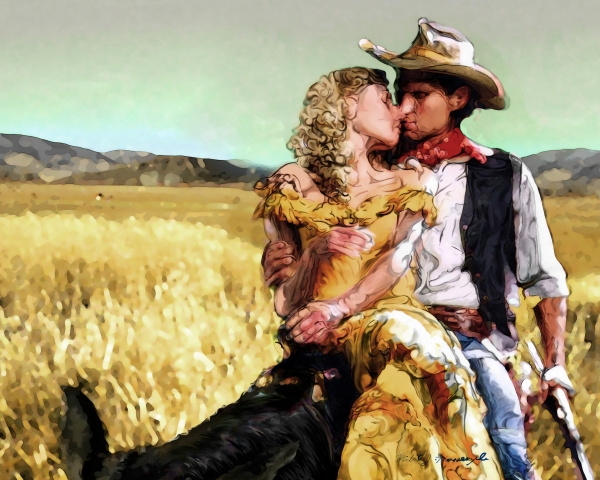
Another iconic symbol of the American West is the cowboy.
I confess. Ever since I was a little girl, I have always loved watching westerns. And the sight of a man in jeans, boots and a Stetson have always made my heart skip a beat. If that man happens to also be astride a fine horse, all the better! *grins*
Right now, I'm working on a couple of books with a western setting. In fact, the very first complete book I wrote was set in a small western town and featured a hero who was a successful cattle baron. And now, I'm returning to writing what I love...stories about horses, cowboys, ladies and ranches in the west.
So, what is it about cowboys that appeals to so many of us? Why do little boys love to don the hat and boots and swing that lasso? Why do little girls get a twinkle in their eye when they see one? What about them makes ladies want to hop right on their horse and ride off into the sunset with them? What about the way they tip their hat makes you feel that all is right with the world? Why do stories of them always catch our ear or seeing them catch our eye? And what is it about the way they drawl the word, "ma'am" that can make you weak at the knees?
Perhaps it's a desire for those simpler times when a man's handshake and his word was his bond, when men treated women with a high measure of respect and courtesy, when loyalty was a highly-prized character trait, and when you had all you could ever hope for if you had a good woman, a good saddle and a good horse.
To me? It's the love of horses and the image that cowboys represent. They might be a little rough around the edges, and they might even stink if they've been riding range for days on end without the luxury of a creek or a shower. But we love them anyway! There is just something about them that has stood the test of time, and I'm sure will continue to do so for years to come.
Before I end, I'd like to share a web site another friend sent that's entitled:
True Cowboy - The Last Cowboy Stronghold
Whether you're looking to delve into the history of the cowboy or want to scope out some modern-day ones, or even if you've got a hankerin' to don the gear and become a cowboy or cowgirl yourself, this site has it all. Enjoy!
* * * * *
NOW IT'S YOUR TURN:
* Do you love cowboys? Why or why not?
* So...what trademarks or icons of the "west" come to mind when you think of a western setting?
* When you read a western story or novel, or when you watch a movie or TV show, what items are required in order for the western setting to be believable to you?
* What did you like most about today's post?
BIO

Tiffany Amber Stockton has been crafting and embellishing stories since childhood, when she was accused of having a very active imagination and cited with talking entirely too much. Today, she has honed those childhood skills to become an
author and
speaker who works in the
health & wellness and personal development industry, helping others become their best from the inside out. She is also an
educational consultant with Usborne Books.
She lives with her husband and fellow author,
Stuart Vaughn Stockton, along with their two children in Colorado. She has sold twenty (21) books so far and is represented by Tamela Hancock Murray of the Steve Laube Agency. You can find her on
Facebook,
Twitter,
GoodReads, and
LinkedIn.


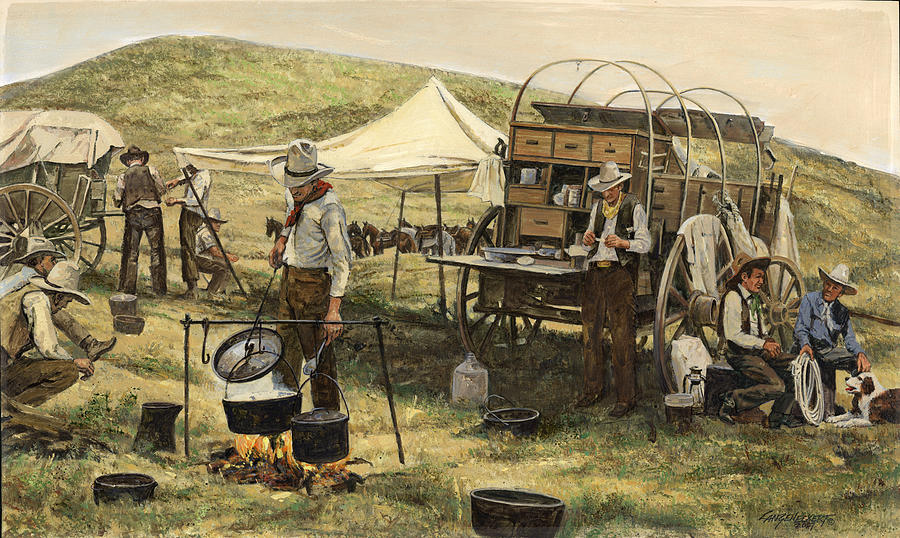
 Recreate this chuckwagon meal to honor the cowboys who shaped the American West.