Showing posts with label Benjamin Franklin. Show all posts

Monday, July 29, 2024

Heroines of the Frontier, Part 4 – Women Who Ventured Alone / The Adventure and Romance of Mrs. Elizabeth Haddon Estaugh


Throughout American history, women, along with their husbands and families, have forged their way across the continent, over raging rivers and through vast woods, across blustery prairies and beneath scorching desert winds. Yet, seldom did they decide to embark on such journeys alone. That drive and desire belongs only to those courageous women who longed for a different future and to discover what the unknown world might offer them as individuals.

Such was the character and fortitude of Elizabeth Haddon Estaugh. First-born of a wealthy and well-educated but humble Quaker, John Haddon of London, and educated in England herself, Elizabeth grew up nurturing a dream of coming to the wilds of America, planted by her father who, in 1698, purchased 500 acres from a Society Friend in the wilderness of what was termed “West Jersey”. Though he never came to view his property himself, Elizabeth became absorbed, even as a child, with the desire to settle in the new country she heard so much of from her Quaker community and those who went there carrying the Gospel.

Legend has it that her father, who made his living as a blacksmith by trade but who had preached and attracted some attention while in London, later had William Penn as a guest at his dinner table. Although Elizabeth would have been too young to join the conversation, being only about fourteen at the time, something in the discourse or conversation that followed must have enticed her even more with thoughts of what the new land had to offer.

English real estate entrepreneur, philosopher, early Quaker and founder of the Province of Pennsylvania (1644-1718) 18th Century illustration, Wikipedia Commons

At seventeen, Elizabeth joined the Quaker sect, and with energy and a practical mind began to set her thoughts toward America with greater earnest. However, her father, for business reasons, determined to remain in England.

Elizabeth was disappointed, ardently desiring to join the Quakers who had gone to reach the Indians, to find prosperity and freedom in this great land, and to join in their labors with them. When her father then offered the land tract to any relative who would settle it on his behalf, she pressed her own suit to go pioneering in the far-off wilderness in his stead. Sympathizing with what she convinced him was her calling, he finally gave way. 

In the spring of 1700, when she was about twenty-one years of age, Elizabeth boarded a two-masted ship on the Thames. She was accompanied by a poor widow known for her good sense and discretion as her housekeeper, and two trustworthy men-servants of the Society of Friends. Weeks later, they landed in the hamlet of Philadelphia.

The Haddon land tract lay in an almost unbroken wilderness, where almost nine miles of rivers and dense forest separated the diminutive port city from the place her future home lay. To someone less brave (and perhaps youthful) the prospects of forging her way there and then taming this land might have appeared doleful. But to Elizabeth, even after enduring the travails of an ocean voyage and seeing the largeness of the task before her, she was no less purposeful and determined. She fully accepted the loneliness and inconveniences she must overcome to forge a new home and settlement in such circumstances.

Always too busy to spend time complaining, and daily trusting in her Heavenly Father’s hand, she became known for her graciousness, efficiency, and tirelessness. The Indians in the region trusted her to be truthful, just, and kind, and she, in turn, learned about natural medicines from them. Elizabeth eventually used her knowledge to aid men, women, and children for miles around. In the meantime, wherever she went, she gathered information on ways she might improve her farm, whether it was for better seeding of crops or increasing dairy production. In the meantime, her home became a universal layover for Friends traveling to the Quaker meeting house in Newtown and as a respite for other weary travelers who found themselves at her door.

Such is how she became more thoroughly acquainted with a minister by the name of John Estaugh. With several other Friends, his sleigh approached her home on a brisk winter’s evening. She had met Mr. Estaugh once before, years earlier in London when he preached there, and she was still a child. Now here was the man himself, seeking respite. She welcomed him and his companions in from the cold.

As the snowstorm raged outside her door, they re-established their brief acquaintance from long ago. We can only imagine how that might conversation might have progressed—him speaking of his time in London, she of her family, and then the Lord’s calling on each of their lives—not to mention what brought them both to America.

The next day, the men worked on clearing a path through the snow, and as Elizabeth was preparing to visit her patients, John asked if he might accompany her in her ministrations. In that event, as John's compassionate nature exhibited itself in the spiritual comfort he offered to the people in her care, she saw him in a more attractive way than ever before. They spent several more days in united efforts together, becoming more thoroughly acquainted as the time passed. But soon he and his friends departed. Then in May, he and some Friends passed by her farm again as they traveled to their quarterly meeting in Salem.

It has been suggested that John might have been a bit slow or awkward at courtship. We don’t know for sure, but for whatever reason he seemed reticent, Elizabeth soon took matters into her own hands regarding their friendship. As he prepared to leave again, she stated her case:

(The following is an unauthenticated conversation taken from William Worthington Fowler’s Woman on the American Frontier / A Valuable and Authentic History of the Heroism, Adventures, Privations, Captivities, Trials, and Noble Lives and Deaths of the "Pioneer Mothers of the Republic" (Kindle Locations 2659-2666). Kindle Edition."

“Friend John, I have a subject of importance on my mind, and one which nearly interests thee. I am strongly impressed that the Lord has sent thee to me as a partner for life, I tell thee my impression frankly, but not without calm and deep reflection, for matrimony is a holy relation, and should be entered into with all sobriety. If thou hast no light on the subject, wilt thou gather into the stillness and reverently listen to thy own inward revealings? Thou art to leave this part of the country to-morrow, and not knowing when I should see thee again, I felt moved to tell thee what lay upon my mind."

After schooling his surprise, he said, "This thought is new to me, Elizabeth, and I have no light thereon. Thy company has been right pleasant to me, and thy countenance ever reminds me of William Penn's title-page, 'Innocency with her open face.' I have seen thy kindness to the poor, and the wise management of thy household. I have observed, too, that thy warm-heartedness is tempered with a most excellent discretion, and that thy speech is ever sincere. Assuredly, such is the maiden I would ask of the Lord as a most precious gift; but I never thought of this connection with thee. I came to this country solely on a religious visit, and it might distract my mind to entertain this subject at present. When I have discharged the duties of my mission, we will speak further." "It is best so," rejoined the maiden, "but there is one thing disturbs my conscience. Thou hast spoken of my true speech; and yet, friend John, I have deceived thee a little, even now, while we conferred together on a subject so serious. I know not from what weakness the temptation came, but I will not hide it from thee. I allowed thee to suppose, just now, that I was fastening the girth of my horse securely; but, in plain truth, I was loosening the girth, John, that the saddle might slip, and give me an excuse to fall behind our friends; for I thought thou wouldst be kind enough to come and ask if I needed thy services." They spoke no further upon this topic; but when John Estaugh returned to England in July, he pressed her hand affectionately, as he said, "Farewell, Elizabeth: if it be the Lord's will I shall return to thee soon."

John Estaugh left for England for a short sojourn but, unable to contain his feelings for her, he returned again in September and made haste to Elizabeth’s farm. John Estaugh and Elizabeth Haddon were married forthwith at a Meeting of the Society of Friends without fanfare but for the presence of a few guests including some Indians known to them.

Their love story is immortalized in a poem by Henry Wadsworth Longfellow in his collection Tales of Wayside Inn.


Soon after their marriage, John became his father-in-law, John Haddon's, business agent in assuming the management of his property in America, which had increased by extensive purchases. The couple also eventually made three visits back to England to see her family, although her father never did set foot in America where his land purchases had drawn his eldest child.

Meanwhile, the farm Elizabeth started flourished and expanded. After being married for twelve years, the couple built a new home, a two-story brick abode within the limits of present Haddonfield.


Images from Find-a-Grave Memorial

Throughout her lifetime, while her husband continued his work in the caring for souls, sometimes taking him away from her for long periods of time, Elizabeth Haddon Estaugh continued to stretch out her hand to the poor and needy. It is said, “She was at once a guardian and minister of mercy to the settlement.”

She and John were happily married for forty years, and she survived another twenty years after his death which occurred in 1742 on the Island of Tortola where he was stricken by fever. (Benjamin Franklin later published one of John’s Gospel tracts.) At the end of Elizabeth’s own life, a published testimonial of the meeting of Haddonfield made these beautiful remarks about her life:

"She was endowed with great natural abilities, which, being sanctified by the Spirit of Christ, were much improved; whereby she became qualified to act in the affairs of the church, and was a serviceable member, having been clerk to the woman's meeting nearly fifty years, greatly to their satisfaction She was a sincere sympathizer with the afflicted; of a benevolent disposition, and in distributing to the poor, was desirous to do it in a way most profitable and durable to them, and, if possible, not to let the right hand know what the left did. Though in a state of affluence as to this world's wealth, she was an example of plainness and moderation. Her heart and house were open to her friends, whom to entertain seemed one of her greatest pleasures. Prudently cheerful and well knowing the value of friendship, she was careful not to wound it herself nor to encourage others in whispering supposed failings or weaknesses. Her last illness brought great bodily pain, which she bore with much calmness of mind and sweetness of spirit. She departed this life as one falling asleep, full of days, 'like unto a shock of corn fully ripe.'"
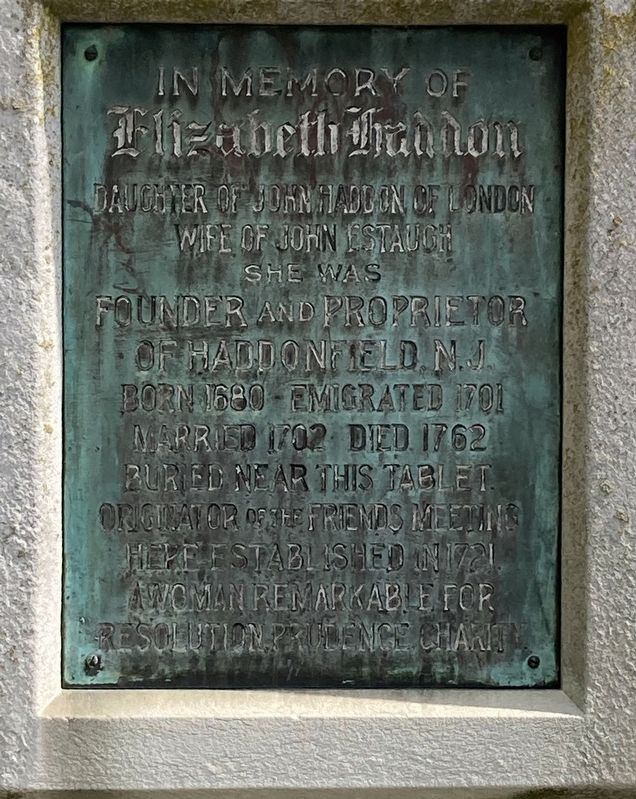
Photo by Thomas Anderson, Historical Marker Database

A memorial in Haddonfield, New Jersey bears the inscription:

In Memory of Elizabeth Haddon. Daughter of John Haddon of London. Wife of John Estaugh. She was Founder and Proprietor of Haddonfield N.J. Born 1680- Emigrated 1701. Married 1702 Died 1762. Buried near this tablet. Originator of the Friends Meeting here established in 1721. A woman remarkable for Resolution, Prudence, Charity
______________________________________________________

Paint Me Althena is refreshed and updated!


a Novel of Second Chances

Three years ago, Ava Day walked away from love. Convinced of her unworthiness to be the woman Ethan and their girls truly need, she’s searching for a new identity. Meanwhile, Ethan's star has risen in the art world, and he's found refuge in new faith and encouragement from a lovely widow. But when Ava's crooked path and a chance encounter lands her in Ethan's home again, her unleashed heart aches for what she lost. Now will conflict between her search for identity, Ethan's new faith, and others caught in the current, break the fragile safety net he offers?

Saturday, November 16, 2019

Thanksgiving in the Old West - and a Giveaway


By Davalynn Spencer

A close friend of mine is having chicken and dumplings for Thanksgiving dinner this year because that’s what her grandson requested.

Works for me.

Typically, it’s hard to imagine the big Thanksgiving spread without a turkey in the middle of the table surrounded by all the fixin’s such as that depicted in Norman Rockwell’s famous painting from the 1940s, Freedom from Want.


Freedom from Want by Norman Rockwell - Public domain
via the National Archives and Records Administration
But sixty to seventy years earlier on the Western frontier, the main dish could have been deer, fish, goose, corned beef, roast beef, tongue (bovine or bison), ham, or quail stew.

Quail on my home front huddling beneath a Colorado blue spruce.
Cranberry sauce and pies were fairly universal, though I imagine those cranberries had to be ordered ahead of time from wherever cranberries grew. Creative cooks might have substituted well-seeded chokecherries, currants, or some such. Dried apple or pumpkin pies were common, as were sweet potatoes, mashed potatoes and gravy, pickles, root vegetables, and cake.

And let’s not forget baked beans, vinegar pie, and the West’s constant standby of fresh biscuits and stout coffee.

Kansas City hotels in the late 1880s reportedly offered oysters, elk, squirrel, opossum, shrimp, and other delectables. I’d probably be late for supper if squirrel was on the menu.

From as early as 1621, people in what became the United States of America celebrated a fall harvest festival during which they thanked God for protection and provision, sharing their feast with neighbors and friends.

The First Thanksgiving at Plymouth, by Jennie August Brownscombe.
This 1925 painting corrected her 1914 depiction of Plains Indians rather than tribes common
to the Plymouth area. Public domain via the National Museum of Women in the Arts.
George Washington first proclaimed a latter Thursday of November as a day of thanksgiving, but not until 1863, during President Abraham Lincoln’s term, was Thanksgiving recognized as a federal holiday. I imagine for many, this call to give thanks during America’s Civil War served as a poignant reminder and challenge.

It has long been touted that early American Benjamin Franklin believed the common turkey to be more honorable than the bald eagle when decisions were being made about the national bird. Much of the tale is hearsay, though in retrospect, it’s hard to imagine the humble turkey replacing the majestically depicted bald eagle.

It’s also hard to imagine a featherless eagle centerpiece on my Thanksgiving table.

However, I have heard of people fending off angry gobblers that had other ideas about what should be served for supper.

What’s on your menu this year? Comment below to have your name tossed in the drawing for an e-copy of my Thanksgiving tale, Mail-order Misfire. And have a blessed and thanks-filled Thanksgiving, whether you celebrate singularly or in the company of others.

~

Wife and mother of professional rodeo bullfighters, Davalynn Spencer can’t stop #lovingthecowboy. She writes award-winning Western romance with rugged heroes, teaches writing workshops, and refuses to put her quail in a stew. She plays the keyboard on her church worship team and wrangles Blue the Cowdog and mouse detectors Annie and Oakley. Connect with her at www.davalynnspencer.com.

Monday, February 25, 2019

The Glass Armonica

By J. M. Hochstetler

I run across some pretty curious things while doing research. Sometimes they make it into my books and sometimes they don’t. Today I want to take a look at one object that I haven’t been able to work into a story, at least so far: the Glass Armonica.

If you’ve ever run a wet finger around the rim of a glass with liquid in it, you’ve discovered that it gives off a tone that varies depending on how much liquid the glass contains. It’s an effect that’s been observed for centuries. In fact, people in Europe began to perform music with sets of tuned water glasses dates as early as 1492—the year Columbus sailed the ocean blue. And by the 17th century, this kind of music was very popular among the upper classes. An Irish man, Richard Pockridge, built and performed on a set of tuned wine glasses he called an“Angelic Organ” in 1743, his repertoire including Handel’s “Water Music”. And in 1746, the composer Christoph Willibald Gluck’s “Verrillon”, played on glasses delighted audiences in Europe.

Benjamin Franklin playing the Glass Armonica
While lobbying Parliament on behalf of Pennsylvania’s legislature in 1761, Benjamin Franklin attended a concert played on the musical glasses. Already a famous scientist and inventor, he began to ponder the problem of creating more convenient form “brought together in a narrower compass, so as to admit of a greater number of tunes and all within reach of hand to a person sitting before the instrument.” He eventually began working with London glassblower Charles James to create such an instrument. They eliminated the need to tune each glass with water by creating graduated glass bowls of the right diameter and thickness to give the desired pitches. A cork was inserted into a hole in the center of each bowl, then the bowls were nested compactly in descending sizes on a horizontal spindle. A fly wheel operated by a foot treadle turned the spindle, and as the bowls turned they were partially submerged in water so that the player could simply rub the wet edges.

Franklin called his instrument the Glass Armonica, after the Italian word for harmony. He took it with him when he went to France during the American Revolution to lobby for the French to enter the war on the side of the Americans. The Armonica became a huge hit in both France and England. Queen Marie Antoinette took lessons. The famous hypnotist, Dr. Franz Mesmer, used the instrument to put his patients into a deeper trance. Composers including Mozart, Beethoven, Donizetti, Haydn, Richard Strauss, and many others wrote music for it. Paganini called its music “a celestial voice,” and Thomas Jefferson thought it “the greatest gift offered to the musical world of this century.”

Glass Armonica
In Hamburg in 1787, Karl Leopold Rollig designed a keyboard version. The instrument was manufactured and sold throughout Europe, but by the mid-1800s it had lost its popularity. Armonicas were said to drive performers mad and evoke spirits of the dead through its eerie, haunting sound, which might have been the result of lead poisoning from paint applied to the bowl edges and the 40% lead content of the glass itself. But the move away from chamber music toward full orchestras performing in large halls as the century moved into to the Victorian age also contributed to the Armonica’s demise. But the Glass Armonica had a rebirth of sorts in 1982 through the efforts of master glass blower Gerhard Finkenbeiner of Waltham, Massachusetts. It even had a cameo part in the movie Mansfield Park.

Watch this brief video about the Armonica to see how it is played and how it sounds. There are lots of other videos of the Armonica on YouTube that you might want to check out too.


What do you think of the instrument? Personally, I think the sounds are lovely and ethereal. Do you like it, or do you think it’s creepy? Does it sound like something that would drive you mad? Would you like to learn to play one? Please share your thoughts!
~~~
J. M. Hochstetler is the daughter of Mennonite farmers and a lifelong student of history. She is also an author, editor, and publisher. Her American Patriot Series is the only comprehensive historical fiction series on the American Revolution. Book 6, Refiner’s Fire, releases in April 2019. Northkill, Book 1 of the Northkill Amish Series coauthored with Bob Hostetler, won Foreword Magazine’s 2014 Indie Book of the Year Bronze Award for historical fiction. Book 2, The Return, received the 2017 Interviews and Reviews Silver Award for Historical Fiction and was named one of Shelf Unbound’s 2018 Notable Indie Books. One Holy Night, a contemporary retelling of the Christmas story, was the Christian Small Publishers 2009 Book of the Year and a finalist in the Carol Award.

Wednesday, July 25, 2018

Spy vs Spy: France and England Match Wits During the American Revolution

J. M. Hochstetler

William Eden, Baron Auckland
I’m currently writing Refiner’s Fire, book 6 of my American Patriot Series, set during the American Revolution. In this installment, Elizabeth Howard has been taken to France for safety after an attempt on her life by the British. Since both Elizabeth and the man she loves, General Jonathan Carleton, are spies, I’ve been digging into the intelligence operations of the French and British, and I’m finding it quite amusing.

Long before France signed formal treaties of alliance with the United States in early 1778, the French were already shipping supplies desperately needed by the Continental Army to aid America in her war with England. A main threat to their efforts was Britain’s Secret Intelligence Service. Headed by William Eden, the Service was already in full operation in France by the time England officially declared war on her old enemy.

Benjamin Franklin
After receiving the news of British General John Burgoyne’s disastrous defeat at Saratoga in December 1777, the British began to seriously consider the possibility of reconciliation with their rebellious colonies. Lord North, the British Prime Minister, made a conciliatory speech before Parliament. George III even went so far as to privately recommend opening a channel of communication with Benjamin Franklin. “That insidious man” as he termed him, was at the time ensconced in Paris as the first of the American’s commissioners sent by Congress.

British agents immediately began to filter into Paris to put out feelers as to what peace terms the Americans might consider. Some of the agents chosen were surprising, and perhaps because of it they were undetected, at least by the Americans. In fact, their main agent, and perhaps the one who maintained the deepest cover was an American who was Franklin’s closest and most trusted friend: Dr. Edward Bancroft. He certainly had the most spectacular success.

Edward Bancroft
Franklin and Bancroft met in London while both men were living there for some years. In his mid thirties, Bancroft, who was a physician, was also from New England. Genial and accomplished, a man of many interests, he was the perfect companion for Franklin, who installed him the commission’s secretary. He worked hard—at more than the commissioners suspected, actually—and was fluent in French, which Franklin could hardly speak. He not only became indispensable to the commissioners’ work, but also lived with them in the Hôtel de Valentinois, giving him access 24/7. John Adams disliked the man for a number of reasons. But although Arthur Lee, the third member of the commission, was convinced he was a British spy, Adams, along with Franklin, discounted the opinion since Lee was suspicious of everyone. Unfortunately, in this case he was right.

Known in the British spy network as Dr. Edwards, Bancroft was secretly a double agent who spied for the Americans as well as for the British. In serving as secretary to the Americans, Bancroft had access to every detail the British could possibly want to know. His orders were to provide, among other things, the American commissioners’ “correspondence with Congress, & their Agents, & the secret, as well as ostensible, Letters from the Congress to them,” and also “Copys of any transactions, committed to Paper, & an exact account of all intercourse & the subject matter treated of, between the Courts of Versailles & Madrid, and the Agents from the Congress.” In addition he was to provide detailed information on all shipping between France and America.

The method of transferring the intelligence was less than genius: Reports were written in invisible ink and placed in a bottle buried in a hole beneath a designated tree on the south terrace of the Tuilleries Palace in Paris. They were retrieved from there by a Mr. Deans every Tuesday evening at half past nine. Rather primitive in light of today’s technological advances in spycraft, wouldn’t you say? Obviously it wasn’t very secret either, considering how much of the intelligence flowing from Paris to London was promptly intercepted by the French.

Charles Gravier, le comte de Vergennes
In fact, espionage was at times carried on in an almost laughably farcical manner on all sides. One example: Bancroft would send the British a list of cargoes that France was shipping to America to aid the war effort. In short order Lord Stormont, the British ambassador to France, sent a vehement objection to the French Foreign Minister, Vergennes, who then helpfully forwarded Stormont’s protests and cargo lists to the American commissioners—who apparently never noticed how often the items were listed in the exact same order as in their own minutes!

Franklin himself is to a large extent responsible for intelligence leaking out of the commission like water out of a sieve. He had a very casual attitude toward security. In fact, an old friend, William Alexander, who had established a residence in Auteuil, less than a mile from Passy where he would be close to Franklin, warned him against leaving his correspondence openly lying about. A cordial, well-to-do Scot, Alexander was in and out of the Hôtel de Valentinois as frequently as a family member and often roused Franklin at an early hour to converse about scientific subjects. He was outspoken in his contempt for British policy toward America, believed the war to be an appalling blunder on England’s part, and favored full independence for America. And he was a British spy.

Regardless of the regular warnings he received, Franklin maintained that it was impossible to detect all spies, adding that “I have long observed one rule which prevents any inconvenience form such practices. It is simply this: to be concerned in no affairs that I should blush to have made public and to do nothing but what spies may see and welcome.” I’m sure that was cold comfort to the ships carrying war supplies that were sunk by the enemy because of intelligence Bancroft and others passed along.

Bancroft was clearly the most successful of the spies surrounding Franklin and remained undetected by the Americans until years after the Revolution. He was, however, only one of a very large number of British spies who gathered reams of intelligence on French and American efforts during the Revolution. Of course, one can be certain that the French were spying on us as well, even as we were making our own attempts to spy on them and the British!

For all our technological advances in spycraft today, it’s certain that the other side is employing corresponding countermeasures. One has to wonder whether in reality we’ve advanced all that far. Please share your opinions as you observe the charges flying back and forth over the Russians attempts to compromise our elections, Chinese hackers, and more!
~~~
J. M. Hochstetler is the daughter of Mennonite farmers and a lifelong student of history. She is also an author, editor, and publisher. Her American Patriot Series is the only comprehensive historical fiction series on the American Revolution. Northkill, Book 1 of the Northkill Amish Series coauthored with Bob Hostetler, won Foreword Magazine’s 2014 Indie Book of the Year Bronze Award for historical fiction. Book 2, The Return, received the 2017 Interviews and Reviews Silver Award for Historical Fiction and was named one of Shelf Unbound’s 2018 Notable Indie Books. One Holy Night, a contemporary retelling of the Christmas story, was the Christian Small Publishers 2009 Book of the Year and a finalist in the Carol Award.


Monday, August 15, 2016

Moravian Missions to the Indians

In doing research on the French and Indian War, I recently ran across a man named Christian Frederick Post, a Moravian missionary who was highly instrumental in negotiating peace between the English and the Native American tribes allied with the French. I knew only a little about the Moravians, and this piqued my interest. In digging further I discovered how extensive the Moravians’ missionary efforts were among the Indians—and how successful. Today we’re going to delve into the history of this denomination and their missions outreach to the Indians.

The Beginnings of the Moravian Church

Jan Huss
The name of the Moravian Church comes from a country currently a part of the Czech Republic, which was then known as Moravia. In the mid ninth century large numbers of people in Moravia and adjacent Bohemia converted to Christianity. When the Roman Catholic Church brought the church in this region under their jurisdiction, many of the members objected and a reformation eventually movement arose. In 1415 Jan Hus, the foremost of the reformers, was convicted of heresy and burned at the stake. The Moravian Church, officially known as the Unitas Fratrum (Unity of Brethren), was established as a result of Hus’s death, 60 years before Martin Luther began what we know as the Protestant Reformation. By 1517 the Moravian Church included at least 200,000 members. It printed its own hymnal and catechism, as well as a Bible for the people of Bohemia and Moravia in their own language.

Count Nicholas von Zinzendorf
The church spread into Poland as the result of persecution and continued to grow rapidly. In 1722 a pietist nobleman, Count Nicholas von Zinzendorf, offered refuge to several Moravian families. They established the community of Herrnhut on his Saxony estate, which became a safe haven for many more refugees. Count Zinzendorf, who eventually became a bishop in the Moravian Church, urged the Brethren to take the gospel around the world, and in 1732 the first missionaries went out to the West Indies and Greenland.

Missions to the Indians

Moravians first came to America in 1735. The community they founded in Savannah, Georgia, didn’t prosper, and in 1740 they began a mission among the Mohicans at the village of Shemomeko, New York, where the first native Christian congregation in the colonies was formed. On Christmas Eve 1741 the Moravians also established a mission called Bethlehem in Pennsylvania in order to spread the gospel to the Delaware Indians. This became the center of Moravian missions in colonial America. Additional communities followed, including Nazareth and Gnadenhutten, as well as congregations in Philadelphia, New Jersey, Maryland, on Staten Island in New York, and in North Carolina.

In 1741 Count Zinzendorf traveled to Pennsylvania. He met with leading men such as Benjamin Franklin, and with the assistance of the well-known translator and negotiator Conrad Weiser, also met with Iroquois leaders and concluded agreements that allowed Moravian missionaries to move freely throughout lands under Iroquois control.

Lenape Chief Lapowinsa
The Moravians quickly developed strong relationships with the Indians among whom they served. Their focus on the Scriptures for guidance in matters of faith and conduct and on religion from the heart was compatible with many Native American spiritual traditions, especially those of the Delaware. The Moravians’ practice of equality of spiritual life in their communities also appealed to the Indians. Unlike other Protestant missionaries, the Moravians lived and dressed like the Indians, and converts shared common quarters with white believers of all social levels. In the Salem, North Carolina, community, in fact, slaves were also able to become full members of the Church and were even eligible for election to church offices.

These practices and the Moravians’ efforts to stop the profitable liquor trade with the Indians aroused opposition from the English colonists. Because of local hostility to the Mohicans in New York, rumors were spread that the Moravians were either secretly Jesuits or were allied with these “atheistic papists”. In spite of those who defended their work, at the end of 1744 the colonial government expelled them from New York, forcing the Moravians to close the mission at Shemomeko.

Baptismal service at a Moravian mission
Moravian missionaries remained faithful to their native converts, however, moving westward with them as the Indians were progressively pushed into Ohio Territory after the French and Indian War ended. They also began new missions in the South, including among the Cherokee in 1801. When the Cherokee were forced to move to Oklahoma in the 1830s, Moravian missionaries moved with them. This mission continued until the end of the Civil War, when it was transferred to the Danish Lutheran Church and became the Oaks Mission School.

Even though the Moravians played an important role in U.S. history, church membership is only about 60,000 in all of North America today. There are more than one million members around the world, however, mostly in eastern Africa. Other major Moravian centers include the Caribbean, South Africa, Winston-Salem, NC, and Bethlehem, PA.

In my next few posts, I’m going to focus on several important Moravian missionaries to the Lenape and other native tribes in Ohio Territory during the 18th and early 19th centuries: Christian Frederick Post, David Zeisberger, and John Heckewelder.

I was very impressed by the Moravian missionaries’ faithfulness to Christ and their attitude toward and treatment of the native peoples they worked among. What do you admire most about the Moravians’ missions and teachings?
~~~
J. M. Hochstetler is a descendant of Jacob Hochstetler’s oldest son John. An author, editor, and publisher, she is the daughter of Mennonite farmers and a lifelong student of history. Northkill, Book 1 of the Northkill Amish Series, won ForeWord Magazine’s 2014 INDYFAB Book of the Year Bronze Award for historical fiction. Book 2, The Return, releases in Spring 2017. Her American Patriot Series is the only comprehensive historical fiction series on the American Revolution. One Holy Night, a contemporary retelling of the Christmas story, was the Christian Small Publishers 2009 Book of the Year.

Saturday, July 25, 2015

History of the U.S. Post Office


William Goddard
They say that necessity is the mother of invention. In Colonial America, Patriot printer William Goddard found that the Crown Post, Britain’s colonial mail system, was blocking his Pennsylvania Chronicle newspaper from getting to his subscribers, as well as blocking important news he needed to include in the paper from getting to him. It was here that necessity birthed the ideas for a new postal system not run by Britain.

Benjamin Franklin
In 1774, Goddard partnered with his friend and mentor, Ben Franklin, to propose a Colonial mail system to the Continental Congress. Franklin had served the Crown Post for a total of thirty-seven years, both as Philadelphia’s postmaster and as the joint postmaster general of the colonies. Franklin lobbied for Goddard’s ideas to be heard, and on October 5, 1774, Goddard gave his extensive designs to Congress. However, due to other pressing matters, they didn’t act upon the idea immediately. But Goddard did.

Goddard began his mail service without the congress’s approval. His new system was run and paid for by subscription service. A private committee was elected by the subscribers, and was in charge of appointing postmasters, determining the mail routes, setting postal rates, and hiring post-riders. By the time the Continental Congress met in May of 1775, Goddard’s Continental Post had 30 post offices between Portsmouth, New Hampshire, and Williamsburg, Pennsylvania. Each post rider was made to swear that he would keep all mailings under lock and key.

On July 26, 1775, the Continental Congress put their approval on the new postal system. ToGoddard’s chagrin, the congress named Benjamin Franklin as the first Postmaster General. They did, however, grant Goddard the position of Riding Surveyor. Franklin drew up a hand-written pass for Goddard, allowing him to travel at his discretion for the surveyor position. Within his new job, Goddard traveled southward to set up new post offices.


Pass written by Benjamin Franklin for William Goddard

Warnings about the Crown Post were circulated among the colonists. One such warning stated:

Letters are liable to be stopped & opened by ministerial mandates, & their Contents construed into treasonable Conspiracies; and News Papers, those necessary and important vehicles, especially in Times of public Danger, may be rendered of little avail for want of Circulation ...

Because of this, the colonists quickly switched their mailings to the Constitutional Post, and by Christmas Day 1775, the Crown Post was forced out of business.

Franklin stayed on as Postmaster General until November 7, 1776. Since the Declaration of Independence was signed on July 4 of that year, Franklin is stated to be the first Postmaster General of the United States. After Franklin’s departure, Goddard hoped for the appointment to the Postmaster’s job, but was again passed over. This time, it went to Franklin’s son-in-law, Richard Bache. At this point, Goddard resigned to pursue other endeavors.

While many credit Franklin as being the creator of the U.S. Postal Service, it truly was Goddard’s invention, born out of the necessity of getting his newspapers into the hands of the colonists, which brought about the postal service as we know it today. Tomorrow marks the 240th anniversary of the service. Why not make an effort to thank your postal worker when he or she comes by.


Jennifer Uhlarik discovered the western genre as a pre-teen, when she swiped the only “horse” book she found on her older brother’s bookshelf. A new love was born. Across the next ten years, she devoured Louis L’Amour westerns and fell in love with the genre. In college at the University of Tampa, she began penning her own story of the Old West. Armed with a B.A. in writing, she has won five writing competitions and finaled in two other competitions. In addition to writing, she has held jobs as a private business owner, a schoolteacher, a marketing director, and her favorite—a full-time homemaker. Jennifer is active in American Christian Fiction Writers and lifetime member of the Florida Writers Association. She lives near Tampa, Florida, with her husband, teenaged son, and four fur children.


Now for Sale:

Nine romantic adventures take readers along for a ride on the Oregon Trail where daily challenges force travelers to evaluate the things that are most precious to them—including love. Enjoy the trip through a fascinating part of history through the eyes of remarkably strong characters who stop at famous landmarks along the way. Watch as their faith is strengthened and as love is born despite unique circumstances. Discover where the journey ends for each of nine couples.


Join nine brides of convenience on their adventures in a variety of times and settings gone by—from a ranch in California…to the rugged mountains of Colorado…to a steamship on the Mississippi…to the dangerous excitement of the Oregon Trail…into high society of New York City. No matter the time or place, the convenient brides proceed with what must be done, taking nuptials out of necessity. . .and never dreaming that God might take their feeble attempts to secure their futures and turn them into true love stories for His glory.