Showing posts with label Cherokee. Show all posts

Saturday, December 3, 2022

Amicalola Falls

 
By: Rebecca May Davie


"Tumbling Waters" is a rough translation of the Cherokee word for Amicalola Falls. The Cherokee Nation cared for and roamed the land where this 729-foot waterfall with its seven cascades exists. The tallest waterfall in Georgia changed hands after the signing of the *New Echota Treaty of 1832 as the Land lottery ensued. 

Amicalola Falls
The first to write about this landmark was William Williamson who explored and searched for land of his own to claim in the lottery. He extolled both the beauty and the difficulty of ascent. At that time, he declared the falls “perhaps the greatest in the world, the most majestic scene.”

A hidden gem, Amicalola Falls was so remote that a member of the Cherokee Nation living nearby
evaded the Georgia Guard. In 1838 the Georgia Guard removed the Cherokee and forced them onto the Trail of Tears, yet she lived there undisturbed until the 1840s.
 
Later in 1852, Bartley Crane occupied the space at the base of the falls and ran a mill. He collected the falls and hundreds of surrounding acres. A Methodist-Episcopal campground began on his land at the base as well. This spot was used by both sides during the Civil War. After, John Crane, Bartley’s son, ran a general store through the Great Depression. In 1940, the State of Georgia bought Crane’s lands for a state park.
 
Today, there are 829 acres to explore. Stairs and roads offer opportunities to view the falls for people on foot or on wheels. There are trails for beginners and advanced hikers to traverse. The trails vary in flora, fauna, and a bit of memorabilia. Notice the photo at left with the old truck stuck in the trees. It must have plummeted from above with no way for recovery from the steep terrain. 

Register at the visitor center before 2:00 pm to attempt the five miles up to the remote Hike Inn for a meal or to stay. The lodge at the top of the falls, accessible by car, also offers accommodation.
 
Amicalola offers an approach trail for the Appalachian Trail (AT). Hikers can make the eight-mile trek to the southern terminus at Springer Mountain. From that point they begin their northbound 2,190 mile journey to Mount Katahdin, Maine.

My favorite time to see Amicalola is in the fall. The changing and falling leaves add to the experience. Peaceful, awe-inspiring vistas inspire us to take a deep breath, slow down, and enjoy. If you haven’t seen this wonder in person, consider a trip today. Would you like to watch videos of the falls in action? Check out this reel on Instagram.

*Read more about New Echota in Denise Weimer's post New Echota Treaty 


As a child, Rebecca loved to write. She nurtured this skill as an educator and later as an editor for an online magazine. Rebecca then joined the Cru Ministry - NBS2GO/Neighbor Bible Studies 2GO, at its inception. She serves as the YouVersion Content Creator, with over 75 Plans on the Bible.com app.

Rebecca lives in the mountains with her husband, the youngest of their two sons, and a rescued dog named Ranger. If it were up to her, she would be traveling - right now. As a member of ACFW, FHLCW, and Hope*Writers, Rebecca learns the craft of fiction while networking with a host of generous writers. She is working on her first fiction novel. This story unfolds from the 1830s in Northern Georgia.

Connect with Rebecca: Clubhouse Facebook Goodreads Instagram Pinterest Twitter Website


Saturday, July 2, 2022

Trail Trees, Part II


by Rebecca May Davie

Welcome back to the discussion about Trail Trees. Native Americans molded these trees to point travelers in a certain direction. They could lead toward meeting grounds, burial sites, water, or other important locations. If you missed the first installment, find the post here: Trail Trees Part 1.  

In addition to Trail Trees and Horse and Rider Trail Trees presented last time, there are Message Trees. The bend in these trees is less severe. Instead of packing the nose that would give information, messages hide in a carved hollow. For example, the Creek used red sticks to convey information. The holes were convenient places to hide correspondence. Others passing by could be unaware of the secret cache.

Message Tree GA
Near village sites and water, there is another possible type of Message Tree. These trees have multitudes of knots circling the tree from base to summit. The meaning is unknown. We wonder if we have one such tree on our property. See the image at left. It appears old enough… but we may never have confirmation. I wish I had taken a photo before the leaves unfurled. Yet, you can just distinguish the multitudes of burls peeking out from under the foliage.

Treasure Trees are yet another variation. These trees bend toward the ground to indicate a buried treasure. Or the bend points toward a cave. In Georgia, before the Cherokee were forcibly removed, they mined gold. To save what belonged to their clans, the resourceful groups found locations to conceal their wealth, hoping to return one day to reclaim their bounty.


Tree with mountain and bird carvings
There are also straight trees with carvings. I read a book that claimed the Cherokee also left messages on trees to show where they buried treasure or to mark events or trails. Beech trees seem to be the preferred species. A family member and I are not in agreement about this tree you see on the right. Does it contain an image? It is of an age; however, the markings may just be a pattern in the bark. My imagination would rather believe it is indeed a message. What do you think? Do you see the mountain and a bird up above?

One could argue that these Native Americans were among the first on the continent to use codes. Secret codes expressed via trees. Fascinating!

Speaking of trees in question… I wonder if this could be a Trail Tree. See the image below. It looks like it has a nose - not the deer's nose. :0) Look above the deer. 

We talked about what and why, how about …

Which? 

Possible Trail Tree with deer beneath
It might be difficult to ascertain if a tree is in fact a Trail Tree and if so, which kind. I found this resource while researching the trees we discovered. If you think you might have a veritable find, fill out a form on the Mountain Stewards website. They are collecting data and seeking funding to protect these paragons of history. 

For more information: Indian Trail Trees by Elaine Jordan. It is out of print, but you may be able to find a copy online or at your local library. Dennis Downes studied these trees and their meanings for over 30 years. Check out his website or download his book, Native American Trail Marker Trees: Marking Paths Through the Wilderness. 

As you can tell, it can be fun, trying to find these trees. When you are in the woods the next time, pay attention. You may discover a Trail Tree or two. Happy hunting!


                     As a child, Rebecca loved to write. She nurtured this skill as                             an educator and later as an editor for an online magazine. 

Rebecca then joined the Cru Ministry - NBS2GO/Neighbor Bible Studies 2GO, at its inception. As the YouVersion Content Creator, she uploaded over 75 plans on the Bible.com app.

Rebecca lives in the mountains with her husband, the youngest of their two sons, and a rescued dog named Ranger. If it were up to her, she would be traveling - right now. As a member of ACFW, FHLCW, Jerry’s Guild, and Hope*Writers, Rebecca learns the craft of fiction while networking with a host of generous writers. She is working on her first fiction novel. This story unfolds from the 1830s in Northern Georgia.
ACFW badgeFaith, Hope, & Love Christian Writers badgeHope*Writers badgeWriting with Grace badge
Connect with Rebecca:


Thursday, June 2, 2022

Trail Trees


by Rebecca May Davie


Trees. They are majestic, awe-inspiring, and life-giving. As a child, I had a favorite tree and spent time perched on its limbs. Now, I live among trees with my family. Those sentinels who have watched countless people and animals cross their paths, the older and ancient trees - they are the most alluring. As Tolkien wisely declared, “I am at home among the trees.”

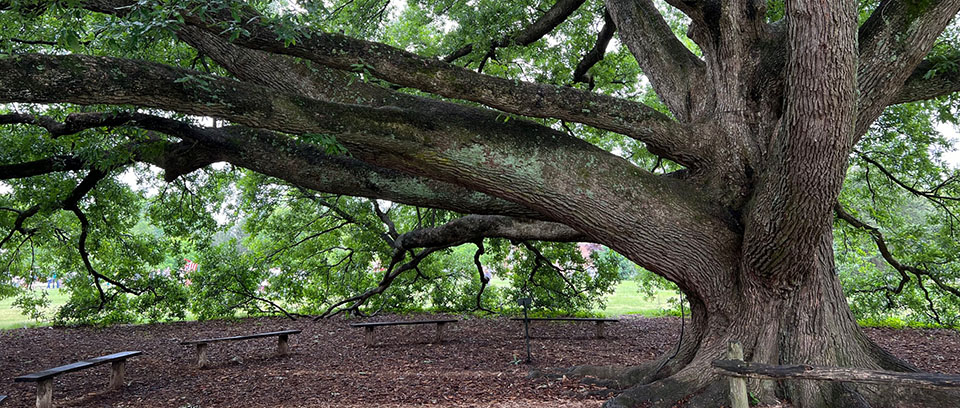
Here are photos, above and below, of a Live Oak we had the pleasure of visiting in Colonial Williamsburg last weekend. Isn’t it glorious? Oh, what this tree has witnessed over time. 

Live Oak in Williamsburg, VALive Oak Tree in Williamsburg, VA

Countless stories and books feature trees. Three favorites are… the Ents in the Lord of the Rings, Shel Silverstein’s, The Giving Tree, and The Lorax, by Dr. Seuss. Yet, these are stories told about trees. What if the trees are the ones doing the telling? Long ago, there were people who told stories with the trees and enabled the trees themselves to share for generations to come.

Possible Trail Tree in GA
I am referring to Trail Trees. These trees are beautiful representations of Native Americans using what they had at their disposal to meet a need.
 
Have you passed by a tree that has an unnatural bend or does not look as if the elements caused the appearance? It could be a Trail Tree.
 
Why?
 
A Trail Tree is a tree that the Native Americans modified to fulfill a purpose. Bent trees point in a certain direction. These help travelers (who understand the meanings) to follow a path. These trees could lead toward meeting grounds, burial sites, water, or other important locations. Often there are trees, one hundred yards apart (in our measurements), until the destination appears. Other trees are markers for something lying beneath or in the direct vicinity. Yet even more are communication trees. Hollows contain messages, relayed with sticks or other implements.
 
How?
 
Trail Tree sketch of how they might have been created
Native Americans formed Trail Trees using a “thong” or a sling-shot shaped sapling. This supported the tree as they bent it 90 degrees. They held the tree down by a rope or sinew and anchored it to the ground. Another bend allowed the rest of the tree to grow toward the sky. Just before this upward limb, they altered the “nose” (bend in the tree). Depending on the purpose of the tree, they hollowed out the nose, packed it with bark and moss, and then sealed it with sap/resin. Sometimes, they cut the nose. Hopefully, this rough sketch will help to explain the process.
 
We do not know what information these noses hold. There are no records of the meanings and the descendants who might know are not sharing this knowledge. It is understandable that they would guard these traditions. The original creators disguised communications so that others who do not have the key, will gloss over the occurrence, and keep on moving.


Two acres from our home is a tree that I would like to believe is a Trail Tree. I am not sure if it is old enough and I have yet to seek confirmation. Years of soil and leaves hide the bottom of this tree, yet you can still see the nose. It is pointing toward the mountain.

Possible Trail Tree in GAPossible Trail Tree in GA

Trees on Etowah River in GA


While walking, you can view Trail Trees at eye-level. They are
often along waterways. Bent trees show where it is safe to cross. Where we used to live at the junction of a creek and a river there were two Trail Trees, one pointing to each body of water. Sadly, in the time that we lived there, one of the trees broke and only the base remains. The image to the left shows an example of a Safe Crossing tree. Though this one is probably too young to be authentic, you get the idea.


Horse and Rider Trail Tree in Crab Orchard, TN
Beyond the trees giving direction at ground level, there are others fashioned so a rider on horseback can locate them – Horse and Rider Trail Trees. These specimens have bends around eight to ten feet or more off the ground. This image shows an example. Thank you to Linda Shaffer, who shared her photo from Crab Orchard, Tennessee.

July 3rd, please check back here at Heroes, Heroines, and History, to read about Message Trees in Part II of this series. Also, you will find suggested resources that could help you learn more. Do you think you might have an example on your property or near where you live? There is an organization studying and protecting these precious remnants from the past. They would like to hear from you and may help you determine the possibility. Read next month to find out how you can submit a query.


As a child, Rebecca loved to write. She nurtured this skill as an educator and
later as an editor for an online magazine. 
YouVersion Bible.com badge

Rebecca then joined the Cru Ministry - NBS2GO/Neighbor Bible Studies 2GO, at its inception. As the YouVersion Content Creator, she uploaded over 75 plans on the Bible.com app.

Rebecca lives in the mountains with her husband, the youngest of their two sons, and a rescued dog named Ranger. If it were up to her, she would be traveling - right now. As a member of ACFW, FHLCW, Jerry’s Guild, and Hope*Writers, Rebecca learns the craft of fiction while networking with a host of generous writers. She is working on her first fiction novel. This story unfolds from the 1830s in Northern Georgia.

Connect with Rebecca: 


Monday, May 2, 2022

The Cherokee Phoenix


by Rebecca May Davie

As the first Native American newspaper, it was also one of the few bilingual papers. From what I was able to discover, the only other paper in existence at the time was The Baton-Rouge Gazette. This edition existed in French and English from 1819-1856. It is possible that the German paper, Die Bloomfield Germania was in print at that time, though I was unable to locate an initial year or whether it featured both languages.

Consider the significance of this achievement. Sequoyah created a syllabary, enabling the possibility of the Cherokee language in print. (You can read more about Sequoyah here.) Their system of communication is in effect shortly after they adopted the syllabary. This printed resource then provided information for Cherokee and English speakers alike. It enabled connection between the Cherokee in what is now Georgia and other locations in America. They became united as the plight to stay on their land unfolded. 

On July 4, 1776, Congress declared, “We hold these truths to be self-evident, that all men are created equal…” It is heartbreaking to recall that still in the 1830s of America, not all were treated as such. Newcomers forced out those who lived there first. Without getting in too deep, suffice it to say there were individuals claiming the Cherokee were not capable of “civilization.” Ponder that for a minute. Their successes to that date portrayed a different story: syllabary, bilingual printed news, governing body, and much more.

This book, Records of the Moravians offers first-hand accounts of missionaries in The Cherokee Phoenix. Featured on the cover is an image of the original publication. 


Timeline for The Cherokee Phoenix

1825 – The Cherokee adopted Sequoyah’s Syllabary. Without it, the newspaper would not exist.

1827 – In October, Elias Boudinot submitted a proposal for the newspaper.

1828 – On February 21, they printed the first edition of The Cherokee Phoenix in New Echota, Cherokee Nation (present day Georgia).

1829 – The name evolved to The Cherokee Phoenix and Indian Advocate.

1834 – Cherokee government no longer had funding to print the paper. The Georgia Guard destroyed the office and press.

1844 – Cherokee citizen William Potter Ross published the paper as The Cherokee Advocate.

1975 – The Cherokee People approved a new constitution. The Cherokee Advocate officially returned.

2000 – The name changed again to The Cherokee Phoenix and Indian Advocate.

2007 – The publication reclaimed the original name – The Cherokee Phoenix.

Present day – The Cherokee Phoenix is present in print, online, on radio shows, and on social media. What would Sequoyah and Elias think of those avenues?

The timeline above proves resiliency. Look at the current Cherokee Phoenix. If you would like to see the original paper, the Library of Congress has scanned copies available. How neat is that? Read the March 6, 1828, edition. Or if you care to learn more about the history, peruse this post from The New Georgia Encyclopedia.

Rebecca May Davie is the YouVersion Content Creator for NBS2GO/ Neighbor Bible Studies 2GO - a Cru Ministry. She has uploaded over 71 plans on the Bible.com app. Rebecca is living in the mountains with her husband, the youngest of their two sons, and a rescued dog named Ranger. If it were up to her, she would be traveling right now. She is working on her first fiction novel. This story unfolds from the 1830s in Northern Georgia. Connect with Rebecca:

Website 
Twitter
“Let your fiction grow out of the land beneath your feet.” – Willa Cather


Wednesday, March 2, 2022

Sequoyah - Creator of the Cherokee Syllabary

Language. One simple word that is anything but.
 
I am infatuated with languages. I remember pretending to speak my own version and mimicking accents with friends when I was a young child. All these years later, I am still hoping to earn the Polyglot moniker. Why is language so alluring? What captivates my interest? Is it the accents, dialects, idioms, structures, history, etymology, or entwined cultures? Each of those aspects and so many more feed my fascination. Merriam-Webster.com defines language as “the words, their pronunciation, and the methods of combining them used and understood by a community.” So, to the above list, I will add… the people.
 
Without the gift of language, especially in written form, we would have limits. The ability to write and record language opens doors to connect, read, learn from afar, work, collaborate, send a note – email – text, and even formulate TikTok videos.
 
If you would like to see variations of language, try Google translate. Type in a short sentence and find the result in a few of their 109+ offerings. Most even have a speaker option so you can hear the answer. Experiment with an unfamiliar tongue to see and hear the diversity. Many languages have beautiful fonts and bonny tones. Two weeks ago, I was working with Burmese for our ministry. Are you familiar with their characters? They are lovely. The following sentence means I love to read.
ဖတ်ရတာ သဘောကျတယ်။

Have you ever considered how languages develop over time? This is a lengthy process tied to history, the influences of other cultures, and other factors. Language is not commonly the project of a single person. Yet there is a monolingual individual without a formal education, who had no knowledge of writing or reading, who assembled a complementary syllabary to his spoken language. How could he generate a system that would be of immediate use and go on to influence the formation of other languages? Sequoyah, a Cherokee, also known as Sogwali, accomplished this feat.


Sequoyah observed the Caucasian settlers where he lived. They had the ability to communicate across distances. He discussed this among his people who were not in favor of recording their thoughts. In their opinion, this was witchcraft. Despite this challenge, he continued to contemplate the scenario when he served in the US Army during the War of 1812. Fighting in the battle at Horseshoe Bend, he watched soldiers employing this method to connect with fellow soldiers and family.

When he returned to civilian life, he toiled as a blacksmith. Out of necessity, he needed a system to record orders and payments. As he was artistic, he would sketch the customers’ likenesses and would use a rudimentary system to retain amounts and objects. This became labor-intensive over time. It is speculated that due to this need and what he observed in exchanges between soldiers, he began the arduous task of creating a solution. 


Sequoyah invested 12 years to compose a system of 86 characters that placed on paper what was an oral language up until that point. Due to his usage of syllabary (characters representing sounds), rather than individual letters, the compilation was easy to master. His daughter was the first to use the written characters. She participated in demonstrations for the Cherokee to prove the efficacy and remove doubts or superstitions. Sequoyah and his daughter went to separate locations. They each wrote messages to the other, then exchanged the missives. They employed this process to prove that the syllables did indeed represent sounds for communication.

The Cherokee Nation adopted Sequoyah’s syllabary in 1825, which spread quickly. This invention allowed them to write a constitution and print the Cherokee Phoenix, a newspaper. These were crucial elements during a harrowed time. It is recorded by the Cherokee Nation of Sequoyah, “He accomplished a feat, which no other person in history has done single-handedly…he brought our people literacy and a gift of communicating through long distances and ages. This one person brought to his people this great gift without hired educators, no books and no cost.” -Georgia Historical Society.

If we consider Sequoyah’s contribution to the Cherokee alone, he provided a means for his nation to communicate across distances. He enabled them to design and record a constitution. The first bilingual and tribal newspaper in the US, the Cherokee Phoenix was born. All these accomplishments were key as they began the fight to remain on their land. In addition, due to the success of his syllabary, other people groups developed their own systems. Sequoyah influenced over 20 scripts for more than 65 languages.

If you would like to learn more about Sequoyah and his life, this video gives a short history.

Do you speak languages other than your native tongue? How would your days be impacted if you only had means of oral communication?

Rebecca May Davie is the YouVersion Content Creator for NBS2GO/ Neighbor Bible Studies 2GO - a Cru Ministry. She has uploaded over 66 plans on the Bible.com app. Rebecca is living in the mountains with her husband, the youngest of their two sons, and a rescued dog named Ranger. If it were up to her, she would be traveling right now. Not quite a polyglot, Rebecca speaks English and French as her L2. College courses last year gave her a rudimentary grasp of Italian. She hopes to learn Spanish next. Meanwhile, Rebecca is working on her first fiction novel. This story unfolds from the 1830s in Northern Georgia.

Connect with Rebecca:  Website 


Monday, August 15, 2016

Moravian Missions to the Indians

In doing research on the French and Indian War, I recently ran across a man named Christian Frederick Post, a Moravian missionary who was highly instrumental in negotiating peace between the English and the Native American tribes allied with the French. I knew only a little about the Moravians, and this piqued my interest. In digging further I discovered how extensive the Moravians’ missionary efforts were among the Indians—and how successful. Today we’re going to delve into the history of this denomination and their missions outreach to the Indians.

The Beginnings of the Moravian Church

Jan Huss
The name of the Moravian Church comes from a country currently a part of the Czech Republic, which was then known as Moravia. In the mid ninth century large numbers of people in Moravia and adjacent Bohemia converted to Christianity. When the Roman Catholic Church brought the church in this region under their jurisdiction, many of the members objected and a reformation eventually movement arose. In 1415 Jan Hus, the foremost of the reformers, was convicted of heresy and burned at the stake. The Moravian Church, officially known as the Unitas Fratrum (Unity of Brethren), was established as a result of Hus’s death, 60 years before Martin Luther began what we know as the Protestant Reformation. By 1517 the Moravian Church included at least 200,000 members. It printed its own hymnal and catechism, as well as a Bible for the people of Bohemia and Moravia in their own language.

Count Nicholas von Zinzendorf
The church spread into Poland as the result of persecution and continued to grow rapidly. In 1722 a pietist nobleman, Count Nicholas von Zinzendorf, offered refuge to several Moravian families. They established the community of Herrnhut on his Saxony estate, which became a safe haven for many more refugees. Count Zinzendorf, who eventually became a bishop in the Moravian Church, urged the Brethren to take the gospel around the world, and in 1732 the first missionaries went out to the West Indies and Greenland.

Missions to the Indians

Moravians first came to America in 1735. The community they founded in Savannah, Georgia, didn’t prosper, and in 1740 they began a mission among the Mohicans at the village of Shemomeko, New York, where the first native Christian congregation in the colonies was formed. On Christmas Eve 1741 the Moravians also established a mission called Bethlehem in Pennsylvania in order to spread the gospel to the Delaware Indians. This became the center of Moravian missions in colonial America. Additional communities followed, including Nazareth and Gnadenhutten, as well as congregations in Philadelphia, New Jersey, Maryland, on Staten Island in New York, and in North Carolina.

In 1741 Count Zinzendorf traveled to Pennsylvania. He met with leading men such as Benjamin Franklin, and with the assistance of the well-known translator and negotiator Conrad Weiser, also met with Iroquois leaders and concluded agreements that allowed Moravian missionaries to move freely throughout lands under Iroquois control.

Lenape Chief Lapowinsa
The Moravians quickly developed strong relationships with the Indians among whom they served. Their focus on the Scriptures for guidance in matters of faith and conduct and on religion from the heart was compatible with many Native American spiritual traditions, especially those of the Delaware. The Moravians’ practice of equality of spiritual life in their communities also appealed to the Indians. Unlike other Protestant missionaries, the Moravians lived and dressed like the Indians, and converts shared common quarters with white believers of all social levels. In the Salem, North Carolina, community, in fact, slaves were also able to become full members of the Church and were even eligible for election to church offices.

These practices and the Moravians’ efforts to stop the profitable liquor trade with the Indians aroused opposition from the English colonists. Because of local hostility to the Mohicans in New York, rumors were spread that the Moravians were either secretly Jesuits or were allied with these “atheistic papists”. In spite of those who defended their work, at the end of 1744 the colonial government expelled them from New York, forcing the Moravians to close the mission at Shemomeko.

Baptismal service at a Moravian mission
Moravian missionaries remained faithful to their native converts, however, moving westward with them as the Indians were progressively pushed into Ohio Territory after the French and Indian War ended. They also began new missions in the South, including among the Cherokee in 1801. When the Cherokee were forced to move to Oklahoma in the 1830s, Moravian missionaries moved with them. This mission continued until the end of the Civil War, when it was transferred to the Danish Lutheran Church and became the Oaks Mission School.

Even though the Moravians played an important role in U.S. history, church membership is only about 60,000 in all of North America today. There are more than one million members around the world, however, mostly in eastern Africa. Other major Moravian centers include the Caribbean, South Africa, Winston-Salem, NC, and Bethlehem, PA.

In my next few posts, I’m going to focus on several important Moravian missionaries to the Lenape and other native tribes in Ohio Territory during the 18th and early 19th centuries: Christian Frederick Post, David Zeisberger, and John Heckewelder.

I was very impressed by the Moravian missionaries’ faithfulness to Christ and their attitude toward and treatment of the native peoples they worked among. What do you admire most about the Moravians’ missions and teachings?
~~~
J. M. Hochstetler is a descendant of Jacob Hochstetler’s oldest son John. An author, editor, and publisher, she is the daughter of Mennonite farmers and a lifelong student of history. Northkill, Book 1 of the Northkill Amish Series, won ForeWord Magazine’s 2014 INDYFAB Book of the Year Bronze Award for historical fiction. Book 2, The Return, releases in Spring 2017. Her American Patriot Series is the only comprehensive historical fiction series on the American Revolution. One Holy Night, a contemporary retelling of the Christmas story, was the Christian Small Publishers 2009 Book of the Year.

Saturday, October 19, 2013

THE TEXAS CHEROKEES


By Laurie Kingery


O si yo, as they say in the Cherokee language, or hello. Those at all familiar with Texas history in the 1800's know of the Comanches, that fierce band of Plains Indians who reacted to white encroachment on their hunting grounds by raiding the settlements and murdering or kidnapping white settlers. But I thought it would be interesting to do a series on some of the lesser-known Indian tribes in Texas. I will begin with the Cherokee, for whom I have a soft spot since I am part Cherokee myself, about one sixteenth, if I remember my Texas family history correctly.


      The Cherokees were one of the so-called "Five Civilized Tribes" who had begun to adopt white ways of dress and living, including the same types of houses whites lived in and the keeping of slaves. They had their own government, an 86-character alphabet (thanks to the famous Cherokee Sequoyah), and newspaper. The men dressed very colorfully with turbans and wide waist sashes over their American-style clothing, and Christianity was widely accepted.


White settlers wanted their land, however, and when gold was discovered at the edge of Cherokee land, their fate was sealed, with President Andrew Jackson's help, despite their having helped defeat the British and Creek Indians in the War of 1812. After they were moved off their lands, the graves of those Cherokees who had died previously were robbed, after they were rumored to contain treasure.
     The Cherokees who came to Texas, though, did so before the Indian Removal Act led to the forced migration of the Cherokees to Oklahoma via the infamous Trail of Tears. A quarter of the 16,000 removed died.
     The Cherokees that I'm most likely related to followed Chief John Bowles, a Chickamauga, to first Missouri, then Arkansas, and finally east Texas in about 1812-1819, where they displaced the Caddoan tribe which had decreased in population thanks to exposure to European diseases.


     But they were never left in peace for long in Texas, either. Segments of the Texas colonial population, when Texas was still part of Mexico, and Mexico itself, frequently tried to use the Cherokees against Stephen Austin and his settlers and later against the United States, after Texas became a state. It wasn't long before the white settlers decided they wanted the Texas land the Cherokees had settled on, too, and the Cherokees were pushed farther and farther toward the plains where the warlike Comanche lived. Chief Bowles was even sent to try to make peace with the Comanches.
      The Texas Cherokees' great ally was Sam Houston, the first president of independent Texas, because he had lived among them. The second president, Lamar, however, hated all Indians including the Cherokee. When Mexico tried to use the Cherokees against the Texans, the Cherokees refused, but Texans didn't believe they weren't allies and instituted an act to remove them from Texas. In a battle in 1839 Chief Bowles and many other Cherokees were killed. Others fled to Mexico, where they were persecuted to an even worse degree. They returned to Texas at Birds Fort, and signed their last treaty in 1843, and were removed to Oklahoma, to join the eastern band of the Cherokee who had been there since the Trail of Tears.
       Just as when the eastern band was removed from Georgia and Tennessee, however, some Cherokee hid in Texas, many of them marrying whites, as my ancestor did, or passing as white. There were several Cherokees who fought with the Confederate States of America, most notably Brigadier General Stand Watie. 


        I hope you've enjoyed this greatly condensed history of the Texas Cherokees. Until next month, Do na da' go hv i (goodbye)!
                        Blessings, Laurie Kingery