Showing posts with label Buffalo Bill's Wild West Show. Show all posts

Monday, August 31, 2026

Lulu Bell Parr - Wild West Champion by Nancy J. Farrier


Lulu Bell Parr_Photo by Terry Baer
We’ve all heard of the famous cowgirls, Annie Oakley and Calamity Jane. We know of their prowess with guns and horses, and the way they made a name for themselves in an era when women weren’t know to have such skills. One of the lesser known women who had a claim to fame in the time period is Lulu Bell Parr.


Lulu grew up in Indiana. Her parents died when she was very young, probably 3-years-old. She and her brother went to live with an aunt and uncle in Fort Wayne, Indiana. Living on their farm, Lulu fell in love with the animals and became a skilled rider by the time she was eight-years-old. 


Although not much is known about Lulu’s early years, she left home in 1903 and joined the Pawnee Bill Wild West Show. She had skill in doing trick riding and shooting guns, but she excelled at riding bucking broncos. She seemed to have a knack for riding an unbroken horse and the people who flocked to the shows loved to watch her. At one point she was titled, “Champion Lady Bucking Horse Rider of the World.”


In 1908, Lulu left Pawnee Bill’s show and joined Colonel Cummins Wild West Brighton Tour. She wanted the chance to go to Europe and perform there. The highlight of her trip was the chance to perform in front of King Edward in England. 


Buffalo Bill and Pawnee Bill

The following year, Lulu left Colonel Cummins because she had the chance to be part of the Buffalo Bill’s Wild West Show. Back in the United States, she traveled with Buffalo Bill until 1913. Buffalo Bill was so taken with Lulu that he presented her with an ivory handled colt with the words engraved, “Buffalo Bill Code to Lulu Parr – 1911.”


In 1916, Lulu moved back to the Pawnee Bill show, but the popularity of the Wild West shows was beginning to wane. Until her retirement in 1929, she went from one small time show to another. By the time she retired at fifty-three, she was broke.

Photo by Terry Baer

Lulu went to Ohio and lived with her brother and his wife. She often entertained neighborhood children with her stories of the wild west and the adventures she’d experienced. She collected mementos from her time with the shows. Lulu’s outfits that she wore were intricate and colorful. Lulu died in 1960 from a stroke.


Have you ever heard of Lulu Bell Parr? While most of us have heard of Buffalo Bill, have you ever heard of Pawnee Bill or Colonel Cummings? I would love to hear your thoughts.  


Nancy J. Farrier is an award-winning, New York Times best-selling author who lives in Southern Arizona in the Sonoran Desert. She loves the Southwest with its interesting historical past. When Nancy isn’t writing, she loves to read, do needlecraft, play with her cats and dog, and spend time with her family. You can read more about Nancy and her books on her website: nancyjfarrier.com.

Tuesday, April 25, 2023

A Brief History of the Rodeo


 by Jennifer Uhlarik

I have loved the Old West since I was a young girl, and I’ve written stories set in the Old West since I was high school. But I’ve been a dweller of the suburbs all my life. I’ve never owned a horse, have ridden horseback only infrequently, and until this past weekend, I’d never gone to the rodeo. That all changed on Saturday when the hubs and I went to a small rodeo at the local county fairgrounds.


The rodeo was a fairly small one, in my estimation. The pre-show was fun, with two handfuls of young children doing some mutton busting. I gotta say, those kids were spunky, and some of them were durn tough! Then, as the sun set, the real show began. It started with five or six brave young men competing in bronc riding, followed by ten or so bull riders. A totally silly intermission of “bull soccer” broke up the events. What is bull soccer, you ask? The asked for four athletic audience members to don those giant bubble suits and get into the arena with a bull and let the 2000 pound beast knock them around for entertainment. Once that was done, another round of bronc riders vied for top spots, then another set of bull riders. The final event of the night was the women competing in barrel racing. Overall, I had fun, despite the fact that only about half the bronc riders made qualifying 8-second rides and none of the bull riders did on this particular night.


In spite of the fact I’d never been to a rodeo until now, I have long known the origin of our modern-day rodeo. Do you? In case you’re unfamiliar, here’s a brief rundown.
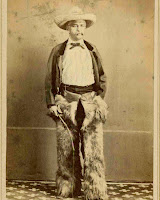
 

A Mexican vaquero

The term “rodeo” comes from the Spanish word rodear, which means roundup. From that, you might guess that rodeo’s roots come out of the Mexican ranch workers known as vaqueros. If you did make such a guess, you’d be right. Throughout the early 1800s, these vaqueros made sport of doing their ranch chores, competing with other ranch workers to see who was better able to ride a wild horse and who could rope the best. Soon, the competitions grew so that one ranch was vying against another in crazy festivals of sport.


After the Texas Revolution (1835-36), and particularly after the United States annexed Texas in 1845, the vaqueros intermingled with American cowboys, and these competitions grew even more. Another big boost to the growing competitions came after the end of the Civil War, when former slaves traveled West and became cowboys. All of these men became the early fabric of our modern-day rodeos.


Jesse Stahl, one of the best bronc riders in history,
circa 1928


The next big boost for modern rodeo came in 1883, when one William F. Cody—better known as Buffalo Bill—began his traveling Wild West Show. Despite the fact that the “wild” west was quickly taming into a more populated and genteel place than in previous decades, Buffalo Bill Cody’s show cemented the romantic notion of its wildness. Among the many facets of his exhibition, sharp-shooting, roping, trick riding, bronc busting and the like were on display for all to see.


Only a handful of years after Buffalo Bill’s Wild West Show got its illustrious start, one of the earliest official rodeos was held in Prescott, Arizona, on July 4, 1888. Others, like the Cheyenne Frontier Days, were held in Cheyenne, Wyoming, in 1897, and even more in the first decade of the 1900s. The sports that comprise rodeo were gaining traction, and by the 1930s, the competitors founded the first cowboy union after having to fight for fair compensation for their work. 


Today, that same union—the Professional Rodeo Cowboys Association—still exists, albeit after at least two name changes. It lists over 5000 competitive members and several thousand more in non-competitive roles, and it hosts hundreds of events each year, culminating in the finals, where millions of dollars in prize money is given away.


It’s Your Turn: Have you ever been to a rodeo? If yes, what was your favorite event? If no, do you desire to see one? Why or why not?


Award-winning, best-selling novelist Jennifer Uhlarik has loved the western genre since she read her first Louis L’Amour novel. She penned her first western while earning a writing degree from University of Tampa. Jennifer lives near Tampa with her husband, son, and furbabies. www.jenniferuhlarik.com


AVAILABLE NOW


Love’s Fortress by Jennifer Uhlarik


A Friendship From the Past Brings Closure to Dani’s Fractured Family


When Dani Sango’s art forger father passes away, Dani inherits his home. There, she finds a book of Native American drawings, which leads her to seek museum curator Brad Osgood’s help to decipher the ledger art. Why would her father have this book? Is it another forgery?


Brad Osgood longs to provide his four-year-old niece, Brynn, the safe home she desperately deserves. The last thing he needs is more drama, especially from a forger’s daughter. But when the two meet “accidentally” at St. Augustine’s 350-year-old Spanish fort, he can’t refuse the intriguing woman.


Broken Bow is among seventy-three Plains Indians transported to Florida in 1875 for incarceration at ancient Fort Marion. Sally Jo Harris and Luke Worthing dream of serving on a foreign mission field, but when the Indians reach St. Augustine, God changes their plans. However, when Sally Jo’s friendship with Broken Bow leads to false accusations, it could cost them their lives.


Can Dani discover how Broken Bow and Sally Jo’s story ends and how it impacted her father’s life?


Friday, March 18, 2016

Lulu Bell Parr - Wild West Champion

With Nancy J. Farrier

Lulu Bell Parr_Photo by Terry Baer
We’ve all heard of the famous cowgirls, Annie Oakley and Calamity Jane. We know of their prowess with guns and horses, and the way they made a name for themselves in an era when women weren’t know to have such skills. One of the lesser known women who had a claim to fame in the time period is Lulu Bell Parr.


Lulu grew up in Indiana. Her parents died when she was very young, probably 3-years-old. She and her brother went to live with an aunt and uncle in Fort Wayne, Indiana. Living on their farm, Lulu fell in love with the animals and became a skilled rider by the time she was eight-years-old.


Although not much is known about Lulu’s early years, she left home in 1903 and joined the Pawnee Bill Wild West Show. She had skill in doing trick riding and shooting guns, but she excelled at riding bucking broncos. She seemed to have a knack for riding an unbroken horse and the people who flocked to the shows loved to watch her. At one point she was titled, “Champion Lady Bucking Horse Rider of the World.”


In 1908, Lulu left Pawnee Bill’s show and joined Colonel Cummins Wild West Brighton Tour. She wanted the chance to go to Europe and perform there. The highlight of her trip was the chance to perform in front of King Edward in England.

Buffalo Bill and Pawnee Bill

The following year, Lulu left Colonel Cummins because she had the chance to be part of the Buffalo Bill’s Wild West Show. Back in the United States, she traveled with Buffalo Bill until 1913. Buffalo Bill was so taken with Lulu that he presented her with an ivory handled colt with the words engraved, “Buffalo Bill Code to Lulu Parr – 1911.”


In 1916, Lulu moved back to the Pawnee Bill show, but the popularity of the Wild West shows was beginning to wane. Until her retirement in 1929, she went from one small time show to another. By the time she retired at fifty-three, she was broke.

Photo by Terry Baer

Lulu went to Ohio and lived with her brother and his wife. She often entertained neighborhood children with her stories of the wild west and the adventures she’d experienced. She collected mementos from her time with the shows. Lulu’s outfits that she wore were intricate and colorful. Lulu died in 1960 from a stroke.


Have you ever heard of Lulu Bell Parr? While most of us have heard of Buffalo Bill, have you ever heard of Pawnee Bill or Colonel Cummings? I would love to hear your thoughts.  


Nancy J Farrier is an award winning author who lives in Southern California in the Mojave Desert. She loves the Southwest with its interesting historical past. Nancy and her husband have five children and two grandsons. When Nancy isn’t writing, she loves to read, do needlecraft, play with her cats, and spend time with her family. Nancy is represented by Karen Ball of The Steve Laube Literary Agency. You can read more about Nancy and her books on her website: nancyjfarrier.com.