Showing posts with label Cheaper by the Dozen. Show all posts

Thursday, June 25, 2026

The Women of the Postage Stamps—Part 5

by Jennifer Uhlarik 

Happy June, everybody! This year of 2026 is nearly half over already, and I’m simply shocked! Aren’t you?


Let’s continue with our series on the women who have been featured on the U.S. Postage Stamps. Last month, we left off with stamps issued in 1981. Today, we pick up in the same year with Edna St. Vincent Millay. Millay picked up the pen early in life, writing poetry from childhood until her death. After entering a poem in a contest where one judge prematurely awarded her first prize, then had that award stripped and came in fourth overall, she gained a bit of notoriety. This led to a supporter offering to send her to Vassar College in 1917. Her time there wasn’t exactly peaceful, as Millay refused to live by the code of ethics for young ladies. However, she managed to graduate, and during the 1920s, Millay rose to fame through her lyrical poetry. In 1928, she became the second person (and first woman) to ever win a Pulitzer Prize. During World War II, she joined the Writers’ War Board, where she wrote propaganda for the American war effort. Her fame as a poet took a hit because of this, though Millay didn’t allow that to stop her. She died in 1950 after breaking her neck due to a fall down the stairs in her home.


Our next lady of the stamp is Babe Didrikson Zaharias. Before she became a renowned in other ways, Mildred Ella “Babe” Didrickson competed in and won sewing competitions, as well as made some professional music recordings. Her major claim to fame, though, was as an amateur athlete in multiple sports. While working as a secretary for an insurance company, Babe was allowed to compete on the company’s amateur team in basketball. She was named an All-American athlete for her work on this team three years in a row, and in 1932 they even competed in the championship. During the same timeframe, she represented the same company in the 1932 Amateur Athletic Union Championships, where she entered eight of ten events and won first place in five of them. Later the same year, she represented the United States in track and field events in the Summer Olympics, where she brought home three medals—two golds and a silver. She also competed in baseball, bowling, billiards…but her greatest claim to fame was in golf. Babe Zaharias was the first woman to ever compete in a regular PGA tournament, was a founding member of the LPGA when it was created a few years after she took up the sport, and was said by New York Times writer Charles McGrath that “Except for perhaps Arnold Palmer, no golfer has ever been more beloved by the gallery.”


Dr. Mary Walker is the next woman featured on a postage stamp, this time in 1982. I’ve written about Dr. Walker before, so if you’d like more information on her, please refer to my earlier post here. She was an abolitionist, a Civil War surgeon, a prisoner of war for four months during 1864, received a medal of honor, and fought for women’s suffrage and many other things after the war’s end.


In 1982, Dorothea Dix earned her place in postal history due to her work for the poor and indigent mentally ill. It was during a stay in Europe during the 1830s that Dix first became aware of the plight of the mentally ill. After returning to America, she began to investigate how the mentally ill were treated when they had no family who could or would take care of them. In Massachusetts, she found that many were locked away in the darkest basement cells in prisons or almshouses, relegated to the areas reserved for the worst criminals. The air was often putrid and foul, with no light by which to see. After presenting her findings to the state legislature, she moved on to a similar task in New Jersey, Illinois, North Carolina, and many other states. All told, her efforts resulted in opening thirty-two mental hospitals in various states, as well as schools for children with learning disabilities, schools for the blind, and nursing schools.


Next up is Pearl S. Buck, a renowned novelist best known for The Good Earth, which earned her a Pulitzer Prize. Raised by her missionary parents in China, Buck spent much of her life in this country, developing a deep love for it and its people. Many of her writings focused on her experiences in China and Japan. After moving back to the United States, Buck spent her later years advocating for the adoption of mixed-race children from other countries. She began the first foster home for such children, located next to her own home—and when it quickly became too crowded for simply fostering these kids, she turned it into the first international adoption agency. She also started orphanages in various other countries.


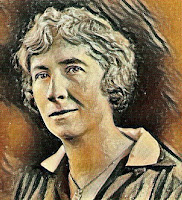
As we wind down our post for today, let’s take a look at Lillian M. Gilbreath, who was featured on a postage stamp in 1984. This interesting lady was mother two twelve children, and also both a psychologist and an industrial engineer. Along with her husband Frank, she paired her two areas of expertise to do studies on how workers used machinery and find ways to streamline those machines to make them more productive. She and Frank were on the cutting edge of this burgeoning industry of “industrial and organizational psychology” (a precursor to our modern-day ergonomics). The husband and wife team worked with many large companies like Macy’s and Johnson & Johnson, and after Frank’s death, Lillian continued her business. She also found ways to streamline the tasks of the typical housewife to make her household chores and duties faster, so that she could seek work outside the home. In that vein, Lillian is credited with created the “work triangle” setup of many modern kitchens. Two of her children—Frank Jr. and Ernestine—wrote two humorous books about life in the Gilbreath family. You’ll certainly recognize at least one of the titles. They were Cheaper by the Dozen and Belles on Their Toes.


It’s Your Turn: Which of the women who were honored with their own stamp do you find the most memorable, and why?


Jennifer Uhlarik
 discovered western novels at twelve when she swiped the only “horse” book from her brother’s bookshelf. Across the next decade, she devoured westerns and fell in love with the genre. While attaining a B.A. in writing from the University of Tampa, she began penning her own story of the Old West. She has finaled in and won numerous writing competitions and appeared on various best-seller lists. Besides writing, she’s been a business owner, a schoolteacher, a marketing director, a historical researcher, a publisher, and a full-time homemaker. She lives near Tampa, Florida, with her husband and fur children.


Available Now: Love and Order: A Three-Part Old West Romantic Mystery


Wanted: 

Family, Love, and Justice


One Old West Mystery Solved Throughout Three Short Romantic Stories


Separated as children when they were adopted out to different families from an orphan train, the Braddock siblings have each grown up and taken on various jobs within law enforcement and criminal justice.


Youngest child, Callie, has pushed past her insecurities to pursue a career as a Pinkerton agent. Middle child, Andi, has spent years studying law under her adoptive father’s tutelage. And the eldest and only son, Rion, is a rough-and-tumble bounty hunter. 


When the hunt for a serial killer with a long history of murders reunites the brother and sisters in Cambria Springs, Colorado, they find themselves not only in a fight for justice, but also a fight to keep their newly reunited family intact. How will they navigate these challenges when further complicated by unexpected romances?


Saturday, February 12, 2022

Lillian Gilbreth – Mother of Happiness Minutes

By Kathy Kovach


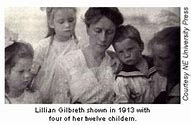
Chances are you’ve heard the term “cheaper by the dozen.” This phrase, a favorite of Frank Gilbreth, alludes to a product markdown if you buy in bulk. He and his wife, Lillian, had twelve living children in the early 20th Century.

Born into privilege as Lillie Evelyn Moller in 1878, she never enjoyed being pampered. Instead of marrying into her station and living a life of ease, she had her heart set on college. Her father was against it but permitted her to attend Berkley in California where she earned a bachelor's degree in English. She did so well that her father allowed her to continue her studies. She eventually became interested in Psychology, earning a doctorate in that field. She decided to go by the name of Lillian as she felt it more dignified for a university graduate and went on to earn Ph. D. degrees at Brown and Rutgers universities.


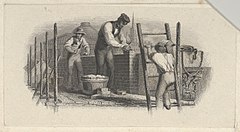
Frank started out working in construction where he developed his efficiency brand. He found himself observing the different techniques brick layers used and showed the workers how they could improve. Frank suggested using scaffolding to save time, instructing them to put the bricks right on the platforms of wood instead bending down to retrieve those on the ground.

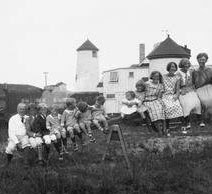
The Gilbreth family at their house in Nantucket

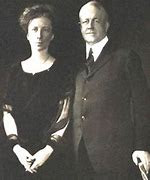
Frank and Lillian married in 1904, and Lillian gave birth about every 15 months thereafter. The couple ultimately birthed thirteen children; however, one was miscarried, and a daughter died of diphtheria at the age of five. In the midst of childbearing, the growing family moved around the country from coast to coast, as well as summering on Nantucket.


Lillian was Frank’s match in every way. He taught her his system, and together they turned their home into a time-management laboratory and ran their growing family like a well-oiled machine. Charts of daily activities from teeth brushing to chores kept everyone busy and out of each other’s way. Even tub time was streamlined as they studied patterns of washing one’s body quickly. With no minute wasted, the sudsed up children learned foreign languages from the phonograph machines placed in both the girls’ and boys’ bathrooms.

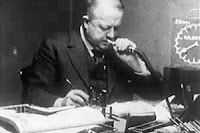
Following the motions of a worker and chronicling her movements

Professionally, the Gilbreths opened an engineering consulting firm, wrote hundreds of articles, published eight books, and ran courses on industrial management. They created the time and motion system to improve efficiency and reduce fatigue. This entails much more than can be stated here. To boil it down in an efficient way (See what I did there?), they took motion picture cameras into factories and workplaces to film workers in their daily activities. As a result, they discovered more than a dozen basic movements that could be tailored toward better production. They named these movements therbligs, a variation of their surname spelled backward. Wikipedia has an excellent definition of the therblig:

Therbligs are 18 kinds of elemental motions, used in the study of motion economy in the workplace. A workplace task is analyzed by recording each of the therblig units for a process, with the results used for optimization of manual labour by eliminating unneeded movements. Wikipedia

Frank and Lillian Gilbreth Time and Motion System

Lillian was more than an efficiency expert, however. While her husband was making sure the world moved in sync, she concentrated on the psyche of the employee, more concerned with their comfort and well-being than the task at hand. She helped develop breaks in the workplace and suggestion boxes. Thanks to Lillian, ergonomics is a thing today as they were instrumental in redesigning the workspace.


Frank died in 1924 leaving Lillian to raise all of their children. Friends offered to take one or two, but the family refused to be split up. Rather than move across the country to live with her mother, Lillian and her brood finally all decided to give it a go on their own. The only obstacle was finances. As a woman, Lillian’s scientific skills weren’t appreciated in a man’s world. Even though she was able to continue with the consulting firm she and Frank had founded, she finally became employed at Macy’s where she was allowed to funnel her interests into marketing and home management.

Following a homemaker's movements in the kitchen

Necessity is the mother of invention

Lillian found that when a task was streamlined or a piece of equipment was tailored to meet the consumers' needs, the happiness quotient was raised. She called this feeling "Happiness Minutes." She brought in several women to gauge how tall a stove should be simply for the comfort of the subjects. We can thank Lillian for shelves in our refrigerator doors and the foot pedal on our trash cans. Ironically, Lillian didn’t like to cook, which no doubt helped in her decision to make life easier for the homemaker. She ultimately invented the electric mixer and the rolling kitchen cart. Even the placement of modern kitchens with the triangular path of stove, refrigerator, and sink are due to Lillian’s efforts. Oh, and wall light switches. Those were hers, too.

An efficient engine in her own right that wouldn’t quit, Lillian was a visiting professor for Perdue and lectured at other prestigious universities. At the age of 86, she became a resident lecturer at the Massachusetts Institute of Technology. She retired in 1968 just before turning 90 and died Jan 2, 1972, in Phoenix, Arizona.


Lillian Gilbreth has been recognized as the First Lady of Engineering and the Mother of Modern Management. However, thanks to her inventions that I enjoy every day, this domestic engineer will forever consider her the Mother of Happiness.


Two of the Gilbreth children, Frank Jr. and Ernestine, wrote a bestselling book honoring their parents. Cheaper by the Dozen was published in 1948 with a follow-up, Belles on Their Toes chronicling life without Frank. Both became movies in 1950 and 1952 respectively. More movie adaptations followed in 2003, 2005 (part 2 of the previously mentioned year), and soon to be released in 2022. A play loosely based on the original book also was written. Following are links to see it in its entirety, delightfully presented by students of The King’s Academy in West Palm Beach, Florida.

Cheaper by the Dozen Live - The Gilbreth Living Room. A Day in Autumn. (Act I, Scene 1) - YouTube

Cheaper by the Dozen Live - The Same. Two Weeks Later. (Act I, Scene 2) - YouTube

Cheaper by the Dozen Live- The Same. A Few Weeks Later. (Act II) - YouTube

Cheaper by the Dozen Live- The Same. A Day in Spring. (Act III) - YouTube


MissAdventure Brides Collection
Seven daring damsels don’t let the norms of their eras hold them back. Along the way these women attract the attention of men who admire their bravery and determination, but will they let love grow out of the adventures? Includes:
"Riders of the Painted Star" by Kathleen E. Kovach

1936 Arizona
Zadie Fitzpatrick, an artist from New York, is commissioned to go on location in Arizona to paint illustrations for an author of western novels and falls for the male model.

Kathleen E. Kovach is a Christian romance author published traditionally through Barbour Publishing, Inc. as well as indie. Kathleen and her husband, Jim, raised two sons while living the nomadic lifestyle for over twenty years in the Air Force. Now planted in northeast Colorado, she's a grandmother, though much too young for that. Kathleen is a longstanding member of American Christian Fiction Writers. An award-winning author, she presents spiritual truths with a giggle, proving herself as one of God's peculiar people.