Showing posts with label pioneer. Show all posts

Thursday, September 8, 2022

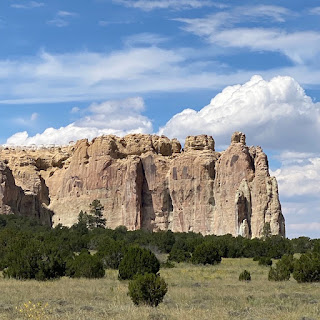
El Morro National Monument--where graffiti becomes history

by Martha Hutchens

El Morro National Monument, Martha Hutchens
Those of you who have read my other blog posts may not be surprised to learn that I grew up in southeast Missouri. This heavily agricultural area used to be a swamp. It receives an average of 46 inches of rain per year. The humidity is intense.

Now, imagine moving from that climate to New Mexico. The air is dry, and even today you are wise to take water with you if you are driving through the more rural areas. Now stretch your imagination a little further. What if you are traveling by horse and wagon, or by foot. Water stops that are only an hour or two apart today would be up to a week apart in those conditions.

Pool at El Morro, Martha Hutchens
Then you see El Morro (headland or bluff) standing in the distance, and you know water lies at the foot of it. The pool at the base of this mesa collected water run off from the cliffs around it. Because the pool is in the shade of the cliffs, the water is cool and even more refreshing.

Inscriptions at El Morro, Martha Hutchens
El Morro National Monument has been a stopping point for travelers for centuries, and the soft rock has convinced more than 2000 to leave their mark.

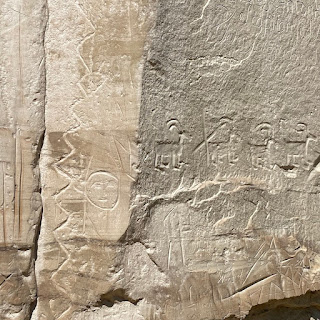
Petroglyphs at El Morro, Martha Hutchens
Ancestral Pueblo people founded a village on top of these cliffs, and their petroglyphs remain behind. It is estimated that as many as 1500 people may have lived in this village, and that the structures had up to 875 rooms. Some structures may have been as high as three stories.

Oñate inscription at El Morro, Martha Hutchens
Juan de Oñate signed the rock in 1605 (15 years before the Pilgrims landed on Plymouth Rock.) He was the first governor of New Mexico under Spain, and is rightly reviled by the Native Americans in the area, for his massacre of the the Acoma people in 1599. He passed El Morro on his way back from what he thought was the Pacific Ocean. In fact, he only got as far as the Gulf of California. It is perhaps a signal of his feelings toward the Native Americans that he wrote his inscription over a pre-existing petroglyph.

Two more Spanish governors signed El Morro in the early 1600’s, Don Juan de Eulate in 1620 and Francisco Manuel de Silva Nieto in 1629. Eulate’s inscription describes himself as a gentleman, but the word was later scratched out. Unfortunately, this editor didn’t sign his name.

In 1632, a Spanish soldier named Luján wrote in stone that he “they passed by . . . to the avenging of the death of Father Letrado,” a priest killed by the Zuni people.

In 1680, the Pueblo people revolted against Spanish rule and the Spaniards retreated from New Mexico. In 1692, General Don Diego de Vargas returned to Santa Fe and reconquered New Mexico, mostly peacefully. He commemorates the event by signing El Morro, where he notes that he has “conquered . . . all of New Mexico at his own expense.” Maybe he thought the Spanish crown should have paid for it?

Several other Spanish inscriptions appear on the rock, with the last dated 1774.

The first American inscription reads, “O. R. March 19, 1836. His simple initials remind us of the many signatures of average people.

In 1848, Mexico ceded New Mexico to the United States as part of the settlement of the Mexican-American War, and in 1850 it was officially organized as a territory. This led to a whole new set of inscriptions on El Morro. Traders, emigrants, soldiers, and others passed by this bluff with its inscriptions and added their own names.

In 1849, Lt. J. H. Simpson and R. H. Kern visited and copied the inscriptions present at that time. Of course, they felt compelled to note their own presence. They carved the following, “Lt. J. H. Simpson & R. H. Kern artist visited and copied these insciptions, September 17 & 18, 1849” After they finished the their writing, they realized they left out the “r” in inscriptions, and inserted it with a editing mark. Talk about your long-lived typos!
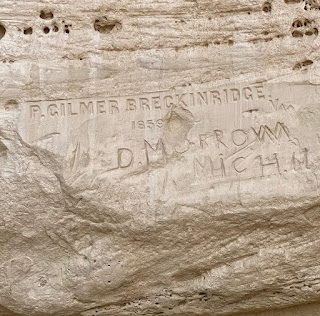
Breckinridge inscription at El Morro, Martha Hutchens
One of the more interesting chapters of U.S. Army’s history is their brief experiment with camels as pack animals in the southwest. Four of the men involved in this experiment signed El Morro, E. Pen Long, F. Engle Jr, Byrn, and their leader, P. Gilmer Breckinridge. I assume the camels found the pool at El Morro as refreshing as the humans did.

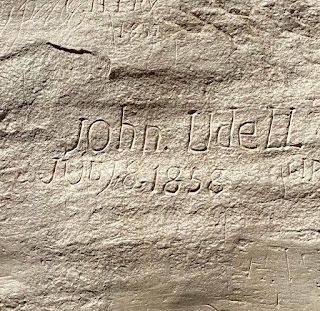
Udell inscription at El Morro, Martha Hutchens
L. J. Rose led the first wagon train along a new trail crossing New Mexico territory to reach California in 1858. They stopped at the water pool by El Morro, and ten of them signed the wall, including Rose, John Udell, and America Frances Baley, and Sarah Fox, who was only twelve years old at the time. Nearly 500 miles farther along the trail, this train would be attacked by Mojave warriors. Sarah Fox was shot with an arrow and witnessed her father’s death. The caravan’s wagons were burned and the people passed El Morro again on their return to Albuquerque. However, the next year they completed their journey to California along a different trail.

In 1906, Teddy Roosevelt designated El Morro as a national monument, though New Mexico would not become a state for another six years. Since then, much work has been done to protect the inscriptions on the rock, because this soft rock that is so easy to carve also erodes easily. During the depression, Franklin Delano Roosevelt created the Civilian Works Administration, which hired men to make a path to the top of El Morro so that visitors could see the remains of the village that once occupied this area. These 48 men also left their mark on the bluff, though not in writing.

If you visit New Mexico, I highly recommend a stop at El Morro, where a thousand years of history is written in rock.

Martha Hutchens is a transplanted southerner who lives in Los Alamos, NM where she is surrounded by history so unbelievable it can only be true. She won the 2019 Golden Heart for Romance with Religious and Spiritual Elements. A former analytical chemist and retired homeschool mom, Martha is frequently found working on her latest knitting project when she isn’t writing.

Martha’s current novella is set in southeast Missouri during World War II. It is free to her newsletter subscribers. You can subscribe to my newsletter at my website, www.marthahutchens.com

After saving for years, Dot Finley's brother finally paid a down payment for his own land—only to be drafted into World War II. Now it is up to her to ensure that he doesn't lose his dream while fighting for everyone else's. No one is likely to help a sharecropper's family.

Nate Armstrong has all the land he can manage, especially if he wants any time to spend with his four-year-old daughter. Still, he can't stand by and watch the Finley family lose their dream. Especially after he learns that the banker's nephew has arranged to have their loan called.

Necessity forces them to work together. Can love grow along with crops?

Friday, April 15, 2022

Fannie Jackson Coppin- Making a Difference


Being born into slavery in 1837, Fannie Jackson (at the time) was one of the least likely people to make a mark in US history. She was not only African American and a slave, but she was also a woman. Her grandfather purchased his own freedom and four of his children's freedom as well, leaving Fannie's mother in slavery in Washington DC.

n

By Unknown author - Fanny Jackson Coppin, Reminiscences of School Life, and Hints on Teaching, Public Domain, https://commons.wikimedia.org/w/index.php?curid=33288962

At the age of twelve, Fannie's freedom was purchased by her Aunt Sarah for $125. To give you an idea of the sacrifice of Sarah Orr Clark, I looked up a women's wages during that time. A woman working in the textile industry could expect to be paid $2 a week plus board (some were as low as $1.25). A woman working in domestic service and tailoring could earn .50-$1 a week.

When Fannie's freedom was purchased, she was then sent to another aunt in Bedford Massachusetts. But she only remained with her aunt for two years, and at the young age of fourteen, Frannie decided she needed to take care of herself. 

She found an employer in Rhode Island and went to work in the household of author George Henry Calvert. The Calverts' were an upper-class family, him being the great-grandson of Lord Baltimore and his wife, Elizabeth, being the descendant of Mary Queen of the Scots. Their aristocratic qualities molded Fannie. Her desire to learn was so great she was allowed one hour every other afternoon to study. She hired a tutor with her earnings and was later able to go to public school. During her stay with the Calverts, Mrs. Calvert taught her domestic skills. Fanny finished her schooling at the Rhode Island State Normal School. It was there she found her love of learning and wanted every Black American to have the opportunity to learn as she did. 


Public Domain, https://commons.wikimedia.org/w/index.php?curid=3078289
Her aunt helped her continue her education at Oberlin College, a college breaking barriers. For they were the first College to accept Black Americans and women. She stayed with two different professors and their families while going to school, becoming part of their families. The second black American to graduate from the school, Frannie earned her bachelor's degree in 1865. While she had attended the college Frannie had four big accomplishments. She established an evening school for freed slaves, she was the first African American to be appointed to the College's preparatory department, and she was elected to the Young Ladies Literary Society. Lastly, she had received a job offer to teach Greek and Latin and higher mathematics.
 

                       By Smallbones - Own work, Public Domain, https://commons.wikimedia.org/w/index.php?curid=10385368

It was in September that Frannie took the job at The Institute of Colored Youth in Philidelphia. She only worked there a year before being promoted to principal of the women's department. Within three years, at the young age of 32, she was promoted yet again to principal of the entire school. This position gave her another first as the first African American woman to gain the title of school principal. Her determination to break the barriers of her people continued on in her life. She saw opportunities and took them or opened doors herself. One of which was raising money for a new department in the school that helped men and women learn crafts. 

By Nick-philly - Own work, CC BY-SA 4.0, 
https://commons.wikimedia.org/w/index.php?curid=79990774


Fanny and her husband went to South Africa and founded a missionary school, Bethel Institute in 1902. Retiring in 1906 due to her health, she traveled with her pastor husband helping organize mission organizations.  Fannie continued to improve the lives of the African Americans until her death in 1913. 


Book 2 in the series, Bride by Beguilement, coming this summer.

A broken heart, a controlling father, and an intrusive Scot leave Charlotte Jackson reeling. Accused of stealing an heirloom pin, she must choose between an unwanted marriage and the ruin of her family name. With the futures of her three younger sisters at stake, as well as her own reputation, Charlotte must navigate through injustice to find forgiveness and true happiness.

Eager to find the traitor who caused the death of his brother, Duncan Mackenzie comes to America and attempts to fit in with Charleston society. But when the headstrong Charlotte catches his eye, Duncan takes on a second mission—acquiring the lass's hand. After being spurned several times, he uses unconventional ways of winning her heart.


Debbie Lynne Costello is the author of Sword of Forgiveness, Amazon's #1 seller for Historical Christian Romance. She has enjoyed writing stories since she was eight years old. She raised her family and then embarked on her own career of writing the stories that had been begging to be told. She writes in the medieval/renaissance period as well as 19th century. She and her husband have four children and live in upstate South Carolina with their 3 dogs, 4 horses, miniature donkey, and 8 ducks. Life is good!

Wednesday, February 9, 2022

Kentucky - First State West of the Appalachians

   By Tiffany Amber Stockton


Last month, I began a new series on Kentucky history and the pioneers who established the state. If you missed that post, you can read it here. This month, we're delving a bit more into Daniel Boone and his forays into the Kentucky frontier.

DANIEL BOONE - KENTUCKY PIONEER


Kentucky was granted statehood in 1792, becoming the first U.S. state west of the Appalachian Mountains. I spent 25 years of my life in Delaware, the First State of U.S., so it's ironic I now live in another "first state." While the original thirteen colonies were engaging in small battles with England over governorship, taxes, political representation, and various freedoms, many residents of those colonies decided to strike out on their own and start exploring the frontier to the west.


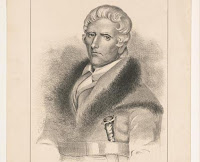
Frontiersman Daniel Boone was one of Kentucky’s most prominent explorers, and many immigrants followed the trail he blazed through the Cumberland Gap, known as the Wilderness Road. His story doesn't begin there, though. He was born in 1734 in a small township northwest of Philadelphia, and at age 15 left Pennsylvania with his family. They headed to the Shenandoah Valley of Virginia, but Daniel left not long after and settled along the Yadkin River near the western edge of North Carolina.


Instead of farming, Boone became a marker or long hunter and made his living selling deerskins from long hunting expeditions out in the wilderness. He was gone for months or years at a time with that trade. In 1755, while serving as a wagoner for General Braddock back in Pennsylvania, he met a trader who regaled him with stories of the abundant wildlife and financial opportunities west of the Appalachian Mountains. But that exploration was put on hold when Daniel married and started a family. He continued to hunt throughout the Carolinas and even down to what became Florida.

In early 1769, that trader (John Findley) found Daniel again and relit the spark in Boone's wanderlust nature. He spent the next four years exploring that wilderness area, and in 1773 began escorting settlers with the intention of permanently settling Kentucky. In 1775, a judge enlisted Boone's help to negotiate with Cherokee tribes and purchase their claims, then he cut a path through southwestern Virginia and northeastern Tennessee that would become the Cumberland Gap Road.

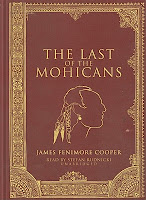
Despite ownership of the land, the settlement of Kentucky was fraught with a great deal of conflict, as England secured the support of the natives to attack settlers during and even after the Revolutionary War. Many were captured and forced to live among the Cherokee or Shawnee. Boone was one of them, although he only lived among the Shawnee for a few months before escaping. His daughter had been captured the year before, but immediately rescued by Boone and his men. That story was eventually immortalized by James Fennimore Cooper in The Last of the Mohicans.

For the next seven or eight years, raids continued and casualties increased. So many battles, and so many deaths among the British, the American settlers, and the natives, all over who would ultimately own the land. By 1787, the British were completely run out and in 1792, statehood was granted. Nearly thirty years of exploration, settlement, and defense had ultimately produced a new state for the U.S., and Daniel Boone became immortalized in American history.


NOW IT'S YOUR TURN:

* Have you ever left your family to move or settle in a completely different region?

* What famous settlers or pioneers are known where you live?

Leave answers to these questions or any comments you might have on this post in the box below. Come back on the 9th of March to learn some fun facts pertaining to Kentucky.


For those interested in my "fictional" life as an author and industry news about other authors, subscribe to my newsletter. Receive a FREE omitted chapter from my book, A Grand Design, just for subscribing!


BIO
Tiffany Amber Stockton has been crafting and embellishing stories since childhood, when she was accused of having a very active imagination and cited with talking entirely too much. Today, she has honed those skills to become an award-winning, best-selling author and speaker who is also an advocate for literacy as an educational consultant with Usborne Books. She loves to share life-changing products and ideas with others to help improve their lives in a variety of ways.

She lives with her husband and fellow author, Stuart Vaughn Stockton, along with their two children and two cats in Kentucky. She has sold twenty-four (24) books so far and is represented by Tamela Murray of the Steve Laube Agency. You can find her on Facebook and GoodReads.

Sunday, January 9, 2022

Horse Racing & Kentucky Pioneers - William Whitley

  By Tiffany Amber Stockton


Last month, in the spirit of Christmas, we learned about some of the island traditions surrounding this special holiday on Chincoteague Island. If you missed that post, you can read it here. This month, I'm beginning a new series featuring facts and people who discovered and settled what is now southeastern Kentucky.


With all the past research I have on my personal family history, and since we have recently moved to Kentucky after 15 years living in Colorado, I needed a new focus as I work on the books coming from my previous research. I'm not sure what will come of what I discover this year, but I'll be keeping my readers informed on my FB Page and VIP  readers group.

You can also stay current on my "fictional" life as an author and receive industry news every 3 months by subscribing to my newsletter. Receive a FREE omitted chapter from my book, A Grand Design, just for subscribing!

WILLIAM WHITLEY - KENTUCKY PIONEER


My family now lives in Whitley County in Kentucky, and as I was driving up the interstate, I saw signs for the William Whitley Historical House. That set me off on a rabbit trail of research looking up who this man was and why he was so important to the state, or commonwealth of Kentucky. I've only just begun to scratch the surface, but here is what I've learned so far.

William Whitley was born in Virginia, and his parents were immigrants from Ireland. Just before the onset of the Revolutionary War, Whitley suggested to his wife that they leave Virginia and move a little west across the Appalachians into the uncharted territory there. Following a scouting expedition, Whitley laid claim to a parcel of land and planted ten acres of corn as proof of ownership. Unfortunately, the local Shawnee and Cherokee tribes weren't too happy with Colonial settlers encroaching on the land the British had promised would be theirs, and they responded with escalated hostility.

William was quite the adventurer, though, and he wasn't one to give up easily. Although he and the other family who scouted with him sought safety inside a nearby fort, Whitley continued to fight for his land. He spent a little time after the Revolutionary War in the Northwest Territory fighting Indians, but when he returned, he again set forth with building his home.

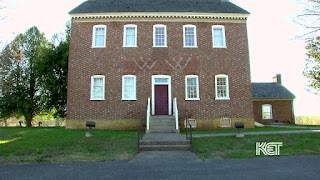
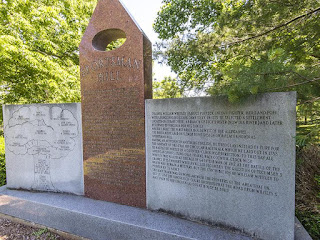
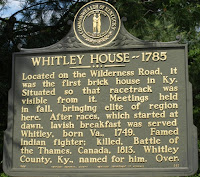
There are a lot of amazing features about the home William built. It was the first brick home west of the Allegheny Mountains, built somewhere between 1787 and 1794. The brick he used was two feet thick!  He did that to help protect his family from Indian attack. He also put the windows high above the ground so attackers couldn't shoot straight through at him, and he didn't have a porch or patio or anywhere around the home where attackers could hide. Rather ingenious of him, I'd say.

One feature I found endearing is that in addition to his own lighter bricks bearing his WW initials, he also had brick initials of EW placed in honor of his wife, Esther, to the rear of the house. He might be a famed Indian hunter, but his wife was known for being a sharpshooter herself. Guess they made quite the pair together!

Although he called his home "Sportsman Hill," friends and area residents considered it the "Guardian of Wilderness Road," so it also holds that name. It actually became a popular meeting and gathering place for other Kentucky settlers like George Rogers Clark and Daniel Boone.

Whitley County and its county seat of Williamsburg were both named after William Whitley. One of his grandsons was William L. Sublette, a fur trader who became co-owner of the Rocky Mountain Fur Company with Jedediah Smith. There's even Whitley City named after Colonel Whitley.

Another fun fact is how important William Whitley was to the establishment of horse racing in the United States. He was an avid fan of the sport, but he didn't care much for how the British designed their tracks. So, he built a track out of clay instead of turf, and he designed the track to be raced in counter-clockwise fashion instead of clockwise as it's done in England. It's why Kentucky is now world-famous for its horse-racing venue and is an integral location for the sport.

My daughter has been bitten by the horse-loving gene that flows down from my mother's side of the family, so we've already made plans to attend the Kentucky Derby and check out the various breeding farms and racing venues throughout the state, as well as the Derby Museum. She even wants to attend a summer horse camp, but we'll have to see about that. *grins*


NOW IT'S YOUR TURN:

* Have you researched anything about the area where YOU live? Are there any interesting facts or people from history who were pioneers in your area?

* What kind of person do you think you would have been had your birthday been in the 1600's or 1700's instead of the 1900's?

Leave answers to these questions or any comments you  might have on this post in the box below. Come back on the 9th of February to learn more about Daniel Boone and his trek across the Cumberland Gap.


BIO
Tiffany Amber Stockton has been crafting and embellishing stories since childhood, when she was accused of having a very active imagination and cited with talking entirely too much. Today, she has honed those skills to become an award-winning, best-selling author and speaker who is also an advocate for literacy as an educational consultant with Usborne Books. She loves to share life-changing products and ideas with others to help improve their lives in a variety of ways.

She lives with her husband and fellow author, Stuart Vaughn Stockton, along with their two children, two dogs, and two cats in Kentucky. She has sold twenty-four (24) books so far and is represented by Tamela Murray of the Steve Laube Agency. You can find her on Facebook and GoodReads.

Wednesday, April 28, 2021

The Kitchen Garden by Donna Schlachter (with giveaway)


Photo by Karolina Grabowska from Pexels

A kitchen garden, so named because of its proximity to the rear door and kitchen of most pioneer houses, provided an important source of food and medicinal plants for the household. With the Westward Expansion in full swing following the 1803 Louisiana Purchase, tens of thousands of settlers moved west of the Mississippi in search of a piece of land to call their own. As a result, volumes of gardening advice were written and distributed. While some followed the 17th century European garden writers, in many parts of the country, Native American practices were adopted, and in some cases, both styles were implemented in the same plot of ground.

Important considerations included the length of the growing season in the area; the sometimes-drastic differences between high and low temperatures; the type of soil; the local wildlife which might eat the tender plants; the family’s food choices; and the amount of work required to raise a particular crop.

While American pioneers rarely had access to large animal manure, as their European cousins did, they made do with what they had. Dung from a family cow or horse provided fertilizer, as did the roaming herds of bison. Following the example of the Native Americans, pioneers learned that eels and dead fish could also be buried in the soil.


Photo by Karolina Grabowska from Pexels

Plant placement depended on fragrance; harvesting styles; whether a perennial or annual; and even fragrance. For example, sweet-smelling herbs and flowers might be planted closer to the kitchen window, while strong-smelling plants, such as cabbage and onions, were relegated to a distant corner. Annual plants, grown from seed, were planted together, while perennials, such as rhubarb asparagus, horse radish, strawberries, and raspberries, were grouped in another bed so the roots weren’t disturbed during harvest, and so that they were contained, as these plants tend to spread. Crops that were harvested continuously, such as radishes and lettuce, were grown in the same bed. Those plants that tended to spread, such as melons, squash, and pumpkins, were set apart, hedged in by cabbages. Crops which could be replanted throughout the growing season, including beets, often were sown a week apart in a separate row, so that a continuous crop provided food throughout the season.

Herbs commonly grown included lavender, marjoram, savory, thyme, and even roses, which provided a bountiful crop of vitamin C-rich rosehips that could stave off scurvy in the winter months. These herbs were dried and stored away, and used in salves, teas, cleaning products, and insect deterrent.

Planting in raised beds of soil allowed for adequate drainage where rainfall was plentiful, while in more arid areas, the plants were sowed at ground level, and often shallow canals were dug around the beds so rainwater collected in barrels could be distributed when the rain was sparse.

Protecting the garden from local wildlife, including rabbits, skunks, raccoons, and deer, was important. Sometimes dense thorny hedges were planted to keep these animals out. At other times, fences were erected, often with sharp points to prevent animals from climbing over. The upright boards, called pickets or pales, were placed close together to keep smaller animals from squeezing through.


To deter insects, a variety of remedies was used. Placing or planting sage as a border around plants sometimes worked. Cabbage leaves laid between plants attracted slugs and snails, and the leaves were burned each morning. Onion skins controlled squash bugs, and soapy water thrown directly on the plants killed some insects, particularly aphids on roses and cabbages.

Preserving the produce of a kitchen garden was often limited to drying or pickling. In particular, peppers and onions were hung in braids or wreaths, while fruit was dried on the roof.


Until the 1930s, seeds were ordered from a catalog at the general store or mercantile. Many hours were spent poring over the pictures, determining if the seed was right for the area and soil type. Pioneers were reluctant to try a new variety because if the seed failed to thrive, their family could go hungry. Favorites with built-in insect resistance and large yields were purchased year after year. Drought resistant plants were important in arid areas, while disease resistant were more important in areas with ample rainfall. Sometimes a household had a large enough garden that they could supply produce to other families, who paid for the herbs and vegetables with eggs, milk, cheese, or perhaps produce the originating family didn’t grow for themselves.

Photo by Karolina Grabowska from Pexels

Because early kitchen gardens focused primarily on providing daily food plus durable products to store over the winter and spring, the range of produce was usually wide. However, the staples of potatoes, carrots, turnips, cabbage, beets, and parsnips, which could be stored in the root cellar, was critical, as this would sustain the family when fresh fruit and vegetables wasn’t available. The more delicate crops, such as lettuce, asparagus, berries, tomatoes, cucumbers, and the like, were enjoyed while they were fresh. Pickling, using a brine solution, was common for tomatoes and cucumbers. Peas, beans, beets, and corn were often canned.


Photo by Karolina Grabowska from Pexels

For a household blessed with a hard-working woman, sometimes assisted by the children when it came time to weed or turn the soil, worries over not enough food were rare. Today, household gardens are coming back into popularity because of concerns over hybridization of crops, use of pesticides and insecticides, and the fact that many crops are harvested before ripening. There is nothing like the taste of a warm, off-the-vine tomato or sweet berries, picked moments before.

Contest: Leave a comment for the opportunity to be entered into a random drawing for “Kate”, the first book in Oregon Trail mystery series, print (US only) or ebook, winner’s choice.

About Kate:


Kate Benton, daughter of a saloon floozy, runs away, straight into the arms of Tom McBride, fleeing from his outlaw brother’s past. Can these two, damaged by life experiences, tear down the walls that separate them with God’s help? Or are they destined to remain alone forever?

Buy links:

Amazon: https://www.amazon.com/Kate-Prairie-Roses-Collection-Book-ebook/dp/B084VTBGF2

Publisher: http://www.plsbookworks.com/2.html


Resources:

https://littlehouseontheprairie.com/pioneer-kitchen-gardens-how-the-pioneers-planned-and-planted/

http://www.lpmastergardener.com/pioneer-heritage-garden.html

http://www.lpmastergardener.com/pioneer-heritage-garden.html


About Donna:


Donna lives in Denver with husband Patrick. As a hybrid author, she writes historical suspense under her own name, and contemporary suspense under her alter ego of Leeann Betts, and has been published more than 30 times in novellas, full-length novels, devotional books, and books on the writing craft. She is a member of American Christian Fiction Writers, Writers on the Rock, Sisters In Crime, Pikes Peak Writers, and Christian Authors Network; facilitates a critique group; and teaches writing classes online and in person. Donna also ghostwrites, edits, and judges in writing contests. She loves history and research, and travels extensively for both. Donna is represented by Terrie Wolf of AKA Literary Management.


www.HiStoryThruTheAges.com Stay connected so you learn about new releases, preorders, and presales, as well as check out featured authors, book reviews, and a little corner of peace. Plus: Receive a free ebook simply for signing up for our free newsletter!

www.HiStoryThruTheAges.wordpress.com

Facebook: www.Facebook.com/DonnaschlachterAuthor

Twitter: www.Twitter.com/DonnaSchlachter

Books: Amazon: http://amzn.to/2ci5Xqq and Smashwords: http://bit.ly/2gZATjm

Etsy online shop of original artwork, book folding art, and gift items : https://www.etsy.com/shop/Dare2DreamUS