Showing posts with label Early 20th Century. Show all posts

Monday, October 12, 2026

Give My Regards to Brede Weg

By Kathy Kovach

Streets named Broadway are plentiful in America. From Los Angeles, California to Paduka, Kentucky—even my hometown of Denver, Colorado. Yet, any mention of Broadway elicits high-stepping dance routines, belting tunes, and bright footlights.

Broadway is synonymous with live theater.
Jennie Bobb, with her daughter, Nellie Longhat, both Delaware (Lenape)
Long before the theaters were built, Broadway’s location was a native American Lenape trading trail cutting through the heart of Manhattan Island. Known as the Wickquasgeck Trail, named for the Wecquaesgeck people, it followed a ridge of dry ground that passed by swamps, boulders, and fields.

In the 17th century, the Dutch moved in. They named their settlement, located in the southern tip of the island, New Amsterdam. By February 2, 1653, New Amsterdam officially became a city after receiving municipal rights.
Utilizing the existing trail to link trade with the rest of Manhattan, they broadened it in 1658 in order to get wagons through. This became de Heere Straet, or Gentleman’s Way. Most people simply referred to it as brede weg, or the broad road. From there, it morphed into Broad Street which eventually rolled off the tongue as Broadway.

As a side note, New Amsterdam became New York in 1664 when the British began to rule.

To think this infamous street went from a dusty native American trail to essentially the very pulse of bustling Manhattan boggles the mind. It has, in fact, escorted an assortment of New York’s population for hundreds of years.

Now that commerce could flow freely, businesses and houses for the elite popped up faster than a standing ovation. Broadway became a social hub, which naturally ushered in various forms of entertainment. Theaters were built. Everything from pantomime to Shakespeare were offered.
The Park Theatre
In 1798, the first world-class theater showed up at the southern end of Broadway, known as the Park Theatre. It hosted highly regarded performers from all over the globe. The Astor Place Theatre was built further uptown in 1847. It was around this area that many other venues clustered, and it is now known as the Broadway theater district.

Then came electricity.
Times Square today
At the dawn of the 20th century, all up and down Broadway, signage announced the next big thing. But no one could see them at night. Colorful lights made them shine . . . temporarily . . . until they burned out at an alarming rate. White lights seemed to last longer. Thus, all bulbs were changed to clear, and Broadway went from being known as a tiny trading trail to The Great White Way in 1901.
Ziegfeld Girls
Over the next two decades, a shining star arose shaping the Broadway musicals that we know of today. Utilizing glitzy music and dance, untamed humor, elaborate sets, and extravagant costumes, Impresario Florenz Ziegfeld managed and produced revues hosting such talents as W.C. Fields, Fanny Bryce, Will Rogers and countless others. Irving Berlin created music for the Ziegfeld Follies, including “A Pretty Girl Is Like a Melody”, that became the theme song for the popular Ziegfeld Girls. These were a host of up to forty women dressed in glamorous costumes who moved about the stage, often as a backdrop to the performers. Enjoy Dennis Morgan singing the Hollywood version in 1936:
By 1920, the area around Broadway and 42nd Street had firmly established itself. Over eighty theaters sprang up and created what we now know as Manhattan’s Theater District.

Who knew Broadway was simply that? A broad street. Yet it has elicited so much more emotion. Broadway is the rhythm and harmony winding through each heart that loves the kicking high step and a serenading tenor. It’s the storyteller that makes us laugh and cry . . . and forget. An escape into another world, if only for three hours.

You know what they say. If you can make it there, you can make it anywhere. And if you do make it there, give my regards.


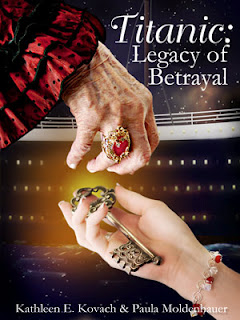
A TIME-SLIP NOVEL

A secret. A key. Much was buried on the Titanic, but now it's time for resurrection.


Follow two intertwining stories a century apart. 1912 - Matriarch Olive Stanford protects a secret after boarding the Titanic that must go to her grave. 2012 - Portland real estate agent Ember Keaton-Jones receives the key that will unlock the mystery of her past... and her distrusting heart.
To buy: Amazon


Kathleen E. Kovach is a Christian romance author published traditionally through Barbour Publishing, Inc. as well as indie. Kathleen and her husband, Jim, raised two sons while living the nomadic lifestyle for over twenty years in the Air Force. Now planted in northeast Colorado, she's a grandmother and a great-grandmother—though much too young for either. Kathleen has been a longstanding member of American Christian Fiction Writers. An award-winning author, she presents spiritual truths with a giggle, proving herself as one of God's peculiar people.


Saturday, April 18, 2026

The Texas Town That Beat the Depression—For a While

 by Tom Goodman


Just south of Granbury, Texas, the Brazos River curls into a horseshoe and nearly closes on itself, leaving a wide piece of land tucked inside the bend. Today, the Pecan Plantation subdivision sits there—a community I knew well when my brother called it home.


But before the golf carts and manned gates, people called that same ground something else.


A Texas utopia.


Kristenstad.


In the early 1930s, Christian Christensen led thirty carefully chosen families to build something rare on that stretch of land. They milled their own lumber from cleared timber, turned the wood excess into chairs and charcoal, and worked the fields together. Nearly everything was produced on site. They even minted their own tokens for trade inside the settlement.


For a time, it worked. No crime. No lawsuits. A steady rhythm of labor and provision.


And then the newspapers found it.


As the Great Depression deepened, glowing accounts of Kristenstad spread far beyond Hood County. One newspaper headline declared, “Depression merely news item to one little Texas community.” Stories were picked up and carried across the country, holding up Kristenstad as an example of communal living that was immune to hard times.


Men and families began arriving with expectations the place was never built to meet. Some came looking for a fresh start. A few came looking to test ideas of their own. Christensen had designed Kristenstad as a disciplined system of shared effort and personal responsibility. The publicity recast it as something easier.


He complained that “criminals, communists, fanatics, and rattle-brained cranks of every description” began to drift in, some gaining a foothold before their intentions were clear.


The original vision—tight, practical, demanding—grew harder to maintain as new arrivals pressed in with different assumptions.


Then the Depression that everyone said Kristenstad was immune to caught up with them. Prices collapsed. Crops failed. Livestock died. Fire took the chair factory, one of their most profitable community enterprises. But in a nation afflicted by economic hardship, few were buying them anyway. 


The final blow to the community was the death of its founder in 1937. He was only sixty-one.


Without him, there was no one left to hold the line—no one to enforce the discipline the system required or push back against those reshaping it from within.


By 1938, the community defaulted on its loans and the land was returned to its original owners. The dream that had been Kristenstad was no more.


Your humble author about 34 years ago on the Brazos where it bends around the Hood County subdivision, Pecan Plantation, the site of what was once Kristenstad. 


Sunday, January 18, 2026

Aurora’s 1897 UFO Crash — A Texas Tale That Won’t Stay Buried

  by Tom Goodman


These days, stories about strange objects in the sky are no longer confined to the fringes. Military pilots testify before Congress. Intelligence officials brief lawmakers behind closed doors. The Pentagon has an office devoted to tracking what it now calls unidentified anomalous phenomena. Whatever these things are—or aren’t—the claims are being explored with new soberness.


Which makes this a fine moment to revisit one of Texas’s oldest sky stories.


On the morning of April 19, 1897, readers of the Dallas Morning News woke to a small headline: “A Windmill Demolishes It.” The article claimed that an unknown “airship” had drifted low over Aurora, Texas, a small town about 45 miles northwest of Fort Worth. The airship struck "Judge Proctor’s windmill," and exploded in a shower of debris. The lone occupant, described as the pilot, was said to be “not an inhabitant of this world.”


Local color filled out the account. A U.S. Signal Service officer opined that the pilot hailed from Mars. Papers found on the body were written in undecipherable symbols. The wreckage, fashioned from a strange silvery metal, defied identification. The pilot, mangled beyond recognition, received a Christian burial in the Aurora Cemetery.


At the time, few took it seriously. Newspapers of the era trafficked freely in hoaxes and high imagination, and the Aurora story was only one of hundreds of airship sightings reported across the country during 1896 and 1897. 


The story went quiet for nearly seventy years.


It resurfaced in the 1960s and roared back to life in the 1970s, when reporters and UFO enthusiasts descended on Aurora. Metal detectors swept the alleged crash site. Investigators fixated on a grave beneath a large oak tree, marked by a curious symbol said to resemble a flying craft. A handful of odd metal fragments fueled headlines. When talk turned to exhuming the supposed alien pilot, local residents and cemetery trustees drew a firm line. A court injunction ended the digging, and the mystery retreated underground once more.


Later embellishments followed, as they always do. One version had the alien surviving the crash, blending into town life, developing an enthusiasm for whiskey and gambling, and eventually meeting an untimely end at the hands of Texas Rangers.


With official eyes trained skyward again, Aurora’s airship still hovers mysteriously over the imagination.


Friday, October 13, 2023

Cookbooks and Sugar Rationing During WWII

By Marie Wells Coutu

During a recent visit to my hometown, my sister and I made our favorite dessert from childhood—chocolate cake with chocolate frosting. Although we both have handwritten copies, we dug out Mother’s old cookbooks to find the original recipe.

The tattered pages of this 1945
cookbook are a testament to how
much my mother used it

It came from a cookbook produced for Lever Brothers’ Golden Jubilee in 1945 that promoted the use of Spry vegetable shortening. The cover of “10 Luscious New Cakes” touts that these recipes feature Spry’s “amazing new one-bowl method.” Spry’s spokesperson, the fictional character Aunt Jenny, is quoted as saying “It’s easy now to get lighter, more delicious cakes—even if you’re short on sugar.”

The first shortening made entirely from vegetable oil was introduced as Crisco by Procter & Gamble in 1911. It provided an alternative to lard, which is made from animal fats. Both helped cooks produce tender and flaky pie crusts, biscuits, and other baked goods.

Lever Brothers introduced Spry in 1936 as a competitor to Crisco, and within only three years it had gained 75% of Crisco’s market share. This success has been attributed to aggressive marketing using “Aunt Jenny.” I suspect the widespread distribution of numerous Aunt Jenny recipe books contributed, as attested to by the collection my mother had.


I don’t know how many of Aunt Jenny’s recipes she actually used, but the Fudge Bar Cake and Minute Fudge Frosting became our family’s favorite. In our home, chocolate cake automatically meant this cake and frosting, and it was always requested for birthdays and other special occasions. [Confession: in her later years, Mother would use a cake mix, but she always made the frosting from this recipe.]

The notation on the cover about the recipes being delicious “even if you’re short on sugar” made me curious about sugar shortages. Of course, I knew about World War II rationing, but I didn’t know the specifics about how sugar was affected. According to the National Park Service [Sugar: The First and Last Food Rationed on the World War II Home Front (U.S. National Park Service)], imports from Hawaii and the Philippines stopped following the Japanese invasion in December 1941, and German U-Boat attacks limited shipments from Puerto Rico and the Virgin Islands. Sales of sugar in the U.S. were halted in late April 1942, and rationing began. Even after the war ended, the global supply of sugar was limited due to disruptions from the war and low crop yields. Sugar rationing in the U.S. continued until June 1947.

In May 1945, the ration of sugar was cut to 15 pounds per person per year. The chocolate cake and frosting recipes each call for one cup of sugar for a single layer. Making a two-layer cake would have used nearly all the sugar ration for a family of four for one week. No wonder cakes were made during the war only for special occasions!


Mother saved a number of other free Spry cookbooks, including “Aunt Jenny Starts a Bride Off Right,” “Good Cooking Made Easy,” and “Enjoy Good Eating Every Day the Easy Spry Way.” I even found a copy of “Aunt Jenny’s Favorite Recipes” among Mother’s cookbooks. That one was reprinted under the public domain in 2018 and is also available to download from the Internet Archive.

If you want to try out any of the recipes, however, you’ll have to use Crisco or another brand of vegetable shortening, since Lever stopped producing Spry sometime in the 1970s.

Aunt Jenny offered recipes and
techniques for cooks during WWII


Multi-award-winning author Marie Wells Coutu finds beauty in surprising places, like undiscovered treasures, old houses, and gnarly trees. All three books in her Mended Vessels series, contemporary stories based on the lives of biblical women, have won awards in multiple contests. She is currently working on historical romances set in her native western Kentucky in the 1930s and 1940s. Her historical short story, “All That Glitters,” won honorable mention in the 2023 Saturday Evening Post Great American Fiction Contest. You can find more about Marie and her novels at her website, MarieWellsCoutu.com.

Truth is messy. But will their shared secret destroy his political career—or sabotage their marriage? After a whirlwind romance, beautiful Shawna Moore marries Hunter Wilson, the governor of Tennessee. Now, she wonders if the governor ever loved her or only hoped to avoid a scandal.
In this modern re-imagining of the biblical story of Bathsheba and King David, an investigative reporter is asking questions. If he discovers the truth about Shawna’s baby, Hunter’s chances for reelection, as well as Shawna’s reputation, will be ruined. Will Hunter’s choice mean the end of his political career or his family?

Tuesday, January 12, 2021

Who Dropped the Ball?

By Kathy Kovach


We’ve all done it (stayed up until midnight eagerly awaiting for the ball to drop in Times Square)—unless you are one of those early birds who can’t last past ten o’clock. In that case, I pray for you nightly. We’ve watched the ball drop at Times Square in New York precisely at midnight to usher in the new year. Kissed that special someone. Toasted with Welch’s Sparkling non-alcoholic white grape juice. Or is that just me? Afterward I’d finish watching the third movie of the night and go to bed happy to have survived...er...been blessed to see another year.

This year, once my brain cleared up after two flutes of Welch’s, I started thinking about this strange tradition. Why a ball? Why a drop? Why New York?


The usage of the time ball dates way back before it became the centerpiece of the world’s largest party. In the 19th Century, a large, wooden ball would drop from poles mounted at observatories and harbors at the same time every day to help ship navigators synchronize their chronometers to the correct time. Using this inspiration, the Western Union building in downtown New York also dropped a ball everyday at noon. In my day, we simply called a phone number that gave the time so we could adjust our errant kitchen clock.

In 1904, the New York Times moved into a new building—the second largest skyscraper in the city. It perched on a triangle of land in Longacre Square, soon to be renamed Times Square, and the address of the tall tower became One Times Square. This same year, the subway line opened, and the newspaper’s publisher, Adolph Ochs, felt a hefty celebration was in order to commemorate the exciting changes and growth. He commissioned Ukrainian immigrant and metal worker, Jacob Starr, to set up a tall sign boasting the numbers of the new year. At precisely midnight, the electric numbers were to be turned on and fireworks would be set off from the base of the building.

However, the firework celebration ended after only a few years due to hot embers falling on the revelers below. In 1907, Ochs again consulted Starr, who was working at a sign-making firm called Strauss Signs to come up with a better display. Remembering the use of time balls, they, along with New York Times chief electrician, Walter Palmer, devised the now infamous ball drop.

Even though electricity wasn’t a new concept at the turn of the century, many houses were still lit with candles and gas lights. That first ball had to be spectacular and something no one had ever seen before. The 700-pound iron ball was five feet in diameter, and fitted with 25-watt lightbulbs. It descended down the pole, and the moment it landed on the rooftop, the lights were turned off and the tall sign displaying 1908 turned on, making it seem as thought the ball had magically become the numbers denoting the new year.

The ball drops behind the numbers, goes dark and the new year numbers spectacularly light up

The ball has gone through seven transformations over the years. It went from five
feet in diameter to the twelve-foot one we see today. It’s been made of wood, wrought iron, and aluminum. Light bulbs to strobe lights to LED lights made it extraordinary. In the 1981-82 event, it was transformed into an apple thanks to then Mayor Ed Koch and his “I love New York” Big Apple campaign. Hand-drawn pulleys made way for automated machinery. Unfortunately, it went dark for two years during World War II as a blackout had been ordered for the city skyline in case German submarines lurked in the harbor. As of the turn of this century, the six-ton structure has become permanent as a visual extravaganza to be seen nightly throughout the year, featuring Waterford Crystal and Phillips LED lights that can create every design possible on the orb.


Whatever your tradition of ringing in the new year, whether toasting with sparkling Welch’s white grape juice or snoozing in a warm bed, the Times Square Ball Drop symbolizes leaving the old behind and embracing the new. A new time, a new day, a new future.


MissAdventure Brides Collection
Seven daring damsels don’t let the norms of their eras hold them back. Along the way these women attract the attention of men who admire their bravery and determination, but will they let love grow out of the adventures? Includes:
"Riders of the Painted Star" by Kathleen E. Kovach

1936 Arizona
New York City artist, Zadie Fitzpatrick, who no doubt witnessed many New Year ball drops in her time, is commissioned to go on location in Arizona to paint illustrations for an author of western novels and falls for the male model.

Kathleen E. Kovach is a Christian romance author published traditionally through Barbour Publishing, Inc. as well as indie. Kathleen and her husband, Jim, raised two sons while living the nomadic lifestyle for over twenty years in the Air Force. Now planted in northeast Colorado, she's a grandmother, though much too young for that. Kathleen is a longstanding member of American Christian Fiction Writers. An award-winning author, she presents spiritual truths with a giggle, proving herself as one of God's peculiar people.


Friday, September 11, 2020

The Straw Hat Riot of 1922


By Kathy Kovach

If you thought the rule of not wearing white after Labor Day was intense, wait until you hear about the men’s version involving a popular hat.

Nowadays, we can’t turn on the television without seeing rioting and unrest in our streets. But is this something new? Obviously, there have been many points in history where a people group has a strong opinion that turned into an adult temper tantrum. But no opinion was so bizarre as the one that sparked the Straw Hat Riot of 1922.

In the early 1900s, men found that straw hats, or boaters, worked well in the summer because they were lighter and airier than the heavy felt or silk head-adorners of the day. Straw hats evoke images of Doris Day and Gordon MacRae crooning “On Moonlight Bay” as they stroll arm in arm under the summer skies. 


Hollywood aside, things took an ugly turn in New York for any man daring to wear their chapeau after September 15, also known as Felt Hat Day.

First, a bit of history. The straw hat started out as a way to cool one’s noggin at sporting events such as boating—why it's called a boater
—but quickly became a fashion statement for those en route to the office or spending the day with that special gal. In short, anybody who was anybody wore them. Because they were made of straw, they didn’t fare well throughout the hot, muggy summer and began to break down after three months of use. Knowing they would have to be replaced next season, stockbrokers began snatching them off the heads of their contemporaries—in good natured fun, of course—should they spot one being worn after September 15. They would then stomp on them and everyone had a jolly good time with it. No one knows why this date was chosen as summer officially ended on September 21. 


As the rest of the population got wind of this tradition, everyone decided to get in on the fun. If anyone was seen strolling about donning their straw hat during the latter half of September, a complete stranger could knock their hat off their heads and demolish it to dust in the street.

The infamous riot actually took place on September 13, 1922, two days before the cut-off, in the former “Mulberry Bend” area of Manhattan. There should have been no mistake as the newspapers heralded the proper date every year. Nonetheless, youth became involved and began their attacks on factory workers. They devised hat-knocker-offers in the form of a long pole with a nail pounded in the end. This made it possible to snag the hat off the unsuspecting head.
 Things escalated when they targeted dock workers. A brawl broke out, and became so violent, it closed the Manhattan Bridge. Arrests were made, but the activity continued the next evening. Mobs of teenagers prowled Amsterdam Avenue, terrorizing every straw hat-wearing man they could find. Many men reluctant to give up their hats were hospitalized after receiving beatings. Reports were filed and more arrests were made.


The longest time a teen was incarcerated was three days. In one case, a dozen kids were brought in to the East 104th Street police station. As seven of the perpetrators were under fifteen, the desk lieutenant summoned their parents and ordered sound spankings right there on the spot. 

One would think this marked the end of the rioting, but not so. They continued in lesser forms over the next two years, tragically ending a life in 1924.

In 1925, President Calvin Coolidge decided to violate the rule, effectively ending the strange tradition.
By 1930, the more resilient Panama hat replaced the cheaper version, and the straw hat became a memory—bad to some but pleasant to others as they recalled boating with their best gal and crooning to the tune of “On Moonlight Bay.”


MissAdventure Brides Romance Collection
Seven daring damsels don’t let the norms of their eras hold them back. Along the way these women attract the attention of men who admire their bravery and determination, but will they let love grow out of the adventures? Includes:
"Riders of the Painted Star" by Kathleen E. Kovach


1936 Arizona
Zadie Fitzpatrick, an artist from New York, is commissioned to go on location in Arizona to paint illustrations for an author of western novels and falls for the male model.


Kathleen E. Kovach is a Christian romance author published traditionally through Barbour Publishing, Inc. as well as indie. Kathleen and her husband, Jim, raised two sons while living the nomadic lifestyle for over twenty years in the Air Force. Now planted in northeast Colorado, she's a grandmother, though much too young for that. Kathleen is a longstanding member of American Christian Fiction Writers. An award-winning author, she presents spiritual truths with a giggle, proving herself as one of God's peculiar people.


Saturday, June 20, 2020

The Gift of the Carnegie Libraries


When I first learned about one of our local libraries in Howell, Michigan, being a historical Carnegie library I was intrigued. I have since learned that Andrew Carnegie funded more than 2500 libraries around the world. 

Andrew Carnegie portrait by unknown
artist, {PD}
Andrew Carnegie is remembered for having a great role in the expansion of the steel industry in the United States and as a wealthy industrialist, but also as a philanthropist. His own personal philosophy was that the rich, once providing for their own needs, should think of their excess wealth as entrusted to them for the betterment of the community. His name lives on today for his charitable work.

A Scottish immigrant who came to America at a young age and settled in Allegheny, Pennsylvania with his family. He funded libraries in the two areas which had given him his start, first, one in Dunfermline, Scotland in 1880 and then in 1886, in Braddock, a town just outside of Pittsburgh. Carved into the sandstone above the entry to his first library were the words “Let there be light.” He remembered working as a bobbin boy and wanting to improve his lot in life, yet as a young teen, Carnegie couldn’t afford the two-dollar subscription to the lending library. As an older man he wanted to make them available to everyone. He would go on to fund the building of 1689 public libraries across the United States.      

The world's first Carnegie Library
in Dunfermline, Scotland, photo by
Stephen C. Dickson, 2014 [CC]
Though Carnegie didn’t insist that his libraries be racially integrated, he did build separate libraries for African Americans, in cities such as Houston, Texas and Savannah, Georgia. One bright spot was in the public library in Washington, D.C. for which he donated $300,000 to be built in 1903. The beautiful building is the city’s oldest public library and was open to all races from its start. 

When a town applied for the Carnegie grant for a public library, they had to establish certain criteria. Did the community demonstrate a need for a public library? Could they provide the land for it to be built on? Pay the staff? Carnegie expected each town to provide 10% of what he donated yearly to run and maintain the library. His funding wasn’t just a handout, but it was a hand up offered to those who would invest in the process and the library was to be available and open to all classes.

Carnegie Library in Washington, D.C.,
Mark Schierbecker, 2012, [CC],
Wikimedia Commons
In regards to our local Howell Carnegie District Library, once the community had outgrown library run by the Ladies’ Library Association, the postmaster wrote to Carnegie in 1901 requesting a donation for the building of a library. In January of 1902, Carnegie’s secretary sent a letter stating that $10,000 would be supplied for the library if the village could provide $1000 annually, as well as a suitable piece of land. After disagreements over building costs Carnegie gave them another $5000 and more funds were raised. The MacPherson family donated the land and an architecture firm in Ann Arbor was hired to complete the building. The library opened in 1906.

Howell Carnegie Library, by Aon25, 2012, [CC],
Wikimedia Commons

The last of the Carnegie libraries was built in 1929. Most of the beautiful brick or sandstone structures still endure today. A few have been torn down and some have been added onto. The Howell Carnegie District Library addition, while having many modern internal features, has tastefully incorporated the old-fashioned architecture and flavor of the original building. 


Carnegie Library, Guthrie, Oklahoma, by Steven C. Price,
2015, [CC], Wikimedia Commons
Andrew Carnegie has also been considered a controversial figure because of his labor practices, particularly because of the incident during the strike at Homestead Steel Works, when workers were killed under the watch of one of his supervisors, Henry Clay Frick. Yet, his legacy of generosity lives on across the United States in the form of these longstanding houses of knowledge and enrichment, known as the Carnegie libraries.

All you have to do is look up.
This collection of five brand new romances is sure to send your heart soaring. Journey from Canada to Georgia and Colorado to Paris by way of Michigan as these couples find love is in the air. All they had to do was look up.

Flying Into Love by Kathleen Rouser:

Unable to say no when others need her, Talia Sampson took on her deceased aunt’s advice column and the care of her special needs niece. Then new veteran, Ben Tanner, shows up unexpected on her doorstep. Hurt many times, he wonders where home is. Talia isn’t happy finding a hot-air balloon with him, but she treasures the old journal with it. Ben hopes restoring her family’s antique will please her, until he discovers a secret that shatters his trust. And Talia hates flying.

Will she trust God—and Ben—enough to go airborne?