By Naomi Craig
What do you know about Ezekiel?
The dry bones coming to life?
The wheel within a wheel and the angels with four faces?
Ezekiel 4:9 bread 😉
The New Temple
Or what about being asked to cook over human dung?
.jpg)
Book of Ezekiel Chapter 37-3 (Bible Illustrations by Sweet Media). Wikimedia
A couple years back I was reading through my Bible Plan and was BLOWN AWAY by the symbolic action that God required of Ezekiel.
Did you know, At the start of the book, Ezekiel, in the Bible, Ezekiel is already in Babylon but his primary messages were for the people back in Jerusalem?
As if that wasn’t challenging enough, right away in chapters 3 and 4, Ezekiel physically bears the burden of Israel and Judah’s sins. One day for every year they strayed, Ezekiel lies on his side, paralyzed.
390 days on his left side for Israel’s iniquities, and 40 days on his right side for Judah. That’s about 14 months.
If that wasn’t enough, Ezekiel is also struck mute, unless the Lord directly places a prophesy in his mouth. This lasts 7 years until the fall of Jerusalem. 7 years.
How is a man who is paralyzed and mute meant to communicate the message to the people a world away?
Amidst the rather bizarre symbolism and signs, we find that Ezekiel had a wife. Suddenly the picture becomes more clear. My husband is a pastor and we’ve been serving in ministry for our whole marriage. I know what it is to serve alongside him in ways I hadn’t planned on. To carry on when he wasn’t able to.
My book, Ezekiel’s Song, addresses what life could have looked like for those living with those symbols and prophesies. The stage is set back in Jerusalem with the wicked king Jehoiakim disregarding the Lord’s repeated messages to repent. Historical sources indicate that Jehoiakim was not a nice guy.
Remember the part where Jeremiah’s scroll is read to the king, and he cuts it with a knife, section by section, and burns it? Yeah, that’s the guy.
So we’ve got Jehoiakim doing all that he can to do his own thing and not follow the Lord. The people think they will be protected because they live in the Lord’s holy city, Jerusalem. And (how I imagine it) Ezekiel and Jeremiah—both who worked as priests—trying to disciple a remnant to be strong in the faith for the inevitable day of destruction.
You can read how it played out with Nebuchadnezzar deporting the Jews here
Fast forward to Babylon.
Ezekiel 1:1-3 says
Now it came to pass in the thirtieth year, in the fourth month, on the fifth day of the month, as I was among the captives by the River Chebar, that the heavens were opened and I saw visions of God. On the fifth day of the month, which was in the fifth year of King Jehoiachin’s captivity, the word of the Lord came expressly to Ezekiel the priest, the son of Buzi, in the land of the Chaldeans by the River Chebar; and the hand of the Lord was upon him there. (Emphasis mine)
According to my research, this has Ezekiel being thirty years old when they had been in captivity for 5 years.
Here’s an interesting side note: based off Levitical law, priests were ordained into service at the age of 30. A Levite could start their service to God at the age of 20 (according to a law put in place by King David—Leviticus has them starting their Levitical duties at 25).

Jewish Priests Wikimedia
All priests were Levites, not all Levites were priests.
This information seems to support that Ezekiel was in Levitical service when he was exiled. And on his 30th birthday when he should have been ordained as a priest—except he can’t be a priest if he’s not at the temple in Jerusalem—he goes out to the wilderness and meets God Most High. Seven days Ezekiel was out by the River Chebar (no currently known location).

All priests were Levites, not all Levites were priests.
This information seems to support that Ezekiel was in Levitical service when he was exiled. And on his 30th birthday when he should have been ordained as a priest—except he can’t be a priest if he’s not at the temple in Jerusalem—he goes out to the wilderness and meets God Most High. Seven days Ezekiel was out by the River Chebar (no currently known location).

Boat on the Euphrates, Wikimedia
Guess how many days the Levite was meditating and fasting before being made a priest?
Seven days.
When Ezekiel should have been stepping into Priestly service, God is laying a mantle of visions and prophecies on him.
His plan was to intercede for the people and point them to God.
God’s plan was for him to be the voice of judgement.
Like all prophets, God specifically says the people may or may not hear the words, but they will know there is a prophet in their midst.
Hebrews are assimilating to their environment in Babylonia OR determined that surely the Lord would not destroy His holy city, Jerusalem.
When God gave Ezekiel the scroll of dread and despair and told him to eat it (like I said, bizarre symbolism) it was actually sweet like honey.
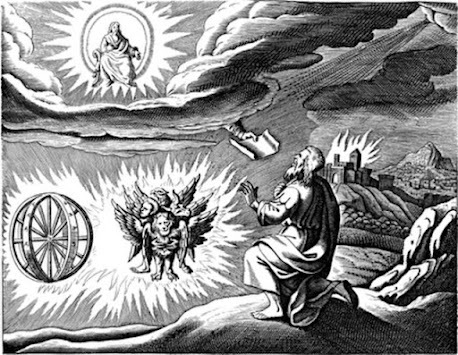
Ezekiel's Vision Wikimedia
This leads me to believe (along with many other references in scripture) that if God gives you an unpleasant task, He will also sustain you with His presence.
How about you? Are you assimilating into the culture around you?
Do you feel God would never allow “this” or “that” because you are His chosen one?
Are you faced with an unpleasant task that brings light to God’s just reaction to sin?
As a priest was meant to be a mediator between God and man and intercede on their behalf, we are called to direct those around us to God and His perfect plan
Perhaps those around us will repent. Perhaps they won’t. Either way, live your life in such a way that they know, a follower of Christ has been in their midst.
 Author of Biblical fiction, avid reader, pastor's wife, Naomi loves reading the Bible and imagining how things were at the time. When she’s not serving in various areas at church or trying to stay on top of mountains of dishes, you'll most likely find her enjoying a good book and a cup of coffee. Naomi co-hosts #BehindTheStory on YouTube and helps facilitate Biblical Fiction Aficionados Community on Facebook. When not writing or trying to wrangle social media, Naomi attempts to get her rescue dog to be cute on command for the many pics she takes throughout the day.

A prophet's heart broken, a woman's joy gone. What does Yahweh have planned for His people?
On the brink of Jerusalem's demise, devoted priest, Ezekiel, sees the insincerity of Judah's worship. Despite his efforts to call the people back to true worship of Yahweh, priests, artisans, valiant warriors, and royals are exiled to Babylon. When God gives him messages of continued judgment for the people in his homeland, his heart breaks. How can he minister to the people from so far away?
The presence of the Lord is tangible when Shiriel sings in the temple, and her voice prepares the hearts of many to worship. When she is exiled to Babylon, her faith is shaken. Does the Lord's presence extend beyond Jerusalem and His holy temple?
Ezekiel is struck mute and paralyzed as he begins his prophetic ministry, and Shiriel devises a plan to get the Lord's message back to the unfaithful people of Judah. Shiriel struggles with discontentment as serving the Lord looks nothing like she'd imagined. Can she provide for her family and carry out her husband's ministry when her joy is gone, and her own dreams are placed on hold?
Find out more at naomicraig.com
Guess how many days the Levite was meditating and fasting before being made a priest?
Seven days.
When Ezekiel should have been stepping into Priestly service, God is laying a mantle of visions and prophecies on him.
His plan was to intercede for the people and point them to God.
God’s plan was for him to be the voice of judgement.
Like all prophets, God specifically says the people may or may not hear the words, but they will know there is a prophet in their midst.
Hebrews are assimilating to their environment in Babylonia OR determined that surely the Lord would not destroy His holy city, Jerusalem.
When God gave Ezekiel the scroll of dread and despair and told him to eat it (like I said, bizarre symbolism) it was actually sweet like honey.
Ezekiel's Vision Wikimedia
This leads me to believe (along with many other references in scripture) that if God gives you an unpleasant task, He will also sustain you with His presence.
How about you? Are you assimilating into the culture around you?
Do you feel God would never allow “this” or “that” because you are His chosen one?
Are you faced with an unpleasant task that brings light to God’s just reaction to sin?
As a priest was meant to be a mediator between God and man and intercede on their behalf, we are called to direct those around us to God and His perfect plan
Perhaps those around us will repent. Perhaps they won’t. Either way, live your life in such a way that they know, a follower of Christ has been in their midst.
Author of Biblical fiction, avid reader, pastor's wife, Naomi loves reading the Bible and imagining how things were at the time. When she’s not serving in various areas at church or trying to stay on top of mountains of dishes, you'll most likely find her enjoying a good book and a cup of coffee. Naomi co-hosts #BehindTheStory on YouTube and helps facilitate Biblical Fiction Aficionados Community on Facebook. When not writing or trying to wrangle social media, Naomi attempts to get her rescue dog to be cute on command for the many pics she takes throughout the day.A prophet's heart broken, a woman's joy gone. What does Yahweh have planned for His people?
On the brink of Jerusalem's demise, devoted priest, Ezekiel, sees the insincerity of Judah's worship. Despite his efforts to call the people back to true worship of Yahweh, priests, artisans, valiant warriors, and royals are exiled to Babylon. When God gives him messages of continued judgment for the people in his homeland, his heart breaks. How can he minister to the people from so far away?
The presence of the Lord is tangible when Shiriel sings in the temple, and her voice prepares the hearts of many to worship. When she is exiled to Babylon, her faith is shaken. Does the Lord's presence extend beyond Jerusalem and His holy temple?
Ezekiel is struck mute and paralyzed as he begins his prophetic ministry, and Shiriel devises a plan to get the Lord's message back to the unfaithful people of Judah. Shiriel struggles with discontentment as serving the Lord looks nothing like she'd imagined. Can she provide for her family and carry out her husband's ministry when her joy is gone, and her own dreams are placed on hold?
Find out more at naomicraig.com