Showing posts with label Fall Flip. Show all posts

Thursday, September 12, 2019

The Craftsman House Series: Decorating the Bungalow

Antique Stickley Chair
by Denise Weimer

For the past several months, we’ve enjoyed a virtual tour of the exteriors and interiors of Craftsman homes, a style currently enjoying a construction revival in our country. During the early 1900s, the architectural firm of Greene and Greene in California responded to the Arts & Crafts movement in America by launching Craftsman-style architecture. The popularity of the style endured until roughly 1929. 


From our recent posts, we can picture the low, spreading exterior style of Craftsman homes, often with stone accents and wooden shingles. Inside, we would expect the use of natural woods, especially oak, with chair rails, colonnades, and built-ins. We can't forget the coffered ceilings and five-panel doors. Walls would be painted in earth tones, adorned by peaceful murals, or feature geometric or nature-themed stencils.  

But let’s say we were lucky enough to own one of these babies. How would we begin to do decorating justice? Some of the ways these homes were gussied up back in the day included:

  • Pottery: Rookwood, Roseville, Van Briggle, Grueby, Teco, Fulper
  • Chinese and Japanese wares
  • Baskets
  • Tiffany pieces and lamps (pendant, table, and floor)
    1920s Rookwood Vase
  • Hammered copper bowls
  • Rugs: William Morris hand-woven Hammersmiths; oriental and Turkish; Donegal carpets from Ireland; grass mats from China or Japan for summer; American Indian designs
  • Glass vases by Tiffany, Steuben, and Loetz
  • Plain, neutral table and bed linens with embroidered, geometric, or natural-styled borders
  • For the walls: old family portraits, framed letters or house plans, botanical prints, and amateur watercolor paintings
  • Furniture: pieces featuring straight lines and inset panels to highlight the quality of the wood, especially white oak, in the style of Gustav Stickley; leather upholstery; settles with cushions rather than sofas; Mission-style rockers; beds with coordinating headboards and footboards
1920s Roseville Vase
Do you own a Craftsman? What personal touches do you include? Chime in below.

In my hot-of-the-press novel, Fall Flip, interior designer Shelby Dodson has to ditch her modern flair to satisfy her retired clients and their Augusta, Georgia bungalow. While her new contractor, Scott Matthews, offers more opinions than she desires, Shelby finds her warehouse full of decorations from previous flipping projects of little help. When she commandeers Scott’s muscles for trips to the river market and antique store, she accidentally jump-starts a romance! Not decorating your own Craftsman home? There’s always the virtual shopping experience with Scott and Shelby (Fall Flip on Amazon)! And good news, it’s won’t dent your wallet near as much.

Represented by Hartline Literary Agency, Denise Weimer holds a journalism degree with a minor in history from Asbury University. She’s a managing editor for Smitten Historical Romance, an imprint of Lighthouse Publishing of the Carolinas, and the author of The Georgia Gold Series, The Restoration Trilogy, and a number of novellas, including Across Three Autumns of Barbour’s Colonial Backcountry Brides Collection. Her historical romance, The Witness Tree, is also releasing this month with Smitten (The Witness Tree on Amazon). A wife and mother of two daughters, she always pauses for coffee, chocolate, and old houses! Connect with Denise here:

Monthly Newsletter Sign-up  

Website  
Facebook  
William Morris Hammersmith Rug
Twitter

See also: Old House Online, “Bungalows of the Arts & Crafts Movement,” Patricia Poore, November 24, 2010. Decorator’s Wisdom, “Decorating a Craftsman Home With Vintage Furnishings,” by Mike and Amy. Arts & Crafts Homes and the Revival, “Carpets and Rugs for Arts & Crafts Style Homes,” by Brian D. Coleman, October 18, 2014.

Monday, August 12, 2019

The Craftsman House Series: Stencils


The Arts and Crafts movement of the early 1900s pushed back the excesses of the Victorian era. One interior touch unique to the style was stenciling. “The whole philosophy revolved around the themes of nature, simplicity and handicraft. Stencils were the A & C response to the heavy, ornate, mass-produced wallpapers found in Victorian homes. … They should be soothing to look at and not call attention to themselves.” (Craftsman Perspective, Arts and Crafts Questions, Interior Decorating)

Landscape friezes and murals were also popular in Craftsman homes. And folks didn’t always confine their stenciling to the area above the plate rail. Even curtains were stenciled, appliquéd, or embroidered.

Stencil patterns generally reflected nature themes or abstracts from the Frank Lloyd Wright collection. Colors tended toward gray or earth tones, sometimes pastels. Some examples: 


In my novel, Fall Flip, debuting next month, interior designer Shelby Dodson has altered her modern style to accommodate the wishes of the retired couple for whom she’s flipping a 1920s bungalow. That makes her authenticity-crazy contractor, Scott Matthews, happy. But what doesn’t make Shelby happy is how artist Caitlyn Curtis keeps popping up. Why does it annoy Shelby when Scott looks Caitlyn’s way? And now Caitlyn has volunteered to stencil pine cones in the bungalow’s dining room. Humph. Does Shelby pick the design, or does Caitlyn get her pine cones? More importantly, can Shelby open her heart to someone like Scott, so different from her late husband? (Fall Flip on Amazon)

Represented by Hartline Literary Agency, Denise Weimer holds a journalism degree with a minor in history from Asbury University. She’s a managing editor for Smitten Historical Romance, an imprint of Lighthouse Publishing of the Carolinas, and the author of The Georgia Gold Series, The Restoration Trilogy, and a number of novellas, including Across Three Autumns of Barbour’s Colonial Backcountry Brides Collection. Her historical romance, The Witness Tree, is also releasing in September with Smitten. A wife and mother of two daughters, she always pauses for coffee, chocolate, and old houses! Connect with Denise here:

Monthly Newsletter Sign-up
Website  
Facebook  
Twitter

See also: Old House Online, “Bungalows of the Arts & Crafts Movement,” Patricia Poore, November 24, 2010. Craftsman Homes and The Revival, “Easy Craftsman Era Curtains,” Brian D. Coleman, October 24, 2011.

Friday, July 12, 2019

The Craftsman House Series: Interiors


In last month’s post, we took a look at defining exterior features of Craftsman homes. This month, let’s step inside the front door. These adorable homes share some commonalities sure to warm your heart.

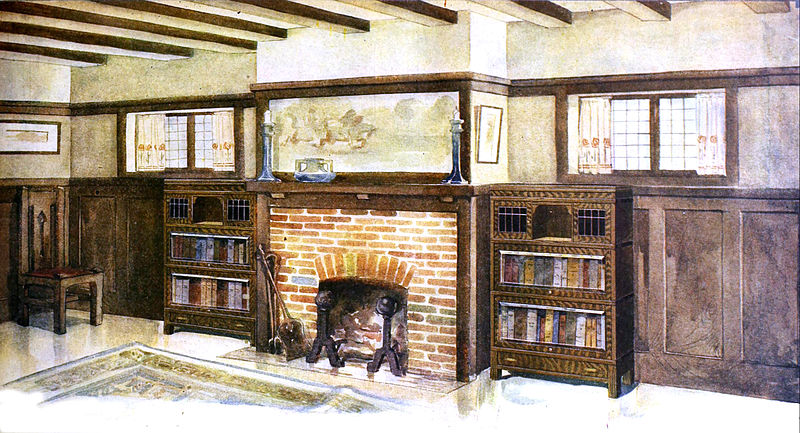
Walls: Often wood-paneled to chair-rail or plate-rail height, stained to a golden oak or oak brown. Painted softwood seen in bedrooms, initially white but other colors later in the period. Stencils above plate rails were popular, using a nature or abstract geometric design in the style of Frank Lloyd Wright. Murals and frescoes. Kitchens and bathrooms feature tongue-and-groove paneling. Generous baseboards and window trim. Plain walls painted in earth tones and hues of vegetables and stones or originally covered with burlap, grass cloth, or nature-inspired wallpaper.

Ceilings: Trimmed with angled or boxed beams and crown moldings.

Doors: Five panels, horizontal and recessed, most common. Pocket doors. French doors with Prairie grid panes.

Bathroom: Lots of white. Hand-crafted, glazed (often green!) or hexagonal tiles. Pedestal sinks and free-standing tubs. Wood trim stained dark, including the mirror-surround. Shaker-style cabinets.

Kitchen: Early sinks were wall-hung or on legs, but starting in the 1920s, some homes employed scalloped half-doors to hide plumbing. Natural oak cabinets with flat-panel doors, some with glass. Pendant lights with mica. Hand-crafted tiles or natural stone as backsplash. Hardware and fixtures with warm finishes, like bronze, antique brass, and copper. Eating nooks with built-in benches.


Special features: Expect to see many practical amenities built into the Craftsman home. Murphy beds, built-in cupboards, telephone nooks, window seats, mud rooms, and ironing boards. Front doors may include surrounds featuring beveled or stained glass in geometric or nature-themed patterns. Colonnades were room-dividing sets of pillars atop pedestal bases rising knee- to chest-high, often joined by a beam or arch; bookcases, bench seats, or glass-fronted china cupboards may be built in.

In my novel, Fall Flip, releasing this September with Candlelight Romance, one of the first disagreements between interior designer Shelby Dodson and contractor Scott Matthews occurs the minute they step inside the 1920s Craftsman bungalow they’re renovating for their retired clients. Leave the rich woodwork natural like preservation-driven Scott suggests, or paint it white like modernist Shelby insists? The bigger question … can Shelby work with a man so different from her late husband? 

 
Represented by Hartline Literary Agency, Denise Weimer holds a journalism degree with a minor in history from Asbury University. She’s a managing editor for Smitten Historical Romance, an imprint of Lighthouse Publishing of the Carolinas, and the author of The Georgia Gold Series, The Restoration Trilogy, and a number of novellas, including Across Three Autumns of Barbour’s Colonial Backcountry Brides Collection. Her historical romance, The Witness Tree, is also releasing in September with Smitten. A wife and mother of two daughters, she always pauses for coffee, chocolate, and old houses! Connect with Denise here:

Monthly Newsletter Sign-up  

Website  
Facebook  
Twitter

See also: Craftsman Perspective, Arts and Crafts Questions, Interior Decorating. Old House Online, “Bungalows of the Arts & Crafts Movement,” Patricia Poore, November 24, 2010. Arts & Crafts Homes and the Revival, “Woodwork & Finishes for the Craftsman Home,” Patricia Poore, December 3, 2013. Arts & Crafts Homes, “Design Elements of the Craftsman House.” Houzz, “Bathroom Workbook: 7 Elements of Craftsman Style,” Mitchell Parker, June 23, 2014. Houzz, “Kitchen Workbook: 8 Elements of a Craftsman Kitchen,” Lisa Frederick, April 3, 2012. The Argyle Sears Home: http://www.antiquehomestyle.com/plans/sears/1923sears/23sears-argyle.htm. Home library: {{Wikipedia|https://commons.wikimedia.org/wiki/File:Craftsman-style_home_library.jpg}}. Home interior: {{Wikipedia|http://home.wikia.com/wiki/Craftsman_style}}