Showing posts with label Feed and flour sack dresses. Show all posts

Sunday, August 23, 2026

FROM FEED SACK TO FASHION


By Mary Davis


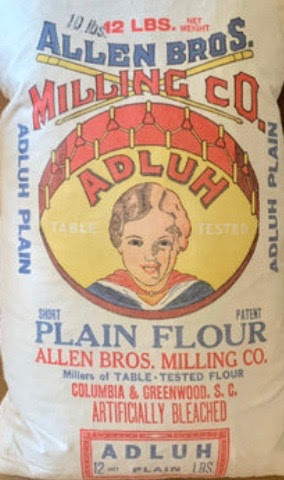
Feed sacks a.k.a. pretties, cotton commodities bags, chicken linen.


Before feed and flour sacks, food was transported in barrels, kegs, boxes, and tins for about the first 200 years in America.


Around the 1820s to 1840s, hand-woven, handsewn cotton bags were made to carry corn, wheat, and other grains to the gristmill, and after it was ground into powder, flour from these dry-goods could be hauled back home. Farmers would stamp their names on their sacks so that the miller would know who the grain belonged to. These bags made transporting products by horseback much easier.


1925

1926

Sacks grew in popularity with the advent of sewing machines, and flour sack machines were invented. Women used them for kitchen towels, diapers, aprons, bandages, rags, and more. Clothing was made as early as the 1890s.


Laframboise Family in Flour/Feed Sack Clothes

When textile mills got involved, they stamped advertising and logos on them. Farm wives would use lard, kerosene, fels, naphtha, and bleach to remove these, with varying degrees of success. When the textile industry got wind of this, they started using washable vegetable dyes to make the promotional printing easer to remove, therefore making their bags more desirable. Poor children were often teased for wearing “chicken-feed clothes.”


By the nineteen-teens, the use of barrels had virtually disappeared.


Flour & Feed Packing Facility, 1918, Cleveland, OH

In the 1920s, marketers decided to up the game of bag appeal, so entered the calico, gingham, and plaid prints as well as days-of-the-week towels and embroidery patterns to turn sacks into pillowcases. There were even dolls and stuffed animals printed on some to sew for children’s toys. Quilts were also a popular item to make from these colorful sacks.


What had once been throwaway packaging became a product unto itself. Companies became competitive and created limited edition prints. Hurry and buy them before they’re gone. <SIGH> Nothing has changed.


Women would send their husbands to the store with instruction to buy so many of a particular print. Heaven help the man who came back with the wrong or mismatched designs.


Feed companies even issued clothing patterns to include how many sacks it would take to make them. Some even included them inside the bag. Clothing made from feed sacks became a booming success. Magazines featured them. County fairs had competitions to see who could make the most beautiful, fashionable dress. Even wedding dresses were sew out of them.


Feedsack dress by Mrs. Dorothy Overall

McCalls and Simplicity patterns also began putting the number of sacks needed to make them.


In the 1930s, sewing garments out of these sacks was a necessity. When WWII came along and textiles were rationed, repurposing this fabric was patriotic, even heroic. Government got involved, instructing people how to make children’s clothing out of sacks. So what had been done out of a need to survive was now a mandate. The feed and flour companies pushed to get feed sack cloth labeled as industrial textile so it wasn’t under rationing efforts.


By the early 1940s, 3.5 million women and children were wearing feed sack clothing. At its height, textile companies were producing 1.3 billion yards of sack cloth per year. After the war, rationing lifted and ready-made clothing became available again. Companies began using paper and plastic for packaging, which were cheaper to produce.


Though not as common, pretties, cotton commodities bags, and chicken linen continued to be printed and worn into the 1960s.


THE QUILTING CIRCLE SERIES Box Set

Historical Romance Series

By Mary Davis

THE WIDOW’S PLIGHT (Book1) – Will a secret clouding a single mother’s past cost Lily her loved ones?

THE DAUGHTER’S PREDICAMENT (Book2) *SELAH & WRMA Finalist* – As Isabelle’s romance prospects turn in her favor, a family scandal derails her dreams.

THE DAMSEL’S INTENT (Book3) *SELAH Winner* – Nicole heads down the mountain to fetch herself a husband. Can she learn to be enough of a lady to snag the handsome rancher?

THE DÉBUTANTE’S SECRET (Book4) – Complications arise when a fancy French lady steps off the train and into Deputy Montana’s arms.

https://www.amazon.com/dp/B0CNZPRRS2/ref=sr_1_7?crid=3NJNTQ5SD1WGB&keywords=the+quilting+circle+by+mary+davis&qid=1700957455&s=digital-text&sprefix=%2Cdigital-text%2C155&sr=1-7


MARY DAVIS, bestselling, award-winning novelist, has over thirty titles in both historical and contemporary themes. Her latest release is THE LADY’S MISSION. Her other novels include THE DÉBUTANTE'S SECRET (Quilting Circle Book 4) THE DAMSEL’S INTENT (The Quilting Circle Book 3) is a SELAH Award Winner. Some of her other recent titles include; THE WIDOW'S PLIGHT, THE DAUGHTER'S PREDICAMENT, “Zola’s Cross-Country Adventure” in The MISSAdventure Brides Collection, Prodigal Daughters Amish series, "Holly and Ivy" in A Bouquet of Brides Collection, and "Bygones" in Thimbles and Threads. She is a member of ACFW and active in critique groups.

Mary lives in Colorado with her Carolina Dog, Shelby, and her pocket black Lab, Willow. She has three adult children and three incredibly adorable grandchildren. Find her online at:
Books2Read Newsletter Blog FB FB Readers Group Amazon GoodReads BookBub


Sources

https://lorabloomquist.com/feedsacks-flour-sacks-grain-sacks-difference/

https://www.youtube.com/watch?v=1yVbH0qK6VQ

https://www.youtube.com/watch?v=2LOu4UmFeTU

https://textileranger.com/2013/09/30/flourishing-in-flour-sacks/

Tuesday, April 4, 2023

The History of Frugal Fashion Flair using Feed and Flour Sacks

 By Mary Dodge Allen

Marilyn Monroe wearing a potato sack (Public Domain)

During hard times, people often ‘made do’ with what they had. And in the early to mid-1900’s, women in rural farming areas made household items and clothing for their families using something they had in abundance... feed sacks.

Until the mid-1800’s, bulk food products such as flour, beans, coffee, sugar, and animal feed were transported in heavy wooden barrels or metal containers. But after 1846, when Elias Howe patented the lock-stitch sewing machine, suppliers began using cost-effective and lighter-weight fabric sacks to transport these goods.

The earliest sacks were made from coarse fabrics, such as canvas, muslin and burlap. They were most often used to make towels, wash/dusting cloths, curtains, and rugs. During WWI, the practice of using these coarse fabric sacks to make clothing became more common, especially overseas. When the American Red Cross sent aid to war-torn countries experiencing supply shortages, the empty sacks were used to make much-needed clothes for refugees.

By the 1920’s, suppliers began using sacks made from softer cotton percale fabrics. These sacks were more suitable for making all types of clothing and household articles, like cloth diapers, pillowcases, quilts and even undergarments. Most of these sacks were decorated only with the supplier’s brand name and logo. 

(Public Domain)


But in October 1924, Asa T. Bales filed a patent for cotton flour sacks in colorful patterns and with brand names and logos printed with ink that would wash away. He assigned his patent to the George P. Plant Milling Co. in St. Louis, for their new line of ‘Gingham’ flour. This marketing ploy caught on, and soon other milling companies were placing their own fashionable prints on their flour sacks. The Percy Kent Bag Company even hired textile designers from New York City to create stylish prints with colorfast dyes.

Flour sack designs (Public Domain)

Family in flour sack clothes (Public Domain)


When the stock market crash of 1929 ushered in the Great Depression, the use of empty sacks to make clothing greatly increased. Most feed and flour sacks held 50 to 100 pounds of goods. A 100 pound sack was approximately 36” x 42” – yielding about 1 to 1 ½ yards of fabric. (At this time, one yard of fabric could cost as much as 60 cents at a retail store). Since most dresses required three yards of fabric, women wanted to find several feed and flour sacks with the same colorful pattern.

(Public Domain)

Some women hosted parties where empty sacks could be traded, while others made extra money by selling their empty sacks.

It became common for farmer’s wives to instruct their husbands to select feed sacks with specific patterns they liked. One feed salesman commented, “Years ago, they used to ask for all sorts of feeds... now they come over and ask me if I have an egg mash in a flowered percale. It ain’t natural.”

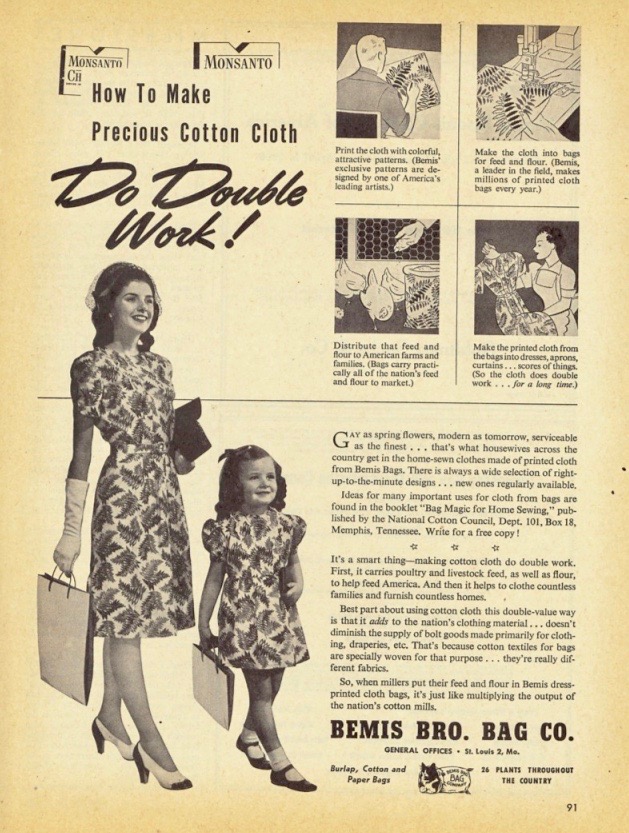
Advertisement circa 1940's (Public Domain)


During WWII, fabrics were in short supply because they were needed by the military for uniforms and other uses. To support the war effort, more and more women used feed and flour sacks to make clothing. The Textile Bag Manufacturers Association coined the slogan, “A yard saved is a yard gained for victory.”

Flour sack pattern (Public Domain)

Many flour sacks came with actual dress patterns on them, along with specific instructions to remove the ink from the brand labels.


Women in flour sack dresses (Public Domain)

Women used creative sewing skills to make their dresses more fashionable, adding ruffled collars, decorative buttons, belts and rickrack. The National Cotton Council even sponsored design contests, crowning the winner, the “National Cotton Bag Sewing Queen.”

But during the 1950’s, packaging began to change. Flour companies switched to using paper sacks, and the use of plastic in food packaging increased. By the 1960’s, fabric sacks were largely phased out.

Home sewing continues, although these days it is not as prevalent as it once was. During my school years, my mother sewed many of my clothes. She was an expert seamstress. I own a sewing machine, but I mostly use it for clothing alterations or repairs.

Did your grandparents talk about using feed and flour sacks in these ways? Do you have memories of your clothes being sewn at home? Do you enjoy sewing now? I’d love to hear your stories and comments.
_______________

PLEASE VISIT THE BLOG TO COMMENT ON THIS POST


Mary Dodge Allen is the winner of a 2022 Christian Indie Award, a 2022 Angel Book Award, and two Royal Palm Literary Awards (Florida Writer's Association). She and her husband live in Central Florida, where she has served as a volunteer with the local police department. Her childhood in Minnesota, land of 10,000 lakes, sparked her lifelong love of the outdoors. She has worked as a Teacher, Counselor and Social Worker. Her quirky sense of humor is energized by a passion for coffee and chocolate. She is a member of the Florida Writer's Association, American Christian Fiction Writers and Faith Hope and Love Christian Writers. 

Mary's novel: Hunt for a Hometown Killer won the 2022 Christian Indie Award, First Place - Mystery/Suspense; and the 2022 Angel Book Award - Mystery/Suspense.

Click the link below to buy Hunt for a Hometown Killer at Amazon.com:


Link to Mary's Spotlight Interview:   Mary Dodge Allen Author Spotlight EA Books